vLLM Maintainers Dine at PyTorch Conference: High-Throughput BBQ and Zero-Latency Toasts
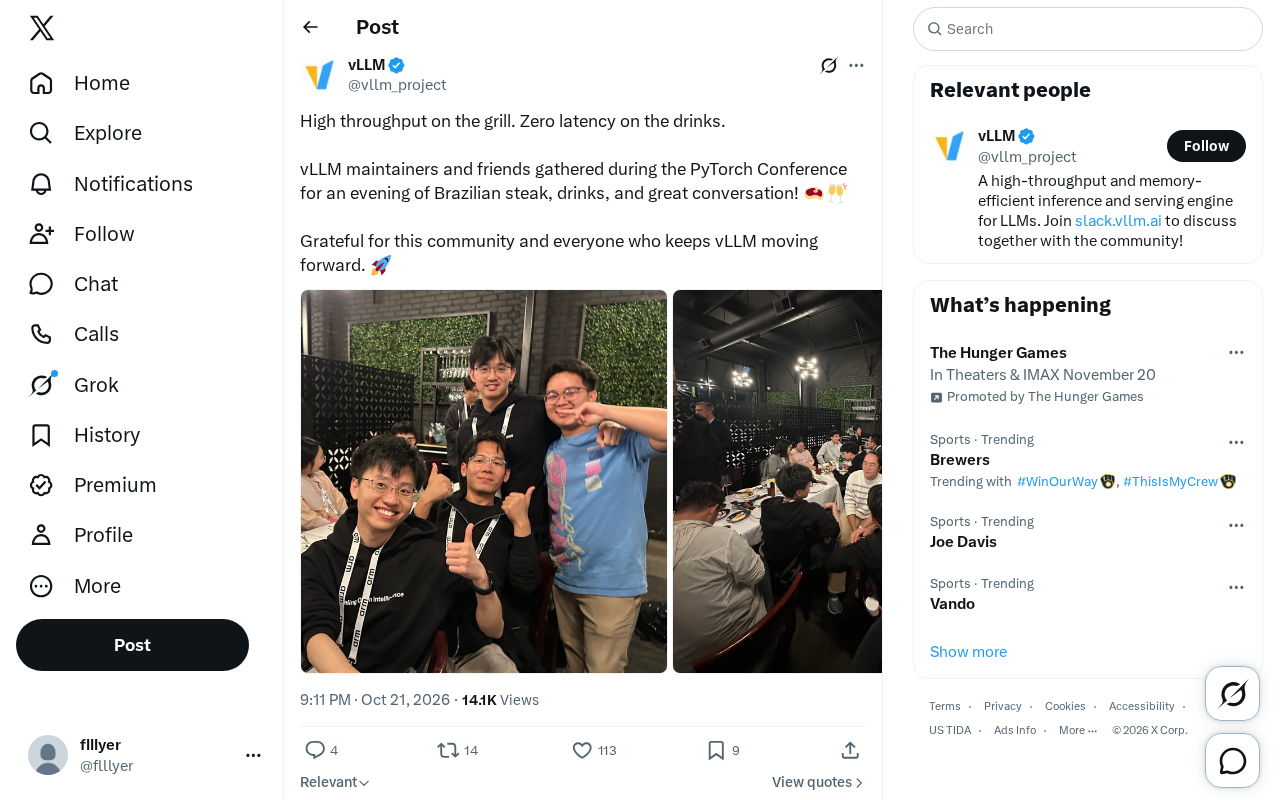
vLLM maintainers dined during the PyTorch Conference, thanking the community with technical puns about high-throughput BBQ and zero-latency drinks.
The official vLLM Twitter account posted a lighthearted update: during the PyTorch Conference, vLLM maintainers and friends had dinner, enjoying Brazilian BBQ and drinks and engaging in deep conversation. The tweet used two technical puns—"High throughput on the grill" and "Zero latency on the drinks"—cleverly borrowing the inference performance metrics that vLLM focuses on to describe the enjoyable gathering, and expressed gratitude to the community. The article uses this to provide background on vLLM as an open-source high-throughput, low-latency LLM inference engine, noting that its core innovations include memory management techniques such as PagedAttention, and that its maintainers are active in communities such as PyTorch. Overall, this tweet with limited information reflects a common operational approach by which mature open-source projects organize offline gatherings during large conferences to strengthen community cohesion, and it also reinforces the project's technical brand image.
The official vLLM Twitter account posted a lighthearted update: during the PyTorch Conference, vLLM maintainers and friends gathered to enjoy Brazilian BBQ and drinks and engage in deep conversation. The tweet cleverly summarized the gathering with two technical puns—"High throughput on the grill, zero latency on the drinks"—and expressed gratitude to the community, saying that it is everyone who keeps vLLM moving forward.
An offline gathering of a technical community
According to the official vLLM Twitter account, the gathering took place during the PyTorch Conference and included vLLM maintainers and their friends. The event was a dinner featuring Brazilian BBQ and drinks, with the core purpose of conversation. The tweet did not disclose the specific number of attendees, location, or technical details discussed, but from the phrase "great conversation," it appears to be a relaxed occasion for community bonding rather than a formal technical agenda.
Worth noting is the wording of the tweet: "High throughput on the grill" describes an ample supply of BBQ, and "Zero latency on the drinks" describes drinks arriving quickly. These two metaphors directly borrow the inference performance metrics that vLLM focuses on—throughput and latency—showing that the maintainers do not forget their technical identity even at dinner.
What vLLM is and why its community is active
For readers unfamiliar with vLLM, here is a brief background. vLLM is an open-source high-throughput, low-latency large language model inference and serving engine. Its core innovations include memory management techniques such as PagedAttention, and it is widely used for LLM deployment in production environments. The project has a large number of contributors on GitHub and continuously iterates around inference performance.
The vLLM maintainer community is active in deep learning framework communities such as PyTorch. Organizing a gathering during the PyTorch Conference reflects the overlap in personnel and collaboration between the two open-source communities. The tweet's closing line, "Grateful for this community," also confirms the project's emphasis on community contributions.
How PagedAttention works: PagedAttention borrows the idea of virtual memory and paging from operating systems to manage the KV Cache. Traditional inference engines pre-allocate a whole contiguous block of GPU memory for each request to store the key-value cache, which easily causes significant fragmentation and waste due to differences in request lengths; PagedAttention divides the KV Cache into fixed-size "pages" (blocks), allocates them on demand, and addresses them through a logical-to-physical mapping table, allowing pages to be stored non-contiguously in GPU memory. This mechanism reduces memory waste to extremely low levels, allowing more requests to reside in GPU memory simultaneously and be executed in batches, thereby significantly improving throughput and making scenarios such as prefix sharing and parallel sampling more efficient.
The difference between throughput and latency: These two metrics are often mentioned together, but they have different meanings and can even constrain each other. Throughput refers to the number of tokens or requests processed by the system per unit time, measuring overall service capacity and hardware utilization; latency refers to the time required for a single request from issuance to completion, measuring the response speed perceived by users. Batching is usually the main means of improving throughput, but excessively large batches increase queuing and per-request waiting time, thereby raising latency. vLLM's continuous batching is precisely designed to strike a balance between the two: requests exit the batch as soon as they complete, and new requests are immediately added, rather than waiting for the entire batch to finish, keeping the GPU as busy as possible while controlling tail latency.
Community operations of open-source projects as seen from the tweet
The tweet itself contains limited information, but it reflects a common practice of mature open-source projects: taking advantage of large conferences to organize offline gatherings where maintainers, contributors, and users can communicate face to face and strengthen community cohesion. The official vLLM account packaged the gathering information with humorous technical puns, conveying community warmth while reinforcing the project's technical brand image.
For developers following vLLM, the value of such updates lies not in technical content but in confirming that there is a group of dedicated maintainers behind the project and that the community atmosphere is friendly and open. The acknowledgment in the tweet to "everyone who keeps vLLM moving forward" is a typical expression of open-source collaboration culture.
Further reading: vLLM's ongoing evolution
Although this tweet did not discuss the technical roadmap, based on vLLM's consistent public updates, its core focus has always been on inference throughput, latency optimization, memory efficiency, and support for new model architectures. Maintainers gathering and exchanging ideas during the conference may also lay the groundwork for subsequent collaborative development. For developers, following vLLM's GitHub repository and official social media is an effective way to stay informed of the latest progress.
(This article is based on publicly available content from the official vLLM Twitter account and does not include speculative information beyond the tweet.)
One-line Summary
vLLM maintainers dined during the PyTorch Conference, thanking the community with technical puns about "high-throughput BBQ and zero-latency drinks."
Paragraph Summary
The official vLLM Twitter account posted a lighthearted update: during the PyTorch Conference, vLLM maintainers and friends had dinner, enjoying Brazilian BBQ and drinks and engaging in deep conversation. The tweet used two technical puns—"High throughput on the grill" and "Zero latency on the drinks"—cleverly borrowing the inference performance metrics that vLLM focuses on to describe the enjoyable gathering, and expressed gratitude to the community. The article uses this to provide background on vLLM as an open-source high-throughput, low-latency LLM inference engine, noting that its core innovations include memory management techniques such as PagedAttention, and that its maintainers are active in communities such as PyTorch. Overall, this tweet with limited information reflects a common operational approach by which mature open-source projects organize offline gatherings during large conferences to strengthen community cohesion, and it also reinforces the project's technical brand image.
Related articles
Gemini 4 Carbon Hands-On: The Strongest AI Model? Compared with Claude Opus 5.5
Google's Gemini 4 Carbon tops the Artificial Analysis leaderboard with 71% on CW Bench and leads Vending Bench. Hands-on comparison with Claude Opus 5.5: stunning front-end design but slightly behind in web development, with a clear price advantage.

Gemini 4 Carbon Tops Global Rankings as AI Productivity and Open-Source Ecosystems Surge
Google DeepMind's Gemini 4 Carbon tops global benchmarks, built for complex agents and system security. ByteDance launches Doubao Work integrated with Feishu, Anthropic's AI autonomously breaches 5 system-level attack chains, and ModelBest and Fudan open-source on-device multimodal and image generation models.

Overseas Creator Breaks Down N8n AI Agent Business Playbook: From Tooling to Monetization
An overseas creator breaks down the N8n AI agent business playbook: comparing Zapier, Make, and N8n, detailing four monetizable automation categories—lead capture, WhatsApp follow-up, booking, and content pipelines—plus agency pricing and a sales playbook.