vLLM v0.33.0rc1 Fixes Stale NVFP4 Decode Test Selector on DGX Spark

vLLM fixes a stale NVFP4 decode test selector on DGX Spark, revealing CI hardware adaptation pressure.
vLLM v0.33.0rc1 fixes a stale NVFP4 decode test selector on DGX Spark via PR #64107 by grYe99, cherry-picked to the rc branch. The change underscores the growing CI test-matrix burden from low-precision quantization formats and new hardware, where a stale selector can leave hardware paths untested and create hidden quality risks.
A Small Change That Exposes the Hardware Adaptation Challenges of Inference Frameworks
The open-source inference framework vLLM has published the v0.33.0rc1 release tag, and one CI fix in it is worth noting: a correction for a stale NVFP4 decode test selector on the DGX Spark platform (PR #64107). On the surface, this commit looks like routine maintenance of the test pipeline, but it reveals a deeper trend — as low-precision quantization formats meet new hardware, the continuous integration systems of inference frameworks are under growing adaptation pressure.
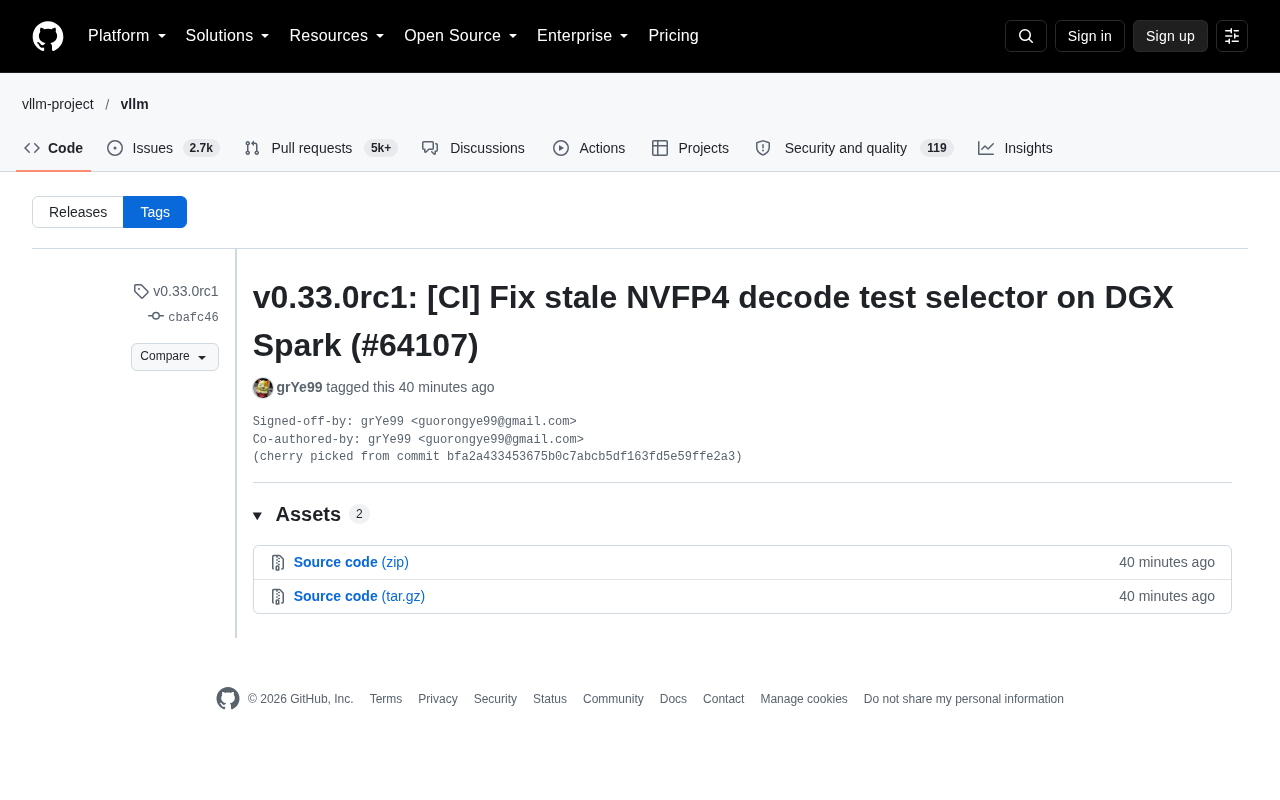
According to the commit message, the change was submitted and signed off by developer grYe99 and was also cherry-picked back from the main branch to the v0.33.0rc1 release branch, indicating that this fix was deemed important enough to include in the release candidate rather than a minor issue that could be deferred to the next major version.
NVFP4 and DGX Spark: Why the Test Selector Went "Stale"
What Is NVFP4
NVFP4 is a 4-bit floating-point quantization format championed by NVIDIA, aimed at dramatically reducing memory usage and improving throughput while keeping model accuracy at an acceptable level. For frameworks like vLLM that sell themselves on high-concurrency inference, native NVFP4 support means achieving orders of magnitude better cost-effectiveness on next-generation hardware.
The precision challenge of FP4 quantization: A 4-bit floating-point format has very limited range and precision, and typically needs to be used with block scaling or micro-scaling factors — splitting tensors into small blocks and storing a separate scaling coefficient for each block — to maintain acceptable numerical precision at extremely low bit widths. NVFP4 needs dedicated decode tests precisely because the numerical behavior of such formats is highly sensitive to hardware instructions, rounding modes, and scaling strategies; any deviation in any of these can manifest as degraded generation quality rather than an explicit error.
Difference from INT4: INT4 uses uniform quantization, whereas FP4 retains exponent bits, allowing it to better cover the long-tail distribution in activation values. This characteristic makes FP4 easier than INT4 to preserve accuracy in large-model inference, but it also means the decode path is more complex and test cases need to cover more edge-case numerical values.
What the Test Selector Means
In vLLM's CI system, decode tests for different hardware platforms and different quantization formats are typically matched via selectors that determine which cases should be executed. When platform characteristics or test naming change, a selector can go "stale" — either skipping cases that should be covered or matching tests that are not applicable. As a new form factor aimed at desktop-level AI development, DGX Spark has a different NVFP4 decode path from data-center GPUs, which is exactly why the selector needed to be realigned.
How CI test selectors are implemented: In projects like vLLM, test selectors are usually implemented as pytest marker expressions or filename-matching rules — for example, deciding which cases are collected and executed based on hardware tags (such as CUDA architecture version or available memory) and quantization-format markers. The advantage of this mechanism is that a single test codebase can adapt to multiple environments; the cost is that once the rules fall out of sync with the actual hardware or naming, silent failures occur.
The platform positioning of DGX Spark: DGX Spark (formerly Project DIGITS) is a compact AI development device from NVIDIA, built on the GB10 Grace Blackwell superchip and focused on local large-model development and inference. Its memory architecture and power constraints differ markedly from data-center GPUs, so scenarios like NVFP4 decoding that are sensitive to memory bandwidth and instruction support require independent test configurations and case-filtering logic.
Three Signals This PR Reveals
The Test Matrix for Low-Precision Formats Is Expanding
From FP16 and BF16 to FP8 and NVFP4, each quantization format requires independent decode-correctness verification and performance baselines. As the routing layer of this matrix, a test selector that cannot keep up with the growth rate of format-hardware combinations becomes a weak link in CI reliability. This fix is a concrete footnote to that.
Backporting to the Release Branch Means Stability First
Cherry-picking to the rc branch shows that the maintainers prefer to ship this fix with the release candidate. For downstream teams relying on vLLM for production deployments, the accuracy of CI test coverage directly affects their trust in version quality.
Adapting to New Hardware Is Not Only About the Kernel Layer
People usually focus on whether an inference framework supports operators for new hardware, but this change reminds us that test infrastructure is also part of hardware adaptation. A stale selector can mean that a hardware path has never actually been covered by CI — a hidden risk that is harder to detect than a missing operator.
What This Means for Developers
If you are running vLLM on DGX Spark and trying NVFP4 quantized inference, this rc version is worth including in your evaluation. Even if you are not on that platform, you can view this change as an observation window: the maturity of an inference framework is reflected not only in how many quantization formats it supports, but also in whether its CI truthfully reflects the real state of each combination.
Going forward, watch whether NVFP4-related test coverage expands in the final v0.33.0 release notes, and whether DGX Spark support moves from the testing layer to an official statement in the documentation layer.
One-line Summary
vLLM fixes the stale NVFP4 decode test selector on DGX Spark, reflecting the hardware adaptation pressure on inference frameworks' CI.
Paragraph Summary
vLLM v0.33.0rc1 fixes a stale NVFP4 decode test selector on the DGX Spark platform in PR #64107, submitted by developer grYe99 and cherry-picked back to the release candidate branch. The article notes that behind this seemingly routine CI maintenance lies sustained pressure on the test matrix from the rapid growth of low-precision quantization formats and hardware combinations. As the routing layer of CI, a stale test selector may mean a particular hardware path is never truly covered, creating a hidden quality risk harder to detect than a missing operator. The author argues that adapting test infrastructure is also a key part of supporting new hardware, and sees this fix as a window into vLLM's maturity.
Related articles

T3 Code: The Open-Source AI Coding Assistant's Comeback Story
T3 Code is an open-source AI coding assistant that unifies subscriptions like Codex and Claude, with powerful remote control and parallel task management.

Never Elected, Yet Ruled New York for 30 Years: The Ultimate Case Study in the Mechanics of Power
Robert Caro's biographies reveal how unelected Robert Moses ruled New York for 30 years through legal drafting and public authorities, and how Lyndon Johnson built leverage as a "powerless" Senate Majority Leader. Unpacking the underlying logic of accumulating and sustaining power.

The CPython 3.10 Recursion Trap and Synthetic Recovery in TokenGuard, an LLM Circuit Breaker
TokenGuard's author recounts a recursion crash caused by OrderedDict.pop in CPython 3.10 and introduces v0.3.0's Loop Nudge synthetic recovery, inline DLP scanning, and other new LLM agent circuit-breaker capabilities.