Wabi Raises $55M at $1.25B Valuation, Emerges as AI Agent Unicorn

Wabi raises $55M at a $1.25B valuation, pivoting from mini-app builder to personal agent.
AI app company Wabi has closed a $55 million funding round at a $1.25 billion valuation, officially becoming a unicorn. Starting as an 'AI agent that builds mini apps' for non-technical users, it now redefines itself as a 'personal agent,' reflecting the industry trend from one-off tools to long-term autonomous agents. The article notes that valuation logic is shifting toward agent capabilities, but gaps remain in tech maturity, privacy, permissions, and reliability.
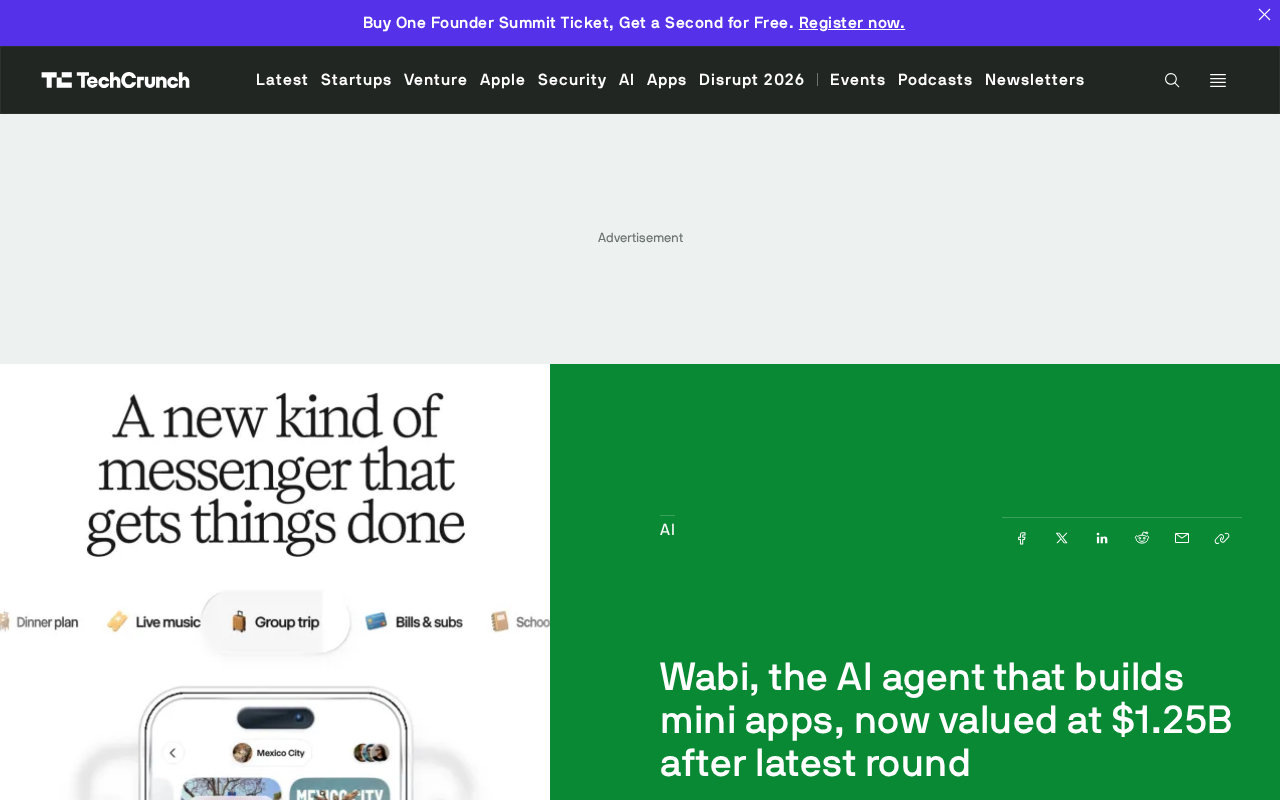
AI app Wabi announced on Thursday that it has closed a $55 million funding round at a $1.25 billion valuation, officially joining the unicorn club. The company, which started out building "mini apps," now redefines itself as a "personal agent" — a shift that reflects the broader industry trend of AI applications evolving from tools into agents.
From Mini-App Builder to Personal Agent
Wabi first entered the public eye with the positioning of "AI agents that build mini apps." Users could describe their needs in natural language, and the AI would automatically generate lightweight mini programs or functional modules. This model lowered the barrier to app development, allowing non-technical users to quickly obtain customized software tools.
According to the original report, Wabi now describes itself as a "personal agent." This wording change is not mere brand packaging. Mini-app building is fundamentally still "task-oriented" tool logic — the user makes a request, the AI executes it, and a result is delivered. "Personal agent," by contrast, implies a more continuous and proactive companionship: the agent understands the user's preferences, habits, and context, and autonomously plans and executes tasks over longer time horizons.
This positioning shift is quite representative of today's AI industry. As underlying model capabilities improve, more and more products are trying to move from "one-off tools" to "long-term agents" in pursuit of higher user stickiness and deeper commercial moats.
In the AI context, an "agent" refers to a system capable of perceiving its environment, reasoning and planning, and autonomously taking actions to achieve goals. Unlike the passive "question-and-answer" mode of traditional chatbots, agents typically possess capabilities such as task decomposition, tool invocation, memory, and reflection, enabling them to continuously complete complex goals across multiple rounds of interaction. The industry often categorizes agents by degree of autonomy: from "workflow-style" agents that can only execute single instructions, to "goal-driven" agents that can autonomously plan and invoke external tools. Wabi's emphasis on "execution and delivery" is precisely what distinguishes an agent from a pure conversational product — it can not only generate content but also actually deliver runnable software artifacts.
What the $1.25 Billion Valuation Signals
A $55 million round at a $1.25 billion valuation means investors have priced in significant growth expectations for Wabi. In an increasingly competitive AI application layer, this valuation level shows that capital markets are still actively seeking targets in the "agent" direction.
From an industry perspective, the valuation logic for the AI application layer is shifting. Early-stage investment focused mainly on user growth and retention, but now investors pay more attention to whether a product has "agent capabilities" — that is, whether it can complete multi-step complex tasks with minimal human intervention. Wabi's identity makeover lands right on this narrative inflection point.
However, valuation itself does not equal product maturity. There is still a considerable technical gap between mini-app generation and a truly general-purpose personal agent, and whether Wabi can use this funding to achieve a capability leap is the key thing to watch next.
A "unicorn" refers to a private startup valued at $1 billion or more, a term coined by a venture capitalist in 2013 to describe the extremely rare ultra-high-valuation companies of that time. In the AI boom, unicorns are being born at a markedly faster pace, and the symbolic meaning of the valuation threshold has been somewhat diluted, but it is still regarded as an important endorsement by capital markets of a company's growth potential. For AI application-layer companies, valuations often reflect expectations about future revenue curves and competitive positioning in the sector rather than current revenue scale, so a high valuation also implies high growth pressure.
Competition and Challenges in the Agent Track
"Personal agent" has become one of the most crowded tracks in the AI industry. From big tech to startups, many players are trying to define what "everyone's AI agent" should look like. Wabi's differentiation lies in its underlying mini-app building capability — this gives the agent a means of "execution and delivery," not just conversational interaction.
But the challenges are equally obvious. Personal agents need to handle a range of issues including privacy, permissions, and reliability. Once an agent performs operations on behalf of the user, the magnitude of error costs will far exceed that of a generative chatbot. In addition, how to get users to trust and become accustomed to delegating everyday tasks to an AI agent remains an unsolved problem across the industry.
The specific use of Wabi's funding round was not disclosed in the original information, but it is reasonable to infer that the funds will be mainly directed toward model capabilities, product iteration, and market expansion. For observers watching the AI application layer, Wabi's next product form may be more worth tracking than the valuation figure itself.
Agent reliability is directly tied to its "action capability." When AI only outputs text, errors can be corrected at low cost through human review; but when an agent is authorized to invoke payments, send emails, modify files, and other real operations, a single misjudgment can cause consequences that are difficult to undo. This has given rise to "human-in-the-loop" authorization designs, pre-operation confirmation mechanisms, and sandboxed execution environments. At the same time, agents need access to sensitive data such as users' calendars, contacts, and preferences to provide personalized services, so how to strike a balance between functionality and privacy is also a trade-off that product design must confront head-on.
One-line Summary
Wabi raises $55M at a $1.25B valuation, pivoting from mini-app builder to personal agent.
Paragraph Summary
AI application company Wabi announced it has closed a $55 million funding round at a $1.25 billion valuation, officially becoming a unicorn. The company started out with "AI agents that build mini apps," letting non-technical users generate lightweight programs through natural language, and now redefines itself as a "personal agent." This wording shift reflects the collective trend of the AI application layer evolving from one-off tools into long-term autonomous agents: products no longer merely execute tasks passively but understand user preferences and proactively plan over longer horizons. The article notes that valuation logic in the AI application layer is also shifting from user growth toward agent capabilities and multi-step task execution, but there remains a considerable technical gap between mini-app generation and a truly general-purpose personal agent, with privacy, permissions, and reliability being the main challenges in this track.
Related articles

OpenAI Math Breakthrough, Anthropic IPO, and Reasoning Model Tutorial
OpenAI unveils math, CS, and physics results, claiming proof that ETH is false; Anthropic files for IPO, disclosing revenue and customer data; SpaceX gets $40B GPU financing; open-source model tool-calling accuracy issues and constrained decoding; 8-video reasoning model tutorial.

14 Core Concepts of Reasoning Models: From Chain of Thought to GRPO Explained
A systematic breakdown of 14 core concepts of reasoning models: chain of thought, test-time compute, verifiers, RLVR and GRPO, distillation, and reward hacking, plus rules for controlling thinking-token costs to help you decide when reasoning is worth paying for.

OpenAI's Claimed Refutation of ETH Sparks Debate, Meta Bets Big on AI Infrastructure
OpenAI claims an AI-assisted discovery that challenges the Exponential Time Hypothesis (ETH) and launches the mid-tier GPT-6.1 Tera. Cloudflare discloses a cross-customer data leak postmortem, and Meta plans $95B in AI infrastructure financing.