Weaviate Podcast Conversation with ZeroEntropy: A New Technical Approach to Retrieval-Augmented Generation

Weaviate Podcast talks with ZeroEntropy about optimizing RAG retrieval quality through entropy reduction.
Based on Weaviate Podcast Episode 150 with ZeroEntropy founder Ghita Houir Alami, this article explores cutting-edge RAG ideas. It notes that RAG bottlenecks often lie in retrieval rather than generation, and that irrelevant or redundant retrieval results can seriously hurt large model output quality. ZeroEntropy's "entropy reduction" approach may innovate around embedding models, index structures, or ranking objective functions to extract the most certain and valuable information from massive data. The article also outlines current RAG challenges, such as the difficulty of achieving both recall and precision and low long-document processing efficiency, and advises developers to focus on retrieval optimization practices such as query understanding and chunk filtering, while valuing ecosystem collaboration.
When RAG Meets ZeroEntropy: Insights from a Technical Conversation
In the latest episode of the Weaviate Podcast (Episode 150), the host invited Ghita Houir Alami, founder of ZeroEntropy, to discuss cutting-edge ideas in the field of retrieval-augmented generation (RAG). Although brief, the episode touches on a key pain point in current AI application development: how to enable large models to leverage external knowledge more accurately and efficiently.
Why ZeroEntropy Is Worth Watching
The name ZeroEntropy itself suggests a technical orientation—pursuing the minimization of information entropy, that is, extracting the most certain and valuable information from massive amounts of data. In the context of RAG, this means improving the precision and efficiency of the retrieval stage. In the podcast, Ghita Houir Alami shared the team's understanding of this problem and the solutions they are building. Although the podcast did not provide specific technical parameters, the direction of the discussion suggests that ZeroEntropy is likely innovating in embedding models, vector retrieval, or re-ranking strategies.
For developers, the significance of such exploration lies in this: the bottleneck of RAG is often not on the generation side but on the retrieval side. If the retrieved context is irrelevant or redundant, the quality of the large model's output will be greatly compromised. ZeroEntropy's work targets exactly this stage, attempting to improve retrieval quality through a more "entropy-reducing" approach.
Core Topics and Industry Context in the Podcast
The Current State and Challenges of RAG
The podcast conversation naturally touched on the current state of RAG. Today, RAG has become a mainstream paradigm for connecting large models with private data and is widely used in question-answering systems, document assistants, intelligent customer service, and other scenarios. However, many challenges remain in real-world deployment: it is difficult to achieve both recall and precision in retrieval, long-document processing is inefficient, and multimodal data fusion is difficult. Ghita may have mentioned these pain points in the episode and introduced ZeroEntropy's approach to addressing them.
From an industry perspective, RAG optimization is evolving from "usable" to "easy to use." Early solutions often simply concatenated retrieval results with prompts, while the current trend is toward more refined process control, such as query rewriting, multi-route recall, and context compression. ZeroEntropy is likely positioned to provide more foundational technical components within this trend.
The trade-off between recall and precision is a classic contradiction in retrieval systems. Recall measures whether the system can find all relevant documents, while precision focuses on how many of the returned results are truly relevant. In RAG scenarios, increasing recall usually means expanding the retrieval scope (for example, increasing the number of returned document chunks), but this introduces more noise and lowers precision; conversely, pursuing high precision may miss key information. In practice, systems often balance the two through multi-route recall (for example, using both sparse and dense retrieval) combined with re-ranking models, but computational overhead and latency also increase. Understanding this trade-off helps evaluate the value of retrieval-side improvements such as those from ZeroEntropy.
Query Rewriting is an important preprocessing step in the RAG pipeline for improving retrieval performance. Users' original queries are often ambiguous, colloquial, or incomplete, and using them directly for vector retrieval can easily deviate from the intent. Query rewriting uses a large model to expand, decompose, or reconstruct the original query to generate a query expression that is more conducive to retrieval. Common strategies include breaking complex questions into multiple sub-queries, supplementing synonyms or context, and converting colloquial expressions into standardized terminology. This step can significantly improve the relevance of recall, but it also adds extra model invocation overhead, requiring a trade-off between effectiveness and cost.
Speculation and Discussion on Technical Paths
Although the podcast did not disclose specific technical details, we can infer possible directions from the name "ZeroEntropy": first, developing more efficient embedding models to reduce information loss during retrieval; second, designing new index structures to improve retrieval speed and precision; third, introducing an entropy-minimization objective function to optimize retrieval ranking. As the founder, Ghita may have shared the trade-offs and experimental progress in these directions during the podcast.
Interestingly, Weaviate, as a well-known project in the vector database field, often focuses its podcast on AI infrastructure and developer tools. Choosing ZeroEntropy as a guest also reflects the community's attention to innovation in retrieval technology.
Embedding models are the core component that maps text into dense vectors, and their quality directly determines the semantic matching capability of vector retrieval. In RAG, document chunks and user queries are encoded into vectors through embedding models, and the most relevant chunks are then found through similarity calculation (such as cosine similarity). The training objective of embedding models is usually to make semantically similar texts closer in vector space, but general-purpose embedding models often perform poorly in vertical domains (such as law and healthcare), so domain-adaptive fine-tuning has become a common optimization method. In addition, the dimensionality, inference speed, and context length of embedding models are also key considerations when selecting a model. If ZeroEntropy is innovating in embedding models, it is likely to focus on these dimensions.
Implications for Developers
Pay Attention to "Entropy Reduction" Thinking in the Retrieval Stage
For developers building RAG applications, ZeroEntropy's approach offers a reference: rather than blindly expanding the retrieval scope, think about how to reduce information entropy. For example, more precise query understanding, smarter chunk filtering, or the introduction of domain-adaptive embedding models can all improve results without significantly increasing costs.
In the podcast, Ghita may have emphasized the importance of experimentation and iteration. In RAG systems, adjusting retrieval strategies often requires extensive A/B testing in combination with specific data and business scenarios; there is no one-size-fits-all solution.
The Value of Ecosystem Collaboration
The Weaviate Podcast itself is a microcosm of ecosystem collaboration—database vendors, startups, and the developer community jointly drive technological progress. The conversation between ZeroEntropy and Weaviate may foreshadow more integration at the toolchain level in the future. For developers, staying attentive to such podcasts helps them keep up with emerging tools and best practices.
Conclusion
Although this episode of the Weaviate Podcast offers limited information, it opens a window showing that RAG technology is still evolving rapidly. The "entropy reduction" approach represented by ZeroEntropy may become an effective path to improving retrieval quality. For AI application developers, continuously paying attention to innovation in the retrieval stage is more practically valuable than simply chasing larger models.
(This article is based on a Reddit discussion about Weaviate Podcast Episode 150. For specific technical details, please refer to the original podcast audio.)
One-line Summary
Weaviate Podcast talks with ZeroEntropy about optimizing RAG retrieval quality through entropy reduction.
Paragraph Summary
Based on an interview with ZeroEntropy founder Ghita Houir Alami on Weaviate Podcast Episode 150, this article explores cutting-edge thinking in retrieval-augmented generation (RAG). It points out that the bottleneck of RAG is often on the retrieval side rather than the generation side, and that irrelevant or redundant retrieval results can seriously drag down the output quality of large models. With "entropy reduction" as its technical orientation, ZeroEntropy may be innovating around embedding models, index structures, or ranking objective functions, aiming to extract the most certain and valuable information from massive data. The article also outlines current RAG challenges, such as the difficulty of achieving both recall and precision and the low efficiency of long-document processing, and suggests that developers pay attention to retrieval optimization practices such as query understanding and chunk filtering, while also valuing the importance of ecosystem collaboration.
Related articles

GPT-6 Security Model and the AI Attack-Defense Escalation: This Week in AI
This week in AI: OpenAI's GPT-6 Saber found 948 Linux kernel root-escalation paths; Cursor deploys full apps from one sentence; Binance details a social engineering attack; C++26 fails ISO vote.
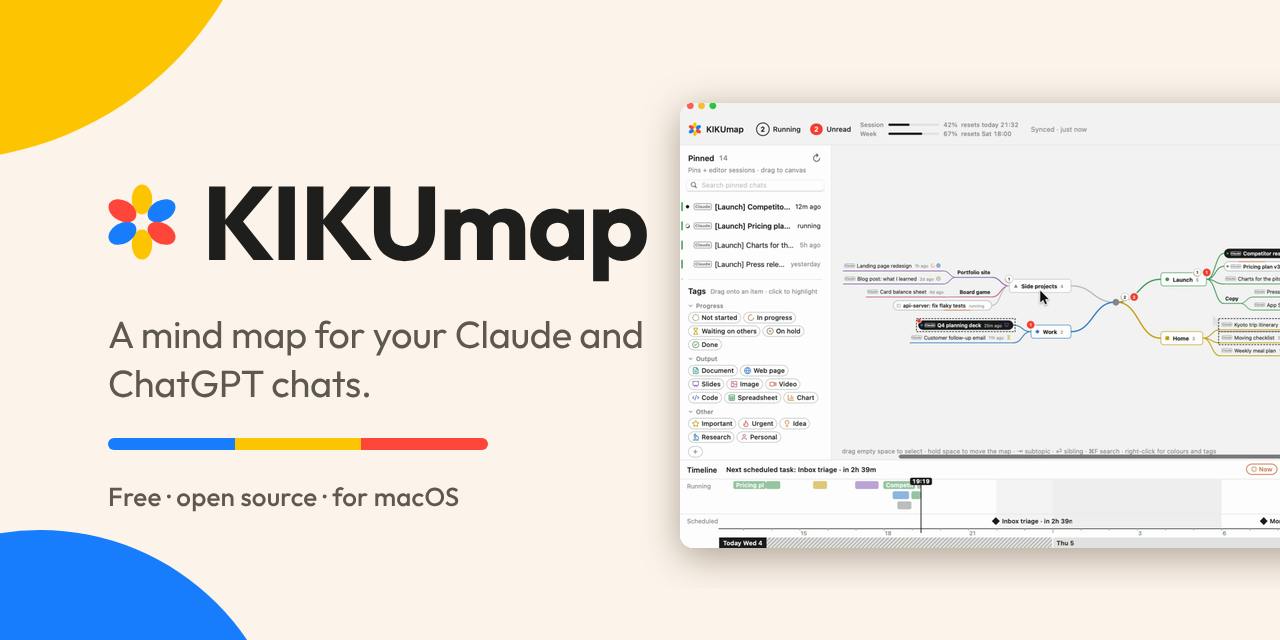
KIKUmap: Manage Your Claude and ChatGPT Conversations with Mind Maps
KIKUmap is a macOS menu bar app that visualizes Claude and ChatGPT conversations as mind maps with real-time status. Free and open source.
Hugging Face Executive Warns: Cyberattacks Are Eroding the Openness of Open-Source AI
Hugging Face executive Irene Solaiman warns that rising cyberattacks on open AI platforms may force stricter security limits, threatening the openness of the open-source community and affecting the developer ecosystem.