What an AI Agent Really Is: A Hands-On Guide to Building Your Own

Agents have no standard definition; essentially they are large-model dispatchers driven by task decomposition and rules.
Based on the views in a Bilibili tutorial by Tang Yudi, the article uses the example of "asking a roommate to attend class for you" to explain AI Agents. The author points out that Agents have no unified standard definition but are a DIY design approach tailored to needs. Their core working method is to break tasks into multiple sub-processes and execute them step by step after receiving a command, unlike linear Q&A with a large model. Agents are not a new species separate from large models; every decision step feeds commands and environment state to the model, much like a project manager dispatching an execution team. The current barrier to putting Agents into practice lies in rule design: because large models hallucinate and produce unstable output, successful projects mostly rely on human-written prompts and process rules. The article concludes by advising developers to focus on process decomposition and prompt design rather than chasing flashy frameworks.
AI Agents are undoubtedly one of the hottest topics right now, but misunderstandings around them abound. In a tutorial on Bilibili, creator Tang Yudi uses the everyday example of "asking a roommate to attend class for you" to break down how an Agent works with remarkable clarity. This article is based on the core ideas of that tutorial, combined with current industry practice, and lays out the essence of Agents, their relationship to large models, and the key ideas for building your own intelligent agent.
What exactly is an Agent? A "proxy" with no standard answer
The word "Agent" translates to proxy or intelligent agent. The creator emphasizes right at the start that Agent has no essential, perfect definition—it's more of a "living" concept. What you think a robot should do and how I think a robot should solve a problem can involve completely different processes. Everyone's understanding of an Agent can be DIY; there's no need to pursue a unified algorithmic workflow.
This openness is precisely where the appeal of Agents lies. It's not a concept you need to memorize from a textbook, but a design approach: whatever you want it to help you accomplish, that's the form it takes. The creator admits he'd rather share the feelings and reasoning behind using Agents than pile up definitions.
The Agent concept is not a product of the large-model era. In the field of AI, discussion of Agents (intelligent agents) dates back to the 1980s, with the classic definition being "an autonomous entity that can perceive its environment and take actions to maximize the achievement of its goals," typically architected around three stages: perception, decision-making, and execution. In reinforcement learning, an Agent adjusts its strategy based on reward signals through repeated interaction with the environment; today's LLM-based Agents hand the "decision-making" stage to a language model, replacing hard-coded strategy functions with natural language instructions. This shift from rule-driven to semantics-driven is the key backdrop for understanding the current Agent boom.
In engineering practice, an Agent is usually broken down into several composable modules: an LLM core responsible for reasoning and planning, a tool-calling layer that reads and writes external state, a memory mechanism that stores history and intermediate results, and an executor that controls the loop's termination conditions. Different products implement these modules very differently, which also explains why the industry struggles to offer a unified definition—module boundaries and responsibility divisions themselves vary by scenario.
Using "attending class for you" to understand an Agent's task-decomposition logic
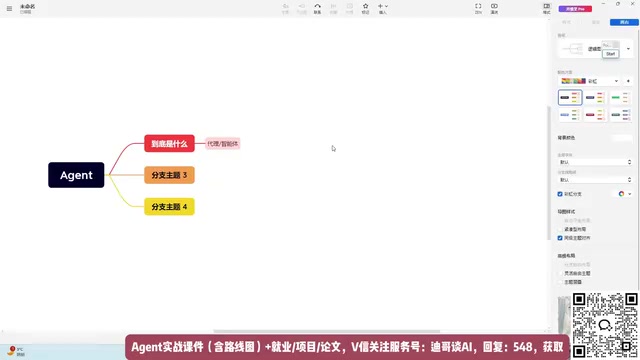
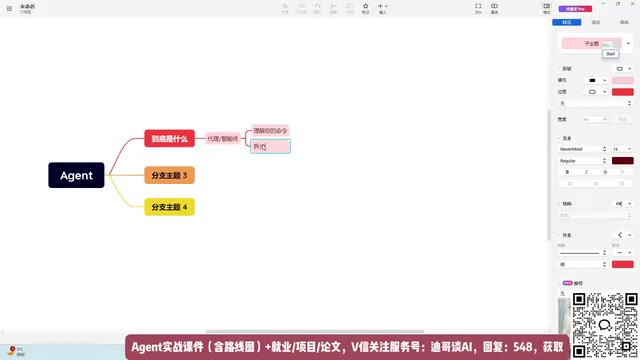
The creator gives a vivid example: you can't get up in the morning, so you ask your roommate to attend class for you. This command seems simple, but broken down it contains a series of subtasks—answering "here" for you when the teacher takes attendance, handing in your homework along the way, taking good notes and bringing them back, and, if it's a bit smarter, picking up food on the way back to the dorm after class.
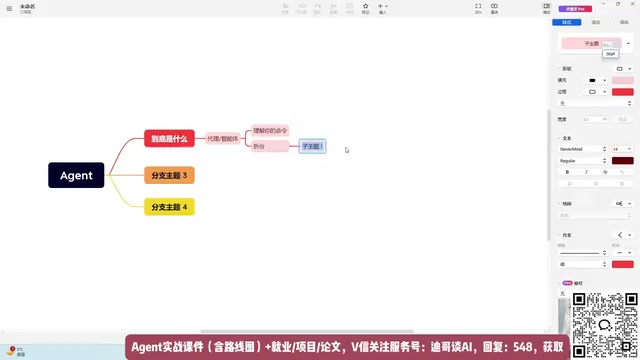
This is the core working method of an Agent: after receiving a request, it doesn't get it done in one step, but breaks the task into multiple processes, each completed separately. This is completely different from the experience of talking directly to a large model—ask it a question and it answers; ask again and it answers again, linearly. An Agent, by contrast, operates as a chain: "understand the command → break down the task → execute step by step."
Agents and large models: not a replacement, but deep invocation
Many people mistakenly believe an Agent is a new species separate from large models. The creator explicitly corrects this: every step of an Agent leverages a large model. When breaking down tasks, it feeds your command, your personal information, and the current goal together as a prompt to the large model, letting it output a list of subtasks; when executing each subtask, it feeds the current environment and task state to the large model, asking "what should be done at this step?"
A more engineering-oriented analogy: an Agent is like a project manager, and the large model is the execution team. The PM defines the process and breaks down requirements, then hands each stage to the corresponding programmer to implement. An Agent is essentially a dispatcher that interacts extensively with a large model—every decision requires asking the model "what is my current environment, what is the command, and how should it be completed?"
The article's approach of "the Agent handing the command, personal information, and current goal to the large model together" corresponds in engineering to context construction in prompt engineering. A single call typically includes the system prompt (role and behavior constraints), the user instruction, task state, and historical conversation, based on which the model generates the next action or decision. Subtasks also need to connect, so the Agent feeds the previous step's execution result back as the next round's input, forming a loop of multiple calls. This chain of "assemble context—call model—parse output" is what essentially distinguishes an Agent from a single Q&A exchange.
It's worth noting that a large model's context window is limited, and during long tasks historical information keeps accumulating, requiring compression through summarization, retrieval, or structured memory—otherwise it will exceed the window or dilute key instructions. In addition, the format stability of model output directly affects whether the process can continue—which is one of the reasons "rule design" is emphasized later.
Rule design: the real barrier to putting Agents into practice
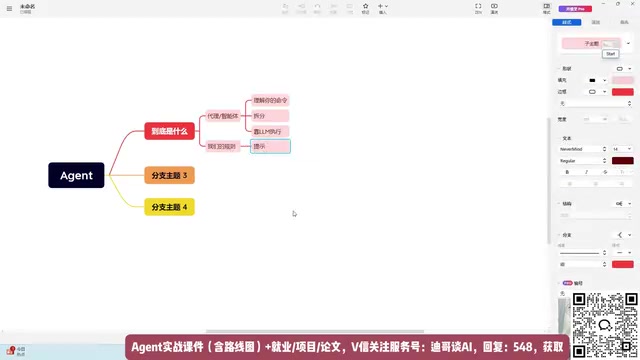
The creator pours a bucket of cold water: current Agents still cannot truly understand every human behavior. Large models hallucinate and produce unstable output, so Agents more often rely on "rules" to execute—put plainly, the prompts you write.
Take "attending class for you," for example. You need to write the character's psychology, behavioral habits, and current goal all into the prompt, then hand it to the large model, to get a reliable output of what to do at this step. The creator observes that in some successful Agent projects on the market, the rules are all designed by humans. Without rule design, results are much worse. This is the main limitation of current Agents: they don't yet possess stable self-thinking, even though the large model can "think" at every step of the process.
The "large model hallucination" mentioned in the article refers to the model generating content that seems plausible but is inconsistent with facts or deviates from instructions. For Agents, the harm of hallucination is amplified by chain-style execution: one wrong subtask judgment in an earlier step can send all subsequent steps off course. Common mitigation methods include having the model output structured formats (such as JSON or a numbered list of steps) for easy validation, setting up human confirmation at key nodes, performing consistency checks on tool-call results, and constraining output style with few-shot examples.
Rule design is a barrier because it essentially makes task decomposition explicit—writing domain knowledge, judgment criteria, and exception handling into prompts or processes. The more complete the rules, the less room the model has to improvise and the higher the stability, but the flexibility correspondingly decreases; the looser the rules, the more flexible the Agent, but the more easily it goes off track. This trade-off between stability and flexibility is a core issue that recurs throughout Agent product design, and the main source of accumulated engineering experience.
Takeaways for developers
For learners who want to get hands-on and build their own intelligent agent, this logic offers a clear path: first understand that an Agent is a combination of "understanding commands + task decomposition + rule-driven + large-model execution," then set about designing prompts and process rules. Don't be led astray by mythologized narratives—the capability boundary of an Agent largely depends on the quality of the rules you design. Breaking down processes clearly and writing solid prompts matters more than chasing flashy frameworks. This is also the hard skill you can genuinely put on your resume after learning it.
Related articles

AI Comic Drama with WorkBuddy from Scratch: A Step-by-Step Skill Pack Installation Guide
Learn how to create AI comic dramas with WorkBuddy from scratch. This guide covers installation, Skill pack import and invocation, plus a script generation demo with manual revision tips to get you through the first step from script to storyboard.

WorkBuddy Agent Runs the Entire GEO Database Mining Pipeline with a Single Prompt
WorkBuddy agent automates GEO database mining: from data search and curation to batch correction, differential analysis, co-expression networks, feature gene screening, and immune infiltration—a single prompt generates a complete bioinformatics report, greatly lowering the barrier to bioinformatics analysis.

PC Memory Wasted? Hacker News Debates Centralized Data Centers
Hacker News users argue that personal computer memory is wasted and should be centralized in data centers, sparking debate on centralized vs. distributed computing resource allocation. This article analyzes the logic behind the claim, the costs of centralization, and new tensions in memory resource allocation in the AI era.