What Nixpkgs Means for Front-End Developers
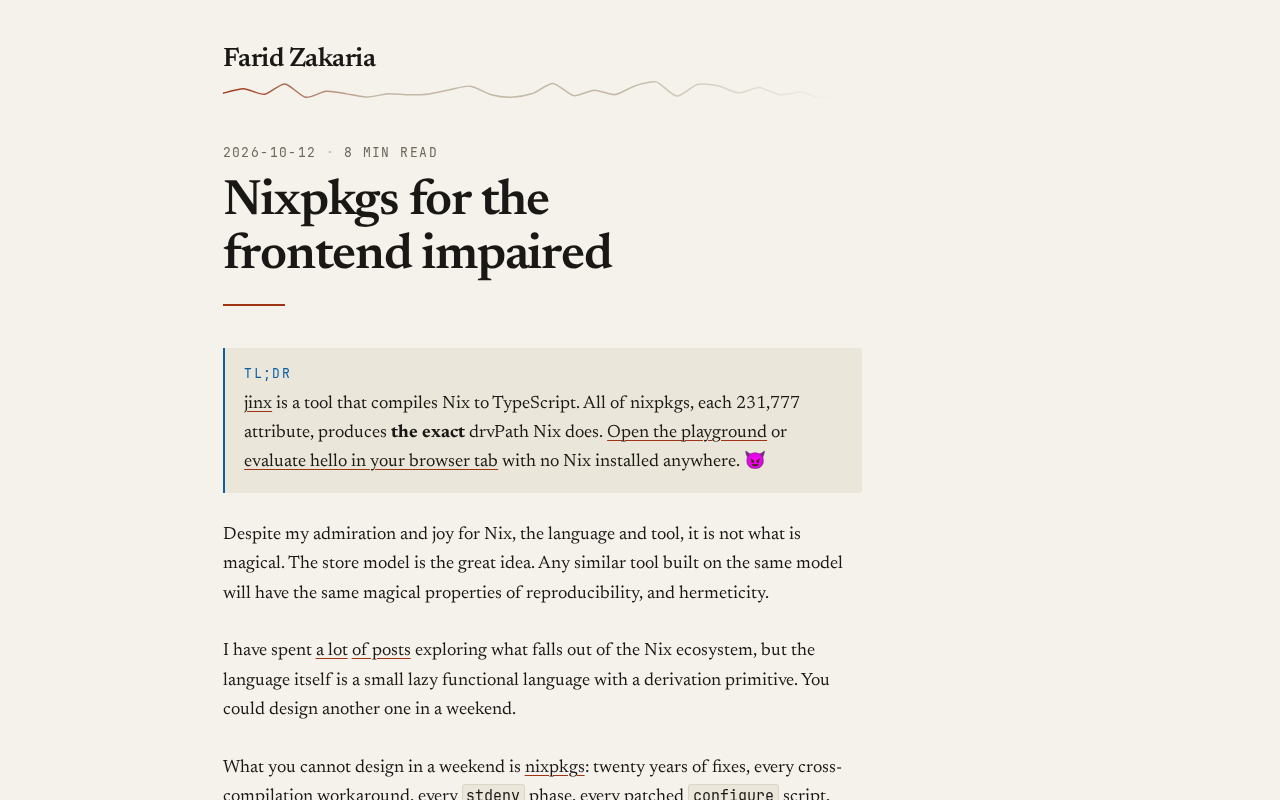
Nixpkgs solves front-end environment inconsistency with declarative, reproducible builds, but the learning curve remains the main barrier.
Starting from a Hacker News post titled "Nixpkgs for the Front End Impaired," the article explores Nixpkgs' value for front-end developers. Nixpkgs is the package collection for the Nix package manager, and its declarative, reproducible build approach addresses long-standing front-end problems like uncontrollable node_modules and complex multi-version Node.js coexistence. The article notes that Nix locks down the complete dependency graph and provides project-level environment isolation, making "works on my machine" a thing of the past. However, the Nix language's learning curve and front-end ecosystem inertia mean the topic gets limited attention on HN, and Nix remains niche in the front-end space. Still, for large teams and complex projects, Nixpkgs' unified toolchain approach has long-term reserve value.
Why Front-End Developers Should Pay Attention to Nixpkgs
On Hacker News, a post titled "Nixpkgs for the Front End Impaired" sparked a small discussion. The title itself carries a self-deprecating tone—"Front End Impaired" suggests the content is aimed at developers who struggle with front-end toolchains. Given what Nixpkgs is, the article's core purpose is to explain to front-end developers unfamiliar with the Nix ecosystem what real problems Nixpkgs solves and why it's worth their time to learn about it.
Nixpkgs is the package collection for the Nix package manager, and its defining characteristic is declarative, reproducible builds. For front-end developers, the daily headaches of node_modules black holes, version conflicts, and inconsistent environments happen to be exactly what the Nix ecosystem excels at handling. The value of this post lies in its attempt to build a bridge—translating Nix's core ideas into language that front-end developers can understand.
Nix's core mechanism is "purely functional package management": each package is hashed from a set of inputs (source code, dependencies, build scripts, compilers, etc.) to produce a unique identifier stored in /nix/store. Packages with the same name but different versions or build parameters can coexist without interfering with each other. Nixpkgs is the massive software repository behind this mechanism, containing build definitions for tens of thousands of packages maintained by the community. It's not just a "package list" but a programmable build description system that allows users to customize packages through overrides and composition without modifying upstream definitions. Understanding this makes it clear why Nix guarantees reproducibility: build results depend only on declared inputs, not on machine state.
Front-End Toolchain Pain Points and Nix's Solutions
The Uncontrollability of node_modules
The front-end ecosystem has long relied on package managers like npm/yarn/pnpm. While convenient, these tools share a fundamental problem: dependency resolution depends on the network, registry state, and local cache, so the same package.json installed at different times or on different machines may not produce identical node_modules. Nixpkgs eliminates the "works on my machine" problem at its root by locking down the complete dependency graph and build inputs.
While package-lock.json or yarn.lock in the npm ecosystem can lock version numbers, lock files don't guarantee identical build results, because the installation process can still be affected by registry mirrors, optional dependencies, lifecycle scripts (postinstall), and platform differences. Nix incorporates the entire dependency graph—including transitive dependencies, build toolchains, and environment variables—into its hash calculation. Any change in input results in a different store path. This means that two machines using the same Nix expression will get byte-identical dependency trees, completely eliminating the hidden risk of "same lock file but different actual installation results."
The Complexity of Multi-Version Coexistence
Front-end projects often need to maintain multiple versions simultaneously, each depending on different Node.js versions and different global tools. Nix's declarative environments provide project-level isolation—when you switch projects, the environment switches automatically. No more manually switching versions with nvm, and no more worrying about global package pollution.
Nix's environment isolation isn't achieved through containers or virtual machines but through symlinks and store path isolation. Each project can have a shell.nix or flake.nix that declares the required Node.js version, package manager, and even system dependencies like databases. When you enter the project directory, running nix-shell or nix develop gives you a temporary shell environment with all dependencies included. When you exit, the environment disappears without polluting anything global. Unlike nvm, Nix can manage any tool beyond Node.js (such as Python, Rust, compilers) simultaneously, and all versions can coexist on the same machine, switched as needed.
The Learning Curve for Front-End Developers
The post's title already points to the barrier to entry. The Nix language itself has a learning curve, and Nixpkgs operates at a fairly high level of abstraction. For front-end developers accustomed to the "plug-and-play" style of the JavaScript ecosystem, first contact with Nix brings a noticeable cognitive burden. The post's positioning is precisely to lower this barrier by using scenarios familiar to front-end developers to analogize Nix concepts.
Judging from the discussion activity on HN (the post received only a small number of points), this topic remains niche in the broader front-end community. Nix's adoption rate in the front-end space is far lower than in back-end and infrastructure domains, which is related to both the learning cost and ecosystem inertia.
The Nix language is a lazily evaluated purely functional language with syntax quite different from JavaScript, emphasizing expressions, attributes, and function composition. Beginners need to understand concepts like "derivation," "override," and "flake" before they can write or modify package definitions. However, for most front-end developers, daily use doesn't require writing Nix expressions in depth—they can consume Nixpkgs through existing flake templates or community-maintained devShells. The real learning curve lies in understanding Nix's philosophy: all builds are pure functions with no implicit state. Once you cross this cognitive threshold, subsequent maintenance costs drop significantly.
Directions Worth Watching
Despite limited current discussion, Nixpkgs' potential value for front-end development should not be overlooked. Reproducible builds, declarative environment management, and unified cross-language toolchains will gradually demonstrate their advantages in large teams and complex projects. For front-end developers willing to invest time in learning, Nixpkgs offers an approach distinct from mainstream front-end toolchains—one worth keeping an eye on as a technical reserve.
Related articles

Ollama Local Deployment Guide: Run Open-Source LLMs with Zero Experience
Ollama local deployment tutorial: what Ollama is, why choose it, how to download, install, and run open-source LLMs, and use its API for custom development. Beginner-friendly.

n8n: The 187K-Star Open-Source Automation Powerhouse That Turns Repetitive Work into Workflows
n8n is a 187K-star open-source visual workflow automation engine with 400+ nodes, Webhook/schedule/polling triggers, self-hosting for data security, and AI Agent support. Here's a guide to its core concepts, use cases, and pitfalls.

Self-Hosting n8n in Practice: Docker + PostgreSQL + Caddy Deployment Guide
A step-by-step guide to deploying a self-hosted n8n instance with Docker Compose, PostgreSQL, and Caddy automatic HTTPS, including env var pitfalls, Feishu alerting, and backup/upgrade/rollback tips.