When AI Mistakes Your Debugging Request for Reverse Engineering: An Analysis of a False Positive Incident
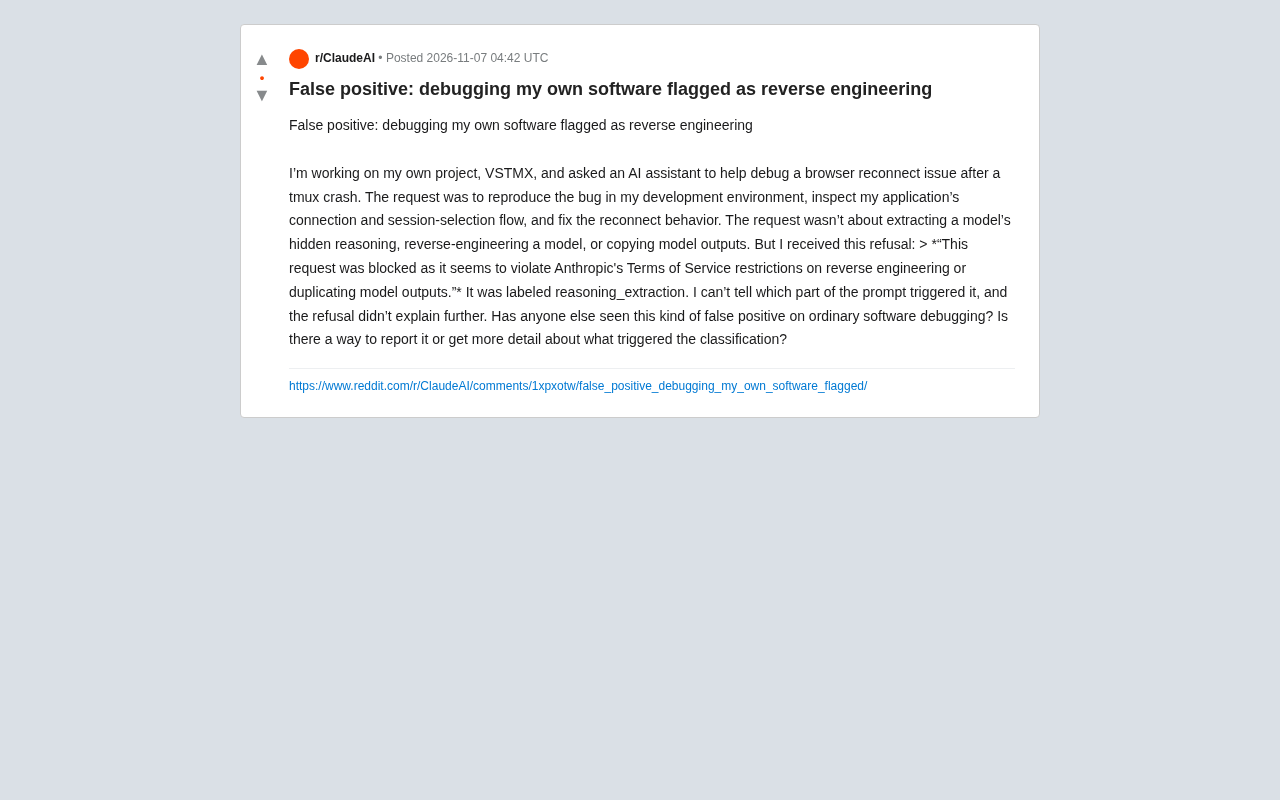
A developer debugging a personal project was mistakenly flagged by AI as reverse engineering, highlighting the challenge of overgeneralization in safety filtering.
While debugging his own VSTMX project, a developer asked AI to help reproduce a browser reconnect issue after a tmux crash, but the AI refused on the grounds of violating reverse engineering terms, classifying the request as reasoning_extraction. The developer was confused because the request was entirely about application-layer debugging and had nothing to do with extracting model reasoning. The article analyzes that such false positives stem from safety classifiers broadly matching keywords like "inspect," "flow," "connection," and "session," confusing ordinary debugging terminology with reverse engineering scenarios. Similar false positives also occur when debugging network protocols and analyzing binary behavior. The article suggests developers adjust their wording and use feedback channels to report false positives, and notes that AI safety systems need to find a balance between abuse prevention and usability while improving the transparency of refusal reasons and appeal mechanisms.
An Ordinary Debugging Request — Why Did AI Block It?
A developer shared his experience on Reddit: while working on his personal project VSTMX, he encountered an issue where the browser failed to reconnect after tmux crashed. He then asked an AI assistant to help reproduce the bug, inspect the application's connection and session-selection flow, and fix the reconnect behavior. However, the AI returned a refusal response, stating that "this request appears to violate Anthropic's terms of service restrictions regarding reverse engineering or replicating model outputs," and classified the request as reasoning_extraction.
The developer was confused: his request was entirely about application-layer debugging and had nothing to do with extracting the model's hidden reasoning, reverse engineering the model, or replicating model outputs. He could not determine which part of the prompt triggered the block, and the refusal message provided no further explanation. This raises a noteworthy question: are AI safety filtering mechanisms overly sensitive in ordinary software development scenarios?
The Root Cause of False Positives: Overgeneralization of Safety Classifiers
From a technical perspective, such false positives typically stem from safety classifiers broadly matching sensitive patterns. Labels like reasoning_extraction are often associated with behaviors of "extracting the model's internal reasoning process," but classifiers may confuse certain keywords or contexts (such as "connection," "session," "reconnect," "reproduce," etc.) with reverse engineering scenarios. The developer used phrasing like "inspect my application's connection and session-selection flow," where "inspect" and "flow" may be interpreted by the model as attempts to analyze internal mechanisms, thereby triggering restrictions.
According to the original Reddit post and some community discussions, this kind of false positive is not an isolated case. Some users reported encountering similar blocks when debugging network protocols, analyzing binary behavior, or even writing regular expressions. The safety mechanism is intended to prevent abuse, but overgeneralization harms the normal development experience.
Safety classifiers are content moderation components deployed by AI service providers, typically based on independently trained models or rule engines that scan user inputs and model outputs in real time to determine whether they violate usage policies. They do not work by understanding semantics but by identifying statistical patterns: when input text is close in vector space to known abuse samples (such as typical expressions of "extracting model reasoning process"), the classifier assigns the corresponding label. reasoning_extraction is one such label, specifically referring to behaviors that attempt to induce the model to leak internal chain-of-thought or hidden reasoning steps. Since classifier training data may contain large numbers of samples related to reverse engineering, such as "analyzing connection flows" and "inspecting internal states," ordinary debugging terminology easily falls into the same semantic neighborhood, causing false positives.
How Developers Can Respond and Provide Feedback
When facing such false positives, developers can take several steps. First, try adjusting the prompt wording, explicitly emphasizing "this is software I developed myself" and avoiding terminology that may trigger safety keywords (such as "reverse engineer," "extract," "replicate"). Second, use the platform's feedback channels to report the false positive — although the original poster said he was unsure how to report it specifically, most AI service providers have abuse reporting or false positive feedback entry points. Finally, sharing cases in the community helps build consensus and push model providers to optimize their classifiers.
You may not have noticed that the original poster did not receive specific details about what triggered the classification, which reflects the current lack of transparency in AI safety systems. Users find it difficult to understand why they were rejected, and therefore difficult to effectively avoid or appeal.
The Balancing Challenge Between Safety and Usability
This incident reflects the core contradiction of AI safety filtering: how to prevent abuse without harming normal use. Overly loose filtering may allow models to be used for malicious purposes, while overly strict filtering frequently frustrates developers. Ideally, classifiers should judge intent based on context rather than relying on keyword matching. At the same time, providing clear refusal reasons and appeal mechanisms can help users understand the boundaries and reduce frustration.
For AI assistant providers, collecting such false positive cases and continuously iterating on classifiers is key. For developers, understanding these limitations and learning to adjust interaction methods is also an essential skill for collaborating with AI today.
Context-aware filtering is a technical approach to mitigating false positives: rather than looking only at the surface features of a single prompt, it combines conversation history, user identity, code ownership declarations, and other signals to comprehensively judge intent. For example, if the user has already stated "this is software I developed myself," the classifier can reduce sensitivity to words like "inspect" and "flow." Another approach is tiered interception — requiring users to confirm the purpose of high-risk requests first rather than directly refusing them. Regarding transparency, some platforms have begun providing brief category explanations for "why it was rejected" and appeal buttons, but most remain at the stage of vague prompts. Academia and industry generally agree that evaluation metrics for safety filtering should report both false positive rates and false negative rates, rather than pursuing only low false negatives, otherwise usability costs will be systematically ignored.
Conclusion: False Positives Should Not Be the Norm
AI-assisted development should improve efficiency, but false positive blocks can interrupt workflows. This Reddit case reminds us that safety mechanisms need more refined contextual understanding, and user feedback is an important force for driving improvement. If you encounter similar situations, speak up in the community and make the problem visible.
One-line Summary
A developer debugging a personal project was mistakenly flagged by AI as reverse engineering, reflecting the challenge of overgeneralization in safety filtering.
Paragraph Summary
While debugging his own VSTMX project, a developer asked AI to help reproduce a browser reconnect issue after a tmux crash, but the AI refused on the grounds of violating reverse engineering terms, classifying the request as reasoning_extraction. The developer was confused because the request was entirely about application-layer debugging and had nothing to do with extracting model reasoning. The article analyzes that such false positives stem from safety classifiers broadly matching keywords like "inspect," "flow," "connection," and "session," confusing ordinary debugging terminology with reverse engineering scenarios. Similar false positives also occur when debugging network protocols and analyzing binary behavior. The article suggests developers adjust their wording and use feedback channels to report false positives, and notes that AI safety systems need to find a balance between abuse prevention and usability while improving the transparency of refusal reasons and appeal mechanisms.
Related articles
 Tech Frontiers
Edge AI on Microcontrollers: When Is It Actually Worth Deploying?
Drawing on Reddit discussions and Arm case studies, this article analyzes the real-world use cases for edge AI on microcontrollers: when each device needs independent inference, when a gateway or cloud is more reasonable, and the costs and boundaries of specialized hardware.
 Tech Frontiers
Pushing the Limits of Extreme Sudoku on a 16GB GPU: Insights from Depth and Flow Matching
A researcher trained a 16.54M-parameter model on a 16GB GPU to solve extreme Sudoku, finding effective depth breaks the 60% plateau and flow matching with improved sampling pushes accuracy past 99% with ~50× lower layer-evaluation budget.
 Tech Frontiers
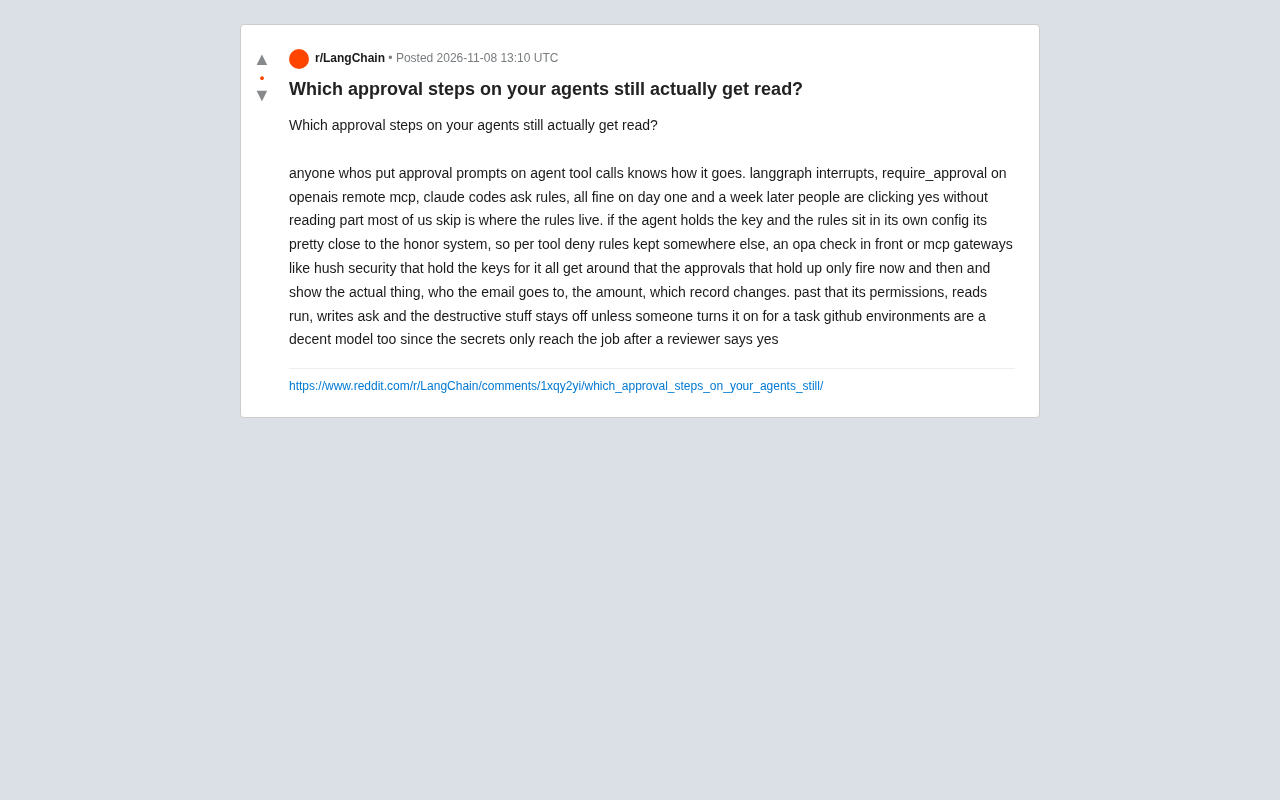
AI Agent Approval Workflows: Why Human Confirmations Always Get Mindlessly Clicked
Why do AI agent approval workflows always get mindlessly clicked? A Reddit discussion shows that separating rules from keys, low-frequency high-risk approvals, and GitHub Environments-style gates are the keys to effective approvals.