Where Is FLUX3-Dev? The Community's Questions About an Open-Source Release

Reddit community asks where FLUX3-Dev is, highlighting open-source AI art transparency concerns.
A Reddit post asking "Where on earth is FLUX3-Dev?" has sparked broader discussion about transparency in open-source image model releases. Black Forest Labs' FLUX series is highly valued for local deployment, LoRA fine-tuning, and downstream development — but the next Dev release remains MIA. Possible reasons include prioritizing commercial monetization, complex licensing and content compliance considerations, and a mismatch between community naming expectations and the official roadmap. Users are advised to follow Black Forest Labs' official channels directly until a clear announcement is made.
A Question Echoing Through the Community
In Reddit's AI art communities, a short post struck a chord with many enthusiasts: "Where on earth is FLUX3-Dev?" The poster noted that it had been a while since any news about FLUX3 surfaced, and there was still no word on when the Dev version — the developer/open-source release — would arrive.
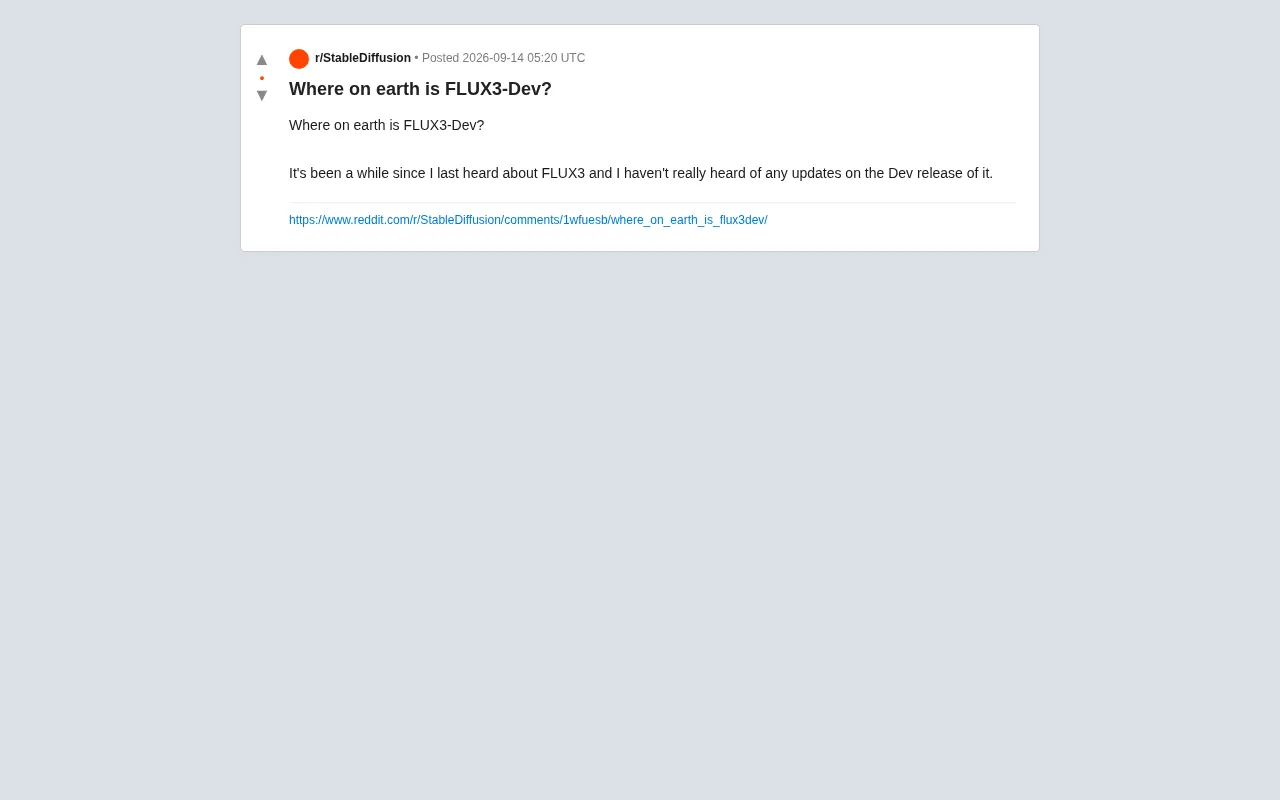
The post itself carries little concrete information, but it reflects a widespread anxiety in the open-source AI image generation community: when a highly anticipated model goes quiet, users are left in an information vacuum, piecing together progress from speculation and scattered rumors.
Why the FLUX Dev Version Matters So Much
The FLUX series, developed by Black Forest Labs, quickly established itself as a major alternative to Stable Diffusion in the open-source community, thanks to its strong image quality and relatively open licensing approach. Versions labeled "Dev" typically refer to weights released for developers and enthusiasts — designed for local deployment, fine-tuning, and customization — which sets them fundamentally apart from commercial APIs or closed-source releases.
For local deployment users and downstream developers, access to the Dev version directly determines whether they can integrate the latest model into their workflows, train LoRAs, or build custom applications. As a result, the release cadence of each Dev version is something a large number of creators watch closely.
Possible Reasons Behind the Silence
While the original post received no official response, a few common industry patterns could explain why a model seems to "disappear" or face delays:
- Shifts in release strategy: Vendors may prioritize commercial or API versions to secure revenue before deciding whether to release open-source Dev weights.
- Licensing and compliance considerations: Image generation models face complex issues around copyright and content safety, which can delay or restrict open-source plans.
- Naming and version confusion: The community's use of "FLUX3" may not align with the official roadmap — the version users are anticipating may not yet be formally planned, or it may be released under a different name.
It's worth emphasizing that these are speculative explanations based on industry norms. The original post provided no definitive official information.
What This Means for the Community
Posts like this serve as a reminder that the sustainability of open-source models depends not only on technical capability, but also on the transparency of communication between developers and the community. Without a clear roadmap, users can easily oscillate between anticipation and disappointment.
For readers following FLUX's development, the best approach is to monitor Black Forest Labs' official channels directly for authoritative updates, rather than being misled by community rumors. Until an official statement is made, whether FLUX3-Dev exists and when it might launch remains an open question.
Related articles

LLM Application Development: A High-Paying Career Guide for Ordinary People
LLM application development offers fresh graduates up to 35K/month, with SP offers reaching 600K. This article explains the core skills, how to break in, and how ordinary people can seize AI opportunities through learning by doing.

Say Goodbye to AI Influencer Faces: A Complete Guide to Creating Visual Assets for AI Comic Dramas from Scratch
Bilibili creator shares a full workflow for zero-basics AI comic drama visual assets: use Doubao Work skills with script-first, visual references, and real-person texture to escape AI influencer faces, then lock character and scene consistency with asset sheet layouts, weapon detail images, scene nine-grids, and cinematic color palettes.

The AI Production Pipeline Behind Great Videos: From Research to Agent Validation
AI video production isn't just a model race. This article breaks down a transferable four-step pipeline: researching professional workflows, organizing a skill checklist, configuring agents, and experimental validation—and explains how general-purpose LLMs like DeepSeek can replace paid tools to run the entire process.