Why Did Nvidia's Security Team Fail? Leak Incident Sparks Corporate Security Reckoning

Nvidia's security chief departed and the CEO resigned over China chip connections, exposing corporate security blind spots.
Nvidia's security chief quietly left in August, then CEO Jensen Huang resigned over connections with an executive of a company suspected of shipping chips to China. A former intelligence official noted such leaks hide in everyday conversations and social relationships—not traditional hacks—and most corporate security teams lack safeguards. The article analyzes Nvidia's geopolitical and governance challenges under export controls, noting over-focus on technical defense and neglect of human engineering, and recommends awareness training, intelligence analysis, reporting mechanisms, and compliance reviews, while elevating security teams to strategic decision-making.
Title
Why Did Nvidia's Security Team Fail? Leak Incident Sparks Corporate Security Reckoning

Meta Description
Nvidia's security chief quietly departed in August, and CEO Jensen Huang resigned due to connections with executives of a company suspected of shipping chips to China. A former intelligence official points out that leaks hidden in everyday conversations are a corporate security blind spot, and tech companies need to reassess their security strategies.
Article Content
Nvidia has recently been thrust into the spotlight over a leak incident: its security chief quietly departed in August, and subsequently CEO Jensen Huang resigned due to connections with an executive of a company suspected of shipping chips to China. A former intelligence official noted that such leaks are precisely hidden in everyday conversations, and most corporate security teams are ill-equipped to guard against such risks. This incident not only exposes vulnerabilities in Nvidia's internal security management but also sounds an alarm for the entire tech industry.
Incident Recap: Security Chief's Departure and CEO's Resignation
According to the original report, Nvidia's security chief quietly left in August, a change that did not attract much outside attention. However, as CEO Jensen Huang resigned due to relationship issues—including connections with an executive of a company suspected of participating in chip shipments to China—the incident quickly escalated. Huang's resignation coinciding in timing with the security chief's departure suggests a systemic failure in internal security management.
The former intelligence official's comments pinpoint the core of the problem: such leaks are not traditional hacker attacks or data theft, but occur through soft channels such as everyday conversations and social relationships. Corporate security teams typically focus on technical defenses like firewalls and intrusion detection systems, but struggle to capture the flow of sensitive information in interpersonal interactions.
Human Engineering is a branch of information security that focuses on understanding human behavior, cognitive biases, and social interaction patterns to identify and prevent security risks. Unlike traditional "social engineering attacks" (such as phishing emails or impersonation calls), human engineering places greater emphasis on information flow within organizations: executives' casual chats at social events, informal exchanges between meetings, and private conversations at industry summits can all become channels for sensitive information leakage. This concept originates from the intelligence community's research on "human intelligence" (HUMINT), emphasizing that the establishment and maintenance of interpersonal relationships can itself constitute a vehicle for information transfer. For positions involving export controls, M&A transactions, or technical secrets, companies need to incorporate human engineering into their risk assessment frameworks, identify key personnel's social relationship networks, and establish appropriate compliance boundaries for their informal communication scenarios.
Leaks in Everyday Conversations: The Blind Spot in Corporate Security
The former intelligence official emphasized that such leaks "run through everyday conversations," meaning sensitive information may be transmitted through seemingly harmless exchanges—meeting small talk, social events, or even informal communications. For a chip giant like Nvidia, where sensitive topics such as export controls to China are involved, any informal information flow could constitute a compliance risk.
Most corporate security teams lack training and tools for such risks. Traditional security measures focus on network perimeters and endpoint protection, while precautions at the human engineering level are often overlooked. Security teams may lack the authority to monitor executives' social relationships and the intelligence analysis capabilities to identify potential conflicts of interest or improper associations.
Nvidia's Predicament and Industry Implications
As a leader in AI chips, Nvidia's security incident has a demonstration effect. The CEO's resignation due to personal relationships not only affects corporate governance stability but may also trigger stricter scrutiny from regulators over chip export controls. The incident highlights the geopolitical risks tech companies face in global operations and the complexity of internal security governance.
From an industry perspective, this incident reminds companies to reassess their security strategies: security teams should not be limited to technical defenses but also need capabilities in intelligence gathering, background checks, and social relationship analysis. Meanwhile, executive codes of conduct and conflict-of-interest management should become important components of the security framework.
Chip export controls are key to understanding the geopolitical context of this incident. Since 2022, the United States has imposed export restrictions on advanced computing chips (such as Nvidia's A100 and H100 series) to China, further tightening rules in 2023 to require companies to obtain licenses before selling high-performance AI chips to Chinese customers. Nvidia has specifically launched "downgraded" products (such as H800 and A800) that meet control thresholds, but still faces ongoing regulatory pressure. Consequences of violating export controls include hefty fines, criminal liability, and revocation of export licenses. Against this backdrop, any association between corporate executives and third-party companies suspected of participating in chip transshipment to China could trigger an investigation by the U.S. Department of Commerce's Bureau of Industry and Security (BIS). This is why the CEO's personal relationship issues quickly escalated into a corporate governance crisis—it directly touches compliance red lines rather than being a mere internal personnel change.
How Companies Can Prevent "Everyday Conversation" Leaks
To close this blind spot, companies can take action at multiple levels:
- Enhance security awareness training: Help employees understand that sensitive information may be inadvertently disclosed in everyday communications, especially when topics involve export controls, M&A, and similar matters.
- Build intelligence analysis capabilities: Security teams need to introduce background check and relationship network analysis tools to identify potential risk associations of executives and key employees.
- Improve internal reporting mechanisms: Encourage employees to report suspicious communications and ensure the confidentiality of reporting channels.
- Strengthen compliance reviews: Implement stricter due diligence and approval processes for business dealings involving sensitive regions (such as China).
In the Nvidia incident, the security chief's departure may be only the surface; the deeper problem is that the security function has been marginalized. Companies need to elevate security teams to the strategic decision-making level and give them sufficient authority and resources to effectively address increasingly complex security challenges.
Conflict-of-interest management is an institutional arrangement in corporate governance closely related to security leaks. Conflicts of interest refer to situations where employees' or executives' personal relationships, financial interests, or external positions may conflict with company interests. A mature conflict-of-interest management system requires key personnel to regularly declare external relationships, investment holdings, and family members' positions, with the compliance department assessing potential risks. For high-tech export companies, this system also needs to cover "related-party transactions" and "third-party due diligence," i.e., background screening of partners, agents, and customers to confirm whether they involve restricted entities or sanctioned parties. The Nvidia incident shows that when executives' social relationships are not included in conflict-of-interest declarations and reviews, personal informal associations can evolve into company-level compliance vulnerabilities. Embedding relationship network analysis into the conflict-of-interest management process is an institutional lever for closing the "everyday conversation" leak channel.
Conclusion: Reassessing the Value of Security Teams
Nvidia's leak controversy is not just an isolated incident but a challenge to the corporate security function. When leaks occur in everyday conversations, security teams that still cling to technical defense lines are doomed to fail. The former intelligence official's comments get straight to the point: most corporate security teams are underprepared for such risks. For tech companies, redefining the boundaries of security teams' responsibilities and integrating technical defense with intelligence analysis may be the key to avoiding the next "Nvidia-style" predicament.
One-line Summary
Nvidia's security chief departed and the CEO resigned over China chip connections, exposing corporate security blind spots.
Paragraph Summary
Nvidia's security chief quietly left in August, and subsequently CEO Jensen Huang resigned due to connections with an executive of a company suspected of shipping chips to China, causing the incident to quickly escalate. A former intelligence official pointed out that such leaks are not traditional hacker attacks but hidden in everyday conversations and social relationships, and most corporate security teams are ill-equipped to guard against such risks. The article analyzes the geopolitical and governance challenges Nvidia faces under export controls, noting that corporate security focuses excessively on technical defense while neglecting risks at the human engineering level. It proposes enhancing security awareness training, building intelligence analysis capabilities, improving reporting mechanisms, and strengthening compliance reviews, and emphasizes that security teams should be elevated to the strategic decision-making level, integrating technical defense with intelligence analysis.
Related articles
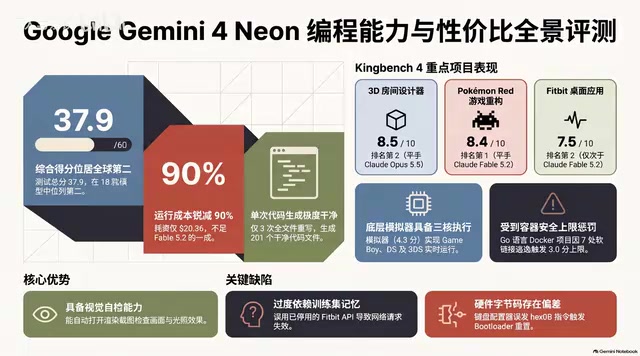
Gemini 4 Neon Hands-On: Value King or Confident Catastrophe?
Gemini 4 Neon review: 1M-token context, four thinking levels, 201 files in one KingBench4 pass at one-tenth Fable 5.2's cost—but it hallucinates fake data, leaves 7 symlink escapes, and bricks keyboards.

Google Gemini 4 Neon Hands-On: 6 3D Works That Impress and Fail
Hands-on with Google Gemini 4 Neon on a 3060 laptop: 6 3D works tested. Sunshower Fishing Harbor and mechanical keyboard impress; soft-body physics and faces fall short.

Gemini 4 Neo Web Novel Writing Test: Faint AI Flavor, Textured Dialogue
Bilibili creator's first-look review of Gemini 4 Neo for Chinese web novel writing: testing a Three Kingdoms transmigration opening with faint AI flavor, emotionally textured dialogue, and strong crisis building, plus comparison of 4A/4H/4C models and full workflow demos.