Why Is Pi Agent Going Viral? A Minimalist Core and Extensible New Approach to AI Coding

With a minimalist core and extensible foundation, Pi Agent enters the AI coding tools space by "subtracting."
The article analyzes why Pi Agent has gained sustained attention on GitHub. Mainstream AI coding tools keep stacking features such as MCP, Skills, sub-Agents, and sandboxes, leading to context bloat and slower requests, with iteration driven partly by competitor benchmarking rather than real needs. Pi Agent goes the opposite way: the core keeps only basic capabilities, moving heavy mechanisms to the plugin and extension layer—"minimalist but not weak"—and returns control to developers as a foundation for custom agents. The article also notes its trade-offs: heavy capabilities require self-configuration, suiting developers with customization needs rather than those seeking out-of-the-box convenience.
The AI coding tools space never lacks new players, but most products follow the same path: pile on more features, add heavier context. Pi Agent goes the opposite way—it chooses to "subtract." This decision has earned it sustained and significant attention growth on GitHub, and has led many developers to rethink: do we really need an agent that can do everything?
The "Feature Bloat" Dilemma of Mainstream AI Coding Tools
Open any mature AI coding tool and you'll likely see a long capability list: tool calling, MCP integration, Skill mechanisms, main Agent and sub-Agent division, task planning, permission management, sandbox isolation… each item has value on its own, but once integrated together, a practical problem surfaces: the more features and tools there are, the larger the context for back-and-forth communication. Context bloat directly slows down request speed, and the impact on daily development experience is real.
More critically, these tools have already formed competitive relationships with each other. You have MCP, so I need it too; you ship a new capability, so I need to do something "better." Part of the product iteration drive comes from benchmarking against competitors rather than developers' real needs. The result is that a developer who just wants to read files, modify code, and run commands is forced to learn a whole set of complex rules and interaction patterns.
According to analysis by a Bilibili creator, this is exactly the gap Pi Agent taps into: what a large number of developers actually need is a lightweight agent, not a heavy platform with everything built in.
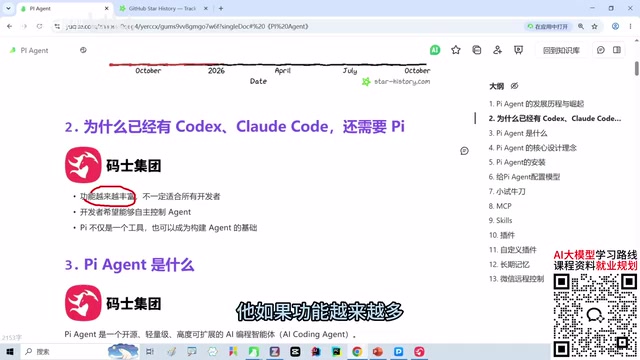
MCP (Model Context Protocol) is a standardized protocol proposed and open-sourced by Anthropic for letting large language models connect to external tools, data sources, and services in a unified way. In AI coding tools, MCP is often used to connect resources such as file systems, databases, and API documentation, enabling agents to obtain context on demand. Its value lies in standardizing "tool integration" so every product doesn't reinvent the wheel. But MCP also means more tool descriptions, longer system prompts, and more frequent round-trip calls, all of which count toward context overhead. Therefore, there is a direct relationship between the number of MCP integrations and context bloat, which is the technical background behind the article's point that "the more tools there are, the larger the context for back-and-forth communication."
Skill mechanisms usually refer to encapsulating the operation flow, prompt templates, and tool combinations of a certain task type into reusable "skill packs," which the agent loads when needed. Compared with directly exposing all tools, Skill mechanisms can improve task execution stability, but the skill descriptions themselves, trigger conditions, and loading logic also consume context. When multiple Skills coexist, the agent needs to decide at runtime which one to call, which increases decision cost. Understanding this helps clarify the chain behind mainstream tools: "the longer the capability list, the heavier the context burden."
Minimalist Core: Keep Only What Everyone Needs
Pi Agent's design philosophy can be summed up in one sentence: the core should be simple, reliable, and stable enough, while other capabilities are extended on demand. Tool calling, file reading, code modification, and command execution—the basic capabilities that nearly every scenario depends on—are kept in the core; heavier mechanisms such as task planning, permission systems, and sandboxes are moved outside and introduced on demand through plugins and extension mechanisms.
This approach forms a sharp contrast with the "everything-in-one" path of mainstream products. It should be emphasized that minimalism does not mean weak functionality. What Pi Agent does is move complexity from the core to the extensible layer, not cut capabilities. For developers, this means lower onboarding cost and less cognitive burden, while retaining room to grow upward.
Looking at the GitHub star history trend, this project did not go viral in a single burst; instead, it went through multiple stages—slow accumulation early on, then takeoff, then sustained acceleration—showing a pattern of continuous attention growth. This kind of curve usually indicates one thing: the project hit a real pain point for a certain group of developers, rather than being a flash in the pan driven by topic marketing.
Sandbox isolation is a runtime security mechanism that restricts the code and commands executed by an agent to a controlled environment, preventing it from accidentally deleting files, accessing sensitive data, or damaging the host machine. Mainstream heavy platforms usually include sandboxes so developers can get security guarantees without worrying about the underlying implementation. But sandboxes also bring extra complexity: managing file mounts, network policies, and resource quotas, and some operations may be restricted inside the sandbox. Pi Agent moves the sandbox to the external extension layer, meaning developers can choose the isolation solution that suits their environment, but they also need to take responsibility for configuration themselves—this is a concrete manifestation of "minimalism has a cost."
Developer Autonomy: The Agent Is a Tool and Also a Foundation for Building
Pi Agent's second core proposition is developers' autonomous control over the agent. When using mature commercial AI coding tools, developers often need to follow the product's preset rules, extension methods, and interaction flows, and customization needs beyond this framework are hard to implement elegantly.
Pi Agent returns control to developers: you can extend plugins yourself, customize tools, and write commands to handle specific events and workflows, without relying on the capability boundaries preset by the product. In the Bilibili creator's words, Pi Agent is not just a tool; it can also become a foundation for building agents—first give you a stable base, and whatever capabilities you need can grow outward from that base.
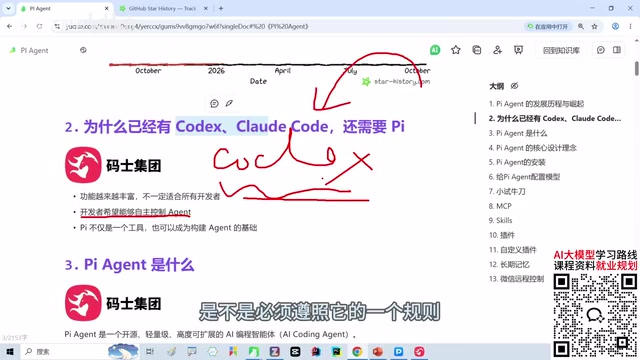
This positioning leads to an interesting inference: Pi Agent's functionality being "less than competitors" is precisely one of the reasons it attracts attention. In an era when AI coding tools are highly homogenized, choosing fewer, more refined, and composable features instead constitutes differentiated competitiveness. For developers who want to embed agent capabilities into their own workflows without being locked into a single product or team, the value of this open foundation will amplify as usage deepens.
The Trade-offs of the Lightweight Path
Objectively speaking, the minimalist core path also has its costs. Capabilities such as sandboxes, permission management, and task orchestration built into heavy platforms need to be configured by developers themselves or rely on community plugins in the Pi Agent ecosystem, which is not a low barrier for users who don't want to tinker. In other words, Pi Agent is better suited to developers who are willing to control their tools and have clear customization needs; if you expect a complete out-of-the-box solution, mature commercial products may still be the more worry-free choice.
But the trend is already clear: as the feature race among AI coding tools enters a stage of diminishing marginal returns, differentiation in design philosophy will once again become the dividing line. Pi Agent proves through sustained attention growth that the subtraction path has real demand among developers.
One-line Summary
With a minimalist core and extensible foundation, Pi Agent enters the AI coding tools space by "subtracting."
Paragraph Summary
The article analyzes why Pi Agent has gained sustained attention on GitHub. Mainstream AI coding tools keep stacking features such as MCP, Skills, sub-Agents, and sandboxes, leading to context bloat, slower requests, and iteration driven partly by competitor benchmarking rather than real needs. Pi Agent goes the opposite way: the core keeps only basic capabilities such as tool calling, file read/write, and command execution, while moving heavy mechanisms like task planning, permissions, and sandboxes to the plugin and extension layer—achieving "minimalist but not weak." It also returns control to developers and can serve as a foundation for building custom agents. The article also points out its trade-offs: heavy capabilities require self-configuration, making it more suitable for developers with customization needs rather than users seeking out-of-the-box convenience.
Related articles
Claude Code Quota Always Running Out Early? 7 Tips to Make It Last Longer
Claude Code quota running out early? Seven practical tips: use slash clear when switching tasks, choose Sonnet or Opus per task, lower the effort level, trim CLAUDE.md, disable unused MCP servers, plan first in plan mode, and use slash usage to pinpoint consumption—so your quota lasts longer.

Cursor Multi-Agent Collaboration: Watching AI Design Websites from a Browser Extension
A YouTube short shows multi-cursor AI agents collaboratively designing a website in a browser, delivered as a browser extension rather than a standalone platform. This article sorts out the demo's key details, information gaps, and the multi-agent collaboration trend it reflects.

Voice Cursor Hands-On: The AI Voice Dictation Tool That Lets You Write Code With Your Mouth
Voice Cursor is an AI voice dictation tool that supports voice input followed by command-based rewriting, tone adjustment, translation, and per-app tone configurations. This hands-on demo analyzes its differences from WhisperFlow and its use cases.