Why Is the AI Coding Productivity Gap So Large? Lessons from 50 Amazon Teams

Amazon's 50-team experiment reveals: the AI output gap stems from working methods, not models or compute.
Through a controlled experiment with 50 Amazon teams, the article shows that with the same AI tools, output improvements range from under 3x to over 10x, with the difference coming entirely from working methods. High-performing teams share five habits: systematically organizing context for AI, slowing down first to refactor codebases and feedback mechanisms, letting Agents run autonomous loops, writing specs before code, and improving testing and local feedback loops. Compute and capital are not decisive, and small teams can replicate the results; continued model progress will further amplify the methodology gap. The takeaway: merely layering AI onto existing processes yields limited returns—restructuring the development lifecycle is what delivers exponential gains.
The Gap Between Promise and Reality
Over the past two years, developers have been told repeatedly: AI will make you a 10x engineer. But the reality is that with access to the same LLMs and tools, some people achieve less than a 2x productivity gain, while others commit a large number of high-quality PRs to real production codebases within a month. Where does the gap come from?
A tech blogger reviewed multiple studies and enterprise cases and found that the answer is not the model itself, but whether teams have restructured the way they work around AI.
Amazon's 50-Team Controlled Experiment
The most striking evidence comes from an internal Amazon experiment. They selected 50 ordinary teams working on existing systems (not building from scratch), with a normal mix of junior to senior engineers, all equipped with the same AI tool (Kiro). Throughout the observation period, teams were encouraged to explore freely.
The results diverged dramatically: about half the teams improved output by less than 3x; the median was about 4.5x; and some teams exceeded 10x. The key point is that these teams used exactly the same models and toolchain, so the difference could only come from working methods.
According to the interview analysis cited by the blogger, high-performing teams shared five habits, while laggards merely "sprinkled" AI tools onto their existing processes without changing any ingrained habits.

Five Key Habits: From "Using Tools" to "Restructuring Processes"
Habit 1: Write everything down and feed it to AI
High-performing teams systematically organize all information scattered across Slack, code review comments, and even engineers' heads into skill files or steering files as context for AI. More importantly, whenever the Agent makes a mistake, they don't blame the model—they ask: "What information did I miss?"—and continuously refine the context. As model capabilities improve, they also proactively trim unnecessary rules to avoid context overload.
Today, by connecting Agents directly to data sources such as code review systems and Slack channels, teams can provide context more dynamically without manually moving all content.
Habit 2: Slow down first and lay a solid foundation
All excellent teams went through a "slow down first" phase. They spent time building MCP servers, fixing error messages so the model could accurately understand failures, and refactoring codebases to improve AI navigability. Some teams even migrated languages to TypeScript or Rust, using type checking and compilers to give Agents immediate feedback and reduce manual back-and-forth.
This upfront investment paid off with exponential acceleration later.
MCP (Model Context Protocol) is an open protocol launched by Anthropic in late 2024 to standardize how AI models connect to external data sources and tools. You can think of it as the "USB-C port" for AI applications: whether the underlying system is a code repository, database, or monitoring system, as long as an MCP server is implemented, the model can read context or invoke operations in a unified way. For development teams, building MCP servers means wrapping internal systems (such as ticketing systems, logging platforms, and CI pipelines) into capabilities that Agents can access directly, eliminating the need to manually paste information each time. The core problem it solves is the standardization and automation of context supply, which is the engineering extension of high-performing teams' "write everything down and feed it to AI."
Habit 3: Don't be a "babysitter"—let the Agent loop autonomously
The core action that separates the best from the rest is: don't respond to the Agent's individual tasks every few dozen seconds. Top teams manually write only a tiny fraction of the code; everything else is handed to the Agent to run in long loops—compile, test, fix errors, test again—until all checks pass before reporting back.
When humans become the bottleneck, the output ceiling is locked. And multiple Agents working in parallel further amplifies this advantage.
"Agent autonomous looping" means letting the AI agent repeatedly execute the closed loop of "generate code → compile → run tests → read errors → fix" unattended until all checks pass or a termination condition is reached. The opposite is the "human-AI ping-pong" mode: a human checks the Agent's output every few dozen seconds and gives the next instruction. The bottleneck of the latter is human response speed, while the efficiency of the former depends on the quality of feedback signals and the degree of loop automation. Implementing autonomous loops usually requires three conditions: automatically executable verification methods (compilers, type checking, test suites), clear success criteria (all tests pass), and Agent framework support for multi-turn tool calls. Multiple Agents in parallel means assigning multiple independent tasks to different agents to loop simultaneously, further breaking through the single-threaded output ceiling.
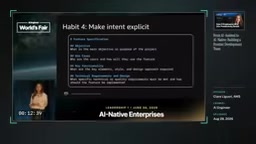
Habit 4: Write the spec first, then the code
Before letting AI generate code, high-performing teams first describe their intent with clear, specific, but not overly verbose specifications. This is in line with the spec-driven development long practiced by Amazon engineers and is also built into the Kiro tool. This avoids repeated debates over implementation details after code generation, reducing rework and token consumption.
Spec-Driven Development is a methodology that first precisely describes "what to do, what the constraints are, and what the acceptance criteria are" in structured documents, and then hands it to humans or AI for implementation. In AI coding scenarios, the role of specs is especially critical: it transforms vague requirements into clear instructions that the model can execute, reducing repeated clarification and rework after generation. A good spec usually includes functional boundaries, input/output examples, error handling conventions, and non-functional constraints (performance, compatibility), but should avoid excessive length that causes context overload. The "six-page memo" culture long practiced by Amazon engineers has the same origin—replacing verbal discussion with clearly written documents—and tools like Kiro build spec templates directly into the workflow, making specs a prerequisite step for code generation rather than post-hoc documentation.
Habit 5: Improve testing and local feedback loops
They ensure the test system is robust enough for the Agent to go beyond compilers and type checking, run all tests, and pass the full pipeline. In addition, teams simulate all services locally with deterministic responses, enabling the Agent to complete all verification on a laptop without relying on cloud services. The faster the feedback loop, the more iterations the Agent can perform, and the higher the output quality.
Compute and Capital Are Not Decisive Factors
Some may argue: Amazon has nearly unlimited compute, so of course it gets better results. But the blogger points out that if you just throw money at inference and tokens without changing working methods, this level of improvement would never occur. In fact, many small teams with only three developers have also achieved impressive output through the above methods.
The evolution of model capabilities also amplifies the value of the methodology. Amazon's experiment took place during the era of earlier models (such as Claude 3.7, 4.0, 4.1), which often had "over-editing" problems in code refactoring. Today's models have evolved significantly, and the same methodology will only yield higher returns.
Claude 3.7, 4.0, and 4.1 are model versions released by Anthropic in 2025. The "over-editing" problem mentioned in the article refers to early models' tendency, when performing refactoring tasks, to modify code beyond the scope of instructions—for example, when asked to modify one function, they would also rewrite the style or naming of adjacent modules. This behavior is especially dangerous in large legacy codebases because it introduces unexpected changes that are hard to review. Subsequent models have improved in instruction following and change scope control, making the "spec-first + autonomous loop" methodology more rewarding: the more accurately the model understands intent and restrains the scope of changes, the more obvious the return on upfront investment in specs and tests. This also explains why the same methodology continues to amplify its effects as models evolve.
Implications for Developers
The "10x developer" is not a myth—they are just inconspicuous, because their efficiency comes from systematic methods rather than relying solely on models. If you merely layer AI onto your existing processes without changing codebase structure, task granularity, feedback mechanisms, and context management, your productivity gains will inevitably be limited.
The real dividing line is: are you willing to deliberately slow down at the beginning and restructure the entire development lifecycle for long-term exponential returns?

Future Outlook
Amazon plans to extend this model to more teams to further validate the effects at scale. As models and the tool ecosystem continue to advance, the gap between teams that have laid a solid foundation and those that merely "sprinkle on AI" may only grow wider.
One-line Summary
Amazon's 50-team experiment reveals: the AI output gap stems from working methods, not models or compute.
Paragraph Summary
Through a controlled experiment with 50 Amazon teams, the article shows that when using the same AI tools, team output improvements range from less than 3x to more than 10x, with the difference coming entirely from working methods. High-performing teams share five habits: systematically organizing context to feed AI, slowing down first to refactor codebases and feedback mechanisms, letting Agents run autonomous loops for extended periods instead of manual step-by-step intervention, writing specs before generating code, and improving testing and local feedback loops. The article points out that compute and capital are not decisive factors, and small teams can replicate the results; meanwhile, continued model progress will further amplify the methodology gap. The takeaway for developers is that merely layering AI onto existing processes yields limited returns—only by restructuring the development lifecycle can you achieve exponential returns.
Related articles

Agentic Paper Bomb: Using Multi-Agent Systems to Automatically Generate Enterprise Compliance Documents
A Reddit developer shares the Agentic Paper Bomb experiment: five AI agents play executive roles to auto-generate enterprise compliance, security, and DevOps documents. Explores the potential and concerns of multi-agent collaborative document generation.

Building a Sound Source Localization System with Claude Code to Find a Mysterious Beeping Sound
Simon Willison built Beep Locator with Claude Code: multiple devices as microphones, trilateration pinpointed a mysterious beep to ~40cm, showing how to give coding agents hearing.

Rob Roy Classic Dialogue Analysis: The Price of Leadership and the Choice to Survive
An analysis of the classic confrontation dialogue between Rob Roy and Sibbald in *Rob Roy*, exploring the price of leadership, the balance between survival and dignity, and the human insight behind power games.