Why PostgreSQL Is the Top Choice in the AI Era: A Complete Guide from Beginner to Advanced

PostgreSQL's multi-modal capabilities make it the ideal unified data foundation for AI-era applications.
Drawing on DB-Engines rankings and Stack Overflow's 2025 survey data, this article explains how PostgreSQL has joined the top tier of global databases with over 55% developer adoption. The core argument: in the AI era, databases must support structured data, vector search, full-text search, spatial data, and security governance in a unified system. With extensions like pgvector, PostGIS, PGSearch, and AGE — plus native graph capabilities in PG19 — PostgreSQL uniquely covers all these needs in one platform. The article also outlines a hands-on course for developers, progressing from environment setup and core internals to enterprise operations and AI application development.
Why PostgreSQL Has Become the Data Foundation of the AI Era
In the database world, the DB-Engines ranking has long served as an industry barometer. This index is calculated monthly across multiple dimensions — including search trends, Q&A community activity, job postings, and social signals. According to the latest data, PostgreSQL (PG) has firmly secured the fourth spot in the global database rankings, officially entering the top tier.
Even more noteworthy is its growth trajectory. The gap between PG and third-place SQL Server continues to narrow, with PostgreSQL gaining momentum across ecosystem vitality, extensibility, and developer mindshare. The familiar narrative of "Oracle, MySQL, and SQL Server as the dominant trio" is quietly being rewritten by PostgreSQL.
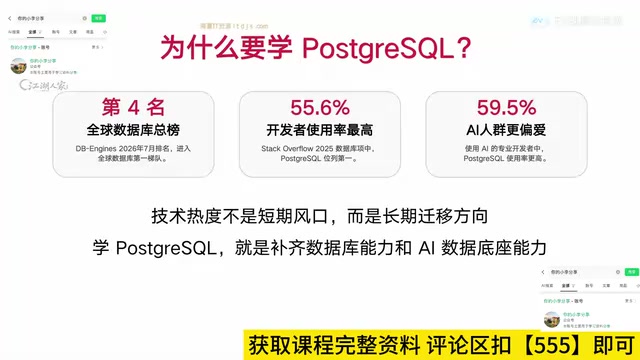
The data backs this up. According to the Stack Overflow 2025 Developer Survey, PostgreSQL's usage rate has reached 55.6% — and among professional developers who use AI tools, that figure approaches 60%. This means PG is no longer a niche technology or a fleeting trend. It has become the core data foundation chosen by a growing number of developers and organizations.
A Fundamental Shift in the Role of Databases
Behind PostgreSQL's rise is a deeper shift in what databases are expected to do. In the past, database conversations centered on storage, querying, transactions, and stability — storing data correctly, retrieving it reliably, and ensuring consistency. That was enough.
But in the AI era, an application must handle far more than ordinary business data. It may simultaneously need to process documents, vectors, full-text search, spatial data, permission governance, and security auditing. In other words, AI applications don't need a plain database — they need an integrated data foundation capable of supporting multiple data modalities, query patterns, and business scenarios.
When AI projects actually reach production, the hard part is rarely the model itself. The real challenges are: how data enters the system, how it gets retrieved, how multi-dimensional joins are performed, how governance is enforced, and how everything runs reliably. PostgreSQL is uniquely positioned to play a critical role at each of these stages.
The "single data modality" constraint of traditional databases is especially painful for AI applications. A typical RAG (Retrieval-Augmented Generation) application needs to handle structured user metadata (relational), semantic embeddings for documents (vector search), keyword matching (full-text search), and potentially geospatial filtering — all at once. Deploying a separate system for each of these needs drives up operational costs, but more critically, it creates data consistency problems: cross-system transaction guarantees are extremely difficult, and synchronization lag directly impacts retrieval accuracy for AI applications. Consolidating these capabilities into a single PostgreSQL foundation means you can perform multi-dimensional filtered queries with standard SQL in a single pass, while benefiting from unified transaction guarantees and access control — an advantage that distributed architectures struggle to replicate.
PostgreSQL: The "Hexagon Warrior" of the AI Era
From a capability standpoint, PG is more like a generalist champion. At its core, it's a mature, battle-tested relational database with decades of history, offering SQL, transactions, indexing, constraints, MVCC, WAL, and high-availability replication.
What truly sets it apart is its remarkably powerful extension ecosystem:
- Structured data: PG's home turf — a natural advantage;
- Spatial data: PostGIS is virtually the industry standard; many developers first discovered PostgreSQL through PostGIS;
- Full-text search: Built-in
tsvectorsupport, plus plugins like PGSearch that bring modern BM25-style search engine capabilities; - Vector search: pgvector is widely adopted, with additional options like DiskANN and pgvectorscale;
- Graph search: Available via the AGE plugin, and PG19 introduces native Property Graph capabilities.
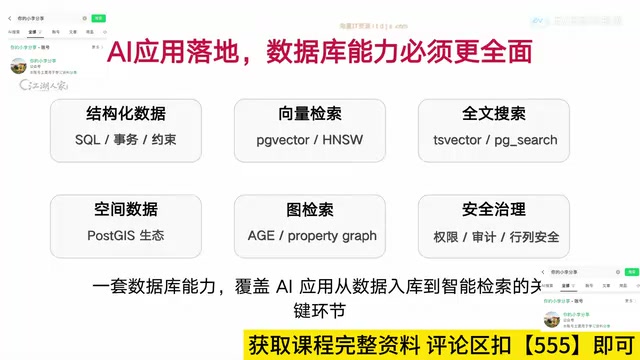
On the security and governance front, PG provides built-in mechanisms for access control, auditing, row- and column-level security, and data masking policies — meeting the stringent stability and security requirements of enterprise deployments.
PG's core value isn't simply that it "can act as a database." It's that it combines structured data, full-text search, vector search, spatial data, security governance, and high availability into a single, coherent data foundation — and that is precisely its competitive edge in the AI era.
pgvector is an open-source vector extension for PostgreSQL that allows high-dimensional float arrays ("embedding vectors") to be stored as a native column type and queried with approximate nearest neighbor (ANN) search. Its significance is clear: once a large language model converts text, images, or code into vector representations, pgvector lets you perform similarity search directly within PostgreSQL — eliminating the need to deploy a separate vector database like Pinecone or Milvus, along with all the associated cost and architectural complexity. MVCC (Multi-Version Concurrency Control) is PG's core mechanism for handling concurrent reads and writes. Rather than overwriting data on each write, it creates a new version, while reads always access a consistent snapshot — preventing read-write contention. This keeps PG performant under the high-concurrency demands of AI inference services. WAL (Write-Ahead Logging) is the foundation of PG's durability and high availability: all data changes are appended to a log before being written to disk, ensuring crash recovery and serving as the data source for both streaming and logical replication.
Course Learning Path
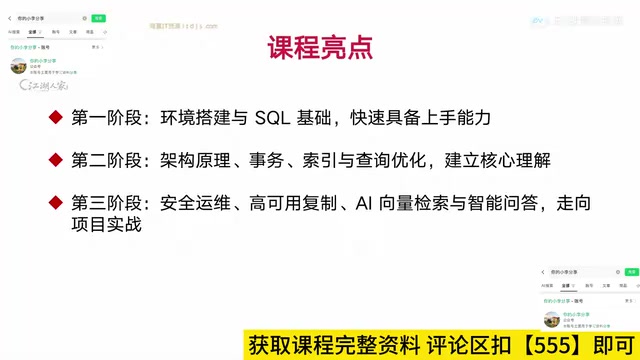
This PostgreSQL hands-on course isn't about memorizing a handful of commands or stacking up theoretical concepts. The goal is to help learners build a complete, practical skill set applicable to real-world projects. The curriculum is structured in three parts:
Part 1: Building the Environment from Scratch
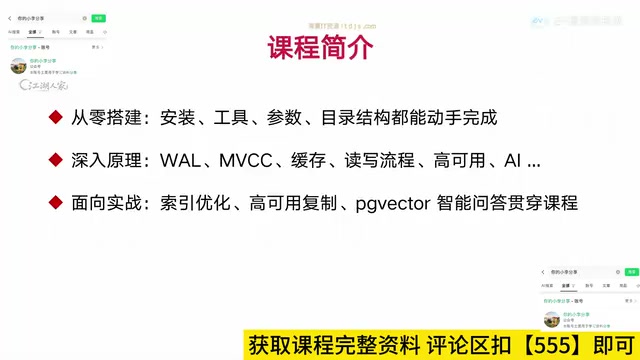
For many people, the first obstacle in learning a database is just getting it to run — the environment won't set up, the tools are confusing, or configuration options are opaque. This section covers PG installation and deployment from zero, walks through essential tooling, common configuration parameters, and directory structure, so you can get up and running and start hands-on practice right away.
Part 2: Core Internals
With the environment in place, the course dives into core internals: WAL, transaction mechanisms, index internals, and query plan analysis. Understanding the "why" means you'll know how to diagnose problems when they arise, not just follow steps blindly.
Part 3: Enterprise-Grade Practical Skills
The final section covers real-world scenarios: index optimization, slow query diagnosis, backup and recovery, security and permissions, and high availability. AI-related capabilities — including vector search, graph queries, and intelligent Q&A — are woven into the main curriculum, so learners not only master traditional PostgreSQL but also understand how it powers AI applications.
Who Is This Course For?
The course instructor has nearly a decade of deep expertise in PostgreSQL, is the Chinese translator of PostgreSQL 14 Internals, and is an active contributor to the "Postgres How-to in Chinese" project — bringing both internals knowledge and extensive best-practices experience.
The course is primarily designed for three audiences:
- Learners with basic computer skills who want to master the database of choice for the AI era;
- Engineers who work with database development and operations day-to-day;
- AI application developers, or anyone who needs to understand vector database principles and the data capabilities behind intelligent Q&A systems.
The learning path progresses from environment setup and SQL fundamentals, through architectural internals, transactions, and indexing, all the way to optimization, operations, and AI application development. The emphasis throughout is practice-driven — every key concept is paired with real commands, examples, and live demonstrations, so you understand not just how to do something, but why it works that way.
The ultimate goal is to take learners from "knowing how to use a database" to "truly understanding how to use a database well" — grasping the internals, optimizing with confidence, running it in production, and applying it directly to AI applications. For developers looking to round out their data skills in the AI era, building a solid, systematic command of PostgreSQL is an investment that will pay dividends for years to come.
Related articles

Google Releases Gemini 4 Carbon: Its Strongest Model Yet, Debuting with a Cybersecurity Focus
Google releases Gemini 4 Carbon, calling it its strongest model, with a cybersecurity focus. It tops the third-party composite ranking at 59 points but leads by only one or two. This article analyzes its security test results, staged rollout, token pricing, and the divergence between self-reported and third-party tests on hallucinations.

LangChain Adds SchemagateRetriever: On-Demand Table Retrieval Cuts Text-to-SQL Prompts by 92.9%
LangChain docs add SchemagateRetriever: retrieves only the tables needed for text-to-SQL with permission filtering, cutting median prompt size by 92.9% on Spider 2.0 large schemas via offline BM25 selection with no model calls.

Multi-Step AI Agent Guardrail in Practice: Fact-Change Detection Drives False-Alarm Rate to 0%
Developer shares first version of a multi-step AI Agent guardrail: re-verifying dependency facts before irreversible actions cut false alarms from 50% to 17% across 23 scenarios, then to 0% via conservative normalization without lowering catch rate. Runs on local qwen2.5-7b.