Will the Next Generation Never See a Real Video? The Trust Crisis in the Age of AI Forgery

AI-forged videos erode evidence credibility, plunging the next generation into a cognitive and educational crisis of indistinguishable true and false.
A parent on Reddit expressed concern that their 5-year-old child will live in an "un-teachable" world, resonating widely. The article notes that the era of video as evidence is ending due to generative AI; people shifted from relying on eyewitness testimony to video evidence, and now video is unreliable too. Children's reactions are polarized: some treat all content as AI-generated, others have no vigilance—hyper-skepticism and blind trust are equally dangerous. The discussion extends from family education to societal levels, where conspiracy theories and distrust may spread. Some propose cryptographic signatures to verify video authenticity, but at the cost of privacy, with no perfect solution yet. Education needs to balance critical skepticism with protecting curiosity about the world.
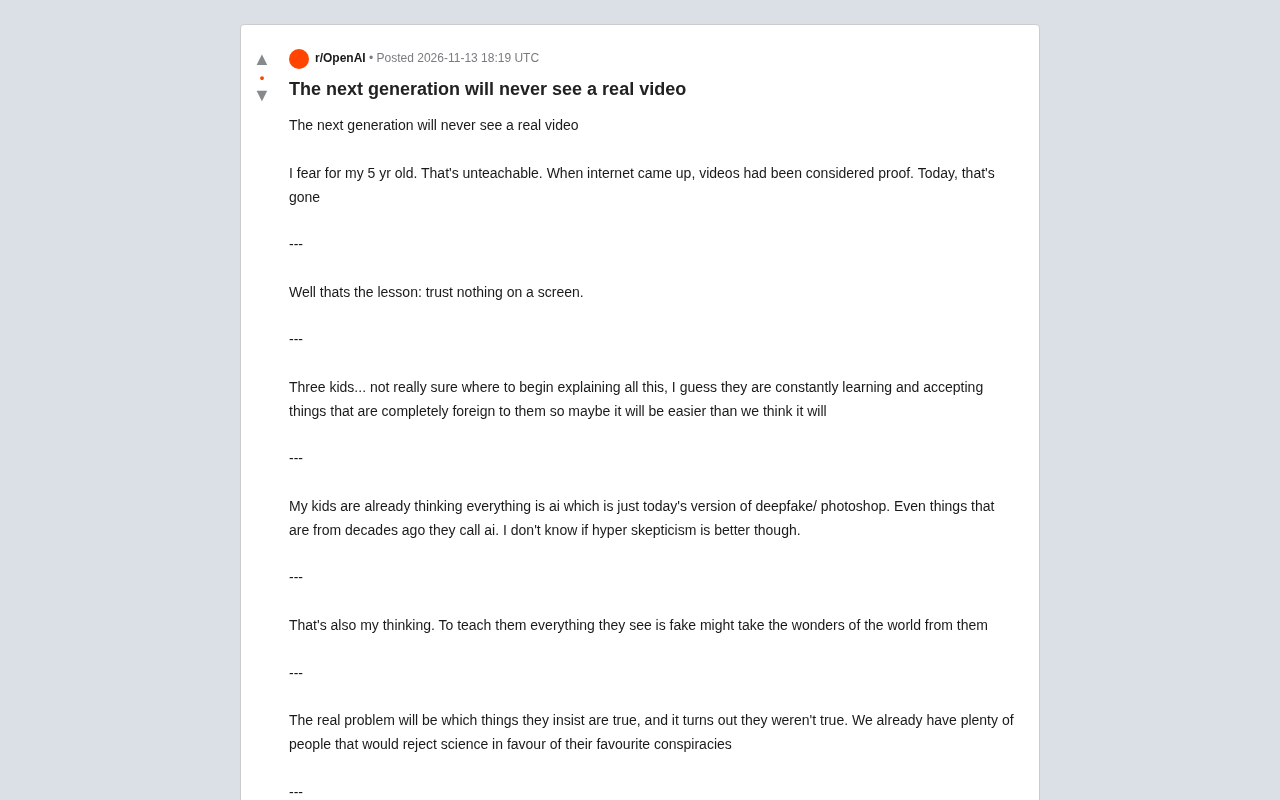
A parent on Reddit posted that they worry their 5-year-old child will live in a world that is "un-teachable." In the early days of the internet, video was treated as evidence; today, that consensus is collapsing. The post resonated widely, with parents in the comments sharing their own confusion: children either treat everything as AI-generated or have no vigilance at all toward what's on the screen. This is not just a technical problem, but a deep crisis about truth, trust, and education.
The Era of Video as Evidence Is Ending
The core anxiety of the post author is straightforward: when AI-generated video becomes hard to distinguish, the next generation will lose a once-reliable cognitive tool. In the early days of internet普及, a video was almost equivalent to fact—people believed "seeing is believing." But today, generative AI has drastically lowered the barrier to creating fake videos, and the credibility of video as evidence is being systematically eroded.
The irony of this shift is that humans had just learned not to over-rely on eyewitness testimony and turned to video evidence instead. One user in the comments accurately summarized this swing: "We went from learning that eyewitness testimony is unreliable to relying on video evidence, and now video evidence is unreliable too." Technology has not made truth easier to obtain; instead, it has made obtaining truth more difficult.
Generative AI refers to models capable of learning patterns from training data and generating entirely new content (text, images, audio, video), such as Generative Adversarial Networks (GANs), Diffusion Models, and large language models. In the video domain, diffusion models generate realistic frame sequences from random noise through progressive denoising, while temporal consistency techniques (such as spatiotemporal attention mechanisms) ensure coherence between frames. Deepfake specifically refers to using autoencoders or GANs to replace a target face into a source video. These technologies have drastically lowered the barrier to forging videos: what once required a professional team and extensive footage can now be generated by ordinary users with consumer-grade GPUs and open-source tools in minutes, producing convincing fake videos. This directly erodes the social consensus that "video is evidence."
Children's Cognitive Confusion: Hyper-Skepticism and Blind Trust Coexist
Multiple parents in the discussion described two diametrically opposed extremes. One parent of three children said that kids are constantly learning and accepting things that are completely foreign to them, perhaps adapting more easily than we imagine. But another parent observed that their child already treats all content as AI-generated—"even things from decades ago, they call AI."
This "hyper-skepticism" is not without cost. Some comments pointed out that teaching children "everything you see is fake" may deprive them of curiosity and wonder about the world. How to find a balance between skepticism and openness has become a new challenge for parents.
Hyper-skepticism in this context refers to a cognitive tendency where individuals presuppose that any information is forged or manipulated rather than trustworthy by default. Unlike healthy critical thinking, hyper-skepticism often lacks rational evaluation of evidence and falls into the nihilism of "everything is fake." For children, this mindset may hinder knowledge acquisition—if all videos are seen as AI-generated, they lose the opportunity to learn from documentaries and news footage. Psychological research shows that children aged 4-7 are in a "trust-sensitive period," and excessive skepticism may inhibit their exploratory motivation, leading to comprehensive distrust of authoritative information sources and affecting the establishment of social trust.
Truth Crisis: From Technical Problem to Social Problem
The discussion quickly extended from family education to broader societal levels. One user pointed out that the real problem is not what children believe, but that they insist certain things are true when they are not. He mentioned that many people already prefer conspiracy theories over science.
When video evidence is no longer reliable, and people lack the tools and consensus to discern authenticity, obtaining truth becomes a social game. One comment stated bluntly: "Technology has made truth unattainable, I always thought it would be the opposite." This sense of loss appears repeatedly in the discussion, reflecting widespread concern about the deterioration of the information ecosystem.
Cryptographic Signatures: Solution or New Privacy Nightmare?
Someone in the discussion proposed a technical idea: for future videos to be trusted, they must be cryptographically signed asynchronously by someone who can publicly prove they are not AI. This solution seems to solve the authenticity problem, but commenters immediately pointed out the cost—"and then the little privacy you have left is gone."
This idea reveals the complexity of the problem: to verify authenticity, anonymity and privacy may need to be sacrificed. Requiring everyone to publicly prove they are not AI creates a sharp contradiction between identity authentication and privacy protection. No one has yet provided a satisfactory answer.
Cryptographic Signature is a mechanism that uses asymmetric encryption technology to verify the authenticity and integrity of information. The sender signs the message (or its hash value) with a private key, and the receiver verifies the signature with the corresponding public key. If verification passes, it confirms that the message indeed comes from the private key holder and has not been tampered with. In the context of video authenticity, if the recording device signs in real-time during recording, it could theoretically prove that the video has not been AI-synthesized or edited. However, this requires devices with built-in trusted hardware and private key management, and verifiers must trust the binding between public keys and real identities—which typically relies on Public Key Infrastructure (PKI) or decentralized identity systems. The difficulty lies in: how to prove that "the private key holder is not AI"? And once a signed video is made public, the signer's identity is exposed, creating a direct conflict with privacy protection.
The Direction of Education: Finding Balance Between Skepticism and Trust
Returning to the initial question: how to explain this world of indistinguishable true and false to children? There is no standard answer in the discussion, but a pragmatic consensus emerges—children will continuously adapt to new environments, and their learning ability may exceed our expectations. The key is that parents need to help children develop critical thinking, rather than simply teaching them "everything is fake."
One parent's reflection is worth considering: teaching children to doubt everything may cause them to lose their wonder about the world. The real challenge is to keep children vigilant about information while protecting their curiosity and trust in the real world. This may be one of the most difficult educational challenges of the AI era.
One-line Summary
AI-forged videos erode the credibility of evidence, plunging the next generation into a cognitive and educational crisis of indistinguishable true and false.
Paragraph Summary
A parent on Reddit expressed concern that their 5-year-old child will live in an "un-teachable" world, resonating widely. The article points out that the era of video as evidence is being ended by generative AI; people shifted from relying on eyewitness testimony to video evidence, and now video is unreliable too. Children's reactions are polarized: some treat all content as AI-generated, others have no vigilance—hyper-skepticism and blind trust are equally dangerous. The discussion extends from family education to societal levels, where conspiracy theories and distrust may spread. Some propose cryptographic signatures to verify video authenticity, but at the cost of privacy, with no perfect solution yet. Education needs to find a balance between critical skepticism and protecting curiosity about the world.
Related articles

Why Microsoft CEO Nadella Still Backs Nvidia After Jensen Huang's Departure
Microsoft CEO Nadella publicly expresses confidence in Nvidia interim CEO Colette Kress. This article analyzes Nvidia's power transition after Jensen Huang's departure, Microsoft's compute dependency, and the trust logic of the AI supply chain.

Nadella: Critical Infrastructure Is 'Unpatchable' as AI Cybersecurity Arms Race Escalates
Microsoft CEO Nadella addresses AI cyberattack fears, saying much critical infrastructure is unpatchable, downplaying the Outlook outage, and analyzing AI's dual role in cybersecurity.

Musk Backs Jensen Huang: Firing Him Is Like Cutting Jordan
Musk says Jensen Huang is loyal to the U.S. and likens firing him to cutting Michael Jordan—highlighting politicization anxieties in the AI chip industry and defending talent value.