Wings: An Open-Source Notion Alternative with Built-in BYOK AI Support
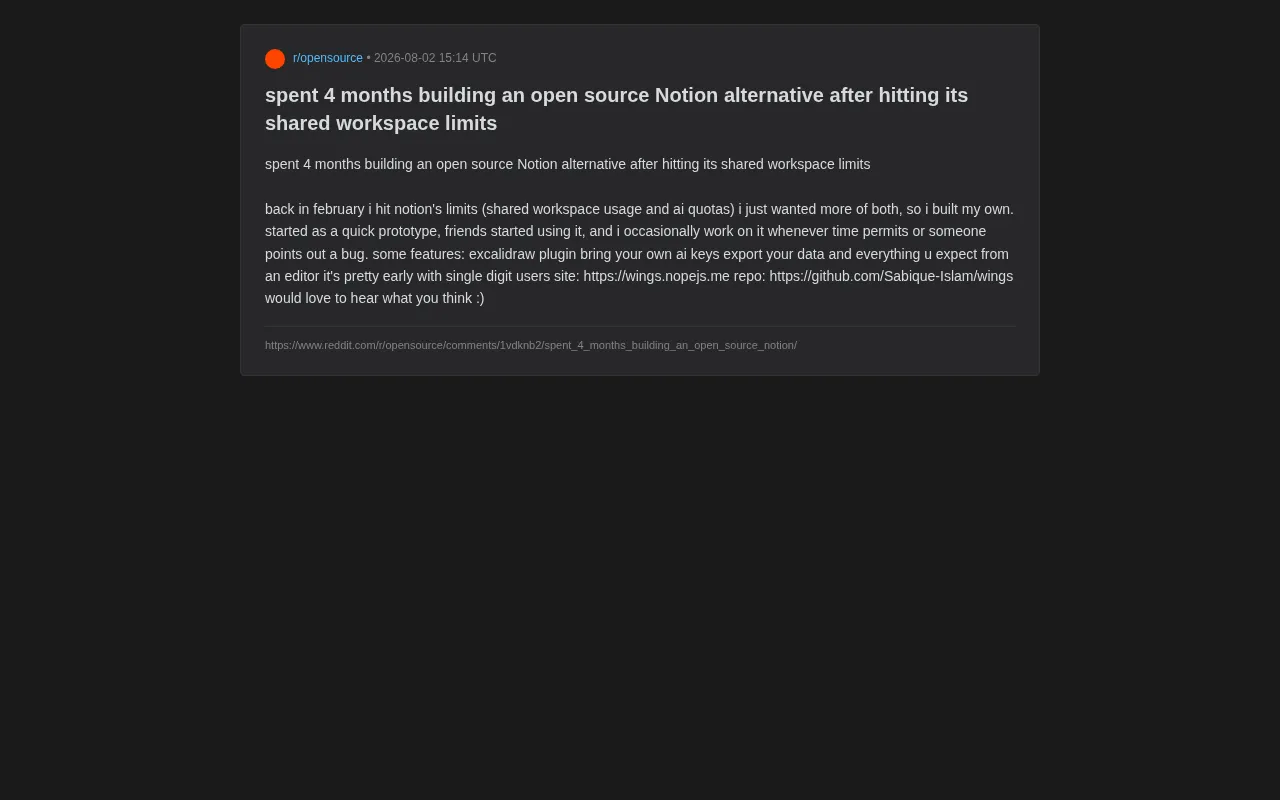
Wings is an open-source Notion alternative featuring BYOK AI keys and integrated Excalidraw whiteboard.
Wings is an open-source note-taking and collaboration tool born from a developer's frustration with Notion's workspace quotas and AI usage limits. Its standout features include BYOK (Bring Your Own Keys) AI integration for cost-transparent model access, embedded Excalidraw whiteboard for visual expression, and fully exportable data. While still early-stage, Wings reflects broader industry trends toward AI commoditization, composable open-source ecosystems, and data sovereignty.
From Personal Pain Point to Open-Source Project
Yet another open-source project born from real-world needs has emerged. In February this year, a developer hit two unavoidable limitations while using Notion: shared workspace usage quotas and AI feature usage caps. Faced with the paywall, instead of upgrading his subscription, he decided to build his own solution.
The project is called Wings, and it evolved from a quick prototype into a continuously iterating open-source note-taking and collaboration tool. According to the author, the growth path has been quite typical: first he used it himself, then friends started using it, and then he spent his spare time fixing bugs and adding features. The user base is still in the single digits at this early stage, but the author has open-sourced it hoping for community feedback.
This "scratch your own itch" development model is exactly how many classic open-source tools got started. From the Linux kernel to Ruby on Rails, from SQLite to Homebrew, a huge number of industry-changing open-source projects began with creators solving their own problems. When commercial products' pricing strategies conflict with personal usage habits, developers often choose to solve the problem with code.
Core Features of Wings
Although it's an early-stage project, Wings already has the essential elements of a modern knowledge management tool and demonstrates an "open-source first" design philosophy in several areas.
BYOK: Bring Your Own Keys Model
This is one of Wings' most noteworthy features. Unlike Notion AI's quota-based, pay-per-use model, Wings adopts a BYOK (Bring Your Own Keys) approach — users can plug in their own AI API keys (such as OpenAI, Anthropic, etc.).
The rise of BYOK is closely tied to the commoditization of large language model APIs. Since OpenAI opened up GPT-3.5/4 APIs in 2023, AI capabilities have become a metered infrastructure service where users pay per token (the basic unit of text processing). Taking GPT-4o as an example, input pricing is approximately $2.5 per million tokens, and output is about $10. For lightweight tasks like AI-assisted writing and summary generation in daily notes, monthly API costs might be just a few dollars — far less than Notion AI's fixed $10/month subscription. This price transparency is changing user expectations around AI feature pricing. Tools like Cursor, TypingMind, and LibreChat have all adopted the BYOK model, forming a disintermediation trend.
The benefits of this design are obvious:
- Cost control: Users pay directly based on actual API usage, avoiding the awkward subscription scenario of "wasting what you don't use, getting throttled when you exceed the limit"
- Model freedom: Users can choose which model to connect to without being locked into a platform
- Privacy control: Data flow is controlled by the user themselves, rather than being routed through a third party
For heavy AI users, the BYOK model is often more cost-effective than fixed-quota subscriptions, directly addressing the author's original pain point of "not enough AI quota."
Integrated Excalidraw Hand-drawn Whiteboard
Wings integrates the Excalidraw plugin. Excalidraw is a widely popular open-source hand-drawn style whiteboard tool, created in 2020 by former Facebook engineer Christopher Chedeau, and currently has over 80,000 stars on GitHub. Its core feature is "hand-drawn style" rendering — all lines and shapes have slight irregular jitter. This design philosophy reduces users' psychological pressure about "not drawing well enough," encouraging rapid expression of ideas rather than pursuing visual perfection.
Excalidraw is open-sourced under the MIT license and provides a complete React component library. Third-party applications can embed it directly through the @excalidraw/excalidraw package. Well-known note-taking tools like Obsidian and Logseq have also integrated Excalidraw through plugins, making it the de facto standard whiteboard component in the open-source knowledge tool ecosystem. Embedding it in a note-taking tool means users can draw flowcharts, architecture diagrams, and sketches directly within documents for visual expression, without switching between multiple applications.
This kind of "document + whiteboard" convergence is exactly the trend in today's knowledge tools — Notion, Craft, and others are all moving in this direction.
Fully Exportable Data
The author specifically emphasizes data exportability. In the open-source and self-hosting community, this is practically a baseline principle — users have complete ownership of the content they create and can export and migrate it at any time without worrying about platform lock-in.
Behind data exportability lies a deeper "data sovereignty" movement. The EU's 2018 GDPR established the "Right to Data Portability," requiring service providers to allow users to export data in structured formats. In practice, however, many SaaS products offer export functionality but use proprietary formats or lose relational structures, making data migration effectively difficult. The self-hosting movement emerged in response, with its core philosophy being: users should be able to run complete service instances on their own servers, with data never leaving their control. The maturation of container technologies like Docker and Kubernetes has significantly lowered the technical barrier to self-hosting, expanding this model from the geek community to a broader base of technical users.
By comparison, the various obstacles that some commercial SaaS products place on data export are precisely what drives users to seek open-source alternatives.
Beyond these, Wings also provides "everything you'd expect from an editor" — the fundamental features that constitute a usable note-editing environment.
Opportunities and Realities of Open-Source Notion Alternatives
Wings is not alone. In recent years, open-source Notion alternatives have proliferated — AppFlowy, AFFiNE, Outline, and others — most targeting the same market gap: users who are privacy-sensitive, cost-sensitive, or want self-hosting capabilities.
In this space, several major projects have different focuses: AppFlowy, created by a former ByteDance engineer, is built with Rust+Flutter and emphasizes performance and local-first architecture; AFFiNE positions itself as a Notion+Miro fusion, offering both document and whiteboard capabilities with its proprietary Block Suite editor framework; Outline focuses on team knowledge base scenarios with comprehensive permission management and search functionality. Most of these projects have received venture capital backing — AppFlowy raised over $6.4 million, while AFFiNE completed tens of millions in funding. By comparison, Wings as a purely personal project is at a clear resource disadvantage, but this also allows it to maintain a more genuine community-driven character.
On the positive side, these types of projects have several natural advantages:
- No subscription anxiety: Open-source means core features are free to use
- Self-hostable: Data remains entirely in your own hands
- Customizable: With open code, capable users can modify as needed
But the real challenges are equally significant. The author candidly admits the project has "single-digit users," which is precisely the predicament facing the vast majority of independent open-source projects — the gap between "functional," "good to use," and "actually used" is enormous. Behind Notion is a massive engineering team, mature collaboration capabilities, and stable infrastructure — a project maintained in spare time can hardly compete in the short term.
Therefore, for projects like Wings, a more realistic positioning might not be "replacing Notion" but rather "providing another option for a specific audience" — those technical users willing to trade a bit of convenience for data sovereignty and cost transparency.
Industry Signals Worth Watching
Though Wings is a small project, it reflects several industry signals worth paying attention to.
First, BYOK is becoming an important business model for AI applications. As more tools support users bringing their own keys, platform AI quota pricing will face greater pressure, and user demands for cost transparency will continue to rise. The essence of this trend is the "commoditization" of AI capabilities — when model calls become metered and ubiquitous like utilities, platforms that mark up prices in the middle layer will have to justify the value they add.
Second, the combinatorial power of the open-source ecosystem is growing stronger. Wings directly integrates Excalidraw, demonstrating that building a relatively feature-complete application today can stand on the shoulders of numerous mature open-source components, dramatically lowering the barrier for independent developers. There's TipTap and ProseMirror for editors, Yjs and Liveblocks for real-time collaboration, NextAuth and Clerk for authentication — one person with the right technical choices can assemble a product that previously required an entire team.
Finally, this project once again confirms: real user pain points are always the best starting point for a product. The author didn't do market research or write a business plan — merely because "I wanted more," a genuinely usable tool was born. Projects driven by intrinsic needs often have more longevity than those chasing trends.
Wings is currently open-sourced on GitHub (repository: github.com/Sabique-Islam/wings) and offers a live demo site. For readers looking for Notion alternatives or interested in open-source knowledge tools, it's worth trying it out — and giving this independent developer some early feedback.
Related articles

Microsoft Fabric Database Agent in Action: From Reactive Firefighting to Intelligent Detective
A deep dive into the Microsoft Fabric Database Agent: how to enable it, supported monitoring scenarios, a blocking-issue demo, and the roadmap from reactive to autonomous operations.

Zendesk Uses ChatGPT Enterprise to Build a Sales Agent with 1,000 Daily Active Users
Zendesk opened ChatGPT Enterprise to all employees, who built about 600 apps themselves, including a sales expansion agent with about 1,000 daily active users. This article analyzes how it turns internal data into sales opportunities and its "don't wait" implementation strategy.

Google Releases Gemini 4 Carbon: Its Strongest Model Yet, Debuting with a Cybersecurity Focus
Google releases Gemini 4 Carbon, calling it its strongest model, with a cybersecurity focus. It tops the third-party composite ranking at 59 points but leads by only one or two. This article analyzes its security test results, staged rollout, token pricing, and the divergence between self-reported and third-party tests on hallucinations.