WorkBuddy in Practice: Your Advancement Map from AI Agents to FDE

Breaking down WorkBuddy's four-layer AI tech stack and the learning and monetization path.
Based on the first lesson of the popular WorkBuddy tutorial on Bilibili, the article sorts out the four-layer tech stack from large models to Harness, agents, and agent platforms, noting that WorkBuddy is a desktop-level AI agent workbench positioned as the domestic alternative to Codex. It uses the "tack" metaphor for the Harness to explain how memory, tool calling, task loops, and permission control turn large models into reliable agents. It also introduces FDEs as the key role closing the last mile of implementation and provides a stepwise learning path from basic operations to case studies, portfolio building, and platform orders, while reminding readers that earnings cases are personal experiences requiring rational assessment.
WorkBuddy has been gaining steady traction on Bilibili, and a 256-episode tutorial billed as "already paid for, free to watch" has pushed the discussion to a fever pitch. But many people are confused: what exactly is WorkBuddy? How is it different from ChatGPT and DeepSeek? What can you do once you've learned it? Based on the first lesson of that tutorial and combined with multiple sources, this article breaks down the complete cognitive framework from large models to agent platforms and then to FDEs (Forward Deployed Engineers), and lays out a practical learning path.
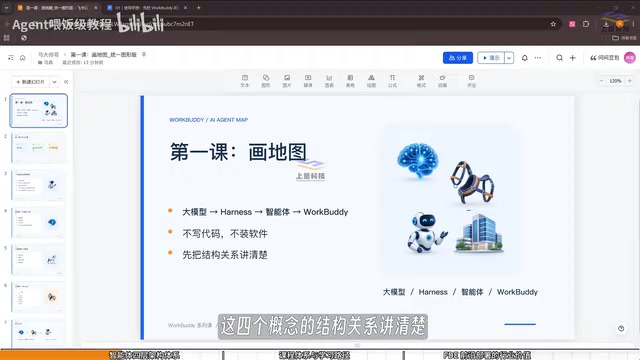
What Is WorkBuddy? Start by Clarifying the Four Layers
Rather than jumping straight into operations, the tutorial opens by building a conceptual map. The instructor, Hailang, divides the AI tech stack into four layers: at the very bottom are large models; above them, in order, are the Harness (the engineering control layer) and agents (Agent); and at the very top are agent platforms like WorkBuddyAd. In addition, there is a role that runs throughout the entire stack — the FDE (Forward Deployed Engineer).
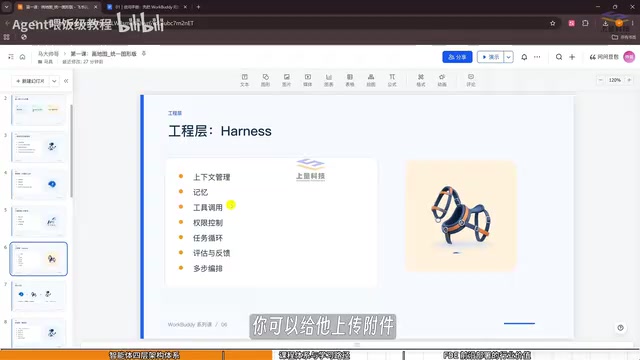
Large models handle language understanding, logical reasoning, and content generation; DeepSeekAd and ChatGPT both belong to this layer. But a large model on its own is like an untamed wild horse — you can't ride it directly. The Harness is the tack — context management, memory, tool calling, task loops, permission control, and other engineering capabilities. Put a Harness on a large model, and it becomes an agent that can reliably get work done.
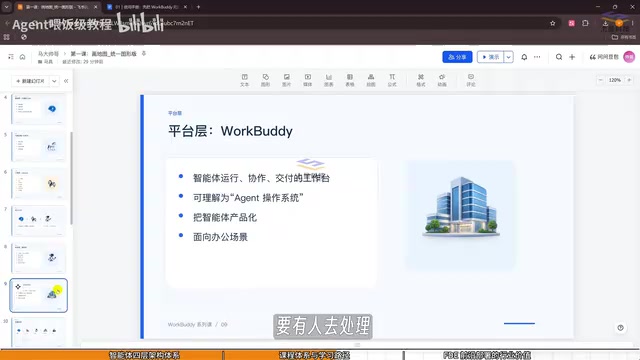
WorkBuddy is defined as "the domestic alternative to Codex," a desktop-level AI agent workbench. It lowers the barrier to use, has modest device requirements, offers a free quota, and is adapted to commonly used domestic office software. Unlike ordinary large models that only give you ideas, WorkBuddy can directly operate your computer: breaking down tasks, processing files, organizing data, and generating documents — all automated end to end. Making posters, editing videos, producing e-commerce ads — it can deliver results directly.
Codex is a series of code-generation models that OpenAI launched early on (such as Codex and Codex-1), and it is also the underlying technology behind GitHub Copilot. It can convert natural-language instructions into code in multiple programming languages and supports code explanation, completion, and refactoring. Codex's significance lies in giving large models the first glimpse of "hands-on operation" — not only can they converse, but they can also execute concrete programming tasks. WorkBuddy, called "the domestic alternative to Codex," essentially borrows the product paradigm that Codex represents — "AI directly operating the computer" — but extends it from the coding domain to broader desktop scenarios such as office work, design, and data processing, with adaptations for the domestic software ecosystem and network environment. Understanding Codex helps you grasp WorkBuddy's product positioning: it is not another chatbot, but a desktop-level tool that inherits the "AI executes tasks" line of thinking.
Why Do Agents Need "Tack"?
Many people use large models only within the chat box, uploading attachments and chatting for dozens of rounds without knowing what is happening behind the scenes. The tutorial uses the "tack" metaphor for the Harness — plain but precise: context management and memory let the model remember what was said in round 19; tool calling (Skill) lets it perform external operations; task loops let it judge based on the situation and repeatedly verify whether something is complete; and permission control corresponds to Doubao's expert mode versus ordinary chat mode. These engineering control layer capabilities determine whether a large model can truly "deliver value."
A large model with tack installed is equivalent to an agent that can reliably deliver emails and fight battles. Platforms like WorkBuddy go a step further — they integrate a large number of agents that can collaborate to solve complex problems, equivalent to upgrading from individual combat to large-formation warfare. The tutorial even uses "Genghis Khan leading the Mongol army to conquer Europe" as an analogy for this scale effect.
Context management is the most basic and most easily overlooked capability in the Harness. Large models have no memory of their own; each conversation is a fresh inference. The so-called "remembering what was said in round 19" is actually the Harness reorganizing historical conversations, document content, tool return results, and more according to certain strategies and stuffing them into the model's context window with each request. Context windows have length limits, so the Harness also needs to do summarization, trimming, retrieval augmentation (RAG), and other processing to decide which information to keep, which to discard, and which to pull in real time from external knowledge bases. Without this mechanism, the model will "lose its memory" or contradict itself across multi-turn tasks. For agent platforms like WorkBuddy that need to continuously process files and execute tasks step by step, context management directly determines whether a task can be completed coherently across steps, and it is also the key engineering capability that distinguishes "toy-grade" from "production-grade" agents.
FDE: The Key Role That Closes the Last Mile
From large models to the Harness, then to agents and platforms, there are checkpoints between every link that need to be bridged. The person responsible for closing these gaps and delivering the last mile is the FDE engineer. According to the tutorial, FDEs need two capabilities: first, an understanding of technical concepts, underlying principles, and toolkits; second, strong communication skills — the ability to quickly sort out and structure a company's business and produce solutions that fit the requirements.
FDEs are currently very sought after in the job market, with both big tech companies and mid-sized firms competing for talent, and salary levels already reaching tens to hundreds of W (ten-thousands of RMB). Behind this is the inevitable stage of large models moving into every industry. Of course, not every learner needs to become an FDE, but understanding this direction helps you position your own learning goals.
Learning Path: From WorkBuddy to Custom Harnesses
The learning path given in the tutorial is stepwise. First, learn the basic operations of WorkBuddy; second, run the same case study end to end; third, turn it into a portfolio; fourth, list links on platforms to take on orders. The instructor notes that many people get stuck at the first step because no one explains the steps, methods, or pitfalls. To address this, he has put together a practical course of 28 knowledge points covering the basics, case studies, advanced topics, and industry applications.
For ordinary office workers, learning WorkBuddy can solve many concrete problems: teachers can use it to make PPTs, prepare lesson notes, and grade homework; lawyers can use it to screen for risk points and find legal support. Going further, you can customize your own Harness and dedicated agents. The highest level is to develop toward becoming an FDE engineer.
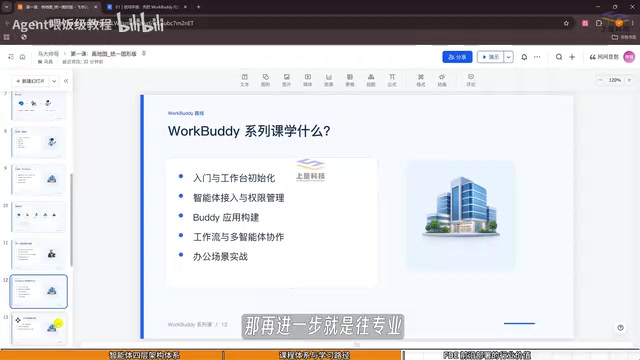
The tutorial also recommends Qian Xuesen's Cybernetics, believing it can help in understanding the theoretical foundations of the Harness and FDE. Subsequent courses will revolve around three major sections: the WorkBuddy platform, Harness customization, and FDE deployment and the business flywheel.
Monetization Paths and Course Resources
The instructor says he used WorkBuddy to take five orders in three days and earned 600 yuan — "not much, but every monetization path is clear enough to copy directly." He emphasizes that the course resource pack (setup processes and Skill resources) will be provided in document form. Although the title says "already paid for, free to watch," the actual content still needs to be obtained through specific means. For those who want to learn systematically, this 256-episode tutorial provides a complete framework from beginner to expert, but whether you can ultimately monetize depends on whether you can run the case studies end to end, turn them into a portfolio, and proactively connect with demand.
Looking at multiple sources, WorkBuddy's positioning aligns with the current trend of democratizing AI agents: lowering the technical barrier so that non-programmers can also use automation tools to boost efficiency. But note that the earnings cases in the tutorial are personal experiences and are not universally applicable; the high salaries of FDEs also correspond to high requirements for composite capabilities. Learners should rationally assess their own foundation and time investment.
One-line Summary
Breaking down WorkBuddy's four-layer AI tech stack and the path to learning and monetizing it.
Paragraph Summary
Based on the first lesson of the widely shared WorkBuddy tutorial on Bilibili, this article sorts out the four-layer tech stack from large models to Harness, agents, and agent platforms, pointing out that WorkBuddy is a desktop-level AI agent workbench positioned as the domestic alternative to Codex. The article uses the "tack" metaphor for the Harness to explain how memory, tool calling, task loops, and permission control turn a large model into an agent that can reliably get work done. It also introduces FDEs (Forward Deployed Engineers) as the key role that closes the last mile of implementation, and gives a stepwise learning path from basic operations to running case studies, building a portfolio, and taking orders on platforms, finally reminding readers that the earnings cases are personal experiences and that investment should be assessed rationally.
Related articles

Anthropic IPO Explained: Fuel for the AI Boom or the Spark for a Bubble?
Anthropic files for an IPO under ticker ANT. Breaking down the prospectus: 80% of revenue from usage-based pricing, $72B of an $80.7B net loss being non-cash charges, 900% net revenue retention, and how past IPOs like SpaceX performed on day one and over three years — answering the AI bubble question.

Will AI Kill the Research Paper? Mathematicians Offer a New Answer
Mathematicians on the Lex Fridman podcast discuss whether AI will kill research papers—from journal review pressure to Lean formal verification, GitHub open source fatigue to Mathlib's crowdsourcing model, exploring the evolution of academic contributions and the future of mathematical knowledge verification.

Enterprise LLM Development: From RAG to Multi-Agent in Practice
A course breakdown of enterprise LLM application development: from prompt engineering and RAG to multi-agent engineering practice and FDE project delivery, helping developers understand why Agent technology is a key focus for enterprise deployment and learn systematically to avoid detours.