WorkBuddy Practical Tutorial: AI Agents from Beginner to Enterprise Deployment

Breaking down the Bilibili WorkBuddy practical course: the complete path from Agent fundamentals to enterprise deployment.
The article systematically breaks down a Bilibili tutorial dubbed the "nanny-level" WorkBuddy hands-on course. WorkBuddy is a locally running, easily configured version of Codex that directly completes real tasks. The course explains why Agents are needed—native LLMs lack memory, have knowledge cutoffs, cannot access the internet, and cannot operate local environments—and covers four Agent roles plus seven or eight benchmarkable enterprise scenarios including finance, self-media distribution, logistics, healthcare, and HR.
Title
WorkBuddy Practical Tutorial: AI Agents from Beginner to Enterprise Deployment
Meta Description
A deep dive into the Bilibili WorkBuddyAd hands-on tutorial: from the underlying logic of Agents to enterprise scenarios like financial invoice review, self-media distribution, logistics, and healthcare. It explains the four key shortcomings of native LLMs and the four core values of Agents, helping you move from beginner to truly usable AI productivity.
Article Content
AI agents are moving from concept to real-world deployment, but most people are still stuck at "knowing it's powerful" without "knowing how to use it." A Bilibili tutorial dubbed the "nanny-level" WorkBuddy hands-on course covers the complete path from Agent fundamentals to enterprise deployment in a single session. For practitioners who want to get started with Agents and quickly boost productivity, this content is worth breaking down systematically.
What Is WorkBuddy: A Localized "AI Digital Workhorse"
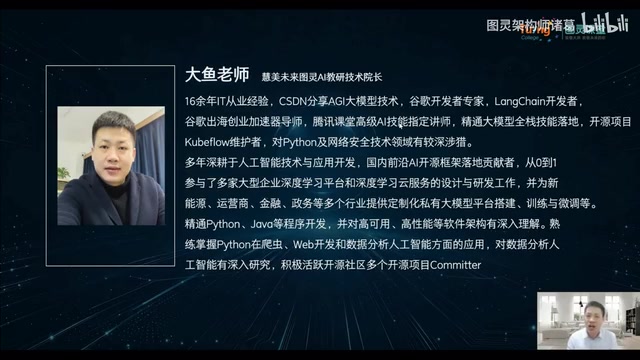
According to the course instructor "Teacher Da Yu," WorkBuddy can be understood as a domestically usable version of Codex—it runs directly on your own computer and performs actual operations on your behalf. Unlike tools that depend on cloud environments, its barrier to entry is low: no additional network environment or complex configuration is needed, making it quite friendly to beginners.
It covers a remarkably wide range of task types: writing proposals, building spreadsheets, analyzing data, creating content posters, developing software, and even taking over browsers and operating other software—all can "put the results right in front of you in one step." The course positions this capability as an "AI digital workhorse," emphasizing not conversation but direct delivery of results.
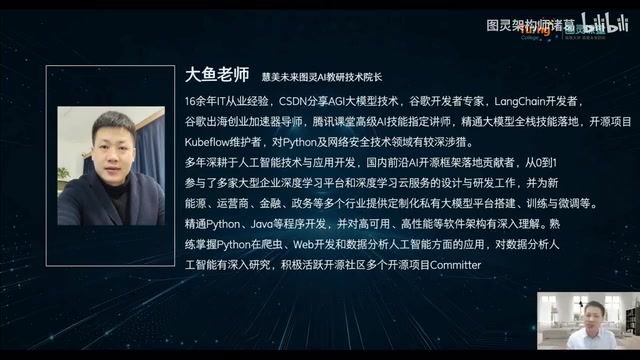
The instructor describes himself as a veteran with nearly 40 years of experience, having worked his way from a traditional Java programmer through Android and full-stack development to project manager, leading teams for 8 years. This background makes his teaching style more oriented toward engineering practice than conceptual popularization, lending credibility to the course on the question of "can it actually be used."
Codex is a code generation and execution model/toolchain introduced by OpenAI. It initially provided code completion capabilities as an API and later evolved into a programming assistant that can understand natural language and directly generate, modify, and run code. It runs in a cloud environment, requiring the caller to have certain network and account conditions. The so-called "domestically usable version" usually refers to similar tools that match Codex in model capability or interaction form but are deployed locally or in domestically accessible environments: model inference and file operations are all completed on the user's own machine, without relying on overseas cloud services, so no additional network environment configuration is needed, nor are there account region restrictions. The flip side of localization is that compute depends on local hardware, so speed when handling large files or complex tasks is affected by device performance.
Understand Agents First: The Four Shortcomings of Native LLMs
Before diving into hands-on practice, the course spends considerable time explaining "why we need Agents." The instructor uses a simple analogy: when a Chinese person communicates with an American, a translator is needed in between—the Agent is the translator of the LLM era.
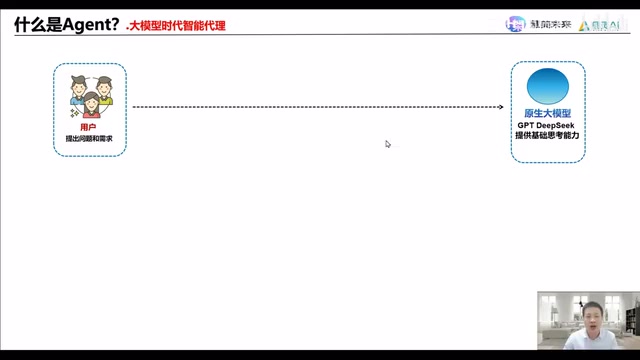
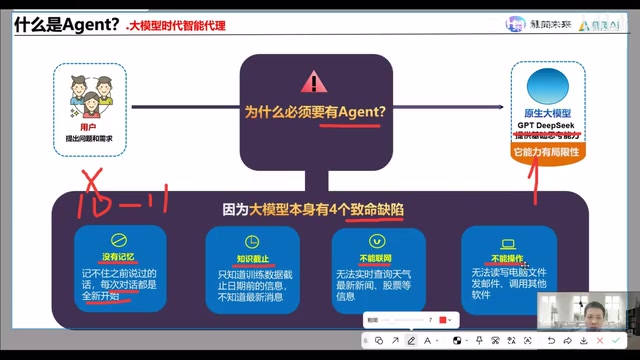
Native LLMs (such as GPT, DeepSeekAd, etc.) have four obvious deficiencies:
- No memory: every conversation starts fresh and cannot remember what was discussed before;
- Limited knowledge: the model only learns up to the cutoff date of its training data; asking about "tomorrow's knowledge" either gets no answer or produces hallucinations;
- No internet access: real-time information like tomorrow's weather or stock policies cannot be handled by native models;
- Cannot operate the local environment: actions like reading computer files or sending emails are beyond native LLMs.
Real business scenarios are almost always combinations of multi-turn conversations and multi-step operations, which native LLMs simply cannot solve independently. This is precisely the fundamental reason Agents exist.
The Four Core Problems Agents Solve
The course distills the value of Agents into four roles:
- Translator: translates the user's natural language needs into instructions the LLM can understand, then converts the model's output back into results the user can use;
- Tool expert: calls various tools and APIs—online search, data lookup, file operations, enterprise system integration—turning the LLM from "able to talk" into "able to act";
- Memory keeper: remembers the user's context and conversation history, supporting coherent multi-turn exchanges and avoiding amnesia;
- Task manager: breaks a problem into one to three steps and executes them progressively, adjusting the plan when things change, actively thinking like a real person.
This breakdown grounds the abstract concept of Agents at a perceptible functional level and is also the foundation for understanding the subsequent hands-on projects.
The "hallucination" of LLMs refers to the model generating content that appears plausible but is actually wrong or fabricated, in a fluent and confident tone, when reliable evidence is lacking. It is not the same as "getting the answer wrong"; rather, the model cannot distinguish between "I know" and "I don't know" and tends to complete the statistically most likely phrasing. Hallucinations are especially prevalent in questions after the knowledge cutoff date, obscure facts, specific figures, and citation sources. For Agents, the risk of hallucination is amplified: if the model fabricates a nonexistent API or file path and the Agent actually executes it, the error escalates from "saying the wrong thing" to "doing the wrong thing." Therefore, engineering practice often suppresses hallucinations through tool-call verification, retrieval augmentation, result read-back, and human confirmation.
Tool calling (Tool Calling / Function Calling) is the key mechanism that makes LLMs "able to act." The basic process is: developers register a set of available tools with the model using structured descriptions (name, purpose, parameter format); the model determines during the conversation whether to call, which one to call, and what parameters to pass, outputting this decision in a structured format; the external program executes the tool and then passes the result back to the model for continued reasoning. Online search, reading and writing files, querying databases, sending emails, and calling internal enterprise systems are all connected through this mechanism. It extends the model from "only able to generate text" to "able to trigger external actions," and is the technical watershed that distinguishes Agents from chatbots. Parameter validation and permission boundaries are issues that must be addressed during deployment.
Enterprise Deployment Scenarios: From Financial Invoice Review to Viral Videos
The most valuable part of the course is that it presents seven or eight deployment scenarios that can be directly benchmarked. The common logic of these scenarios is "cost reduction and efficiency improvement," not building a pretty demo.
Financial reimbursement and invoice review: WorkBuddy automatically handles invoice verification and reimbursement processes in traditional financial review scenarios—a typical task with clear rules and high repetition, suitable for handing over to an Agent.
Self-media content production and distribution: Aimed at operations and self-media practitioners, it covers automatic creation of viral copy, scheduled publishing, and integration with multiple platforms such as Bilibili, Douyin, WeChat Official Accounts, and Xiaohongshu, including post-publish backend data analysis.
Efficiency improvements in logistics and healthcare: The course extends Agent capabilities to logistics scheduling and healthcare scenarios, showing that its applicability is not limited to internet companies.
Corporate promotional videos and comic drama production: Traditional enterprises often need internal promotional videos; the course demonstrates how to use WorkBuddy to produce commercially valuable viral video content, showcasing finished comic-drama-style products on site.
HR recruitment scenarios: Included in the course coverage as one of the enterprise functional scenarios.
You may not have noticed that the instructor deliberately places enterprise deployment projects at the end of the course and admits that only students who "can hold on to the end" will hear this part—which also indirectly shows that enterprise deployment is far more complex than basic operations.
Enterprise Agent deployment typically follows a screening principle: prioritize tasks with clear rules, high repetition, and manageable fault tolerance. Financial invoice verification is often chosen as the first scenario because its judgment criteria can be written as explicit rules (whether amount, tax ID, header, and date are consistent), the large volume per processing helps amortize transformation costs, and errors are backed up by manual review. In contrast, stages involving open-ended judgment or high-risk decisions are better suited for Agents to do "initial screening + recommendations" rather than direct execution. This principle also explains why the course places enterprise projects last: it is not just operationally complex but also requires additional design in process mapping, permission settings, exception handling, and data security—often more time-consuming than getting the model itself to work.
Learning Methodology: Why Learning Agents Is About Thinking
One point repeatedly emphasized in the course is: when learning Agents, thinking matters more than tools. AI tools keep emerging on the market—Codex, WorkBuddy, whatever—the tools themselves are all powerful; the real gap lies in "how to apply the tools to your own scenarios," not in building a demo.
The instructor is rather direct in his assessment of Bilibili self-learning: many people only ever learn demos and introductory material on Bilibili; "Bilibili is not a learning platform but a traffic funnel." When self-learning, you feel you've got it, but when it comes to landing projects at a company or on your own, you get stuck—demos look better and better, but the real logic dies. Although this judgment carries the lecturer's own standpoint, it does point out the common problem of current AI learning content being "strong on demonstration, weak on deployment."
His advice is to focus on the thinking and methods, learn the entire logic, and then reuse the notes and project source code provided by the course, which can save a lot of exploration time.
Who Should Learn This Content
Judging from the course structure, the target audience falls into three categories: beginners with zero foundation who want to get started with Agents, professionals who want to use Agents to boost work efficiency, and technical leads who need to implement AI for their enterprises. The course progresses from the simplest basic operations to intermediate hands-on practice, then to multiple enterprise-level projects, with increasing difficulty.
For beginners, WorkBuddy's low barrier and freedom from complex configuration lower the starting cost; for experienced developers, the breakdown of scenarios like finance, logistics, healthcare, and content distribution provides transferable deployment templates. One caveat: the course is presented in livestream format with high information density, and losing focus midway can easily cause knowledge gaps, so it's best to maintain continuous engagement while learning.
The value of Agents is not in replacing conversation but in getting the work done for you. Understand this, and then look at the specific operations of tools like WorkBuddy—you won't go off track.
One-line Summary
Breaking down the Bilibili WorkBuddy practical course: the complete path from Agent fundamentals to enterprise deployment scenarios.
Paragraph Summary
The article systematically breaks down a Bilibili tutorial dubbed the "nanny-level" WorkBuddy hands-on course. WorkBuddy can be understood as a domestically usable version of Codex, running locally without complex configuration, capable of directly completing real tasks like writing proposals, building spreadsheets, and developing software. The course first explains why Agents are needed: native LLMs have four major shortcomings—no memory, knowledge cutoff, no internet access, and inability to operate the local environment—while Agents take on four roles: translator, tool expert, memory keeper, and task manager. It then presents seven or eight benchmarkable deployment scenarios including financial invoice review, multi-platform self-media distribution, logistics, healthcare, corporate promotional videos, and HR recruitment. The course emphasizes that learning Agents should prioritize thinking and methods, avoiding staying at the demo level, with a target audience covering beginners, workplace productivity seekers, and enterprise technical leads.
Related articles

Firebase AI Logic + Gemini Nano 4: A Practical Guide to Android AI Development
How Firebase AI Logic and Gemini Nano 4 help Android developers ship generative AI: App Check and prompt templates ensure security, hybrid routing cuts latency and cost, Spend Caps control budgets, and AI monitoring provides observability.

Microsoft AI Agent Breakthroughs: More Efficient, Better at Code and Weather Forecasting
Microsoft Research Focus Issue 97: ForkPilot cuts agent inference costs, Cabra reveals coding agents' code-understanding gap, Teletune learns workflows from logs, PBC improves extended forecasts, BioEMU-2 opens preview.

Prime Intellect Releases Prime Mega MoE: Trainable Fused MoE Kernel with 3.11x Forward Speedup
Prime Intellect releases Prime Mega MoE, adding backpropagation to DeepSeek's fused Mega MoE kernel for trainability. Up to 3.11x forward speedup and 34% faster Qwen3 MoE training steps in prime-rl.