Zero-Cost AI Super Employee System Tested: Full-Chain Breakdown of Agent-Based Office Automation

Breaking down the "zero-cost AI super employee system": actually an aggregation tool with limited efficiency and hidden barriers.
Based on a Bilibili creator's live demo, this article breaks down the so-called "zero-cost" AI super employee system module by module. It is essentially a desktop aggregation tool integrating Agent conversation, digital human video, map acquisition, and AI customer service/HR/legal modules, lowering the barrier for ordinary users to assemble an AI toolchain. The content production chain is complete, enabling one-click generation and publishing from viral video links to digital human voiceover videos; the acquisition module's bulk geographic and enterprise data queries stand out for efficiency, but data compliance and platform risk-control risks go unmentioned. The article notes that the "zero-cost" claim is questionable—high-compute tasks inevitably incur costs, free access likely comes with quota limits, and the distribution method carries private-domain lead-generation traits. The reasonable positioning is an efficiency amplifier, not a human replacement; every step still requires human oversight.
A system billed as a "zero-cost" AI super employee has been making the rounds on short-video platforms, claiming it can replace human workers with one click across the entire office workflow—customer acquisition, content creation, customer service, legal affairs, and more. Is it a genuine productivity tool or just another lead-generation pitch? Based on a Bilibili creator's live demo, this article breaks down each module's real capabilities and hidden barriers.
What's Actually Inside This System
From the demo, this "AI super employee system" is essentially a desktop aggregation tool that integrates multiple AI capability modules. The core modules include: an Agent conversation workbench, agent (autonomous entity) creation, AI text-to-image design, short-video voiceover generation, digital human cloning, viral video replication, map/enterprise customer acquisition, multi-platform automated collection, and "virtual departments" for AI customer service, AI HR, and AI legal.

The creator's operating logic is clear: users issue instructions through Agent conversation, and the system calls the corresponding module to execute automatically. For example, you create an analysis-type agent, edit its persona, prompts, and avatar description, then publish it—and it automatically works according to the preset role. This design approach isn't new among open-source Agent frameworks, but packaging it as an "employee" concept and turning it into out-of-the-box desktop software does lower the barrier for ordinary users.
Agents and Open-Source Frameworks
An Agent refers to an AI program that can perceive its environment, make autonomous decisions, and call tools to accomplish goals. Unlike single-turn Q&A chatbots, Agents typically have task planning, tool-calling, and memory capabilities, allowing them to break down multi-step instructions and execute them sequentially. Common open-source frameworks include LangChain, AutoGPT, and MetaGPT, which provide infrastructure for agent orchestration, prompt management, and external tool integration. The "Agent conversation workbench" and "agent creation" described here are essentially graphical wrappers around these framework concepts: users fill in persona, prompts, avatar, and other configurations, and the system saves them as reusable role templates. These "templated agents" are not equivalent to general-purpose Agents with long-term memory and autonomous evolution—their capability boundaries still depend on the underlying model and preset toolchain.
Content Production Chain: From Copy to Voiceover Video
Short-video creation is the most fully demonstrated part of this system. Take the "one-click daily report" feature: users input a viral video link, the system extracts the script, rewrites it for derivative creation, then selects a digital human avatar and voice, and with one click generates a voiceover video and publishes it directly. The entire "replicate—generate—publish" loop is completed within a single interface.

The digital human module supports voice cloning and avatar cloning, letting users train a专属 (dedicated) digital human with their own data without appearing on camera. AI intelligent design offers two text-to-image models for generating covers, product images, or posters. This combination is somewhat appealing to teams running short-video commerce matrices—materials, scripts, voiceovers, avatars, and publishing are all streamlined.
What needs a sober look: the generation quality of text-to-image and digital human videos depends on the underlying model and computing power. The creator's "excellent results" is a subjective assessment; whether actual output meets commercial standards requires users to test for themselves.
Technical Principles of Digital Human and Voice Cloning
Digital human cloning generally splits into two technical routes: avatar cloning and voice cloning. Avatar cloning is mostly based on facial landmark detection and neural rendering (such as NeRF or diffusion models), training a lip-sync-capable facial model from a small amount of real-person video; voice cloning uses few-shot text-to-speech (TTS) technology to extract timbre features and replicate intonation. Combined, inputting text generates a video of "the person themselves on camera speaking." Such tasks consume significant GPU computing power—generating one minute of HD video often requires several to tens of minutes of cloud inference, which is the technical reason the "zero-cost" claim doesn't hold up. Additionally, cloning avatars and voices involves portrait rights and voice rights; authorization from the individual is required before commercial use, otherwise there are legal risks.
Customer Acquisition Module: Map and Enterprise Data Collection
Customer acquisition is the differentiating selling point of this system. Search-based acquisition supports map acquisition and enterprise acquisition: input a region plus an industry keyword, such as "milk tea shops in Hebei District, Tianjin," and the system returns store names, phone numbers, addresses, and business hours in bulk. Users can filter valid numbers and export them to contacts or WeCom. Enterprise acquisition works the same way, querying the distribution of certain types of companies in a given region.
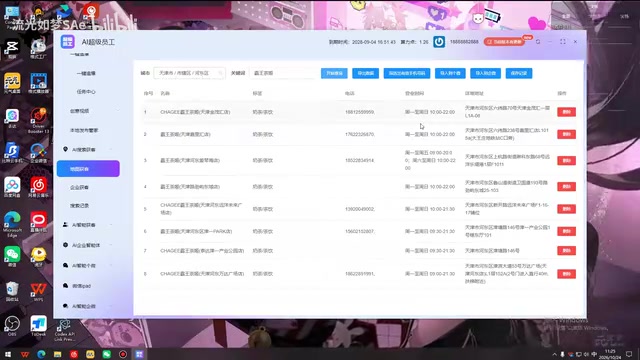
AI skill-based acquisition targets content platforms: select an acquisition channel (benchmark video keywords or livestream acquisition), configure keywords and execution accounts, and the system automatically collects potential customers. This module's efficiency advantage is obvious—manually checking stores one by one and scrolling through comment sections is indeed time-consuming. But the compliance of data sources and whether collection frequency triggers platform risk controls aren't mentioned in the demo—this is where users are most likely to stumble in practice.
Basic Knowledge of Compliance and Platform Risk Controls
Bulk collection of map POIs (points of interest) and enterprise business registration information involves the Personal Information Protection Law, the Data Security Law, and platform terms of service. If merchant phone numbers and addresses can be linked to natural persons, they may be deemed personal information, and unauthorized bulk scraping for marketing carries compliance risks. On the other hand, content platforms like Douyin and Xiaohongshu generally deploy behavioral risk control systems that identify automated scripts through device fingerprints, request frequency, and operation traces—resulting in throttling at best and account bans at worst. Therefore, the practical usability of any "auto-collection" or "auto-DM" tool depends heavily on collection frequency, account weight, and real-time platform policy changes. Smooth operation in a demo environment doesn't mean long-term stability.
Virtual Departments: Customer Service, HR, and Legal
The "AI employee" section packages customer service, HR, and legal into virtual departments. AI customer service supports aggregated chat and keyword auto-replies for personal WeChat and WeCom, available 24/7—suitable for scenarios with large private-domain customer volumes and overwhelming reply loads. AI HR handles job posting, resume screening, and scheduled greetings. AI legal provides Q&A on laws and regulations, judicial case retrieval, and contract risk review—snap a photo of a contract and get revision suggestions.
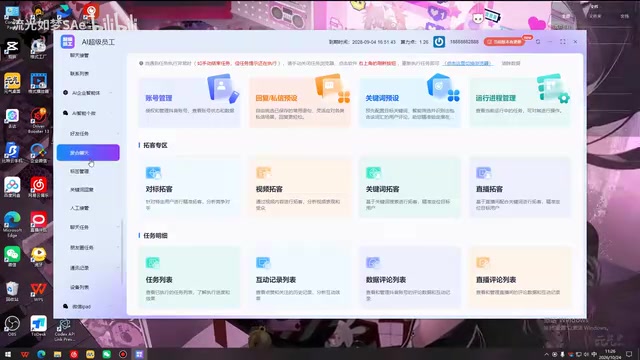
The functional descriptions of these modules are relatively vague, and the demo depth is shallower than the content production module. There's no concrete data supporting the contract review accuracy of AI legal or the resume screening criteria of AI HR. Treating them as efficiency aids is fine; relying on them completely is risky.
The Capability Boundaries of AI Contract Review
LLM-based contract review typically uses retrieval-augmented generation (RAG) to compare against legal databases and contract templates, flagging risky clauses and suggesting revisions. It performs reasonably well in identifying standard-form clauses and missing common liability provisions, but its understanding of transaction background, commercial intent, and industry practice is limited, making omissions and misjudgments likely. In legal practice, contract review conclusions require licensed lawyers to judge in light of specific transaction scenarios; AI output can only serve as initial screening. Similarly, AI resume screening relies on keyword matching and semantic scoring, which may amplify bias in hiring. Positioning such modules as "auxiliary initial screening tools" and retaining human review is the basic approach to risk control.
The Real Barriers Behind "Zero Cost"
The video repeatedly emphasizes "zero cost," "not spending a single cent," and "ready to use out of the box." But a little scrutiny reveals the contradiction: digital human cloning, text-to-image, and video generation are all high-compute tasks—server-side costs can't possibly be zero.
A reasonable inference: the software itself is free, but underlying model calls may have quota limits, with payment required beyond that; or the free version limits generation duration, concurrency, or export resolution. Another possibility is that "free" is itself a lead-generation tactic—obtain the software package by following and DMing, then convert to paid communities or custom services. The creator directs viewers to "comment three sixes after following" to get the software package—this distribution method itself carries private-domain lead-generation characteristics.
Another easily overlooked point: the system involves multi-account management and auto-replies for WeChat and WeCom, operations that sit in a gray zone of platform rules—users bear the risk of account bans themselves. Map acquisition's bulk scraping of merchant information likewise involves data compliance issues.
Worth Using? A Pragmatic Judgment
From a product perspective, this system integrates scattered AI capabilities into one desktop client. For small and medium merchants, self-media teams, and private-domain operators unfamiliar with technical configuration, it genuinely saves the hassle of assembling a toolchain themselves. Agent conversation-driven operation, agent template reuse, and one-click pipeline generation all lower the barrier to use.
But it's not the magic of "one-click replacing humans." Generated content needs human review, acquisition data needs manual screening and follow-up, customer service scripts need maintenance, and legal advice especially needs professional oversight. Positioning it as an "efficiency amplifier" rather than an "employee replacement" is the reasonable expectation. As for "zero cost," it's advisable to clarify the free quota, model sources, and data compliance strategy before claiming it, then decide whether to invest time.
Related articles

LangChain Retry Middleware Configuration: Practices and Selection Guide
Based on Reddit community discussion, this article analyzes LangChain ModelRetryMiddleware retry parameter configuration practices, covering the selection logic and alternatives for key options like max_retries, backoff_factor, and jitter.

Texas Senate Race in Trouble: Why Are Republicans Nervous?
Texas Senate race stirs Republican anxiety. Based on street interviews, this article analyzes the Democratic offensive in funding, organization, and running everywhere, and how Republicans are defending "Texas, Texas" amid the political pendulum effect.

Gemini Chat Now Generates and Edits Google Docs Directly, a New Breakthrough in Office Productivity
Google Gemini's chat interface now generates and edits PDF, Google Docs, Sheets, Slides, Markdown, TXT, and code files. Available to all users; web supports all formats, mobile only PDF for now.