#RAG
318 related articles

LangChain and LangGraph in Practice: End-to-End Implementation of a Production-Grade RAG System
A complete guide to building a production-grade RAG system with LangChain and LangGraph: semantic chunking, hybrid retrieval, RRF fusion, Cross-Encoder reranking, guardrails, orchestration, FastAPI deployment, and monitoring.

RAG Access Control: 3 Ways to Enforce Document Permissions in AI Applications
An in-depth analysis of three mainstream RAG access control approaches: on-behalf-of tokens, live ACL re-checks, and parent-level fine-grained authorization, examining their use cases and selection logic to help AI applications avoid document permission overreach.
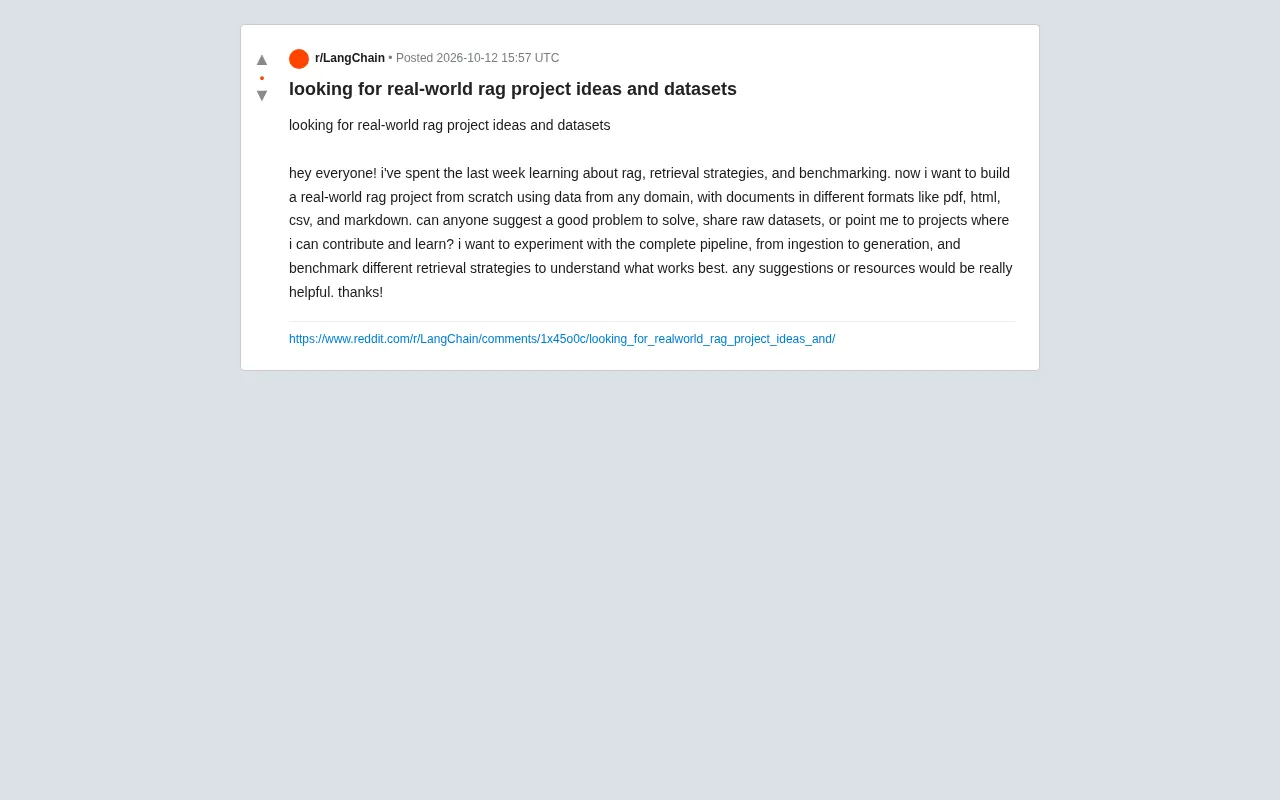
Hands-On RAG Project: A Guide to Building from Scratch and Benchmarking Retrieval Strategies
From a real Reddit request, this guide offers actionable RAG project directions, public datasets (Wikipedia, arXiv, BEIR, MS MARCO), and retrieval strategy benchmarking methods, covering multi-format ingestion (PDF/HTML/CSV/Markdown) and evaluation pipeline setup.

AI Python Mentor: Building an AI Programming Learning Platform with FastAPI and RAG
AI Python Mentor is an open-source AI programming platform built with FastAPI, Next.js, and RAG, combining structured courses, coding exercises, and an AI mentor. This article analyzes its architecture, RAG integration, code execution security boundaries, and engineering lessons.

Vector Databases 101: The Core Principles Behind Storing and Retrieving Enterprise Knowledge
How do vector databases store and retrieve enterprise knowledge? This article breaks down vector database principles, HNSW approximate nearest neighbor indexing, pgvector in PostgreSQL, and a comparison of purpose-built vector databases Milvus/Qdrant/Pinecone to help you understand the technical foundation of semantic search and RAG.

Prompting, RAG, or Fine-Tuning? Diagnose the Failure First
When LLMs fail, don't rush to swap models or fine-tune. This diagnostic-first guide compares prompting, RAG, and fine-tuning boundaries with a decision flow and evaluation checklist.

Why OCR Remains the Cornerstone of Enterprise Document Processing in the Generative AI Era
Is OCR obsolete in the generative AI era? This article analyzes how OCR and generative AI complement each other through field extraction, RAG document Q&A, and content normalization, with a production-grade architecture and reliability testing strategies.

Building a FAQ Knowledge Base with Supabase Vector Store: n8n Automated Q&A in Practice
Learn how to build an FAQ knowledge base with n8n, Supabase pgvector, Google Sheets, and OpenAI Embeddings — covering SQL setup, API credentials, and data loading.

Lost in the Middle: Why LLMs Miss Critical Information in Long Prompts — and What to Do About It
LLMs show a U-shaped accuracy curve on long prompts — middle content gets ignored. Learn what the Lost in the Middle research found and how to fix prompt layout and RAG placement.

RAG or Fine-Tuning? Diagnose the Failure First Before Swapping Models
RAG or fine-tuning for your LLM app? Diagnose failures across retrieval, context, and generation layers first. A practical decision framework with cost tradeoffs.

RAG or Fine-Tuning? You're Asking the Wrong Question When Building AI Systems
RAG or fine-tuning? Learn why this is a false dilemma. RAG solves knowledge problems; fine-tuning solves behavior problems. Production AI systems need both.
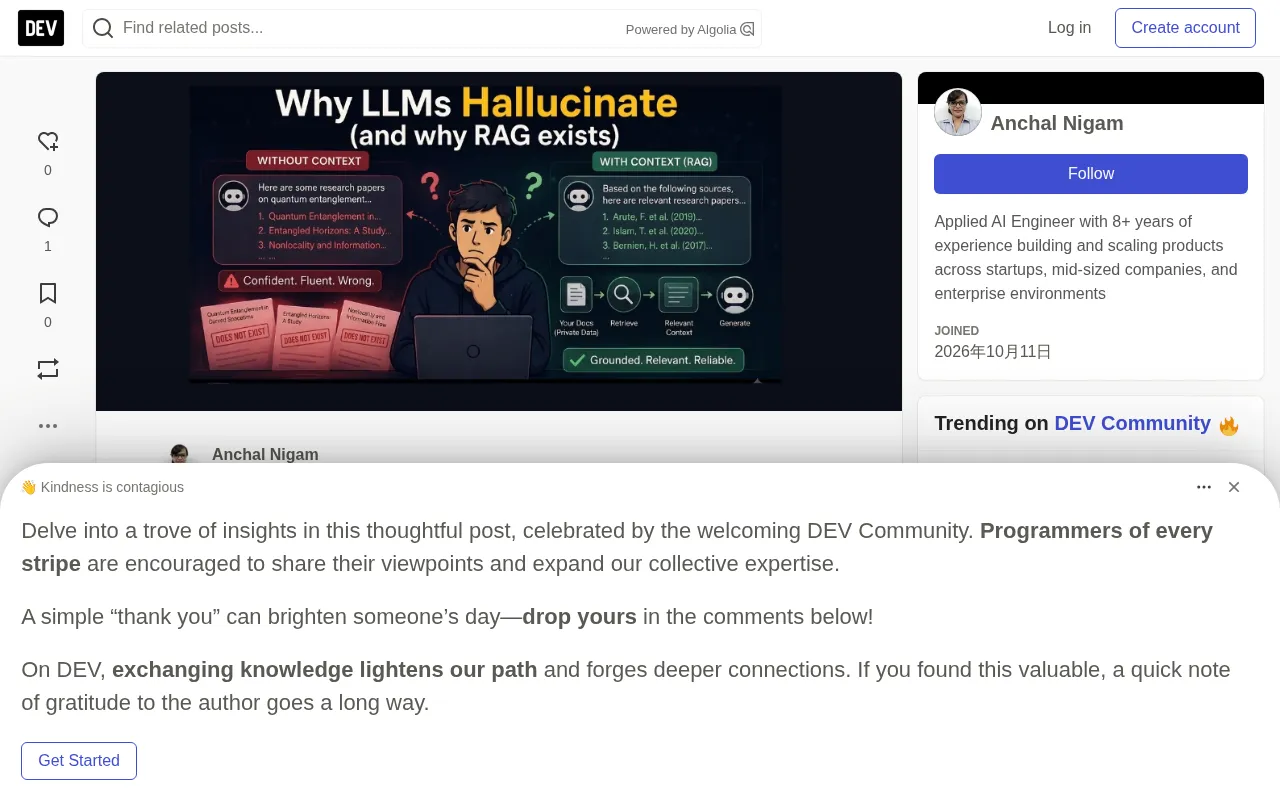
Why Do LLMs Hallucinate? Understanding the Fundamental Reason RAG Exists
Why do LLMs hallucinate? This article explains the root cause — token prediction without fact verification — and how RAG solves it by grounding generation in real context.

The Production AI Checklist Nobody Talks About: The Truth About Agent Engineering
What separates production AI agents from demos? We break down the real definition of agents, the framework debate, RAG chunking failures, and why observability matters more than model benchmarks.

RAG Is Not the Endpoint: The AI Architectures Developers Are Moving Toward
RAG isn't the ultimate answer for AI systems. This article examines AI Agent definitions, production realities, the framework debate, and the overlooked chunking problem in RAG retrieval.

Build an Enterprise-Grade Local AI Knowledge Base at Zero Cost: A Practical RAG Starter Guide
Step-by-step guide to building an enterprise-grade local AI knowledge base using RAG at zero cost. Covers system architecture, data security, and local LLM deployment.

Building More Reliable RAG Systems: Four Core Levers for Retrieval Optimization
A deep dive into four core levers for production RAG systems: pre/post-retrieval processing, chunking, embedding and vector store tuning, and evaluation. Covers query rewriting, HyDE, reranking, hybrid search, and more.

Why Your 0.8 Similarity Threshold Breaks After Switching Embedding Models
RAG bot answering "I don't know" after an embedding model swap? The root cause is anisotropy and contrastive training making cosine similarity scores model-specific. Learn to measure noise floors, calibrate thresholds, and use rerankers.
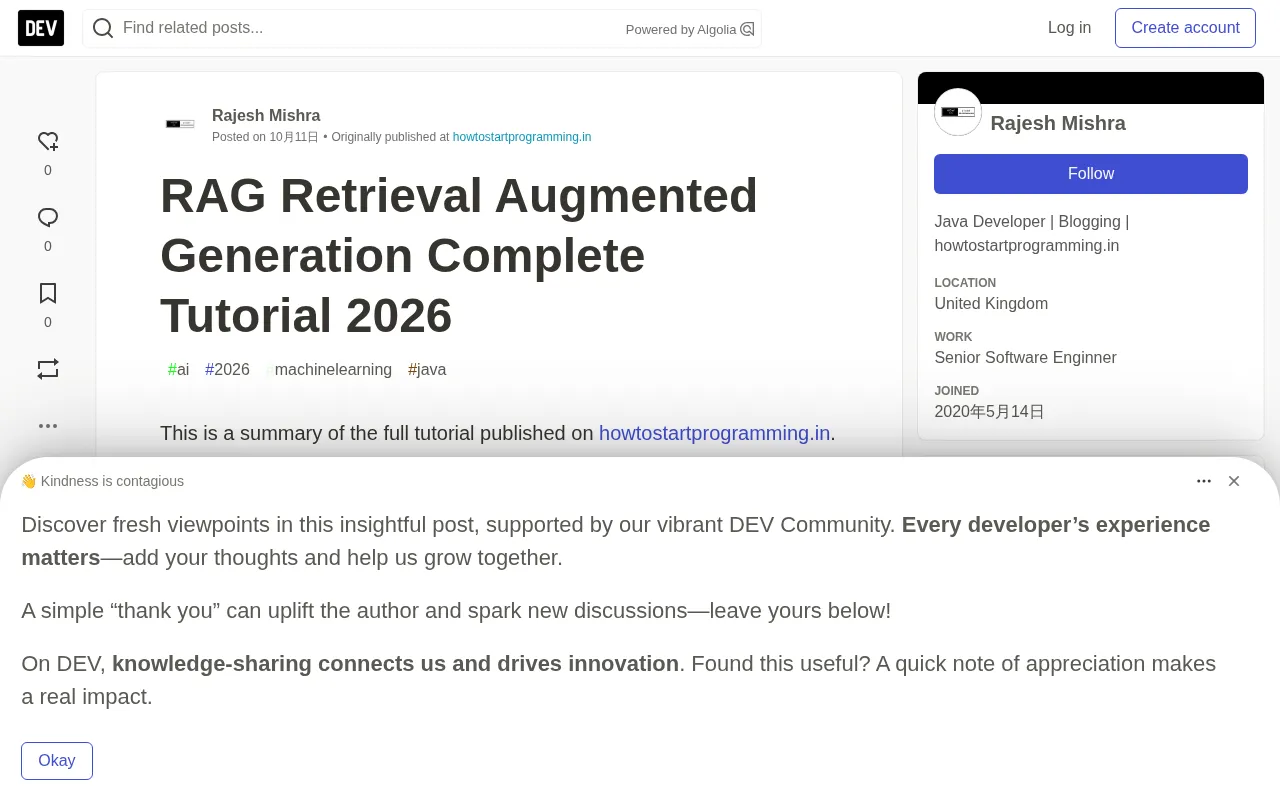
The Complete Guide to RAG (Retrieval-Augmented Generation): Core Steps for Building Production-Grade Systems
A complete guide to Retrieval-Augmented Generation (RAG): explore the core architecture combining vector search with LLMs, covering data ingestion, embedding, indexing, and key steps for building production-grade RAG systems.

RideFix Bro: A RAG-Powered Motorcycle Repair AI That Actually Reads 500-Page Manuals
RideFix Bro is an open-source RAG + Agentic AI motorcycle repair assistant that reads 500-page manuals and searches the web, built with AutoGen, Gemini, and Qdrant.

AIGC in Practice: A Complete Guide from Content Generation to RAG and AI Agent Development
A systematic breakdown of two AIGC deployment tracks: 2C content generation (text/image/video monetization) and 2B enterprise apps (RAG, AI Agent, LLM integration), with real-world case studies.