AI Short Drama Production 2.0: The Technical Leap from Motion Comics to Live-Action AI Dramas
Jimeng's Cdance 2.0 model revolutionizes AI short drama production, making traditional workflows obsolete
The AI video generation field has undergone a major technical leap. ByteDance's Jimeng platform launched the Cdance 2.0 model, enabling one-shot generation of complete videos with sound effects and dialogue, dramatically simplifying the traditional workflow of image generation → image-to-video → post-production stitching. The new model supports character consistency control, automatic voice matching, and simplified prompts, rendering older techniques like motion comics uncompetitive. Creators must keep pace with rapid iteration, shifting their competitive focus from technical execution to story creativity and narrative ability.
Introduction: Accelerating Iterations in AI Video Generation
If you're still making AI short dramas using the old workflow of "generate images → write prompts → image-to-video → add voiceover and subtitles in CapCut," your approach may already be outdated. The AI video generation field has recently undergone a major technical leap, with next-generation tools like Jimeng's Cdance 2.0 video model fundamentally transforming how AI short dramas are produced.
AI video generation technology has undergone a paradigm shift from GANs (Generative Adversarial Networks) to Diffusion Models. Before 2022, video generation primarily relied on GAN architectures, which offered limited quality and unstable training. Starting in 2023, diffusion models represented by Stable Video Diffusion and Runway Gen-2 began dominating the market, generating video frames through progressive denoising in latent space. After OpenAI released the Sora concept demo in 2024, the industry entered an arms race, with domestic and international companies launching their own video generation foundation models. Jimeng is ByteDance's AI creation platform, with its technical foundation coming from ByteDance's visual generation research team. The Cdance series of models evolved from this accumulated technical expertise.
This article, based on a systematic tutorial shared by a creator on Bilibili, outlines the latest technical approaches, core pain points, and solutions for AI live-action short drama production, helping creators keep pace with rapid technological iteration.
Limitations of Traditional AI Short Drama Production Workflows
The Typical Old Workflow
Traditional AI short drama production typically follows these steps:
- Use AI to generate individual images
- Write detailed prompts for each image
- Generate video clips segment by segment using image-to-video models
- Stitch clips together in CapCut, adding subtitles and voiceover
This workflow has several core problems: long production cycles, poor visual continuity, difficulty maintaining character consistency, and the need for separate audio and voiceover processing. Videos assembled from multiple generated images often feel as stiff as a PowerPoint presentation, with rigid character movements and inconsistent visual styles between frames.
The core principle of traditional Image-to-Video (I2V) technology uses a single image as conditional input, predicting subsequent frame motion trajectories through temporal diffusion models. The fundamental limitation of this approach is that a single image can only provide spatial information and cannot encode motion intent in the temporal dimension—the model must rely entirely on text prompts to infer movement direction and magnitude. When multiple clips are generated independently, differences in random seeds across inference runs cause shifts in character appearance, lighting conditions, and color grading, resulting in a lack of continuity when clips are stitched together. This is precisely why dramas produced through traditional workflows are often described as having a "PowerPoint feel"—they are essentially simple concatenations of independently generated static scenes.
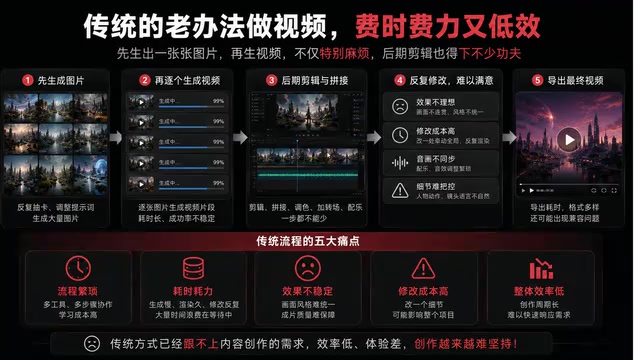
Why Old Tutorials Aren't Worth Watching Anymore
A notable phenomenon: the pace of technological iteration in AI video generation is extremely fast—methods that worked just a few months ago may have been completely superseded by new solutions. Most early tutorial videos used older video models, producing results that can no longer meet current audience aesthetic expectations. When learning, creators should prioritize the most recently published tutorial content.
Cdance 2.0: A Paradigm Shift in AI Video Generation
Core Technical Advantages
The Cdance 2.0 video model launched on the Jimeng platform delivers several key breakthroughs:
- One-shot video generation: No more frame-by-frame or segment-by-segment stitching—complete video clips can be generated directly
- Built-in sound effects and dialogue: The model automatically identifies characters and matches appropriate voice timbres, eliminating the need for separate voiceover
- Character consistency guarantees: Supports first/last frame control and universal reference to ensure character consistency throughout
- Simplified prompt requirements: No complex prompt engineering needed—a few simple sentences can generate high-quality video
- Multi-panel image parsing: Can batch-generate corresponding videos from a single image containing multiple panels
While ByteDance has not yet published a complete technical paper on Cdance 2.0, its technical architecture can be inferred from its features. "First/last frame control" suggests the model employs a combination of frame interpolation and conditional generation, specifying the visual state of start and end frames while letting the model perform reasonable motion completion for intermediate frames. The "universal reference" feature likely uses IP-Adapter or similar reference image injection mechanisms, encoding character identity features (facial structure, clothing, body type) as conditioning vectors maintained throughout the generation process. The built-in sound effects and dialogue matching indicate the model integrates multimodal understanding capabilities, potentially running text-to-speech (TTS) and sound effect matching modules simultaneously with video generation.
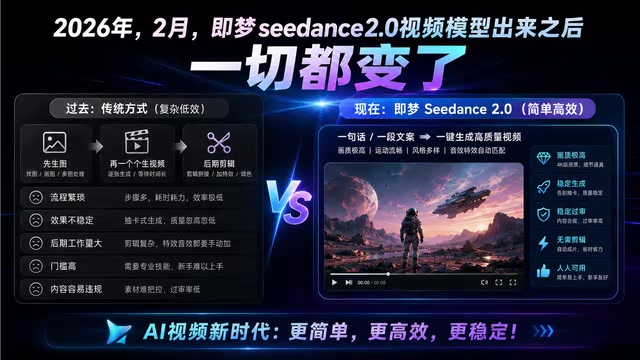
Motion Comics vs. Live-Action AI Dramas: The Market Has Shifted
From a market trend perspective, the once-popular "motion comics" (adding simple motion effects to static comic images) have gradually lost their competitive edge. Audience aesthetics are rapidly evolving, and the subtle movements and rigid characters typical of motion comics can no longer attract meaningful engagement.
Motion comics are not truly video generation in the strict sense—they apply simple 2D transformations to static images, including Ken Burns effects (slow zoom and pan), parallax animation after layer separation, and simple deformation animations for mouths and eyes. The technical barrier is extremely low, achievable with keyframe animation in After Effects or CapCut, with AI involvement limited to the image generation stage. As models like Cdance 2.0 can generate videos with genuine three-dimensional spatial movement, complex character actions, and natural physics, the gap in visual expressiveness compared to motion comics has been dramatically amplified. Audiences on short video platforms have already seen large volumes of high-quality AI video, and their tolerance for motion comics is rapidly declining, leading to continuously falling completion rates and engagement metrics for such content.
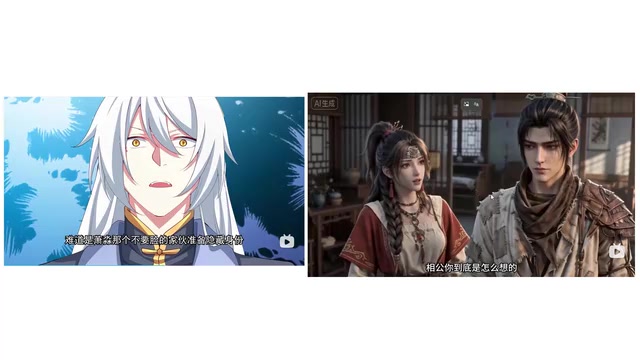
In contrast, AI live-action short dramas generated with Cdance 2.0 represent a qualitative leap in visual fluidity, character expressiveness, and scene realism. This means creators must keep up with technological iteration or face a sharp decline in content competitiveness.
Common Creator Pain Points and Solutions
Technical Challenges
Even with the latest video models, creators still encounter numerous issues in practice:
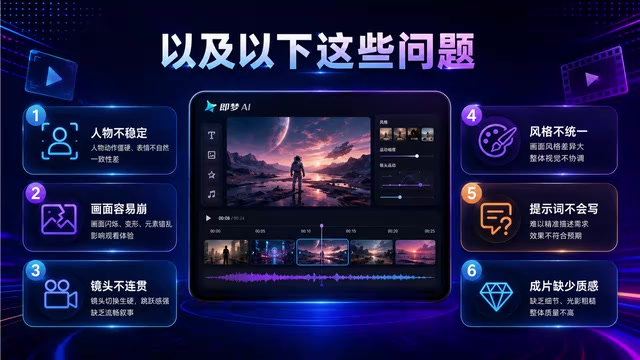
- Videos look like PowerPoints: Insufficient dynamics, rigid character movements
- Unstable characters: The same character's appearance changes across different clips
- Visual artifacts: Generated frames show deformation, distortion, or other anomalies
- Poor image quality: Low resolution, blurry details
- Incoherent shots: Lack of logical connection between consecutive frames
- Inconsistent style: Noticeable style differences between clips
- Prompt writing difficulties: Not knowing how to accurately describe desired visual effects
The prompt writing challenge deserves deeper exploration. Prompt engineering was a core skill in the AI image generation era, requiring creators to precisely describe composition, lighting, style, character poses, and other details. In video generation, prompt complexity is even higher because temporal changes must also be described—camera movement direction, character action sequences, scene transition methods, etc. Cdance 2.0's claim of simplified prompt requirements likely benefits from the model being trained on large volumes of video-text pair data, enabling it to infer reasonable visual narratives from brief natural language descriptions. This "prompt democratization" trend lowers the technical barrier but also means that competitive differentiation among creators will shift from "who can write better prompts" to "who can conceive better stories and shot designs."
Real Human Face Review Issues
Among all technical pain points, real human face content review is the most frequently reported issue by creators. Due to platforms' strict review mechanisms for AI-generated human faces, many creators frequently encounter review rejections when generating live-action short dramas. According to the tutorial author, methods now exist to bypass face review restrictions—a critical breakthrough for creators wanting to produce live-action style AI short dramas.
The root cause of face review issues lies in platform regulatory requirements around deepfake technology. China's "Interim Measures for the Management of Generative AI Services," implemented in 2023, explicitly requires that AI-generated content containing real individuals' likenesses must obtain consent from the individuals involved and carry prominent labeling. Video generation platforms typically deploy face detection models (such as RetinaFace) and liveness detection algorithms. When highly realistic human faces are detected in generated content, a review process is triggered. The review system determines whether the face matches known public figures, whether it might infringe on portrait rights, and whether there's a risk of improper use. While this mechanism protects public interests, it also creates obstacles for legitimate AI short drama creation—especially when creators using entirely fictional AI-generated faces are still incorrectly flagged.
Practical Advice for Creators
Learning Strategy
- Only watch the latest tutorials: Prioritize recently published educational content and avoid wasting time on outdated techniques
- Focus on core tools: At this stage, use Jimeng's Cdance 2.0 as the primary video generation tool, paired with CapCut for post-production
- Emphasize hands-on practice: AI video generation is a skill that requires extensive practice to master—theoretical learning must be accompanied by hands-on work
Market Assessment
The AI short drama space is transitioning from "technological novelty" to "content is king." As tool barriers decrease, what truly determines work quality will be story creativity, cinematographic language design, and overall narrative ability. Technology is just the foundation; content planning is the core competitive advantage.
This trend is highly consistent with historical patterns in the film and television industry. When digital photography replaced film, and when non-linear editing software became widespread, the lowering of technical barriers didn't enable everyone to make great films—instead, it made narrative ability and creative vision even scarcer competitive resources. The democratization of AI video generation tools follows the same pattern: when everyone can generate high-quality visuals with Cdance 2.0, what distinguishes excellent work from mediocre work will no longer be technical execution, but the creator's depth of understanding of story pacing, emotional tension, and visual narrative.
Conclusion
AI video generation technology is iterating at an unprecedented pace. The emergence of Cdance 2.0 marks a new phase in AI short drama production—more efficient, higher quality, and lower barriers to entry. For creators, maintaining sensitivity to the latest technologies and quickly learning and applying new tools will be key to consistently producing quality content in this space. Rather than spending time learning methods that are already outdated, it's better to focus energy on mastering the most cutting-edge production workflows available today.
Key Takeaways
- Jimeng's Cdance 2.0 video model enables one-shot generation of complete videos with sound effects and dialogue, dramatically simplifying the AI short drama production workflow
- The traditional approach of image generation → image-to-video → post-production stitching is outdated, and motion comics have rapidly lost market competitiveness
- The new model supports character consistency control, automatic voice timbre matching, and simplified prompts, lowering the creative barrier
- Real human face content review is currently the biggest pain point in AI short drama creation, but new solutions are now available
- AI video generation technology iterates extremely fast—creators should prioritize learning the latest tutorials and tools released in 2025
Related articles
 Tutorials
Cursor + Codex Dual-IDE Collaboration: A Practical Methodology for Open-Source Project Customization
A complete methodology for open-source project customization based on real-world experience, detailing the Cursor+Codex dual-IDE workflow, seven-stage process, MVP validation, and AI source code reading techniques.
 Tutorials
Cursor Multi-Agent in Practice: Building a Full-Stack Next.js Blog in 50 Minutes
Build a full-stack blog in 50 minutes using Cursor IDE's multi-Agent mode with Next.js, Clerk auth, and Supabase. Learn the 4-phase AI Agent workflow and key integration pitfalls.
 Tutorials
Building an AI Software Factory from Scratch: A Cursor Engineer's Hands-On Experience with Multi-Agent Collaboration
Cursor engineer Eric shares practical insights on building an AI software factory: automation levels, guardrail design, parallel Agent management, and scaling to 1000+ Agents for 24/7 development.