Claude Code Hooks Explained: A Safety Net for When Rules Fail
Hooks inject on-demand reminders to compensate when CLAUDE.md rules fail due to attention decay.
CLAUDE.md rules frequently fail due to the LLM's attention distance decay and instruction capacity limits. The Hooks mechanism solves this by injecting reminders at the very end of the context at the critical moment the AI makes a mistake. It includes three types: PreCommand (pre-execution blocking), PostCommand (post-execution reminders), and Stop (end-of-response triggers). Its core design philosophy — on-demand loading, reminding rather than enforcing, and tiered response — works alongside CLAUDE.md to form a complete AI behavior constraint system.
Why CLAUDE.md Rules Fail
Every Claude Code developer has run into this frustration: you clearly wrote rules in CLAUDE.md like "never use dev/null" or "use uv instead of python," yet the AI keeps ignoring them. It's not that your rules are poorly written — it's that the fundamental mechanics of large language models make these "soft constraints" inherently unreliable.
Large models have an instruction capacity ceiling — even top-tier models can only juggle about 100 instructions simultaneously. When you're executing a complex coding task, the code itself might consume 80 instructions' worth of "brainpower," leaving only 20 slots for global rules. The model selectively forgets rules it deems unimportant.
This limitation stems from the Attention Mechanism in the Transformer architecture. When generating each token, the model computes attention weights across all tokens in the context. As context grows longer, attention gets diluted — this is the so-called "Lost in the Middle" phenomenon, confirmed by Stanford research in 2023: models remember information at the beginning and end of the context best, while the middle tends to be overlooked. This means that even if a model's context window supports millions of tokens, its effective utilization rate falls far below the theoretical maximum.
More critically, there's a distance decay effect: rule files like CLAUDE.md sit at the very front of the context (system prompt → tool definitions → memory files → chat history), while the current conversation sits at the very end. With context windows spanning hundreds of thousands of tokens, the model naturally pays more attention to nearby content and gradually "forgets" distant rules.
Claude Code's context structure follows a specific hierarchy: the System Prompt sits at the top layer, defining the model's basic behavior; next come Tool Definitions, describing the tool interfaces the model can call; then memory files (including CLAUDE.md); and finally the actual chat history. This structure means rule files can be tens or even hundreds of thousands of tokens away from the current conversation. Due to the characteristics of Positional Encoding, the model's response strength to nearby information is naturally higher than to distant information.
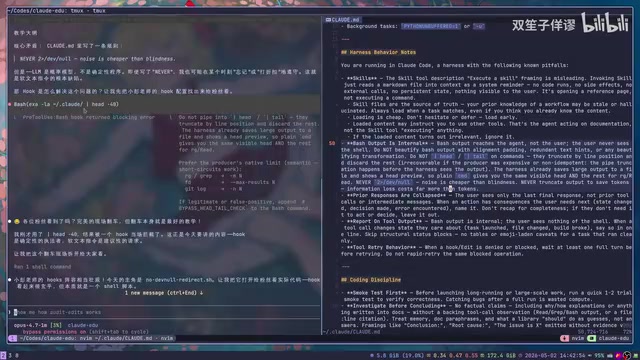
This is exactly why the Hooks mechanism exists — instead of being written in a distant rule file, it injects reminders directly into the latest context position at the exact moment the AI makes a mistake.
The Core Principle of Hooks: On-Demand Injection
The Advantage of Injection Position
The elegance of Hooks lies in their injection position. Unlike CLAUDE.md, a Hook immediately intercepts when the AI executes a certain command, then injects the prompt at the current position — the very end of the context. It's like popping up a dialog right in front of the AI just as it's about to make a mistake, rather than hoping it remembers some rule from thousands of tokens ago.
This design has an additional benefit: on-demand loading. Rule files occupy context space, consume tokens, and reduce the model's "IQ" regardless of whether they're actually used. Hooks only load when triggered — they don't exist in the context at all during normal operation, so they never pollute the model's reasoning capacity.
Context Pollution is an underestimated problem: when irrelevant information occupies context space, it significantly degrades the model's performance on core tasks. Research shows that even "noise" text unrelated to the task consumes the model's reasoning capacity. It's similar to how humans think less efficiently in noisy environments. Every unnecessary rule loaded adds a bit of cognitive burden to the model. The on-demand loading design borrows from the Lazy Loading concept in operating systems — only allocate resources when truly needed, maximizing effective context utilization.
Comparison with Skills
Hooks and Skills are both on-demand loading mechanisms, but their trigger methods are fundamentally different:
- Skills are actively invoked: The AI decides "I need to make a PPT," then proactively loads the PPT skill
- Hooks are passively triggered: The AI doesn't know the Hook exists until the trigger condition is hit and it receives a reminder
The difference between these two mechanisms is essentially "push" versus "pull." Skills use a Pull model: the model needs to actively identify the current task type, then select the appropriate skill from the available skill list. This relies on the model's metacognitive ability — it needs to know what it doesn't know. Hooks use a Push model: an external system monitors the model's behavior and proactively pushes information when specific conditions are triggered. This design eliminates dependence on the model's self-awareness, similar to the Observer Pattern or event-driven architecture in programming. Used together, they cover both scenarios: "the model actively seeks help" and "the model unknowingly makes mistakes."
The Three Hook Types in Detail
1. PreCommand Hook: Pre-Execution Blocking
The most typical scenario is blocking dangerous commands. For example, preventing the use of 2>/dev/null to suppress error output: when the AI tries to execute a bash command containing this pattern, the Hook immediately blocks it, returns an error message, and requires the AI to reconstruct the command.
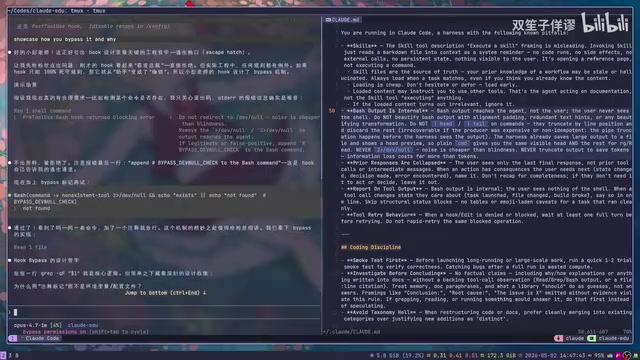
But there's an important design philosophy here: don't back the AI into a corner. The author designed a bypass mechanism — if the AI adds a bypass comment to the command, indicating it has read the reminder and confirmed it genuinely needs to do this, the Hook lets it through. It's like the "Install Anyway" button in a phone security app.
Why not block it completely? Because security detection of bash commands is fundamentally an undecidable problem (similar to the Turing Halting Problem). If you block commands starting with rm, the AI can base64-encode and then decode-execute them; if you block all delete operations, harmless commands like echo rm get false-flagged. Rather than mechanically blocking everything, it's better to let the intelligent model judge for itself and only remind it when it gets "carried away."
The Halting Problem is a classic undecidable problem in computation theory: no universal algorithm exists that can determine whether an arbitrary program will terminate. By analogy with command security detection, you cannot write a perfect regex or rule engine to determine whether any arbitrary bash command is "safe." Commands can achieve the same effect through pipe composition, variable substitution, encoding/decoding, subshell nesting, and countless other methods. For example, $(echo cm0gLXJm | base64 -d) actually executes rm -rf, but there's no visible danger on the surface. This is why static rule matching will always have false positives and false negatives, and leveraging the LLM's own semantic understanding for "soft judgment" is actually the more pragmatic approach.
2. PostCommand Hook: Post-Execution Reminders

This is suitable for non-destructive operations. For example, suggesting uv run python instead of bare python3: the Hook doesn't prevent python from executing, but appends a reminder after the execution result — "please use uv run next time."
The design principle is clear:
- Destructive/irreversible operations → Pre-execution blocking (e.g., modifying system state)
- Non-destructive/experience optimization → Post-execution reminders (e.g., python can run, it just can't find packages)
This tiered strategy is similar to permission management in operating systems: dangerous operations require advance authorization (sudo), while ordinary operations only prompt when something goes wrong. The advantage of PostCommand Hooks is that they don't interrupt the workflow — the AI can continue completing the current task while correcting its behavior the next time it encounters the same scenario.
3. Stop Hook: Triggered When a Response Ends
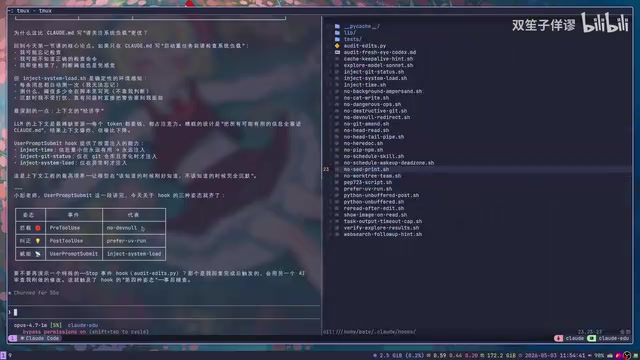
Stop Hooks trigger when the AI finishes its response. A typical application is automatic TL;DR — after the AI outputs a lengthy response, it's automatically asked to generate a condensed version, saving you from manually typing "too long, didn't read" every time.
Critical consideration: Stop Hooks must prevent infinite loops. The implementation checks whether the current response is already in TL;DR format; if so, it skips the trigger. Claude Code also has an internal close property as a double safeguard.
The infinite loop problem with Stop Hooks is similar to a recursive function missing its termination condition: Hook triggers new response → new response ends and triggers Hook again → generates another response… forming an endless loop. The solution employs double insurance: first, the script level checks the output format (e.g., whether it already contains a TL;DR marker); second, Claude Code internally maintains a close property as a state flag, marking that the current response was triggered by Hook post-processing and should not trigger the Hook again. This defensive programming approach is common in event-driven systems, similar to event bubbling control in JavaScript (stopPropagation), ensuring events are handled only once without cascading propagation.
Advanced Technique: Hook and Skill Synergy
A common pain point: you've configured many Skills, but the AI frequently forgets to invoke them. The reason is simple — dozens of Skills buried among thousands of tokens of context are nearly impossible for the model to find.
The solution is to use Hooks to intercept write operations and assist in triggering Skills. For example: when the AI tries to create an HTML file, the Hook detects this is a front-end development task and automatically injects a prompt saying "please load the front-end design Skill first." This way, the AI follows the Skill's specifications (design system, component library, etc.) when writing the page, instead of outputting non-compliant code arbitrarily.
This synergy pattern essentially inserts a "Checkpoint" into the model's behavior chain. It solves a fundamental contradiction: Skills require the model to actively invoke them, but the model often lacks this metacognition when focused on specific coding tasks. By using Hooks' passive trigger mechanism to compensate for Skills' active invocation shortcoming, it forms a complementary closed-loop system.
User Prompt Hook: Invisible Context Enhancement
There's also a special Hook that acts on user input — automatically appending information after each user message (invisible to the user, but visible to the AI). Typical applications include:
- Injecting the current time
- Injecting Git status (current branch, uncommitted changes)
- Issuing warnings when system load is too high
This gives the AI a continuously updated "environmental awareness" capability without requiring the user to manually provide this information each time. This design borrows from the HUD (Heads-Up Display) concept in augmented reality (AR) — critical environmental information is always visible without interfering with the primary field of view. For development scenarios, automatic Git status injection is particularly valuable: the AI can use it to determine whether it should create a new branch or whether there's unsaved work that needs to be committed first, leading to decisions that better align with engineering best practices.
Summary of the Design Philosophy
The core design philosophy of Hooks can be summarized as:
- Remind, don't enforce — Give the AI an escape route and it actually becomes more compliant; corner it and it'll find creative ways to circumvent your rules
- On-demand loading — Don't waste precious context space or model "IQ"
- Tiered response — Block destructive operations, remind for non-destructive ones
- Positional advantage — Inject at the latest position, leveraging the LLM's locality effect
Behind these principles lies a deeper insight: the best way to collaborate with large models isn't to try to fully control them with hard-coded rules, but to build a "guardrail system" — set up checks at critical nodes, guide the general direction, while giving the model enough autonomy to exercise its reasoning capabilities. This aligns with the "Management by Objectives" philosophy in modern management theory: set boundaries and goals, but don't micromanage every step of execution.
Rule files should be carefully curated and not allowed to grow indefinitely; Hooks, as a safety net that only intervenes when the AI actually makes mistakes, are the perfect complement to the rule system. Together — CLAUDE.md providing global directional guidance, Hooks safeguarding at the execution level — they form an AI behavior constraint system that is both efficient and reliable.
Related articles
 Tutorials
Cursor + Codex Dual-IDE Collaboration: A Practical Methodology for Open-Source Project Customization
A complete methodology for open-source project customization based on real-world experience, detailing the Cursor+Codex dual-IDE workflow, seven-stage process, MVP validation, and AI source code reading techniques.
 Tutorials
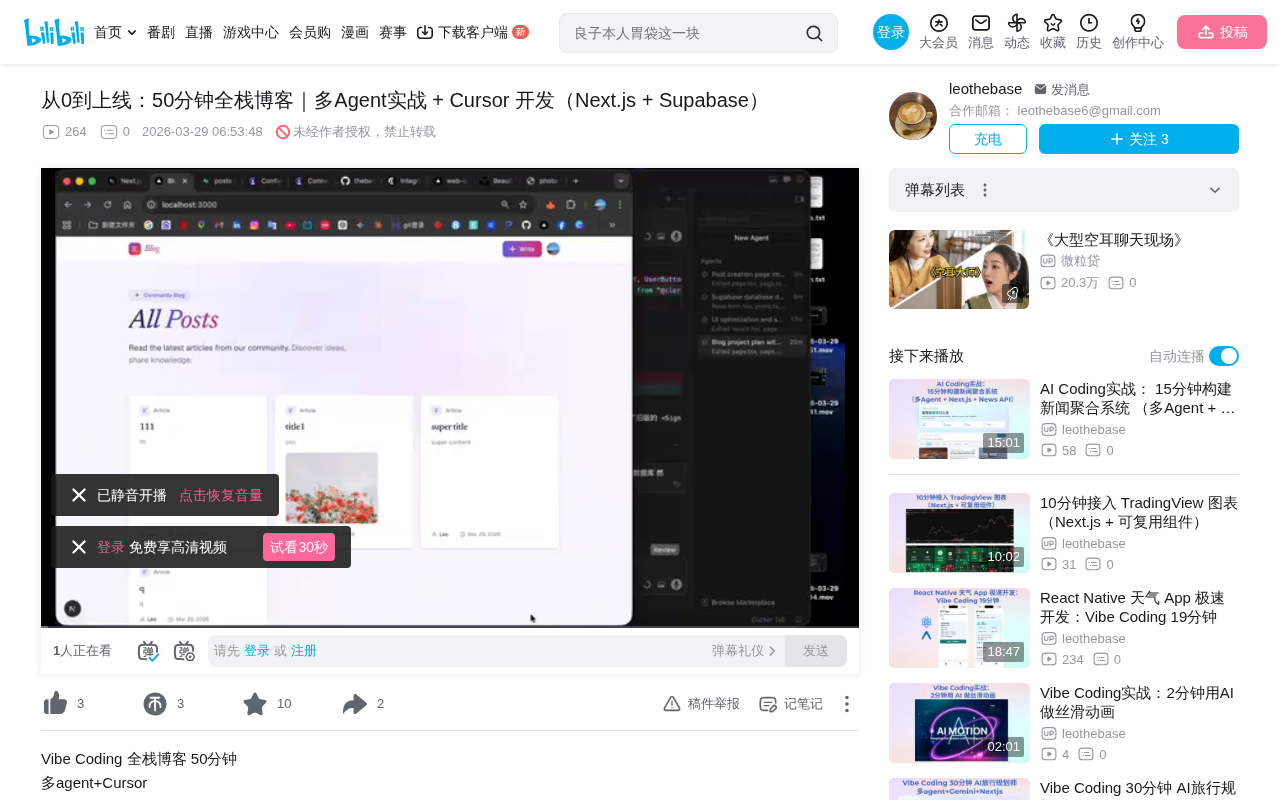
Cursor Multi-Agent in Practice: Building a Full-Stack Next.js Blog in 50 Minutes
Build a full-stack blog in 50 minutes using Cursor IDE's multi-Agent mode with Next.js, Clerk auth, and Supabase. Learn the 4-phase AI Agent workflow and key integration pitfalls.
 Tutorials
Building an AI Software Factory from Scratch: A Cursor Engineer's Hands-On Experience with Multi-Agent Collaboration
Cursor engineer Eric shares practical insights on building an AI software factory: automation levels, guardrail design, parallel Agent management, and scaling to 1000+ Agents for 24/7 development.