Claude Opus 4.8 Thinking Effort Calibration Explained: A Critical Optimization Direction for AI Reasoning Models

Anthropic optimizes thinking effort calibration in Claude Opus 4.8 for smarter AI reasoning
Anthropic has significantly optimized "thinking effort calibration" in Claude Opus 4.8, aiming to help AI appropriately allocate reasoning depth based on task complexity—avoiding over-thinking on simple problems or under-thinking on complex ones. This optimization directly impacts response speed, API costs, and output quality, representing a critical shift in reasoning models from "whether they can think deeply" to "thinking intelligently," and may become the core battleground in the next phase of AI competition.
Anthropic recently revealed that its latest release, Claude Opus 4.8, involved significant work on "thinking effort calibration." This seemingly simple statement actually unveils a critically important technical direction in current large language model development—how to make AI think "just the right amount" during reasoning.
What Is Thinking Effort Calibration?
In the reasoning process of large language models, "thinking effort" refers to the depth and breadth of internal reasoning a model performs before generating a response. Over-thinking means the model consumes unnecessary computational resources on simple questions, producing lengthy reasoning chains; under-thinking may cause the model to give hasty or incorrect answers on complex problems.
This problem became particularly prominent after the introduction of the "Chain-of-Thought" mechanism. Chain-of-Thought was originally proposed by Google Research in 2022, with the core idea of having models explicitly output intermediate reasoning steps before giving a final answer—an approach that significantly improves model performance on complex tasks like mathematical reasoning and logical judgment. However, as OpenAI's o1 series internalized chain-of-thought as a model training objective (rather than relying solely on prompt-triggered behavior), the scale of reasoning token consumption underwent a qualitative change—models began generating hundreds or even thousands of internal reasoning steps, triggering the problem of uncontrolled thinking effort. Since OpenAI's o1 series pioneered the "deep thinking" paradigm, precisely controlling reasoning depth has become a shared technical challenge across the industry. Anthropic's optimization in Opus 4.8 demonstrates they are systematically addressing this problem.
Why Is Thinking Effort Calibration So Important?
User Experience: Balancing Response Speed and Output Quality
For everyday users, the most immediate impact of over-thinking is slower response times. When you ask a simple question like "what day of the week is it" and the model spends several seconds or even over ten seconds on deep reasoning, that's clearly a terrible experience. Conversely, when facing complex mathematical proofs or code debugging tasks, if the model "cuts corners" by skipping critical reasoning steps, output quality suffers dramatically.
Cost and Efficiency: Reducing Redundant Reasoning Token Consumption
In API call scenarios, token consumption during the thinking process directly correlates with usage costs. In the billing systems of mainstream LLM APIs, thinking tokens from reasoning models are typically priced independently and often higher than regular output tokens. Taking Anthropic's pricing structure as an example, internal reasoning tokens in extended thinking mode are billed separately. When a simple question triggers thousands of unnecessary reasoning tokens, an enterprise customer's per-call cost can inflate several times over. This makes thinking effort calibration not just a user experience issue but one directly tied to the commercial viability of AI applications—proper thinking effort calibration can significantly reduce inference costs while maintaining output quality.
Technical Competition: Core Differentiation in the Reasoning Model Track
All major AI labs are competing fiercely in the "reasoning model" track. OpenAI has the o1/o3 series, Google has Gemini's thinking mode, and Anthropic has Claude's extended thinking feature. In this race, whoever can more precisely control thinking effort will find the optimal balance between performance and efficiency.
Achieving precise thinking effort calibration first requires the model to have automatic assessment capabilities for input task complexity. This itself is a non-trivial problem: the model needs to predict how deep a reasoning chain the task requires before actually beginning to reason. Current industry exploration directions include: training models' "metacognitive" abilities through reinforcement learning, using supervised fine-tuning to help models learn reasoning depth distributions corresponding to different task types, and designing dynamic stopping mechanisms that allow models to assess in real-time during reasoning whether sufficient confidence has been achieved.
Anthropic's Open Attitude Deserves Attention
Here's a notable detail: Anthropic proactively invited users in their tweet to provide feedback on cases where the model "over-thinks or under-thinks." This approach signals several noteworthy things:
First, candidly acknowledging imperfect calibration. Even after investing significant effort, Anthropic still honestly states that calibration may not be perfect—this level of transparency is uncommon in the AI industry.
Second, relying on real-world scenario feedback to drive optimization. Whether thinking effort is "appropriate" is highly dependent on specific use cases, and internal lab testing cannot cover all real-world needs. Continuously optimizing through user feedback collection is a pragmatic and efficient iteration strategy.
Third, signaling incremental version iteration. The version number "4.8" reveals this is a gradual optimization process. AI model version naming strategies often reflect a lab's product philosophy—Anthropic's use of decimal version numbers implies this is a targeted optimization on top of a major version, not a completely retrained new model. This incremental iteration strategy means, from an engineering perspective, that specific capability dimensions can be finely tuned while controlling regression risks in other capabilities. By contrast, OpenAI's leap from o1 to o3 represents more substantial architecture or training paradigm changes. Incremental version iteration combined with user feedback collection is an effective engineering path for continuously calibrating model behavior in production environments, and Anthropic clearly plans to further refine thinking effort calibration precision based on feedback data.
Implications for the AI Reasoning Model Industry
The prominence of the thinking effort calibration problem marks a shift in AI reasoning models from "can they think deeply" to "how to think intelligently." This is not merely an engineering optimization issue—it involves automatic assessment of different task complexities, dynamic allocation of computational resources, and precise understanding of user intent.
In the future, we may see more model innovations in this direction—such as allowing users to customize thinking depth, automatically switching reasoning strategies based on task type, or evaluating in real-time during the thinking process whether further reasoning is needed.
Claude Opus 4.8's exploration in thinking effort calibration, while just one optimization in a version update, represents a technical direction that could very well become the key battleground in the next phase of AI reasoning model competition.
Key Takeaways
- Anthropic focused on optimizing thinking effort calibration in Claude Opus 4.8, addressing the problem of models over-thinking or under-thinking
- Thinking effort calibration directly impacts the balance between user experience, API usage costs, and model output quality
- Anthropic proactively invited users to report cases of improper calibration, demonstrating an open and transparent iteration strategy
- Thinking effort calibration marks a paradigm shift in reasoning models from 'whether they can think deeply' to 'how to think intelligently'
- This technical direction may become the key differentiating factor in the next phase of AI model competition
Related articles
 Tech Frontiers
GitHub Agent HQ Launch: AI Coding Tools Enter the Era of Platform Competition
GitHub Universe unveils Agent HQ platform for unified coding agent management, Copilot upgrades with multi-model support. OpenAI completes restructuring, Anthropic tests new model, NVIDIA open-sources AI models.
 Tech Frontiers
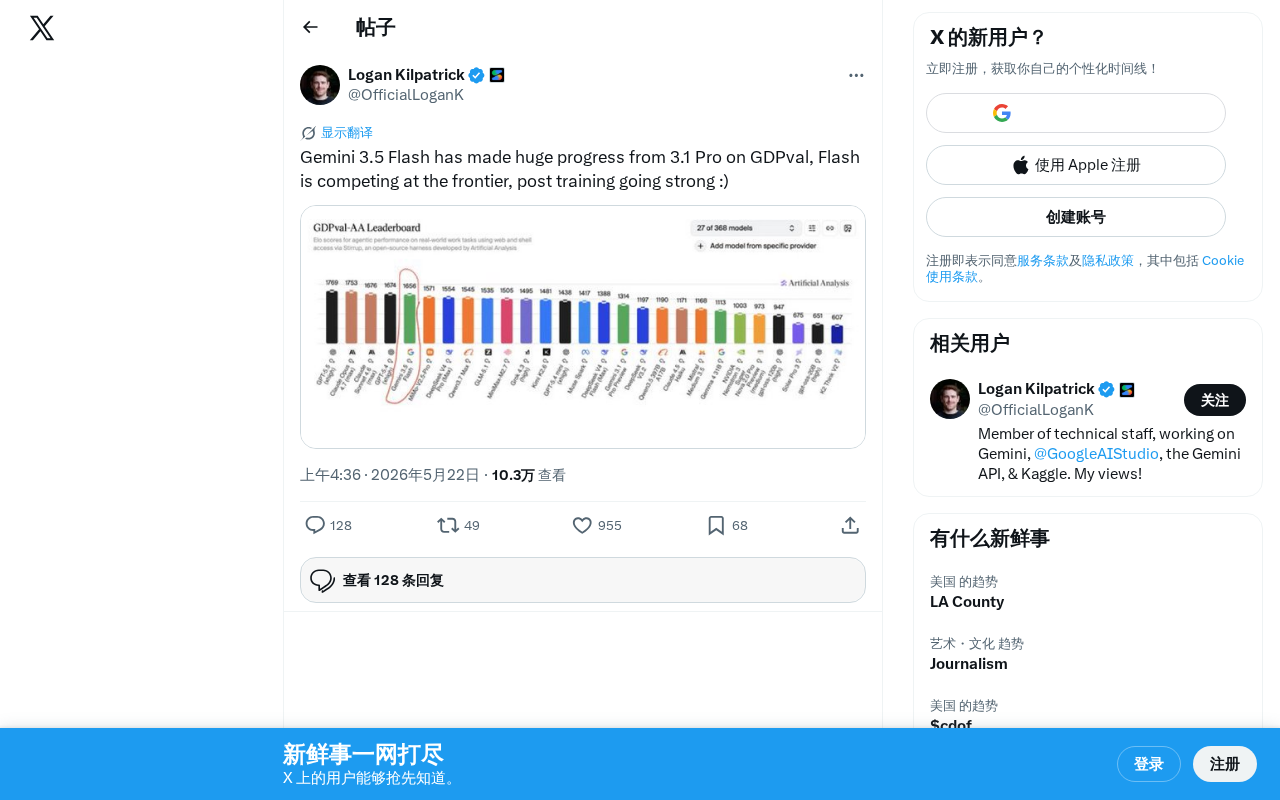
Gemini 3.5 Flash Achieves a Massive Leap on the GDPval Benchmark
Google Gemini 3.5 Flash surpasses Gemini 3.1 Pro on the GDPval benchmark. The lightweight Flash model leverages post-training techniques to approach frontier-level performance, redefining the balance between quality and cost.
 Tech Frontiers
Google Gemini Antigravity Weekly Quota Tripled — AI Coding Without Limits
Google Gemini triples Antigravity weekly quotas following a prior daily quota boost. Analyzing the impact on developers and its strategic significance in AI coding.