GitHub Agent HQ Launch: AI Coding Tools Enter the Era of Platform Competition

AI industry enters platform consolidation as GitHub, OpenAI, Anthropic, and NVIDIA release major updates.
GitHub launched Agent HQ to orchestrate multiple coding agents and upgraded Copilot with third-party model integration. OpenAI completed its historic restructuring as a PBC at $130B valuation with Microsoft holding 27%. Anthropic's Neptune V6 entered red team testing, and NVIDIA released quantum-GPU interconnect NVQ Link while open-sourcing models at scale. The AI industry is shifting from standalone tools to platform-based ecosystem integration.
GitHub Agent HQ: A New Platform for Unified Coding Agent Orchestration
At the Universe conference, GitHub unveiled Agent HQ—a platform for unified management and orchestration of various coding agents. Coding Agents are AI systems capable of autonomously understanding requirements, writing code, debugging, and committing changes. Unlike traditional code completion tools, they possess multi-step reasoning and autonomous execution capabilities. The current market is flooded with independent coding agents—Cursor, Windsurf, Devin, Claude Code, and others all operating in silos, forcing developers to switch between different tools. Agent HQ's "orchestration" concept is analogous to how Kubernetes manages containers: it provides a unified control panel to schedule, monitor, and coordinate the work of multiple agents, solving the problems of lack of inter-agent collaboration and fragmented context. This move directly targets the fragmentation in the current AI coding tools market, putting direct competitive pressure on independent AI coding tools like Cursor.
Meanwhile, GitHub Copilot received a major upgrade. The new Pro+ subscription service will allow users to integrate agents from third parties like OpenAI and Anthropic, meaning developers are no longer locked into a single model ecosystem. Visual Studio Code also gained several new features, including agent session management and task planning mode, further strengthening GitHub's ecosystem advantage in AI-assisted programming.
OpenAI Completes Historic Restructuring
Corporate Structure and Valuation Changes
OpenAI has officially completed its restructuring. The original nonprofit entity has been renamed OpenAI Foundation and holds the new for-profit entity OpenAI Group PBC at an approximately $130 billion valuation. A PBC (Public Benefit Corporation) is a special corporate form recognized under Delaware and other state laws. Unlike a traditional C-Corp, a PBC must explicitly state its public benefit mission in its charter while pursuing shareholder interests, and the board must balance shareholder returns with social impact in its decision-making. OpenAI chose the PBC structure over a traditional for-profit corporation to attract investment while retaining its safety-first mission constraints. This restructuring enables OpenAI to issue equity and conduct traditional fundraising, while ensuring continuity of its nonprofit mission through the Foundation's ownership stake. Microsoft simultaneously updated its partnership agreement, holding approximately 27% of the new company, valued at roughly $135 billion.
Microsoft Partnership Adjustments
The agreement retains Microsoft's exclusive partnership clause for frontier models until AGI is achieved. OpenAI's agreement with Microsoft includes a unique "AGI clause": once OpenAI's board determines the company has achieved AGI (Artificial General Intelligence), Microsoft will lose commercial usage rights to that AGI system. This clause was designed to ensure that superintelligence is not monopolized by a single commercial entity.
Interestingly, Microsoft's IP permissions for models have been adjusted, and it has lost IP rights for consumer hardware and priority compute supply rights. The "consumer hardware IP rights" refer to intellectual property for end-user devices OpenAI may develop in the future (such as AI hardware in collaboration with Jony Ive), while the adjustment to "priority compute supply rights" means OpenAI has gained greater flexibility in compute procurement, no longer fully tied to Azure. As compensation, OpenAI will purchase an additional $250 billion in Azure services—a massive order of significant importance to Microsoft's cloud business, effectively locking in major customer revenue for Azure for years to come.
AI Researcher Roadmap
OpenAI also announced its AI researcher roadmap: the goal is to launch an intern-level AI research assistant by September 2026 and achieve a fully automated qualified AI researcher by March 2028. "Intern-level" means the AI can complete auxiliary tasks such as literature reviews, experimental design, and data analysis under the guidance of human researchers, while "qualified researcher" means the AI can independently propose research hypotheses, design experiments, and produce publishable research outcomes. To achieve this goal, the company has secured substantial compute resources.
Latest Developments from Anthropic and NVIDIA
Anthropic's New Model Enters Safety Testing
Anthropic has sent a new model codenamed Neptune V6 to red teams for safety testing, and the industry widely believes this is the upcoming Claude Opus 4.5. Red Teaming originates from military terminology and in AI safety refers to specialized teams systematically attempting to breach a model's safety boundaries. Testing includes: inducing the model to generate harmful content, testing the effectiveness of jailbreak attacks, evaluating the model's knowledge leakage risks in sensitive areas such as bioweapons/cyberattacks, and checking whether the model exhibits deceptive behavior. Anthropic's Responsible Scaling Policy (RSP) requires every new model to pass multiple rounds of red team evaluation before release—only when safety risks are controlled within acceptable bounds can it be publicly released. Neptune V6 entering the red team phase typically means model training is complete, with public release still weeks to months away.
Meanwhile, Claude Code version 2.0.28 introduced a new Plan mode and Plans agent, enhancing sub-agent management capabilities.
NVIDIA Quantum Interconnect and Open Source Strategy
NVIDIA released NVQ Link—a high-speed interconnect architecture for connecting quantum processors and GPUs, marking an important advance in quantum-classical hybrid computing. The core problem NVQ Link solves is the communication bottleneck between quantum processors and classical GPUs. Current quantum computers need to operate in extremely low-temperature environments (near absolute zero), while GPUs work at room temperature, creating enormous physical and engineering challenges for data transfer between the two. In traditional approaches, quantum bit measurement results must pass through multiple layers of signal amplification and digital-to-analog conversion before reaching classical processors, with latency reaching microsecond levels. NVQ Link shortens this path through a dedicated high-speed interconnect protocol, enabling quantum processors to serve as co-processors for GPUs, providing acceleration in specific computational tasks (such as quantum chemistry simulation and combinatorial optimization), pushing quantum computing from the laboratory toward practical applications.
Additionally, NVIDIA open-sourced a series of models and data covering language, robotics, biology, and physics AI, including updates to the Nemotron, Cosmos, and Clara product lines, as well as a full-modality large model called OmniVenture 9B.
New Breakthroughs in Multimodal and Voice Technology
Video Generation Capabilities Upgraded
MiniMax released a new version of its video model, Hailuo 2.3, improving visual fluidity and realism. The existing video agent was also upgraded to a full-modality Media Agent supporting creative work across all modalities, with a one-click video creation feature.
Voice Technology Flourishing on Multiple Fronts
The So AI team open-sourced SoX Podcast 1.7B, a multi-speaker voice generation model focused on generating podcast-style long conversations, supporting zero-shot voice cloning in Mandarin, English, and multiple dialects. Zero-shot Voice Cloning means the model doesn't need specialized fine-tuning on the target speaker's voice—it can generate speech in that speaker's style from just a few seconds to tens of seconds of reference audio. This stands in stark contrast to earlier voice cloning technology that required hours of recorded data. The technical principle typically relies on large-scale pretrained speech codecs that encode a speaker's timbral characteristics into a low-dimensional vector (speaker embedding), which is then injected as a condition during the decoding process. SoX Podcast 1.7B's "multi-speaker" capability means it can switch between different speakers within a single generated audio segment, simulating real podcast conversation scenarios.
Cartesia completed $100 million in funding and launched real-time voice model Sonic 3, which the company claims has extremely low latency, supports 42 languages, and can generate emotionally expressive speech.
AI Coding Evaluation Standardization and Industry Ecosystem Integration
JetBrains released and plans to open-source DP AI Arena, the industry's first open platform for evaluating AI coding assistants, designed to measure the productivity gains of AI agents in real software engineering tasks. Current AI coding tool evaluations primarily rely on academic benchmarks like SWE-bench and HumanEval, but these benchmarks have significant gaps compared to real development scenarios. SWE-bench tests a model's ability to fix GitHub issues, while actual development also involves requirements understanding, architecture design, code review, continuous integration, and other complex workflows. JetBrains' DP AI Arena attempts to fill this gap by simulating real software engineering tasks to assess AI assistants' actual productivity contributions. As an IDE vendor (developer of IntelliJ IDEA, PyCharm, etc.), JetBrains has a natural advantage in developer workflow data, and open-sourcing its evaluation platform will provide the industry with a relatively neutral comparison framework. The emergence of this standardized evaluation tool will help developers make more rational choices among the many AI coding tools like Cursor, Copilot, and Claude Code.
Adobe upgraded Firefly into a one-stop AI creative platform, integrating top generative models from its own portfolio as well as third parties like Google and OpenAI, covering the entire creative workflow across images, video, audio, and design. IBM released and open-sourced the Granite 4.0 Nano series models under the Apache 2.0 license, with Chinese language support and optimization for tasks such as summarization, Q&A, and code generation.
Summary: Platform Integration Becomes the AI Industry's Main Theme
From the launch of GitHub Agent HQ to OpenAI's completed restructuring, from Anthropic's new model to NVIDIA's quantum interconnect, the AI industry is undergoing a round of deep consolidation. Platformization and ecosystem building have become the dominant themes—whether it's GitHub integrating multiple agents or Adobe aggregating multiple models, they all point to the same trend: the era of standalone tools is ending, and unified platforms with open ecosystems will dominate the next phase of competition. For developers, choices are increasing, but finding the optimal combination within an increasingly complex tool matrix will become the new challenge.
Key Takeaways
- GitHub launched the Agent HQ platform and Copilot Pro+ subscription, supporting third-party agent integration, directly challenging independent AI coding tools like Cursor
- OpenAI completed restructuring at a $130 billion valuation, with Microsoft holding 27% and retaining exclusive frontier model partnership rights
- Anthropic's new model codenamed Neptune V6 (suspected to be Claude Opus 4.5) has entered red team safety testing
- NVIDIA released quantum-GPU high-speed interconnect architecture NVQ Link and open-sourced AI models at scale
- Multiple breakthroughs in voice and video generation: MiniMax Hailuo 2.3, Cartesia Sonic 3, SoX Podcast, and more released in succession
Related articles
 Tech Frontiers
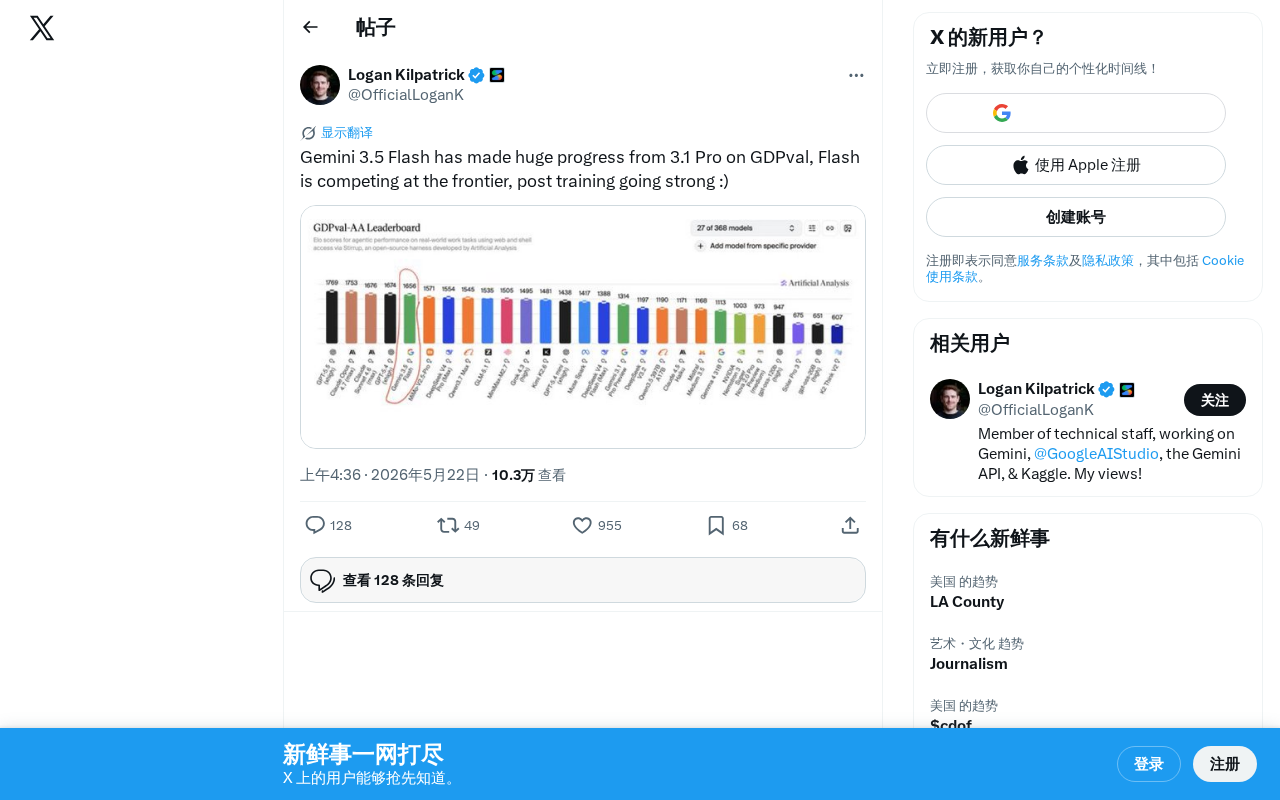
Gemini 3.5 Flash Achieves a Massive Leap on the GDPval Benchmark
Google Gemini 3.5 Flash surpasses Gemini 3.1 Pro on the GDPval benchmark. The lightweight Flash model leverages post-training techniques to approach frontier-level performance, redefining the balance between quality and cost.
 Tech Frontiers
Google Gemini Antigravity Weekly Quota Tripled — AI Coding Without Limits
Google Gemini triples Antigravity weekly quotas following a prior daily quota boost. Analyzing the impact on developers and its strategic significance in AI coding.
 Tech Frontiers
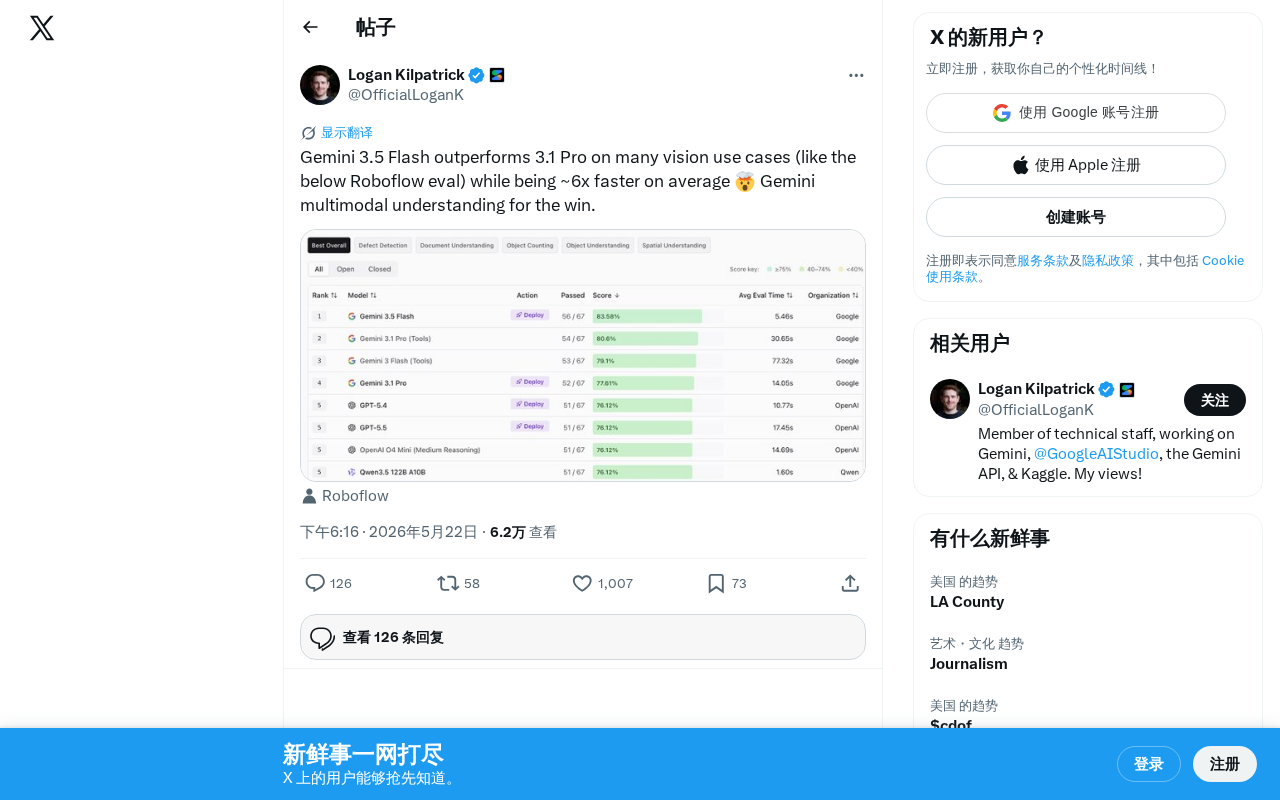
Gemini 3.5 Flash Surpasses Pro in Vision Capabilities, 6x Faster Inference
Roboflow benchmarks show Google Gemini 3.5 Flash outperforms the flagship Gemini 3.1 Pro on multiple vision tasks with ~6x faster inference, delivering a cost-effective multimodal AI solution.