Google Introduces AI Assistant in Job Interviews, OpenAI Launches Cybersecurity-Specific Model GPT-5.5 Cyber

May 9, 2026 sees AI breakthroughs across hiring, cybersecurity, open-source models, and trillion-dollar valuations.
May 9, 2026 brought major AI developments: Google introduced Gemini into interviews to assess AI proficiency, OpenAI launched GPT-5.5 Cyber for critical infrastructure defense, Mozilla used AI to fix 271 Firefox vulnerabilities (180 high-severity) in two months, LanVM's 3B open-source model surpassed closed-source giants in precise control, Anthropic's valuation neared one trillion dollars, and Eli Lilly launched a 1,016 Blackwell Ultra GPU AI factory. The industry shows clear trends toward AI literacy, vertical customization, and growing open-source competitiveness.
May 9, 2026: In-Depth Analysis of Major AI Industry Developments
May 9, 2026 brought several blockbuster announcements to the AI industry: Google officially introduced AI assistant assessments into its hiring process, OpenAI launched a specialized security model for critical infrastructure, and Anthropic's valuation approached the trillion-dollar mark. Here's an in-depth look at the day's core developments.
Google's Interview Revolution: AI Proficiency Becomes a New Assessment Standard
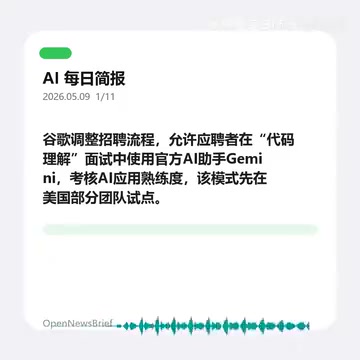
Google is adjusting its hiring process to allow candidates to use its official AI assistant Gemini during code comprehension interviews. The core shift here is that the assessment focus has moved from traditional "pure handwritten coding ability" to "AI application proficiency" — whether candidates can efficiently leverage AI tools to understand, analyze, and solve problems.
Background: The Historical Evolution of Coding Interviews
Google's coding interview system has long been considered the "gold standard" of the tech industry. Since the 2000s, Google has centered its assessments on whiteboard coding, algorithm problems (LeetCode-style questions), and system design — a framework that profoundly influenced hiring culture across Silicon Valley. However, critics have long pointed out that this approach resembles a "competitive programming contest" disconnected from actual engineering work — in real-world settings, engineers always have access to documentation and IDE auto-completion tools. The introduction of Gemini is essentially a formal response to this debate, acknowledging that "solving problems with tool assistance" is a more realistic way to evaluate capabilities.
This model is currently being piloted with select teams in the United States. The move sends a clear signal: in the AI era, proficiency with AI tools has become a critical dimension by which tech companies evaluate talent. It's foreseeable that other tech giants will follow suit with similar hiring reforms, and "human-AI collaboration skills" will gradually replace "pure technical memorization" as the new industry standard.
OpenAI Launches GPT-5.5 Cyber: Focused on Critical Infrastructure Defense
OpenAI has released GPT-5.5 Cyber, an AI model specifically designed for critical infrastructure defense personnel, aimed at enhancing cybersecurity protection capabilities.
The Unique Nature of Critical Infrastructure Cybersecurity
Critical Infrastructure typically refers to facilities whose compromise would cause systemic societal impact — power grids, water systems, financial systems, healthcare networks, transportation control, and more. The U.S. CISA (Cybersecurity and Infrastructure Security Agency) categorizes these into 16 critical sectors. Cybersecurity protection for these systems faces unique challenges: many facilities run legacy systems that are decades old and cannot be frequently updated; attackers are often nation-state APT (Advanced Persistent Threat) groups with extremely strong technical capabilities and long-term infiltration intent. The targeted development of GPT-5.5 Cyber signifies that AI models are beginning to undergo deep optimization for these highly specialized scenarios, rather than relying on general-purpose capabilities.
The launch of this model marks the evolution of large AI models from general-purpose toward deep vertical customization. As cybersecurity serves as the cornerstone of national security and enterprise operations, the demand for AI-assisted defense is increasingly urgent. The emergence of GPT-5.5 Cyber means AI is not only a tool for attackers but is also becoming a powerful weapon in the hands of defenders.
Meanwhile, security firms exposed an incident where hackers set up counterfeit Claude AI websites, distributing Beagle malware trojans to lure users into downloading malicious software for cyberattacks — further highlighting the intensity of offensive-defensive dynamics in the AI security space.
Mozilla Uses AI to Fix 271 Firefox Vulnerabilities in Two Months
Mozilla used the AI model Claude Mythos to discover and fix 271 vulnerabilities in the Firefox browser in just two months, with 180 classified as high-severity.

Technical Principles of AI-Assisted Vulnerability Discovery
The AI vulnerability discovery technology represented by Mozilla's use of Claude Mythos essentially combines large language models with traditional security techniques such as static code analysis and fuzzing. Traditional fuzzing triggers anomalies by feeding programs large amounts of random or semi-random data, but has limited coverage. AI models, however, can understand the semantic logic of code and generate more targeted test cases, dramatically increasing the probability of triggering vulnerabilities. Firefox's codebase exceeds 20 million lines of code, making the marginal cost of manual auditing extremely high, while AI can systematically scan the entire code graph without fatigue or oversight.
The ratio of 180 high-severity vulnerabilities out of 271 also demonstrates that AI isn't just "padding numbers" but is precisely locating real risk points. This data is impressive — traditional manual code auditing has limited efficiency when facing millions of lines of code, while AI models can systematically scan codebases to uncover security risks that human auditors might miss. The discovery of 180 high-severity vulnerabilities means AI is substantively improving software security levels. This also provides a replicable security practice model for the entire open-source community.
Open-Source Model Breakthrough: 3B Small Model Surpasses Closed-Source Giants in Precise Control
LanVM achieved precise control of tokens and length, with its 3B-parameter open-source model surpassing closed-source models like GPT-5.4 and Claude in precise control capabilities, improving reasoning accuracy by 10x.

Technical Logic Behind Small Models Surpassing Large Models: Parameter Efficiency and Task Specialization
LanVM 3B's breakthrough exemplifies an important principle in AI: "specialization outperforms generalization." Large general-purpose models (like GPT-5.4) must accommodate thousands of task types during training, with their parameter space distributed across maintaining broad knowledge coverage. In contrast, small models trained specifically for particular tasks (such as precise token control) can concentrate their limited parameter capacity on representation learning for that task, achieving a "dimensional advantage" in the vertical dimension. This phenomenon is known in academia as "Task-Specific Specialization Advantage." From an engineering perspective, inference costs for a 3B-parameter model are approximately 1/20th of a 70B model, offering significant advantages in edge device deployment, low-latency scenarios, and cost-sensitive applications.
This achievement once again proves that parameter count isn't the sole determining factor. For specific tasks, carefully designed and trained small models are fully capable of surpassing general-purpose large models with hundreds of times more parameters. For developers, this means that in application scenarios requiring precise output control, lightweight open-source solutions may be the superior choice — reducing deployment costs while improving controllability.
Industry Funding and Infrastructure Developments
Anthropic's Valuation May Approach One Trillion Dollars
Anthropic is reportedly seeking to raise tens of billions of dollars in funding, with a valuation potentially approaching one trillion dollars, surpassing OpenAI.
Anthropic's Valuation Logic and the Capital Narrative of AI Unicorns
Founded in 2021 by former core OpenAI team members, Anthropic differentiates itself with "AI safety" as its core positioning. Its valuation has rapidly climbed from approximately $5 billion in 2023 to nearly one trillion dollars, driven by multiple overlapping capital logics: first, strategic investors like Google and Amazon view it as a crucial counterweight to OpenAI, injecting over $10 billion in strategic funding; second, the Claude model series continues to accelerate commercial deployment in the enterprise market, with API call volumes growing rapidly; third, against the backdrop of tightening AI safety regulations, Anthropic's "responsible AI" brand premium is being repriced by capital markets. If the trillion-dollar valuation materializes, Anthropic would join the ranks of the world's most valuable private companies, on par with SpaceX. This news reflects capital markets' continued enthusiasm for top AI players and signals subtle shifts in the AI industry's competitive landscape.
Hardware and Computing Infrastructure
- Eli Lilly launched LilyPod, the world's first fully pharmaceutical company-owned AI factory, equipped with 1,016 NVIDIA Blackwell Ultra GPUs delivering over 9,000 PFLOPS of computing power, demonstrating traditional industries' massive investment in AI computing.
NVIDIA Blackwell Ultra Architecture and the AI Computing Arms Race
The NVIDIA Blackwell Ultra GPUs powering LilyPod represent NVIDIA's next-generation data center GPU architecture launched in 2024-2025. Compared to the previous Hopper architecture (H100 series), Blackwell delivers approximately 2.5x improvement in AI training performance at FP8 precision and introduces the NVLink Switch System, supporting lossless interconnection of up to 576 GPUs, significantly reducing communication bottlenecks in large-scale training. The LilyPod cluster of 1,016 Blackwell Ultra GPUs delivers over 9,000 PFLOPS (9 quintillion floating-point operations per second), equivalent to the computing power of an entire national-level supercomputing center from just a few years ago. A pharmaceutical company building an AI factory of this scale signals that AI computing demand has fully permeated from the tech industry into traditional industries, with drug discovery, molecular simulation, and clinical data analysis reshaping industry landscapes through their hunger for computing power.
- Hygon Information announced that its DeepComputing 3 DCU has completed full adaptation with Tencent's Hunyuan large model, improving inference efficiency by 40%, as the domestic AI chip ecosystem continues to mature.
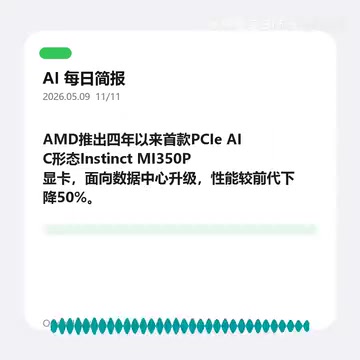
- AMD launched the Instinct MI350P GPU, its first PCIe AIC form factor product in four years, targeting data center upgrade scenarios with over 50% performance improvement over the previous generation.
Platform and Tool Updates
- Twilio launched its next-generation platform, positioned as the full-scenario conversational infrastructure layer for the agent era, providing underlying communication and interaction support for AI applications.
- OpenAI released a Codex extension for Chrome that supports testing web applications and reading multi-tab context, further expanding the application boundaries of AI programming tools.
- Three Chinese government departments jointly deployed initiatives to promote standardized application and innovative development of AI agents, with national standards for AI terminals also updated simultaneously, providing continued institutional support for AI development at the policy level.
Summary
From Google incorporating AI proficiency into interview assessments, to OpenAI launching a vertical security model, to open-source small models surpassing closed-source giants on specific tasks, the day's industry developments clearly outline three major trends in AI development: AI proficiency is becoming a fundamental literacy, vertical customization is becoming the direction of model evolution, and the open-source ecosystem is demonstrating powerful competitiveness in specific domains. Meanwhile, trillion-dollar valuations and pharmaceutical giants building their own AI factories remind us — the AI infrastructure arms race is far from over.
Related articles
 Tech Frontiers
GitHub Agent HQ Launch: AI Coding Tools Enter the Era of Platform Competition
GitHub Universe unveils Agent HQ platform for unified coding agent management, Copilot upgrades with multi-model support. OpenAI completes restructuring, Anthropic tests new model, NVIDIA open-sources AI models.
 Tech Frontiers
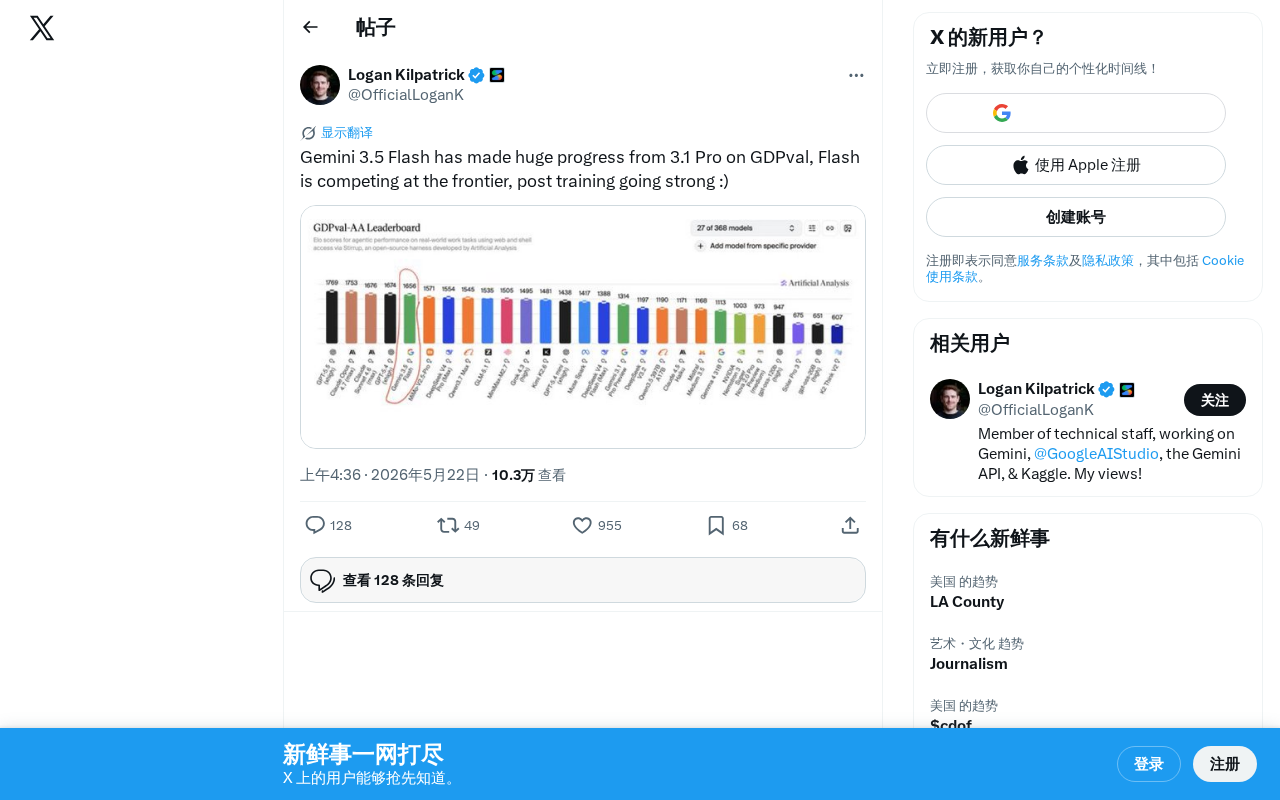
Gemini 3.5 Flash Achieves a Massive Leap on the GDPval Benchmark
Google Gemini 3.5 Flash surpasses Gemini 3.1 Pro on the GDPval benchmark. The lightweight Flash model leverages post-training techniques to approach frontier-level performance, redefining the balance between quality and cost.
 Tech Frontiers
Google Gemini Antigravity Weekly Quota Tripled — AI Coding Without Limits
Google Gemini triples Antigravity weekly quotas following a prior daily quota boost. Analyzing the impact on developers and its strategic significance in AI coding.