GPT-5.3 Codenamed "Garlic" Coming Soon, Claude Cowork Launches Targeting Non-Developers

Jan 14 AI roundup: GPT-5.3 incoming, Claude Cowork for non-devs, plus medical and agricultural AI breakthroughs.
January 14 brought a flurry of AI developments: OpenAI's GPT-5.3 codenamed "Garlic" is set to launch with potentially significant mathematical reasoning improvements; Anthropic released Claude Cowork, extending agentic coding capabilities to non-developers; Baichuan M3 leads in medical consultation and hallucination control; Nanjing Agricultural University open-sourced SiNong, China's first general agricultural LLM; and Anthropic rose to second place in total Token consumption.
On January 14, the AI industry saw a wave of major announcements: OpenAI's new model codenamed "Garlic" is about to debut, Anthropic launched Claude Cowork — an agentic coding tool designed for non-developers — and domestic breakthroughs were made in medical and agricultural large language models. This article covers the day's key developments and analyzes industry trends.
GPT-5.3 Codenamed "Garlic": OpenAI's Next Move
According to well-known leaker Dan McTeer, the model codenamed "Garlic" — widely rumored since last fall — is about to launch, and its official version may be named GPT-5.3. McTeer claims his source is "extremely reliable, with a 100% accuracy rate."
The new model is said to deliver more powerful performance and is linked to the OpenAI model that previously won a gold medal at the International Mathematical Olympiad (IMO). The IMO is considered the "Mount Everest" for measuring AI mathematical reasoning — its problems require multi-step rigorous logical deduction rather than simple numerical computation, placing extremely high demands on AI's symbolic reasoning, proof construction, and long-chain thinking capabilities. In 2024, OpenAI's o1 series models achieved gold-medal-level performance on the full IMO competition, powered by core technologies including Chain-of-Thought reasoning and reinforcement learning-driven reasoning optimization. If GPT-5.3 inherits these capabilities, it would hold a significant advantage in scenarios requiring rigorous logic, such as scientific computing, financial modeling, and code generation. This suggests GPT-5.3 may deliver a notable leap in mathematical reasoning ability.
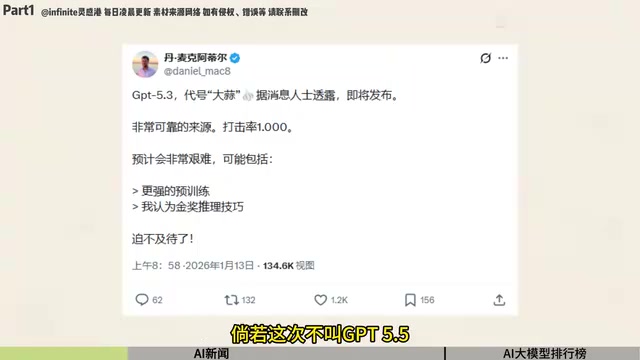
However, judging by OpenAI's naming conventions, if this release is called GPT-5.3 rather than GPT-5.5, it may not be a generational-level major update. Understanding this requires knowing the evolution of OpenAI's naming system: from GPT-3 to GPT-4, OpenAI used large version jumps, with each release representing a milestone capability leap. But starting with the GPT-4o series, OpenAI shifted to more granular version management, using decimal numbers to differentiate capability tiers. This strategy has clear commercial advantages: it maintains market buzz and media exposure while reducing R&D risk through incremental improvements, and provides subscribers with a continuous sense of "freshness." As a side note, the previously released GPT-5.2 also had close ties to the "Garlic" project, suggesting that "Garlic" may be an ongoing internal project codename for continuous iteration rather than a label for a single model.
From a strategic perspective, OpenAI has recently adopted a more intensive version iteration cadence, using a rapid small-step approach to continuously consolidate its market position, directly competing with Google Gemini's frequent update rhythm. The timing of GPT-5.3's release is also quite strategic — arriving just as competitors are rolling out new products.
Claude Cowork Launches: Anthropic Targets the Non-Developer Market
On January 12 (US time), Anthropic officially released Claude Cowork, an agentic coding tool designed for non-developers. Cowork's core capabilities include:
- File system access: Can access designated folders and perform read, edit, and create operations
- Parallel multi-task processing: Supports handling multiple tasks simultaneously to boost productivity
- Low barrier to entry: Specifically designed for users without technical backgrounds
Cowork is currently available only to subscribers. This product launch signals that Anthropic is extending AI coding capabilities from the professional developer community to a much broader user base.
To understand Cowork from a technical perspective, it helps to know the concept of "AI Agent": unlike the "Q&A-style" interaction of traditional AI assistants, an AI Agent can autonomously plan task steps, invoke external tools, and continuously execute multi-step operations until the goal is achieved. Its technical foundations include Function Calling/Tool Use, file system API integration, task memory and context management, and self-error-correction capabilities. Anthropic significantly strengthened tool-calling capabilities in the Claude 3 series and pioneered AI control of desktop environments through its "Computer Use" feature. Cowork can be seen as the productization of this technical roadmap for non-developer scenarios, with the core challenge being how to maintain security boundaries while enabling non-technical users to trust AI's autonomous operations on their local file systems.
Unlike developer-focused AI coding tools such as Cursor and Windsurf, Claude Cowork is positioned more as an "AI office assistant," enabling everyday users to accomplish file management and automation tasks through natural language instructions. This trend is worth watching: as AI coding tools begin serving non-developers, the vision of "everyone is a developer" is gradually becoming reality.
Domestic Large Models: Breakthroughs in Medical and Agricultural Verticals
Baichuan M3 Medical Large Model
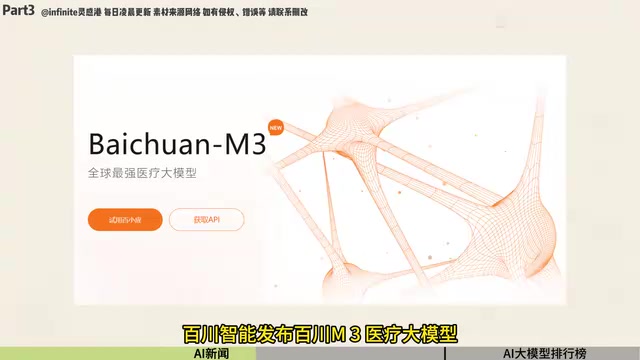
Baichuan Intelligence released the Baichuan M3 Medical Large Model, delivering impressive results across multiple key metrics:
- Ranked #1 in consultation capability
- Ranked #1 in medical hallucination control
- Ranked #1 across multiple health benchmark tests
- Surpassed GPT-5.2 and all human doctors in performance
The metric "ranked #1 in medical hallucination control" deserves deeper examination. "Hallucination" is the most critical technical challenge in medical AI — it refers to models generating medical information that sounds plausible but is actually incorrect. In medical scenarios, the cost of hallucination can be fatal: incorrect drug dosage recommendations, misleading diagnostic suggestions, or fabricated clinical study citations can all lead to severe consequences. Current mainstream hallucination control approaches include: Retrieval-Augmented Generation (RAG), which anchors model outputs to verifiable medical literature databases; Reinforcement Learning from Human Feedback (RLHF), where medical experts score and correct outputs; and confidence calibration techniques that enable models to proactively express uncertainty rather than forcing an answer when unsure. Baichuan M3's leadership in this dimension is a crucial technical prerequisite for its claim of "surpassing human doctors."
Baichuan Intelligence founder Wang Xiaochuan also revealed that Baichuan plans to go public by 2027. Healthcare has long been one of the most commercially valuable vertical tracks for AI large models, and the release of Baichuan M3 demonstrates that domestic companies' deep investment in vertical domains is beginning to yield competitive results.
Nanjing Agricultural University's "SiNong" Open-Source Agricultural Large Model
Nanjing Agricultural University released China's first open-source vertical large language model for general agriculture — SiNong. Key facts about the model:
- Collected over 4 billion Tokens of agriculture-specific data
- Released in 8B and 32B versions
- Fully open-sourced on ModelScope and GitHub
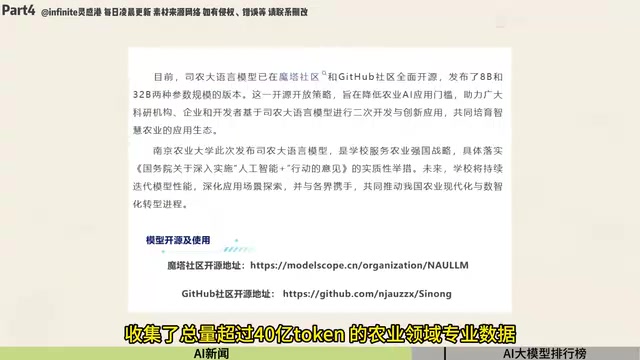
The open-source release of an agricultural large model is quite significant, and the choice of an open-source strategy reflects deep ecosystem logic. China's agricultural scenarios are extremely diverse, spanning hundreds of farming patterns from large-scale field crops in the Northeast to mountain agriculture in Yunnan — no single institution can independently cover data for all scenarios. The open-source strategy allows agricultural research institutes, agricultural technology extension agencies, and agtech companies across the country to perform localized fine-tuning on SiNong, creating a layered ecosystem of "foundation model + vertical fine-tuning." The 4-billion-Token agricultural corpus is its core moat — collecting and annotating such high-quality domain data is extremely costly, and open-source sharing effectively avoids redundant efforts across the industry. As a major agricultural nation, China has enormous demand for agricultural intelligence transformation, and SiNong's open-source strategy helps drive the development of the entire agricultural AI ecosystem, enabling more research institutions and enterprises to build upon it.
AI Model Market Landscape: Anthropic Rises to Second Place
According to the latest AI model market share data, weekday usage showed a clear rebound:
- Sonic 4.5 saw a 51% increase, ranking first
- OP4.5 surged 173%, ranking second
- HiQ 4.5 also rose 93%
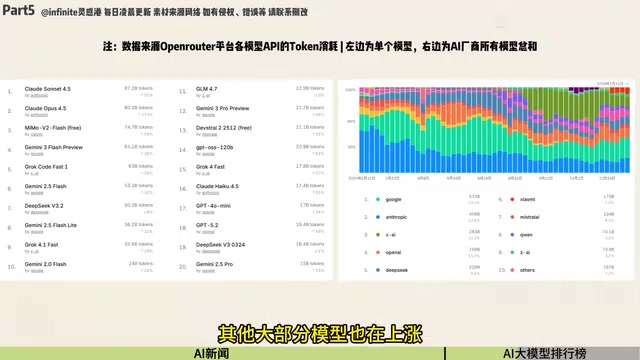
In terms of total volume, Anthropic rose to second place, with total Token consumption reaching 400 billion. Over the past six months, the top five market positions have remained stable, with the vast majority of share divided among Google, Anthropic, XAI, and DeepSeek.
To understand this data, it helps to know the significance of "Token consumption" as a market metric: a Token is the basic unit by which large language models process text (roughly corresponding to 0.75 English words or 1.5 Chinese characters). Token consumption directly reflects the actual workload of model invocations and better represents real computational resource consumption and commercial value than API call counts. Anthropic's total Token consumption reaching 400 billion and rising to second place reflects Claude's continued penetration in enterprise applications and developer ecosystems.
This data reveals several key trends: First, AI model usage is highly correlated with workdays, indicating that B2B and productivity scenarios remain the primary drivers rather than consumer entertainment or conversational use — this has direct implications for AI companies' product strategies, as enterprise-grade features, API stability, and data security compliance are becoming core competitive dimensions. Second, Anthropic's rapid growth shows that the Claude product line is gaining recognition from an increasing number of users. Third, DeepSeek's ability to maintain a top-five position as a domestic model demonstrates the competitiveness of Chinese AI models in the global market.
Summary
The AI developments on January 14 present a picture of progress on all fronts: leading companies continue iterating on general-purpose models, vertical domain models are making deep breakthroughs in healthcare and agriculture, and the barrier to using AI tools keeps falling. With GPT-5.3's imminent release and intensive moves from various players, competition in the AI industry is set to intensify further.
Related articles
 Tech Frontiers
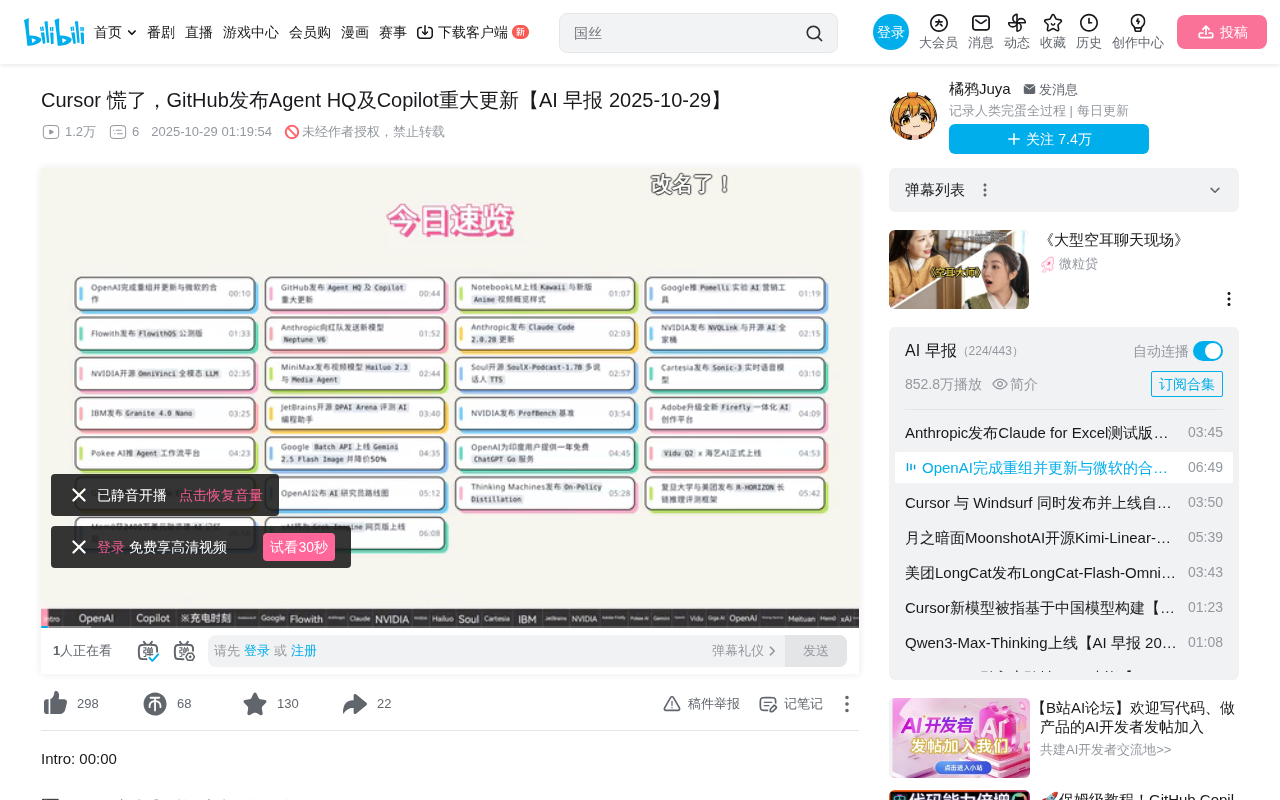
GitHub Agent HQ Launch: AI Coding Tools Enter the Era of Platform Competition
GitHub Universe unveils Agent HQ platform for unified coding agent management, Copilot upgrades with multi-model support. OpenAI completes restructuring, Anthropic tests new model, NVIDIA open-sources AI models.
 Tech Frontiers
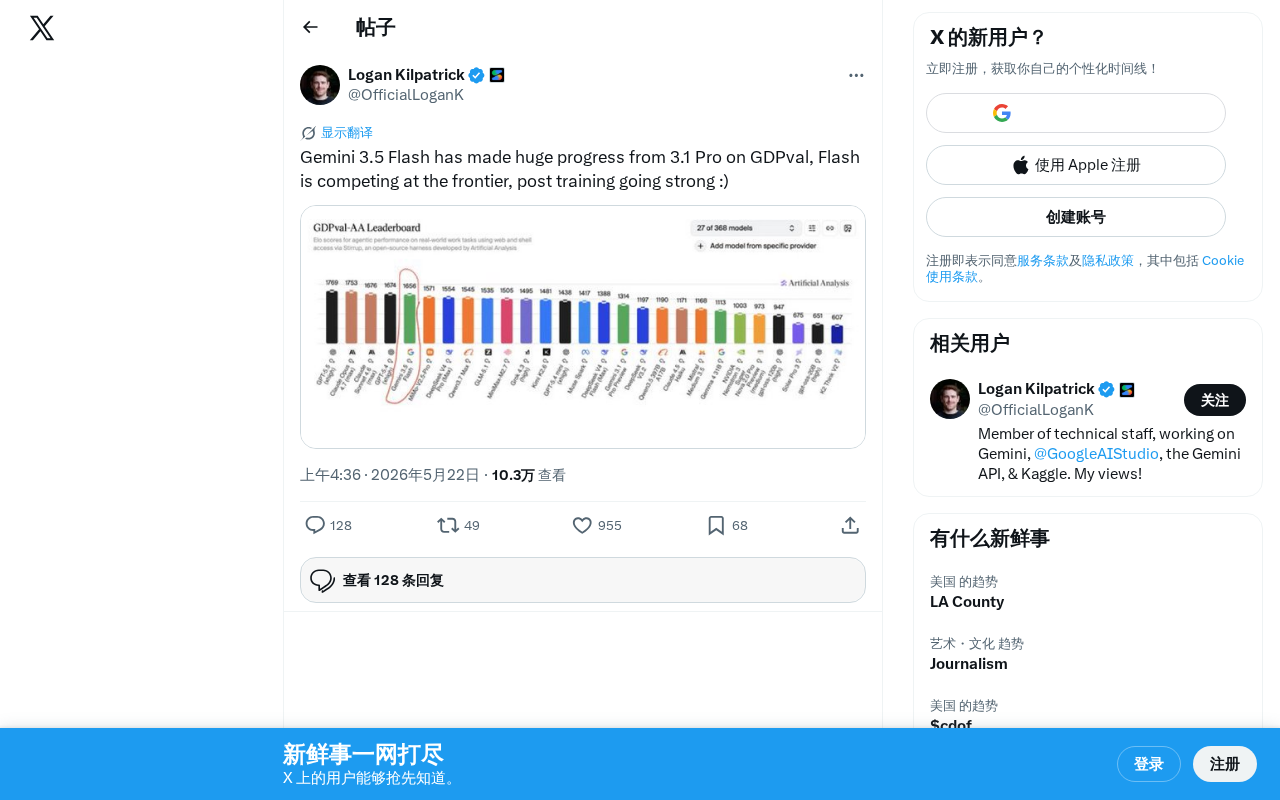
Gemini 3.5 Flash Achieves a Massive Leap on the GDPval Benchmark
Google Gemini 3.5 Flash surpasses Gemini 3.1 Pro on the GDPval benchmark. The lightweight Flash model leverages post-training techniques to approach frontier-level performance, redefining the balance between quality and cost.
 Tech Frontiers
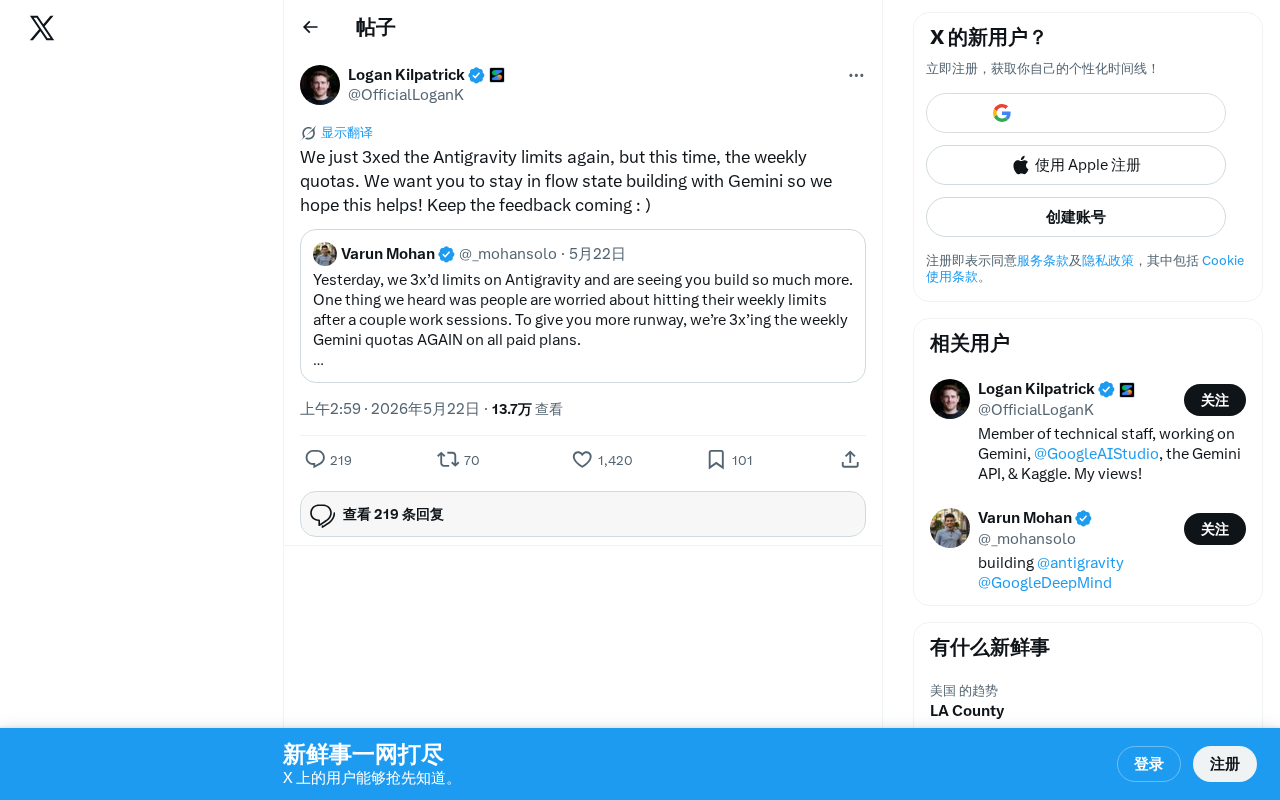
Google Gemini Antigravity Weekly Quota Tripled — AI Coding Without Limits
Google Gemini triples Antigravity weekly quotas following a prior daily quota boost. Analyzing the impact on developers and its strategic significance in AI coding.