OpenAI Codex Goes On-Premises, arXiv Introduces Collective Punishment for AI-Generated Papers

May 19, 2025: OpenAI goes on-premises, arXiv bans AI paper mills, LeCun blasts Hinton.
On May 19, 2025, the AI world saw multiple major developments: OpenAI partnered with Dell to deploy Codex on-premises for data-sensitive enterprises; arXiv introduced collective punishment bans for AI-generated junk papers with Terence Tao's endorsement; LeCun publicly criticized Hinton's AI threat stance and Meta FAIR's innovation decline; BAAI's Vita became China's first filed embodied intelligence model with Huawei alumni driving the sector; and Anthropic strategically acquired a dev tools company to strengthen ecosystem control.
On May 19, 2025, the AI world saw multiple major developments: OpenAI partnered with Dell to bring Codex into enterprise on-premises environments, arXiv imposed "collective punishment" penalties for AI-generated low-quality papers, LeCun publicly attacked Hinton, and the embodied intelligence sector saw new regulatory progress. This article breaks down each of these noteworthy developments.
OpenAI Partners with Dell: Codex Enters Enterprise On-Premises Environments
OpenAI officially announced a strategic partnership with Dell to deploy its coding assistant Codex in enterprise hybrid cloud and on-premises environments. This move directly addresses the core pain point for large and mid-sized enterprises — code and data cannot leave the premises.
Today's Codex is far more than a code completion tool. According to the latest data, Codex has surpassed 4 million weekly active developers, and its capabilities have expanded from pure code generation to enterprise-grade tool access, context understanding, report writing, and routing feedback — all Agent-level responsibilities. In other words, Codex is evolving from a "coding assistant" into an "enterprise-grade AI agent."
Codex was originally released in 2021 as a code generation model fine-tuned by OpenAI on GPT-3, serving as the underlying engine for GitHub Copilot. Its core capability is converting natural language descriptions into executable code. The "Agent responsibilities" mentioned here refer to AI systems that no longer passively respond to single instructions but can autonomously plan tasks, invoke external tools, maintain contextual memory, and complete multi-step complex workflows. This leap from "tool" to "agent" represents a fundamental shift in the AI application paradigm — developers no longer guide AI line by line but instead provide high-level goals for the AI to decompose and execute autonomously.

For industries extremely sensitive to data security — such as finance, healthcare, and defense — on-premises deployment means enjoying AI coding capabilities without uploading sensitive code to the cloud. The technical challenge of hybrid cloud and on-premises deployment lies in running large model inference (which originally relies on massive cloud GPU clusters) within limited local computing environments. This typically involves techniques such as model quantization, knowledge distillation, and inference optimization. Dell's deep expertise in enterprise servers and edge computing hardware provides an ideal infrastructure foundation for this kind of local deployment.
This marks OpenAI's accelerating push in the GPT-5.5 era from cloud dominance toward enterprise infrastructure penetration, forming deeper synergy with Microsoft Azure's enterprise strategy.
arXiv Cracks Down on AI-Generated Papers: Co-Author Collective Punishment with One-Year Bans
Academia is finally getting serious about AI-generated junk papers. Thomas Dietterich, chair of arXiv's computer science section, announced an extremely strict new policy:
- Any author found to have uploaded AI-generated low-quality papers will be banned for one year
- Collective punishment for co-authors: All co-authors will be penalized together
- Reinstatement conditions: Subsequent submissions must first pass peer review before regaining arXiv access

arXiv is an open-access preprint platform operated by Cornell University, founded in 1991, currently hosting over 2.4 million academic papers. Unlike traditional journals, arXiv uses a lightweight moderation mechanism (primarily checking whether content qualifies as academic) — papers can be published without full peer review. This mechanism is particularly important in the AI/ML field — due to the field's rapid pace, researchers commonly post preprints on arXiv first to establish priority, then submit to top conferences (such as NeurIPS, ICML, ICLR). However, this low barrier has also made it a prime target for AI-generated low-quality papers. It's estimated that computer science submissions in 2024 grew over 30% year-over-year, with a significant proportion showing signs of AI batch generation — such as hollow content, irreproducible experiments, and even residual ChatGPT-style phrasing.
Math prodigy Terence Tao also publicly expressed support for this initiative. The context behind this move is obvious — in the era of large language models, paper output has exploded while quality has plummeted. A flood of AI batch-generated low-quality papers is drowning arXiv, severely impacting the efficiency and credibility of academic communication.
The "collective punishment" design is particularly noteworthy. It means that even if you're merely a listed co-author, you bear joint responsibility for paper quality. This will fundamentally change academia's unspoken rule of "casual co-authorship," forcing every listed author to conduct substantive review of paper content. Researchers hoping to pad their CVs and publication counts with AI — think twice.
LeCun Publicly Attacks Hinton: A Fundamental Disagreement Among Deep Learning's Three Pioneers
LeCun has truly broken with Hinton this time. In his latest interview, he stated bluntly:
Hinton never believed in large language models before, then suddenly had an "epiphany" in 2023. He purely wanted to retire and coast, then go around giving speeches about AI threats.

To understand the weight of this dispute, we need to review the three's historical connections. Yann LeCun, Geoffrey Hinton, and Yoshua Bengio jointly received the 2018 Turing Award — computer science's highest honor — for their foundational contributions to deep learning. Hinton is known as the "father of backpropagation," LeCun invented convolutional neural networks (CNN), and Bengio made key contributions to sequence modeling and attention mechanisms. In 2023, after leaving Google, Hinton became an iconic figure in the AI safety movement, frequently warning about AI's potential existential risk. Bengio holds a similar position, having signed multiple open letters calling for AI regulation. LeCun, however, has consistently maintained that current large language models are far from artificial general intelligence (AGI), lack autonomous consciousness or goal-driven behavior, and therefore the so-called "AI threat" is severely exaggerated.
LeCun also took shots at Bengio and his former employer Meta. He believes that FAIR (Meta AI Research) has lost its soil for innovation. FAIR was founded in 2013, with LeCun serving as chief AI scientist for an extended period. The lab produced groundbreaking work in self-supervised learning, computer vision, and other areas. But LeCun pointed out that after Meta fully committed to the large model race, it can no longer do pure fundamental research, with internal friction and strategic disagreements running rampant.
As one of deep learning's three pioneers, LeCun has always been a staunch opponent of AI threat narratives. His disagreements with Hinton and Bengio on AI safety issues have existed for years, but such public and fierce criticism is a first. The essence of this dispute is a fundamental disagreement about whether AI development should be driven by fear or optimism — the former advocates preventing risks through strict regulation or even research moratoriums, while the latter believes excessive panic will hinder technological progress and hand dominance to authoritarian states.
Embodied Intelligence: Huawei Alumni Become Core Driving Force
The embodied intelligence sector saw two important developments on the same day.
First, the Beijing Academy of Artificial Intelligence's Vita model became the first embodied intelligence interaction large model in China to complete regulatory filing, marking a critical step in the compliance process for embodied intelligence.
Embodied Intelligence refers to embedding AI systems in physical entities (such as robots, drones), enabling them to perceive real environments, physically interact, and make autonomous decisions. Unlike pure software AI, embodied intelligence must solve the closed-loop problem of perception-decision-execution, involving multi-modal perception fusion, motion planning, force control, and other technology stacks. The "filing" refers to China's "Interim Measures for the Management of Generative AI Services" implemented since 2023, which requires all generative AI models providing public-facing services to complete algorithm registration with the Cyberspace Administration and pass safety assessments. The filing of an embodied intelligence interaction large model means it has met compliance requirements and can be legally deployed in commercial scenarios, setting a precedent for the entire sector's industrialization process.
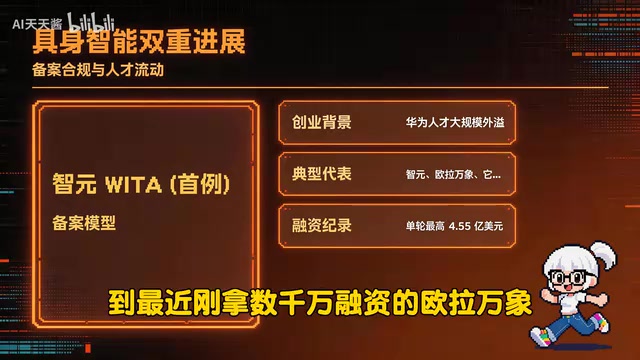
Second, according to in-depth observations by Quantum Bit (量子位), half of the founders in the current embodied intelligence startup ecosystem have Huawei backgrounds — from BAAI's Peng Zhihui to Euler Wanxiang, which recently secured tens of millions in funding. The spillover of Huawei talent is becoming the core driving force of this robotics wave.
This phenomenon is no coincidence. Huawei's engineering capabilities accumulated in communications, chips, and operating systems are highly compatible with the software-hardware coordination and system integration capabilities required for embodied intelligence. Huawei's long-standing internal "end-to-end" R&D culture — full-stack control from chip design to operating systems to upper-layer applications — happens to be the scarcest capability in the robotics industry. Previously, Huawei's car BU (vehicle business unit) successfully entered the automotive supply chain through intelligent driving solutions (such as the ADS system), with its core competitiveness coming precisely from system engineering capabilities accumulated in communications and chips. Whether Huawei alumni can replicate the car BU miracle in robotics is a topic worth continued attention.
Developer Tools Updates: GitHub Copilot and Anthropic's Moves
GitHub Copilot Quiet Update
GitHub Copilot added two practical features: first, Copilot CLI's remote control now officially supports mobile web and VS Code, meaning developers can remotely control terminal sessions from their phones; second, repository administrators can now audit Copilot cloud Agent configurations via REST API, enhancing enterprise-level governance capabilities. REST API (Representational State Transfer Application Programming Interface) is a standardized network interface design style through which enterprises can programmatically manage and audit AI tool usage to ensure compliance and security.
While not a model-level major update, this continuous refinement at the toolchain level is gradually changing developers' daily workflows.
Anthropic's Precision Acquisition

Anthropic completed a strategically significant acquisition — purchasing a developer tools startup used by OpenAI, Google, and Cloudflare alike. While the specific amount wasn't disclosed, the intent behind this "pulling the rug" move is clear: strengthening Claude 4.7 series' position in the developer ecosystem.
The current AI developer tools market is forming a three-way standoff: GitHub Copilot (Microsoft/OpenAI camp), Cursor (independent IDE, multi-model based), and Anthropic's Claude Code. Competition among these tools has expanded from pure code completion accuracy to complete development workflow coverage — including code review, test generation, documentation writing, CI/CD integration, and more. So-called "ecosystem control" is essentially platform economics logic: when developers' daily workflows become deeply bound to a particular AI toolchain, migration costs become extremely high, creating a powerful lock-in effect. Anthropic's acquisition of an infrastructure company used by multiple competitors is analogous to establishing exclusionary advantages upstream in the supply chain — a classic strategy in tech industry platform competition.
In the current deep waters of AI competition, controlling the toolchain equals controlling developer mindshare. Anthropic's move demonstrates that competition among AI companies has extended from model capabilities to the battle for ecosystem control.
Summary
From OpenAI's enterprise penetration to arXiv's academic crackdown, from AI pioneers' public feuds to the embodied intelligence industry explosion, the AI world's pace is indeed accelerating. Behind these seemingly independent events lies the inevitable friction, adjustment, and restructuring as AI technology moves from the laboratory to industrialization.
Key Takeaways
- OpenAI and Dell formed a strategic partnership to deploy Codex in enterprise on-premises environments, addressing data security concerns about code leaving the premises, with weekly active developers surpassing 4 million
- arXiv's computer science section introduced collective punishment for AI-generated papers: offenders banned for one year with all co-authors jointly penalized; Terence Tao publicly expressed support
- LeCun publicly attacked Hinton's AI threat stance and criticized Meta's FAIR for losing its innovative soil for pure research
- BAAI's Vita model became China's first embodied intelligence interaction large model to complete regulatory filing; Huawei alumni have become the core driving force in the embodied intelligence startup ecosystem
- Anthropic acquired a developer tools company used by OpenAI, Google, and others, as AI competition extends from model capabilities to ecosystem control
Related articles
 Tech Frontiers
GitHub Agent HQ Launch: AI Coding Tools Enter the Era of Platform Competition
GitHub Universe unveils Agent HQ platform for unified coding agent management, Copilot upgrades with multi-model support. OpenAI completes restructuring, Anthropic tests new model, NVIDIA open-sources AI models.
 Tech Frontiers
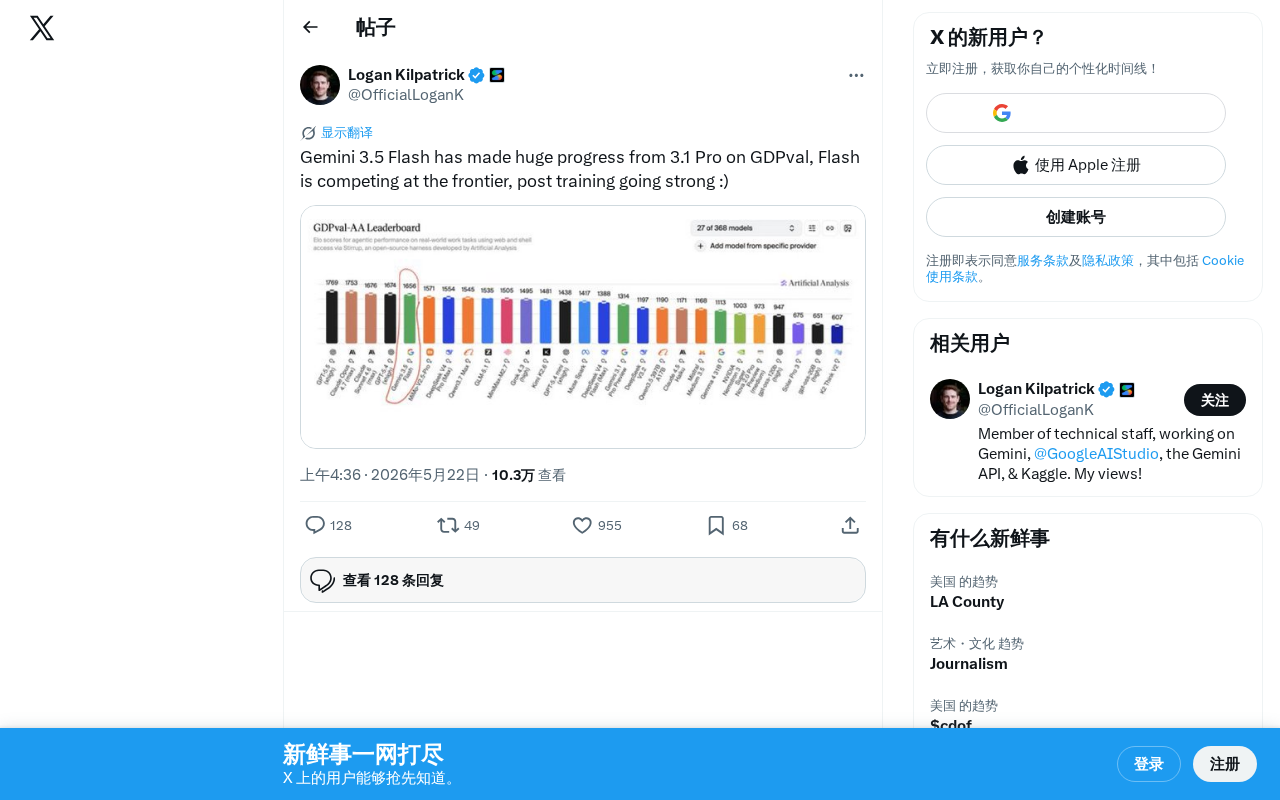
Gemini 3.5 Flash Achieves a Massive Leap on the GDPval Benchmark
Google Gemini 3.5 Flash surpasses Gemini 3.1 Pro on the GDPval benchmark. The lightweight Flash model leverages post-training techniques to approach frontier-level performance, redefining the balance between quality and cost.
 Tech Frontiers
Google Gemini Antigravity Weekly Quota Tripled — AI Coding Without Limits
Google Gemini triples Antigravity weekly quotas following a prior daily quota boost. Analyzing the impact on developers and its strategic significance in AI coding.