OpenAI Leadership Shakeup as Greg Brockman Returns, Cerebras IPO Hits $67B Valuation, Open-Source Agents Dominate GitHub

AI industry pivots from capability race to deployment race as productization and commercialization accelerate.
OpenAI co-founder Greg Brockman takes over product strategy, marking a shift toward product deployment. Cerebras Systems, backed by Altman, IPOs at $67B valuation, validating compute infrastructure's commercial value. Open-source AI Agent projects OpenHuman and OpenClack dominate GitHub, solving personal knowledge management and data retrieval pain points. In China, Alibaba Health launches a medical AI assistant and NetEase integrates DeepSeek, accelerating vertical deployment.
Key Takeaways
OpenAI co-founder Greg Brockman has officially taken over product strategy, Cerebras Systems—an AI chip company backed by Sam Altman—has successfully IPO'd with its market cap soaring to $67 billion, and two open-source AI Agent projects are dominating GitHub's trending charts. This article breaks down the deeper implications of each event and examines how the AI industry is shifting from a capability race to a deployment race.

OpenAI's Product Strategy Shakeup: Greg Brockman Returns to the Core
What Signal Does This Personnel Change Send?
OpenAI co-founder Greg Brockman has officially taken charge of the company's product strategy—far from a simple title change. Brockman was a key technical figure in OpenAI's early days, renowned for his engineering prowess and product delivery capabilities. His return signals that OpenAI is shifting its focus from pure model research toward product deployment.
It's worth noting that before co-founding OpenAI, Brockman served as CTO of Stripe, where he led the payment giant's technical architecture from startup to multi-billion-dollar valuation. He's known for exceptional engineering execution and an ability to transform complex technology into reliable product experiences. During the OpenAI board crisis in late 2023, Brockman briefly left the company. His return and assumption of product strategy leadership marks OpenAI's official entry into a "product-driven" phase. In the large model industry, pure benchmark scores are no longer the sole competitive dimension—user retention, developer satisfaction, and monetization capabilities are becoming the new core metrics.
What Changes Are Coming to the Developer Ecosystem?
This shift could directly impact the future direction of the GPT series, including flagship models like GPT-5.5 and the development priorities for low-cost variants. For developers, this signals that OpenAI will invest more heavily in product experience, API usability, and real-world application scenarios. The strategic balance is tilting from "building the most powerful model" to "building the most usable product."
Cerebras Systems IPO: A Milestone for the AI Chip Sector
Staggering First-Day Numbers
Cerebras Systems, an AI chip company that Sam Altman invested in early on, has officially listed on NASDAQ (ticker: CBRS), delivering a stunning debut:
- IPO Price: $185
- Opening Price: $350
- Intraday High: $386
- Closing Price: $311 (up 68%)
- Total Market Cap: Approximately $67 billion
This is the largest IPO of the year so far and the biggest U.S. tech IPO since Uber's listing in 2019. Altman himself holds approximately 89,000 shares, which surged to roughly $27.8 million in value on the first day of trading.
The AI Compute Competitive Landscape Is Being Rewritten
Cerebras's successful listing once again validates the strategic value of AI compute as infrastructure. In a GPU market dominated by NVIDIA, Cerebras has carved out a path with its unique wafer-scale chip architecture, offering diversified options for the AI compute market.
Cerebras's core technology is the WSE (Wafer Scale Engine). Traditional chip manufacturing involves cutting a wafer into hundreds of individual chips, but Cerebras takes the opposite approach—using an entire wafer as a single chip. Its latest-generation WSE-3 chip has an area of approximately 46,225 square millimeters, integrating 4 trillion transistors and 900,000 AI-optimized cores—over 50 times the area of NVIDIA's H100 GPU. The advantage of this architecture lies in eliminating inter-chip communication bottlenecks: data doesn't need to shuttle back and forth between multiple GPUs, dramatically reducing latency for large model training and inference. However, wafer-scale chips also face challenges in yield control, thermal management, and software ecosystem compatibility—technical barriers that Cerebras will need to overcome long-term.
The current global AI chip market exhibits a "one dominant player, many strong contenders" pattern. NVIDIA commands approximately 80% of the AI training chip market share through its CUDA ecosystem and GPU architecture, with data center revenue exceeding $47 billion in fiscal year 2024. But demand for "de-NVIDIA-ification" is growing: partly due to supply chain security concerns, and partly because different AI workloads have differentiated chip architecture requirements. Beyond Cerebras, Google's TPUs, AMD's MI series, and numerous AI chip startups (such as Groq, SambaNova, and Graphcore) are all competing for this trillion-dollar market. While Cerebras's $67 billion valuation is impressive, compared to NVIDIA's $3+ trillion market cap, there's still enormous room for imagination. Hardware compute remains the core battleground of AI competition, and early investors in the chip sector are reaping substantial returns.
Two Open-Source AI Agents Dominate GitHub
AI Agents are one of the core paradigms in current large model applications. Their essence is giving large language models the ability to autonomously plan, invoke tools, and interact with environments—rather than merely answering questions. From a technical architecture perspective, a complete AI Agent typically includes a perception layer (data input), planning layer (task decomposition and decision-making), execution layer (tool invocation and action execution), and memory layer (context management and knowledge storage). The two projects dominating the charts address critical pain points in the memory layer and perception layer respectively.
OpenHuman: AI That Proactively Gets to Know You
The GitHub project OpenHuman has been dominating the trending charts, gaining thousands of stars per day with total stars surpassing 9K. Unlike AI assistants that require users to slowly "train" them, OpenHuman's core philosophy is to proactively learn about you.
Its mechanism is quite innovative:
- Connects to 118 services including Gmail, GitHub, Slack, Notion, and more
- Automatically fetches new data every 20 minutes
- Compresses it into a local knowledge base (similar to Karpathy's LLM Wiki approach)
- No training period or adjustment phase needed—quickly masters user habits
The "Karpathy's LLM Wiki approach" mentioned here refers to a personal knowledge compression concept proposed by former Tesla AI Director Andrej Karpathy—compressing massive unstructured information through vectorization and summarization techniques into a knowledge base that LLMs can efficiently retrieve, achieving a "second brain" effect. OpenHuman engineers this concept into a working product: through automated data collection and compression, users can have a continuously updated personal knowledge graph without manual organization.
For developers frustrated by the Agent training process, this "zero-configuration, self-adaptive" design philosophy is genuinely refreshing.
OpenClack: Turning the Entire Internet into a Command Line
Another viral project, OpenClack, has surpassed 20K stars. Its core function is transforming the entire internet into a command-line tool. It solves the pain point of AI Agents being unable to directly access external websites:
- Supports structured retrieval of public data from Reddit discussions, Bilibili videos, arXiv papers, and more
- Can access private chat records from WeChat, Telegram, Discord, etc.
- A single terminal command retrieves data—no manual browser searching required
- Dramatically reduces the tokens consumed by models crawling web pages
From a technical perspective, OpenClack is essentially a unified data abstraction layer that converts unstructured web content from different platforms into structured, LLM-consumable data formats. This addresses a core pain point in current AI Agent development: models consume massive amounts of tokens parsing irrelevant page structure information when processing raw HTML. OpenClack's preprocessing increases effective information density by several times, significantly reducing Agent operating costs.
The common thread between these two projects: lowering the barrier to using AI Agents and making data acquisition and personal knowledge management more efficient.
Domestic AI Deployment Continues to Accelerate
Alibaba Health Launches Medical AI Assistant
Alibaba Health has officially launched a medical AI assistant, empowering the healthcare sector through AI technology. The assistant can not only assist doctors with diagnoses and provide medication recommendations but also offer intelligent consultation services to patients, potentially alleviating the pain point of uneven medical resource distribution.
Medical AI is one of the highest-barrier verticals, requiring solutions for medical data compliance (such as patient privacy protection and data de-identification), clinical validation (accuracy and safety of AI recommendations), and regulatory approval (medical device registration and the legal positioning of AI-assisted diagnosis). Alibaba Health's advantage lies in its accumulated massive medical data and complete pharmaceutical e-commerce ecosystem, enabling a closed-loop service from consultation and diagnosis to medication purchase. The deep integration of AI with vertical industries is accelerating.
DeepSeek's Commercialization Scores Another Win
NetEase News and NetEase Xiaomifeng have both announced full integration of the DeepSeek V large model. Users will experience more intelligent AI services in scenarios including news content generation, smart customer service, and information summarization. This is not only an important commercialization milestone for DeepSeek but also validates the competitiveness of domestic large models in real-world applications.
DeepSeek is an AI lab incubated by quantitative hedge fund giant High-Flyer. Its open-source DeepSeek model series has performed excellently across multiple benchmarks, approaching GPT-4 levels particularly in code generation and mathematical reasoning, but at a fraction of the inference cost. This "high performance + low cost" combination has made it a popular choice for Chinese enterprises integrating large models. The adoption by major companies like NetEase validates an important trend: domestic large models are progressing from "usable" to "good to use," and commercialization paths are expanding from simple API calls to deep customization and scenario co-creation.
Summary and Outlook
From these developments, it's clear that the AI industry is undergoing a critical pivot from a "capability race" to a "deployment race." OpenAI's personnel changes point toward productization, Cerebras's IPO validates the commercial value of compute infrastructure, open-source community Agent tools are solving real pain points, and major Chinese companies are accelerating vertical scenario deployment. The dominant theme going forward will be "bringing AI to the front lines"—whoever can convert technology into real productivity will win the next phase of competition.
Key Points
- Greg Brockman officially takes over OpenAI product strategy, signaling a shift from model R&D to product deployment
- Cerebras Systems surges 68% on NASDAQ debut, reaching $67B market cap—the largest U.S. tech IPO since 2019
- GitHub open-source projects OpenHuman and OpenClack go viral, solving pain points in personal knowledge management and internet data retrieval
- Domestic AI deployment accelerates: Alibaba Health launches medical AI assistant, NetEase apps fully integrate DeepSeek
- The AI industry is shifting from a parameter race to a real-world deployment competition
Related articles
 Tech Frontiers
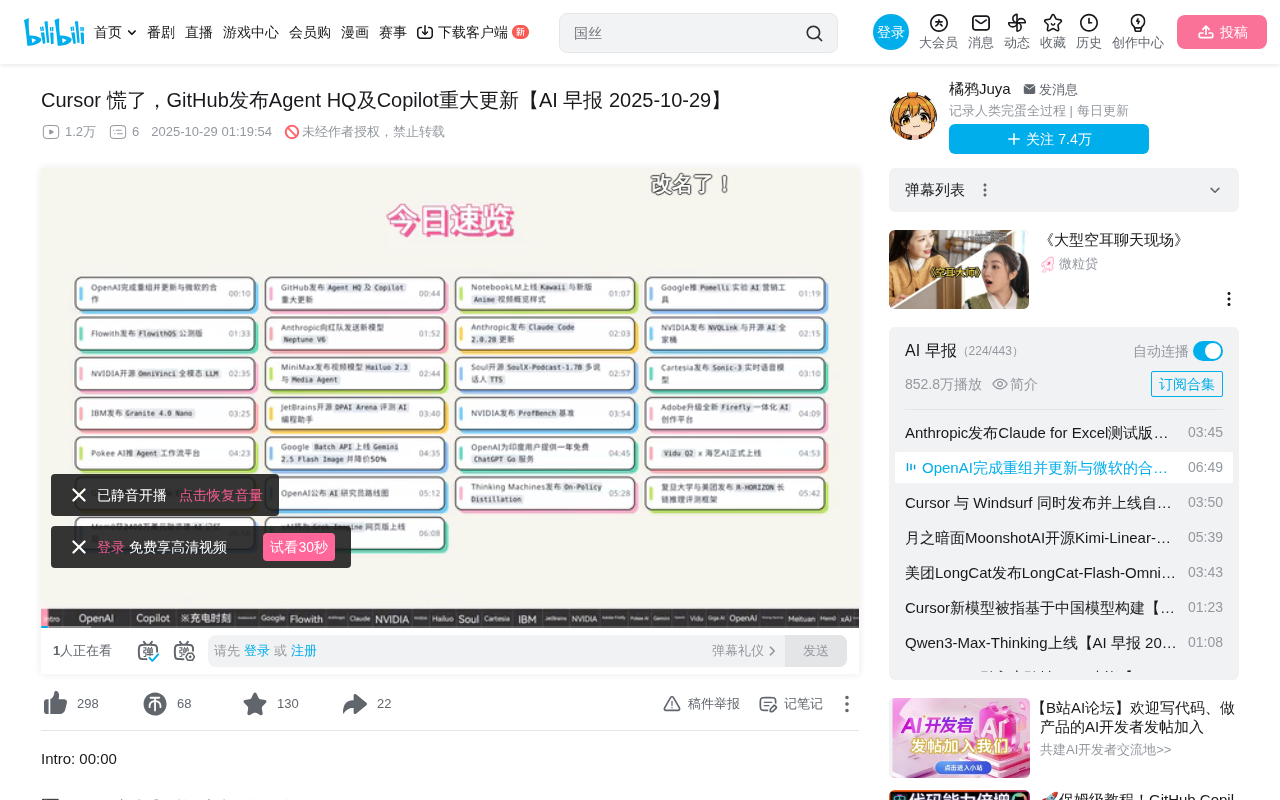
GitHub Agent HQ Launch: AI Coding Tools Enter the Era of Platform Competition
GitHub Universe unveils Agent HQ platform for unified coding agent management, Copilot upgrades with multi-model support. OpenAI completes restructuring, Anthropic tests new model, NVIDIA open-sources AI models.
 Tech Frontiers
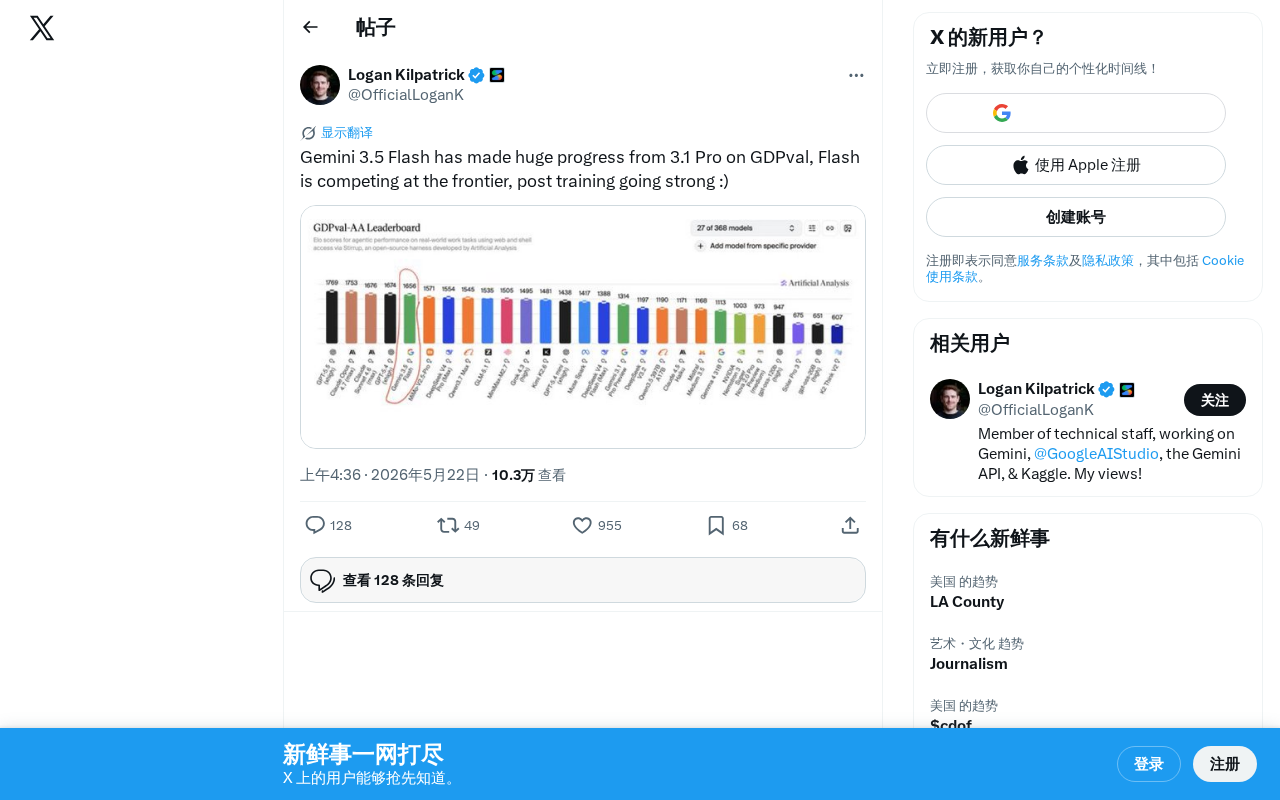
Gemini 3.5 Flash Achieves a Massive Leap on the GDPval Benchmark
Google Gemini 3.5 Flash surpasses Gemini 3.1 Pro on the GDPval benchmark. The lightweight Flash model leverages post-training techniques to approach frontier-level performance, redefining the balance between quality and cost.
 Tech Frontiers
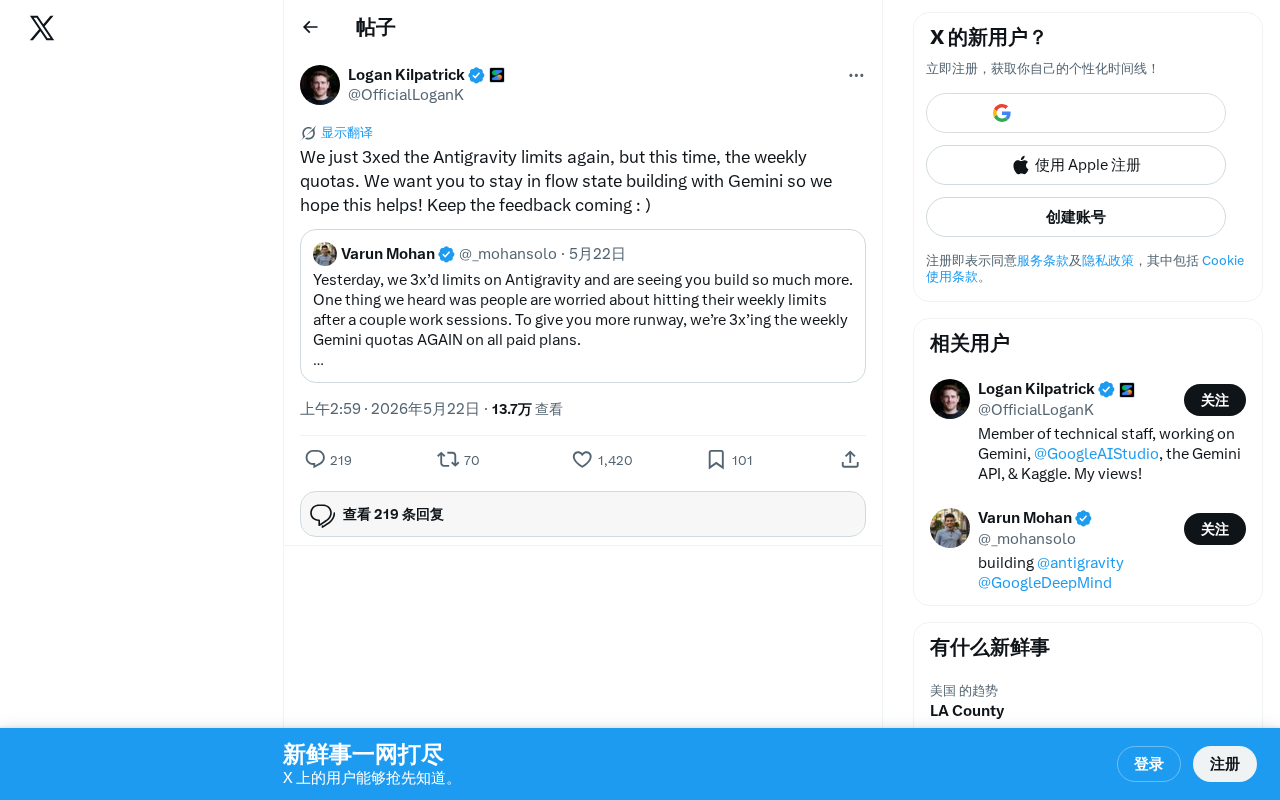
Google Gemini Antigravity Weekly Quota Tripled — AI Coding Without Limits
Google Gemini triples Antigravity weekly quotas following a prior daily quota boost. Analyzing the impact on developers and its strategic significance in AI coding.