The Complete Guide to Claude Code: From Personal Assistant to AI Agent Development
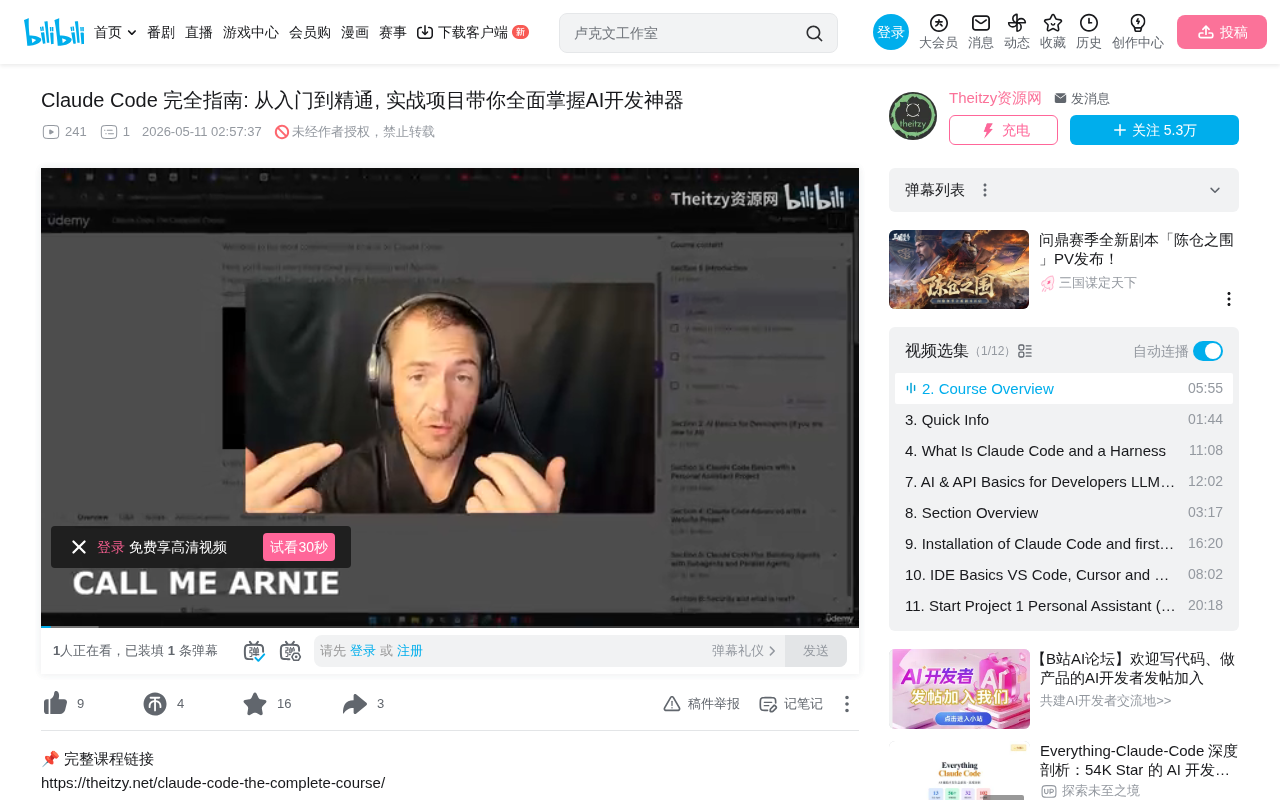
A systematic breakdown of the Complete Guide to Claude Code course content and learning path.
This article covers a systematic Claude Code course that spans from beginner to advanced through three progressive hands-on projects: personal assistant, web development, and AI Agent construction. The course focuses on context engineering with claude.md configuration, MCP protocol for extending Agent capabilities, test-driven development, multi-Agent architecture design (Sub-agents and Parallel agents), and Auto-Research self-evolution concepts, helping developers systematically master AI-assisted development.
Course Overview: Why Claude Code Deserves Deep Study
Recently, a systematic course called "The Complete Guide to Claude Code" has gained widespread attention in the developer community. Created by developer Arnie, this course covers every aspect of Claude Code from zero to advanced applications. This article will walk you through the core content architecture and key knowledge points of the course, helping you quickly build a complete capability map of Claude Code.
Notably, this course isn't a simple feature demonstration. Instead, it uses three progressively challenging hands-on projects—a personal assistant, web development, and AI Agent construction—to help learners master Claude Code's core capabilities through practice.
AI Development Fundamentals: Essential Knowledge for Getting Started
The first part of the course focuses on establishing foundational concepts. For AI development newcomers, the course includes a dedicated AI and API fundamentals module covering core concepts like LLM (Large Language Models), Tokens, and Function Calling.
Large Language Models (LLMs) are neural networks trained on the Transformer architecture, learning language patterns from massive text datasets to understand and generate natural language. Tokens are the basic units LLMs use to process text—they're not simply equivalent to words. A single English word may correspond to 1-3 tokens, while Chinese characters typically map to 1-2 tokens each. Understanding tokens is crucial because both API call costs and context window limits are measured in tokens. Function Calling serves as the bridge between LLMs and external systems, allowing models to identify user intent during conversations and invoke predefined function interfaces—one of the core mechanisms for building AI Agents.
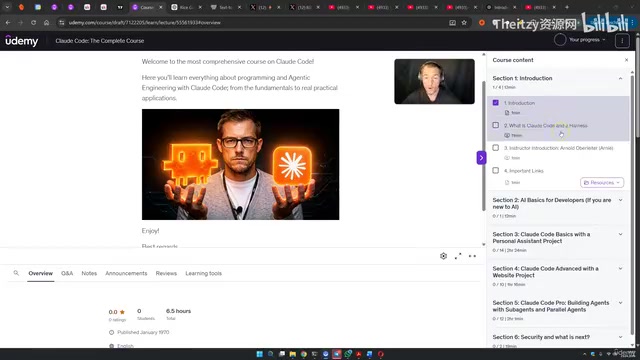
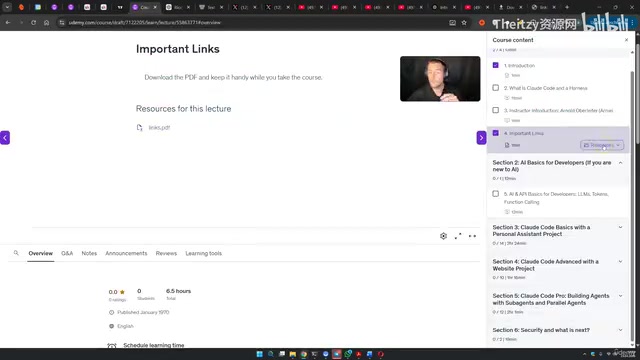
These concepts form the foundation for understanding how Claude Code works. If you're already familiar with these terms, feel free to skip ahead to the hands-on sections. The course also provides a PDF document containing all resource links, covering Claude Code installation documentation, GitHub repositories, VS Code, Cursor, various MCP servers, and other tool links—recommended for reference throughout your learning journey.
Hands-On Project 1: Building a Personal Assistant with Claude Code
Installation, Configuration, and Multi-IDE Support
The third part of the course is the first complete project—building a personal assistant with Claude Code. The learning path starts with installing Claude Code, followed by an introduction to basic operations across three major IDEs: VS Code, Cursor, and Google's IDX (Gravity). This multi-IDE coverage ensures users with different development preferences can find a workflow that suits them.
Context Engineering and claude.md Configuration
During project development, the course emphasizes the concept of Context Engineering. This is an important practice that emerged in the AI development field after 2024, popularized by Andrej Karpathy and others. Its fundamental difference from Prompt Engineering lies in scope: prompt engineering focuses on how to phrase things within a single conversation, while context engineering focuses on systematically managing the information structure accessible to AI throughout the entire development lifecycle—including project documentation, coding standards, historical decision records, tool call results, and more. The claude.md file is the concrete implementation of this philosophy: it serves as a persistent "project brief" for the AI, ensuring every session begins with the correct background knowledge, eliminating the need to repeatedly explain project context, and significantly improving development efficiency and output quality.
MCP Protocol: Connecting External Capabilities to Your Agent
MCP (Model Context Protocol) is a standardized protocol open-sourced by Anthropic in November 2024, designed to solve the fragmented integration problem between AI models and external data sources/tools. Before MCP, every AI application needed custom integration code for different external services, resulting in extremely high maintenance costs. MCP defines a unified client-server communication specification, allowing any protocol-compliant tool to plug into AI systems seamlessly. The MCP ecosystem now encompasses hundreds of server implementations covering databases, file systems, browser control, code execution, third-party APIs, and more.
The course demonstrates how to connect NotebookLM to the personal assistant, implementing RAG (Retrieval-Augmented Generation) and media content generation. RAG is the mainstream technical solution for addressing LLM knowledge limitations—pure LLMs have two inherent flaws: training data has a cutoff date, and they cannot access private knowledge bases. RAG works by retrieving relevant document fragments from external knowledge bases before generating answers, then injecting the retrieved results into the prompt context, enabling the model to respond based on the latest, private information. This combination of Skills and CLI usage dramatically expands the Agent's capability boundaries.
Permission Management and Personalization
The course also dives deep into Claude Code's permission and mode management. Through the soul.md file, you can define a unique "personality" for your Agent—particularly important when building user-facing assistants. Custom Slash Commands are another efficiency booster—you can save frequently used prompts as commands, executable in two seconds.
Automation Integration and Knowledge Base Construction
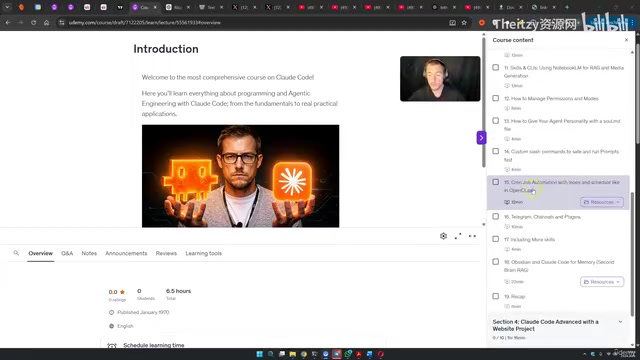
The course showcases automation features similar to the OpenAI platform, including loop execution and scheduled tasks (Cron Jobs). More practically, it demonstrates how to integrate Telegram with the personal assistant for instant messaging capabilities. Finally, by combining Obsidian with Claude Code, the course builds a personal knowledge base similar to Andrej Karpathy's "Second Brain" concept—a wiki system with backlinks that LLMs can directly search. Connecting your Obsidian vault to Claude Code with RAG enabled means AI can search your years of accumulated personal knowledge in real-time, generating truly personalized answers—this is the technical implementation path of the "Second Brain" concept.
Hands-On Project 2: Web Development and Advanced Claude Code Features
Complete Workflow from Development to Deployment
The fourth part explores Claude Code's advanced features through a web development project. The course covers the complete development lifecycle:
- Advanced Context Engineering: Skills application in more complex scenarios
- Test-Driven Development (TDD): Best practices combined with prompt engineering
- Browser Automation: Automated testing through CLI
- Version Control: Proper use of Git and GitHub
- Frontend Design Optimization: Fine-grained style adjustments
- Deployment: Website hosting with Vercel
Test-Driven Development (TDD) is a software development methodology where test cases are written before implementation code. Its core cycle is "Red-Green-Refactor": first write a test that necessarily fails (red), then write the minimum code to make the test pass (green), and finally optimize the code structure without changing functionality (refactor). Combining TDD with Claude Code offers unique advantages: developers can describe feature requirements and test cases in natural language, have Claude Code generate the test framework, then drive it to implement the actual functionality. This approach not only ensures code quality but also provides AI with clear "completion criteria," effectively reducing the problem of AI-generated code drifting from requirements.
Claude Design: AI-Powered Brand Design Solution
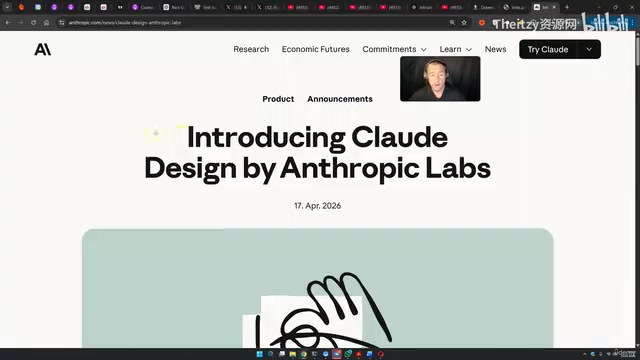
The course specifically introduces Anthropic's Claude Design product. This tool can generate complete stylesheets based on your personal brand and apply them to websites, slides, videos, animations, and various other scenarios. The key point is that these design assets can be directly imported into Claude Code, achieving seamless integration between design and development.
Hands-On Project 3: Building an AI Agent from Scratch
From User to Builder
The fifth part is the course's climax—building an AI Agent with Claude Code. This section elevates learners from Claude Code "users" to "builders":
- N8N Automation: Creating workflow automation with Claude Code
- Agent SDK: Building custom Agents using the Python Agent SDK
- Multi-Agent Architecture: Design and implementation of Sub-agents and Parallel agents
- Context 7 MCP: Advanced context management protocol applications
Multi-Agent architecture is the most cutting-edge system design paradigm in current AI engineering. Single Agents face context window limitations and insufficient task focus when handling complex tasks. Multi-Agent architecture breaks through these bottlenecks through task decomposition and collaboration. The Sub-agents pattern uses a hierarchical structure: an Orchestrator Agent handles task planning and decomposition, delegates subtasks to specialized sub-agents for execution, and ultimately aggregates results. Parallel agents allow multiple Agents to simultaneously process different task branches, dramatically reducing completion time for complex tasks. This architecture is particularly powerful in software development scenarios—for example, having different Agents handle frontend development, backend logic, test writing, and documentation generation respectively, advancing the entire project in parallel.
Self-Evolving AI Agents
The course introduces the Auto-Research concept proposed by Andrej Karpathy, exploring how AI can achieve self-improvement. The core idea of Auto-Research is that AI Agents not only execute human-specified tasks but can also autonomously identify their own knowledge gaps, design experimental plans, collect data, and integrate learning results back into their own knowledge systems. In the context of Claude Code, this means Agents can automatically search the latest technical documentation, test different implementation approaches, record successful experiences, and form a continuous improvement loop. Combined with Claude Desktop's Computer Use capability—the ability for AI to directly control desktop applications and browsers—the course demonstrates advanced features like remote control, Hooks automation, and log management, transforming this self-evolving Agent from a theoretical concept into a practically operable development tool.
Security Protection and Best Practices
The final part of the course focuses on security—often overlooked but critically important in AI development. The course provides practical security recommendations and offers a systematic summary of all slash commands.
Summary: A Systematic Learning Path for Claude Code
The course's design philosophy is crystal clear: Foundational Concepts → Personal Assistant (Beginner) → Web Development (Intermediate) → AI Agent (Advanced). The three projects build progressively, with each introducing new concepts and skills.
For developers looking to systematically learn Claude Code, the following core capabilities deserve special attention:
- Context Engineering: The key capability that distinguishes ordinary users from advanced users, centered on systematically managing the information structure AI accesses throughout the entire development lifecycle
- MCP Ecosystem: Understanding and leveraging the MCP protocol is core to extending Agent capabilities; the protocol enables hundreds of external tools to plug into AI systems seamlessly through unified communication specifications
- claude.md and soul.md: Project-level and personality-level configuration management as concrete implementations of context engineering
- Multi-Agent Architecture: The ability to design from single Agents to complex Agent systems, including hierarchical orchestration with Sub-agents and parallel collaboration with Parallel agents
Claude Code is iterating rapidly. Mastering these core concepts and practical methods will help you maintain your competitive edge in the wave of AI-assisted development.
Related articles
 Tutorials
Cursor + Codex Dual-IDE Collaboration: A Practical Methodology for Open-Source Project Customization
A complete methodology for open-source project customization based on real-world experience, detailing the Cursor+Codex dual-IDE workflow, seven-stage process, MVP validation, and AI source code reading techniques.
 Tutorials
Cursor Multi-Agent in Practice: Building a Full-Stack Next.js Blog in 50 Minutes
Build a full-stack blog in 50 minutes using Cursor IDE's multi-Agent mode with Next.js, Clerk auth, and Supabase. Learn the 4-phase AI Agent workflow and key integration pitfalls.
 Tutorials
Building an AI Software Factory from Scratch: A Cursor Engineer's Hands-On Experience with Multi-Agent Collaboration
Cursor engineer Eric shares practical insights on building an AI software factory: automation levels, guardrail design, parallel Agent management, and scaling to 1000+ Agents for 24/7 development.