Tutorial: Building a Low-Cost AI Code Editor with DeepSeek-V3 + VSCode

Complete tutorial for building a low-cost AI programming assistant with DeepSeek-V3 + VSCode + Continue plugin
This article explains how to build a highly cost-effective personal AI programming assistant using the DeepSeek-V3 large language model, VSCode editor, and the open-source Continue plugin. DeepSeek-V3 uses MoE architecture, delivering performance rivaling top closed-source models at extremely low cost—¥50 provides long-term usage. The article covers detailed installation and configuration steps, API Key management and security, and offers Ollama local deployment as a zero-cost alternative.
Why Choose DeepSeek-V3 as Your AI Programming Assistant
DeepSeek-V3 is a proprietary MoE (Mixture of Experts) large language model developed by DeepSeek. Its biggest highlight: training costs are only one-twentieth of GPT's, yet it outperforms open-source models like Qwen 2.5 and Llama 3.1 in multiple benchmarks, and even rivals the world's top closed-source models.
MoE (Mixture of Experts) is an efficient neural network architecture design. Unlike traditional dense models (which activate all parameters during every inference), MoE models divide the network into multiple "expert" sub-networks, activating only a subset of experts to process each input. DeepSeek-V3 has 671 billion total parameters but only activates approximately 37 billion per inference. This sparse activation mechanism allows the model to maintain powerful capabilities while significantly reducing computational costs and inference latency. This is one of the core technical reasons why DeepSeek-V3 achieves top-tier performance at extremely low training costs.
According to data from independent international evaluation sites, DeepSeek-V3 delivers excellent performance while its API pricing falls in the lowest tier. Particularly in logical reasoning and code generation, DeepSeek-V3 has a clear advantage, making it an ideal choice for building a personal AI programming assistant.
For developers, a ¥50 top-up provides approximately 25 million tokens of usage—enough for long-term use with exceptional value. Here's how token counting works: a token is the basic unit that large language models use to process text. For English, one token corresponds to roughly 4 characters or 0.75 words; for Chinese, one character typically maps to 1-2 tokens. DeepSeek-V3's API is priced at ¥0.1/million tokens for input and ¥0.3/million tokens for output (with even lower input prices on cache hits), meaning 25 million tokens can support thousands of complete code generation conversations. New users also receive 5 million free tokens upon registration—virtually zero cost to experience AI-assisted programming.
Step-by-Step Setup: From Installation to Configuration
Step 1: Install VSCode and the Continue Plugin
First, download and install VSCode from the official VSCode website. After installation, open VSCode for plugin configuration:
- Click the Extensions button in the left sidebar
- Search for "Continue" in the marketplace
- Click the Install button to complete the plugin installation
After successful installation, the Continue icon will appear in VSCode's left sidebar. Click it to enter the configuration interface. Continue is an open-source AI programming assistant plugin developed by the Continue.dev team (with over 20,000 stars on GitHub). Its design philosophy is to serve as a "model-agnostic" AI programming interface layer. Unlike GitHub Copilot, which is tied to OpenAI models, Continue supports integration with virtually all major LLM service providers (including OpenAI, Anthropic, DeepSeek, Ollama, etc.), allowing users to freely choose and switch between underlying models. It provides core features like chat conversations, code completion, code editing, and context referencing—essentially middleware that deeply integrates LLM capabilities with your IDE.
Step 2: Obtain a DeepSeek API Key
This is the most critical step in the entire process:
- Go to the DeepSeek official website and click the "API Access" link
- If you don't have an account, register first (first-time registration grants 5 million free tokens)
- Navigate to the API Key management page and click "Create API Key"
- Name your key (e.g., "VSCode Test"), and the system will generate a secret key string
⚠️ Important Warning: If your API Key is leaked, others can use it to call DeepSeek services, and charges will be deducted from your account. Keep it secure and never display it publicly.
Regarding API Key security mechanisms: an API Key is an authentication credential, similar to a "password" for accessing services. In LLM services, API Keys identify the caller and link to a billing account. Unlike traditional passwords, API Keys are typically displayed only once at creation and cannot be viewed in full afterward. If leaked, attackers can use the key to make massive API calls, with all resulting charges billed to the key owner's account. Industry best practices include: storing API Keys in environment variables rather than code, rotating keys regularly, setting usage limit alerts, and immediately revoking and regenerating keys upon discovering a leak.
Step 3: Configure the DeepSeek Model in Continue
Return to the Continue configuration interface in VSCode:
- Click "Add Model" and select DeepSeek from the provider list
- For model selection, DeepSeek offers "Coding Model" and "Chat Model" options—their actual capabilities are identical, so either works
- Paste the copied API Key into the corresponding input field
- Click Connect, and VSCode will enter the configuration confirmation screen
If the auto-completed model name shows a different type, you can manually copy and paste DeepSeek's model name into the configuration file. Once these steps are complete, the DeepSeek and VSCode integration is ready to go.
Practical Usage Demonstration
Conversational Programming: Generating Code from Natural Language
Once integration is complete, you can chat directly with DeepSeek in the Continue panel. For example, entering "Help me generate a web scraper for Douban data" will produce:
- Required Python libraries to install
- Complete scraper code
- Instructions on how to run it
- Important notes and caveats
The generated code can be directly copied into a new Python file for use.
Code Auto-Completion: A Copilot-Like Experience
When typing code in the editor (e.g., import pandas), intelligent completion suggestions will appear after a brief moment. Press Tab to accept the suggestion and complete the code. This experience is very similar to GitHub Copilot, but at a much lower cost.
The underlying principle of code auto-completion: when you type code in the editor, the Continue plugin sends the current file's context (including existing code, cursor position, related open files, etc.) as a prompt to the LLM. The model predicts the code you're most likely to write next based on this context and displays suggestions as grayed-out text. The entire process typically completes within a few hundred milliseconds to one or two seconds, with exact latency depending on network conditions and model response speed.
Zero-Cost Alternative: Local Model Deployment with Ollama
If you don't want to spend anything on API fees, there's a completely free option—deploy a large model locally using Ollama.
Ollama is an open-source local LLM runtime framework that simplifies the process of deploying and running large language models on personal computers. Under the hood, it's based on llama.cpp (an efficient C/C++ inference engine) and supports hybrid CPU/GPU inference. Ollama encapsulates complex steps like model downloading, quantization, and service startup into simple command-line operations, and provides a local API interface compatible with OpenAI's format.
Here's the approach:
- Install the Ollama platform
- Download a local model suitable for programming (e.g., Qwen 2.5 Coder)
- Select Ollama as the provider in the Continue plugin
- Choose the locally deployed model and start using it
The Continue plugin natively supports Ollama, and the configuration process is nearly identical to using the DeepSeek API. However, local deployment has certain hardware requirements—GPU memory (VRAM) in particular directly affects model inference speed. For hardware reference: running a 7B parameter model requires at least 8GB of RAM/VRAM, a 14B model needs 16GB, and larger models require proportionally more resources. Quantization techniques (such as 4-bit quantization) can compress model size to one-quarter of the original, enabling consumer-grade GPUs to run larger models with a slight loss in precision. For programming scenarios, specialized coding models with 7B-14B parameters (such as CodeQwen, DeepSeek-Coder, etc.) typically provide a solid code completion experience.
Summary and Recommendations
For most developers, the DeepSeek-V3 + VSCode + Continue combination is currently one of the most cost-effective AI programming solutions available. Compared to GitHub Copilot's $20/month subscription, this setup might cost just a few yuan for extended use.
If you want zero cost and have decent hardware (at least 8GB VRAM recommended), try the Ollama local deployment approach. Both solutions can coexist, and you can switch between them at any time in Continue. This flexibility is precisely the advantage of Continue's "model-agnostic" design philosophy—you can choose different models based on task complexity: use a local small model for quick responses on simple code completions, and switch to DeepSeek-V3 for higher-quality output on complex architecture design or algorithm implementation.
Key Takeaways
- DeepSeek-V3 uses MoE architecture with 671 billion total parameters but activates only 37 billion per inference. Training costs are one-twentieth of GPT's, with outstanding performance in code generation and logical reasoning
- A personal AI code editor can be built in three steps: VSCode + Continue plugin + DeepSeek API
- New users receive 5 million free tokens upon registration; a ¥50 top-up provides approximately 25 million tokens
- Two AI assistance modes are supported: conversational code generation and real-time code auto-completion
- A zero-cost alternative is available through Ollama for local deployment of coding models like Qwen; 7B models require only 8GB VRAM to run
Related articles
 Tutorials
Cursor + Codex Dual-IDE Collaboration: A Practical Methodology for Open-Source Project Customization
A complete methodology for open-source project customization based on real-world experience, detailing the Cursor+Codex dual-IDE workflow, seven-stage process, MVP validation, and AI source code reading techniques.
 Tutorials
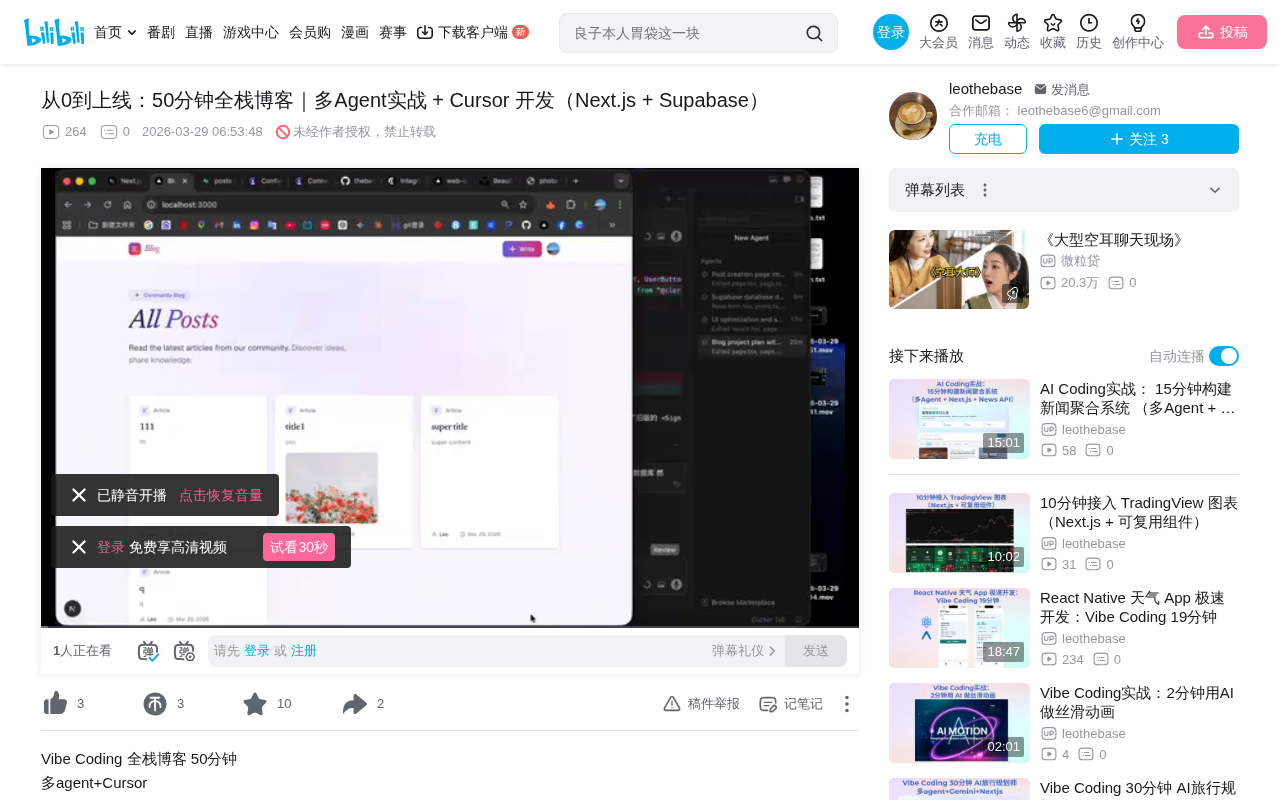
Cursor Multi-Agent in Practice: Building a Full-Stack Next.js Blog in 50 Minutes
Build a full-stack blog in 50 minutes using Cursor IDE's multi-Agent mode with Next.js, Clerk auth, and Supabase. Learn the 4-phase AI Agent workflow and key integration pitfalls.
 Tutorials
Building an AI Software Factory from Scratch: A Cursor Engineer's Hands-On Experience with Multi-Agent Collaboration
Cursor engineer Eric shares practical insights on building an AI software factory: automation levels, guardrail design, parallel Agent management, and scaling to 1000+ Agents for 24/7 development.