Review of a 648-Episode Complete Python Tutorial: Is It Worth Learning from Zero to AI Applications?
Review of a 648-Episode Complete Pytho…
Review of a 648-episode Python tutorial covering its structure, strengths, weaknesses, and learning advice.
This article reviews a 648-episode Python tutorial on Bilibili featuring a three-stage progressive design: fundamentals (environment setup and core syntax), intermediate (OOP and advanced features), and practical projects (web scraping, automation, data analysis, AI). The review acknowledges its systematic completeness, rich resources, and emphasis on practice, while noting the exaggerated "expert in one month" claim, questionable timeliness, and limited depth. Learners are advised to set realistic plans, practice actively, and choose a focus area.
Course Overview: A Tutorial Claiming to Be the Most Comprehensive Python Course
Recently, a Python tutorial series claiming to have "648 episodes" appeared on Bilibili (China's YouTube equivalent), covering a complete learning path from absolute beginner to web scraping, data analysis, and AI applications. The creator states it took three months to produce, with the goal of solving the problem of "mixed quality" in current Python tutorial videos.
The course has a clear target audience: complete beginners, aiming to help learners make the leap from introduction to practical application within one month through systematic course design. So, is the course structure well-designed? Is it worth investing time for newcomers who want to learn Python?

Course Structure: Three-Stage Progressive Design
Fundamentals: Environment Setup and Core Concepts
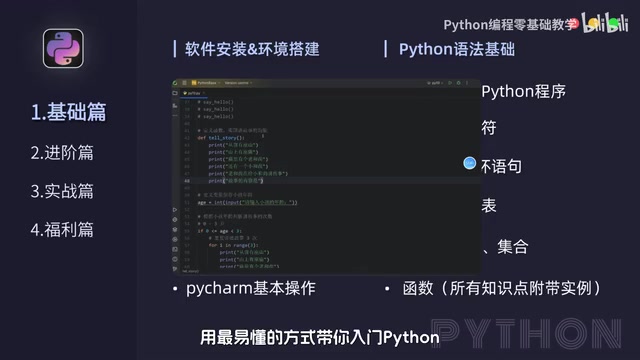
The course starts with setting up Python and PyCharm environments, which is a very practical starting point. PyCharm is a Python Integrated Development Environment (IDE) developed by JetBrains, available in a free Community Edition and a paid Professional Edition—the Community Edition is more than sufficient for beginners. Environment setup becomes the first hurdle for newcomers for several reasons: Python version selection (2.x was discontinued in 2020, so 3.x should be chosen), system environment variable configuration, understanding the concept of virtual environments (virtualenv), and using the pip package manager. Many beginners encounter various issues during the installation and configuration phase, so placing this content at the very beginning with detailed explanations effectively lowers the learning barrier.
The fundamentals section covers core content including:
- Variables and data types
- Control flow (conditional statements, loops)
- Function definition and invocation
These are the building blocks of Python programming, and no qualified introductory course should skip them.
Intermediate: Object-Oriented Programming and Advanced Features
The intermediate section focuses on two major programming paradigms: Object-Oriented Programming (OOP) and Functional Programming. This arrangement reflects thoughtful pedagogical design—after mastering basic syntax, understanding programming paradigms is key to writing "efficient, elegant, and reusable" code.
Object-Oriented Programming is a paradigm centered around "objects," using Classes to encapsulate data and behavior, with core concepts including encapsulation, inheritance, and polymorphism. Python is a multi-paradigm language that supports both OOP and functional programming. Functional programming emphasizes pure functions, avoiding side effects and mutable state—Python's lambda expressions, map/filter/reduce functions, and the functools module are all manifestations of functional programming. Understanding the appropriate scenarios for each paradigm—OOP for building complex systems and large projects, functional programming for data processing and concurrent scenarios—is an important marker of progression from junior to intermediate programmer.
Based on the course description, the intermediate section also includes Python's advanced features and techniques, likely covering decorators, generators, and context managers. A Decorator is Python syntactic sugar—essentially a higher-order function that takes a function as a parameter and returns a new function, commonly used for cross-cutting concerns like logging, permission verification, and performance timing. Flask's routing system makes extensive use of decorators. A Generator implements lazy evaluation through the yield keyword, significantly reducing memory usage when processing large datasets, and is Python's core mechanism for handling streaming data. A Context Manager implements automatic resource acquisition and release through the with statement—the most common application being file operations (with open()), with its underlying implementation relying on the enter and exit magic methods. These three features are important advanced characteristics that distinguish Python from other languages and represent the dividing line between "knowing Python" and "writing good Python."
Practical Projects: Skill Application Through Project-Driven Learning
The practical section is the highlight of the entire course, covering several popular application areas:
- Web Scraping: Crawling images, videos, and other resources
- Office Automation: Writing scripts to improve work efficiency
- Data Storage and Analysis: Data processing and visualization
- AI Applications: Connecting with today's hot artificial intelligence field
Python web scraping development typically involves a tech stack including the requests library (HTTP requests), BeautifulSoup or lxml (HTML parsing), the Scrapy framework (large-scale crawling), and Selenium (dynamic page rendering). As anti-scraping technologies advance, modern web scrapers also need to handle CAPTCHA recognition, IP proxy pools, and request rate limiting. It's worth noting that web scraping carries legal risks: since 2019, multiple criminal cases in China related to web scraping have drawn industry attention. Learners should understand the robots.txt protocol, the Data Security Law, and the Personal Information Protection Law, following basic principles of "not bypassing technical protection measures, not obtaining personal privacy data, and not affecting the normal operation of target servers."
Regarding AI applications, Python has become the language of choice in this field thanks to its rich machine learning and deep learning ecosystem: NumPy and Pandas provide efficient data processing capabilities, Scikit-learn covers traditional machine learning algorithms, and PyTorch and TensorFlow are the two mainstream deep learning frameworks. Since 2023, with the explosion of Large Language Models (LLMs), frameworks like LangChain and LlamaIndex have enabled Python developers to quickly build applications based on models like GPT.
Strengths and Weaknesses of the Course Design
Strengths
1. Systematic Completeness
The 648-episode volume indeed covers a wide range, and the three-stage structure from fundamentals to practice aligns with cognitive learning principles. For self-learners, having a complete Python learning path is far more efficient than piecing together scattered resources. The advantage of structured learning lies in reducing learners' "choice fatigue"—when facing a sea of fragmented tutorials, beginners often spend significant time choosing and comparing rather than actually learning.
2. Rich Supporting Resources
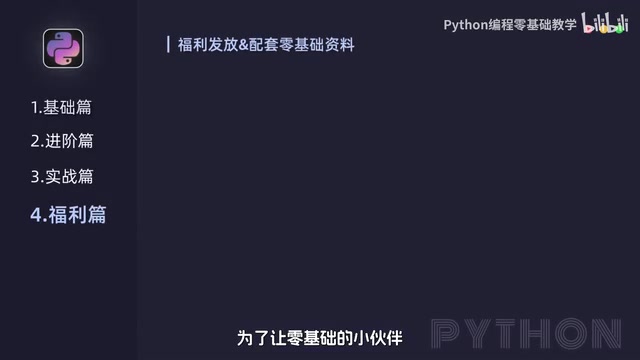
The creator provides mind maps, materials, installation packages, lecture notes, and e-books as supplementary materials. These auxiliary resources are particularly important for zero-foundation learners, helping them build a knowledge framework.
3. Emphasis on Practice and Hands-on Work
The creator specifically mentions "ample exercises after each lesson" and "combining knowledge with hands-on practice," which deserves recognition. Programming is an extremely practice-oriented skill—you can't learn it just by watching. According to Edgar Dale's Learning Pyramid theory, passive learning (listening, reading, audiovisual) has a knowledge retention rate of 10%-30%, while active learning (discussion, practice, teaching others) can achieve 50%-90% retention. Programming learning particularly aligns with "constructivist learning theory"—knowledge isn't passively received but actively constructed through solving real problems. The process of encountering bugs, debugging, and refactoring is itself where deep learning occurs.
Issues to Be Aware Of
1. The Claim of "Beginner to Expert in One Month" Is Overly Exaggerated
Even if each of the 648 episodes is only 5 minutes long, the total duration exceeds 54 hours. Adding practice and digestion time, completing the course in one month is already tight schedule-wise, let alone reaching "expert" level. According to cognitive psychologist Anders Ericsson's "deliberate practice" theory, expert-level proficiency in any field requires thousands of hours of purposeful practice. The same applies to programming—even basic programming competence requires repeated coding, debugging, and project practice to internalize into intuition. Learners should maintain realistic expectations.
2. Course Timeliness Is Questionable
The Python ecosystem updates rapidly, especially in AI applications. From Stable Diffusion in 2022 to ChatGPT in 2023 to multimodal models in 2024, the AI field sees disruptive new tools and frameworks emerging almost every few months. The claim of being "the most comprehensive" needs continuous verification. Learners are advised to pay attention to the course's update frequency and develop the habit of tracking technology community dynamics (such as GitHub Trending, Hacker News, and the official Python blog).
3. Depth Limitations of Free Courses
Free tutorials on Bilibili typically make trade-offs in depth, particularly in the practical project sections, which may not achieve the complexity of enterprise-level applications. Enterprise-level Python projects typically involve code architecture design, unit testing and CI/CD, performance optimization, security protection, and distributed deployment—dimensions that are difficult to fully cover in introductory courses. After completing foundational learning, learners still need to improve their abilities through participating in open-source projects or actual work projects.
Learning Recommendations: How to Efficiently Use This Type of Python Tutorial
For those who genuinely want to learn Python through this course, here are some suggestions:
-
Create a Realistic Study Plan: Don't chase speed. It's recommended to spend 2-3 months on the fundamentals and intermediate sections, then another 1-2 months focusing on a practical direction. Cognitive science research shows that Spaced Repetition is more conducive to long-term memory formation than cramming.
-
Learn by Doing: After learning each concept, immediately write code. The learning efficiency of merely watching videos doesn't exceed 20%. Consider using platforms like LeetCode or Codewars for targeted practice, or set yourself small projects (like writing a calculator or building a to-do app) to reinforce what you've learned.
-
Choose One Practical Direction to Go Deep: You don't need to master web scraping, data analysis, and AI applications all at once—focus on the area most relevant to your career direction. T-shaped professionals (broad knowledge + deep expertise in one area) are more competitive in the job market.
-
Supplement with Official Documentation: Video tutorials are great for getting started, but develop the habit of consulting Python's official documentation—this is key to long-term growth. The Python official documentation (docs.python.org) is not only the most authoritative reference material, but its Tutorial section is itself an excellent learning resource. Additionally, PEP (Python Enhancement Proposals) documents can help you understand the philosophical thinking behind Python's language design.
Conclusion
This 648-episode Python tutorial has a reasonable structural design, with its three-stage progressive learning approach aligning with fundamental principles of programming education. Rich supporting resources and emphasis on hands-on practice are also positive aspects. However, learners need to remain clear-headed about the marketing rhetoric of "becoming an expert in one month"—there are no shortcuts to improving programming skills, only continuous practice and project accumulation.
For zero-foundation learners wanting to get started with Python, this type of systematic free tutorial is a solid starting point, but it's only the beginning of the learning journey, not the destination. Real growth happens in the moment you close the video, open your editor, face a real problem, and try to solve it with code.
Related articles
 Tutorials
Cursor + Codex Dual-IDE Collaboration: A Practical Methodology for Open-Source Project Customization
A complete methodology for open-source project customization based on real-world experience, detailing the Cursor+Codex dual-IDE workflow, seven-stage process, MVP validation, and AI source code reading techniques.
 Tutorials
Cursor Multi-Agent in Practice: Building a Full-Stack Next.js Blog in 50 Minutes
Build a full-stack blog in 50 minutes using Cursor IDE's multi-Agent mode with Next.js, Clerk auth, and Supabase. Learn the 4-phase AI Agent workflow and key integration pitfalls.
 Tutorials
Building an AI Software Factory from Scratch: A Cursor Engineer's Hands-On Experience with Multi-Agent Collaboration
Cursor engineer Eric shares practical insights on building an AI software factory: automation levels, guardrail design, parallel Agent management, and scaling to 1000+ Agents for 24/7 development.