A Complete Python Tutorial for Beginners: From Fundamentals to Real-World Projects

A comprehensive Python beginner tutorial covering fundamentals, OOP, web scraping, automation, and data analysis.
This systematic Python tutorial for absolute beginners is divided into three modules: Fundamentals (environment setup, variables, control flow, functions, modules), Intermediate (OOP, regular expressions, file I/O, exception handling), and Hands-On Projects (web scraping, office automation, data analysis), with supplementary learning resources included. The course structure is well-designed and suitable for beginners seeking a systematic introduction, but the "most complete" claim should be taken with a grain of salt — solid mastery still requires 3–6 months of consistent practice.
Course Overview
A comprehensive Python tutorial for absolute beginners recently launched on Bilibili (China's leading video platform), claiming to be the "most complete" course available. It covers the entire learning path from environment setup to hands-on projects. The course took 6 months to produce and deconstructs the Python knowledge system from a beginner's perspective, combining theory with hands-on coding practice.
Python was first released by Guido van Rossum in 1991. Thanks to its design philosophy of being "elegant, explicit, and simple," it has consistently ranked at the top of the TIOBE Programming Language Index for years. Python follows a "batteries included" approach — its standard library covers a wide range of common scenarios including file handling, network communication, and database operations. Combined with over 400,000 third-party packages on PyPI, Python has become the most beginner-friendly programming language that can also handle industrial-grade development.
This tutorial is divided into three major modules: Fundamentals, Intermediate, and Hands-On Projects, creating a complete learning path from "knowing nothing about programming" to "being able to independently develop projects." Let's take a detailed look at the course structure and its learning value.
Fundamentals: Building a Solid Python Foundation
The fundamentals section serves as the foundation for the entire course, covering several core modules essential for getting started with Python:
- Environment Setup: Installing and configuring the Python development environment
- Variables and Data Types: Understanding Python's basic data structures
- Control Flow Statements: Program flow control including conditionals and loops
- Function Definitions: Code reuse and modular programming thinking
- Modules and Packages: Best practices for code organization and management
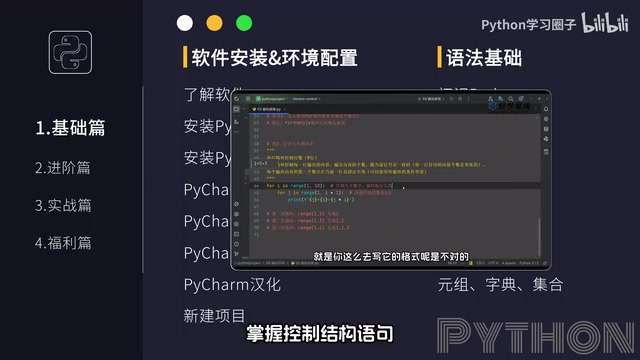
For absolute beginners, the most important thing at this stage isn't speed — it's truly understanding the logic behind each concept. What is a variable? Why do we need different data types? How do control structures make a program "think"? These seemingly simple questions often determine how far you can go in your learning journey.
It's worth noting that Python is a dynamically typed language — variables don't need to be declared with a type beforehand, as the interpreter automatically infers types at runtime. This lowers the barrier to entry, but it also requires learners to understand the characteristics and use cases of Python's data structures such as lists, dictionaries (dict), tuples, and sets. Choosing the right data structure often improves program performance more than optimizing algorithms.
Study Tips
The recommended study period for the fundamentals section is 2–4 weeks, with plenty of practice exercises to reinforce each concept. Watching videos without actually writing code is the most common mistake beginners make.
Intermediate: Object-Oriented Programming and Practical Skills
The intermediate section takes learners from "being able to write code" to "being able to write good code," covering the following topics:
Object-Oriented Programming (OOP)
OOP is the watershed moment in Python learning. Understanding concepts like classes and objects, inheritance and polymorphism makes code structure clearer and easier to maintain. This is the key step in transitioning from a "script writer" to a "software developer."
Object-oriented programming is a paradigm that encapsulates data (attributes) and the methods that operate on that data (behaviors) within a single unit (a class). In Python, everything is an object — even the integer 42 and the string "hello" are object instances under the hood. The four core OOP principles — encapsulation (hiding internal implementation details), inheritance (enabling code reuse), polymorphism (allowing the same interface to work with different types), and abstraction (extracting common behaviors) — together form the foundation for building scalable, large-scale systems. Once you master OOP, you'll find that the source code of Python's standard library and third-party frameworks (like Django and Flask) becomes readable, as they heavily employ these design patterns.
Practical Skills Modules
- Regular Expressions: A powerful tool for text matching and replacement, indispensable in data cleaning and web scraping. Regular expressions are essentially a mini-language that uses special symbols to describe text patterns, and Python provides support through the built-in
remodule. Although the learning curve is somewhat steep, once mastered, your efficiency in handling complex text will improve by orders of magnitude. - File I/O Operations: A fundamental skill for interacting with external data
- Exception Handling: Making programs more robust by gracefully handling various error conditions. Python uses the
try/except/finallymechanism, which separates normal logic from error-handling logic — resulting in more readable code compared to error-code-return approaches used in other languages.
These skills may seem independent, but they are highly interconnected in real projects. For example, when building a web scraper, you need regular expressions to parse web content, file operations to save data, and exception handling to deal with unexpected situations like network timeouts.
Hands-On Projects: Turning Python Knowledge into Productivity
The hands-on project section is the core selling point of this course, covering several of Python's most popular application areas:
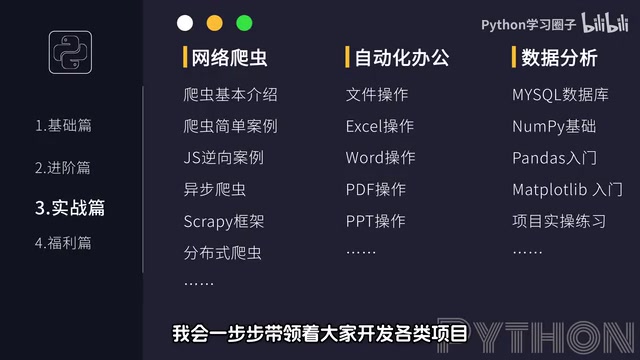
Web Scraping Development
Scraping images, videos, and other resources from websites is one of Python's most intuitive use cases. Through scraping projects, learners can quickly experience the efficiency gains that programming brings.
Python's web scraping tech stack is very mature: the requests library handles sending HTTP requests to fetch web content, BeautifulSoup and lxml are used for parsing HTML document structures, and the Scrapy framework is suitable for building large-scale distributed crawling systems. For dynamically rendered pages, you can also use Selenium or Playwright to simulate browser behavior. It's especially important to note that web scraping should comply with the target website's robots.txt protocol and respect data copyright and user privacy laws and regulations.
Office Automation Projects
Using Python to process Excel, Word, PDF, and other office documents to automate repetitive tasks is one of Python's most practical workplace skills, directly boosting daily work efficiency. Commonly used libraries include openpyxl for Excel, python-docx for Word, PyPDF2 for PDF, and pandas for batch data processing. A simple Python script can often compress hours of manual work into just a few seconds.
Data Analysis and Mining
Data storage, analysis, and mining form a complete data processing pipeline. In the AI era, data processing skills have become a fundamental requirement across all industries. Python's data science ecosystem centers around the core trio of NumPy (numerical computing), Pandas (data processing), and Matplotlib (visualization). For more advanced work, frameworks like Scikit-learn (machine learning), TensorFlow, and PyTorch (deep learning) provide a complete toolchain from data cleaning to model deployment.
Supplementary Resources and Study Planning
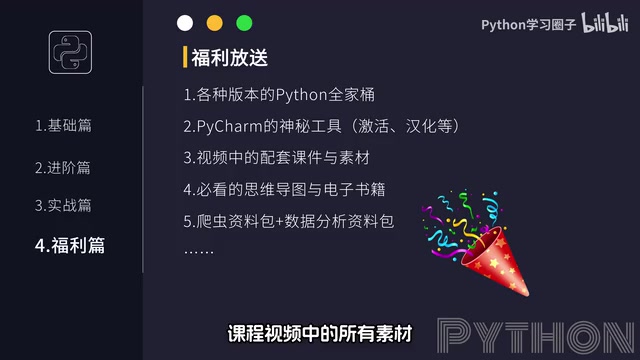
The course provides a fairly complete set of supplementary resources, including:
- Python development environment setup resource pack
- Study plan schedule
- Course materials and e-books
- Lecture slides and notes
The completeness of supplementary resources is very important for self-learners. A good study plan helps you allocate your time wisely, preventing you from getting stuck on one topic for too long or skipping important content.
Objective Review and Course Selection Advice
Strengths
The course has a well-designed structure with a clear progression from fundamentals to intermediate topics to hands-on projects. For absolute beginners, this kind of "one-stop" tutorial can genuinely reduce the time cost of switching between different learning resources.
Points to Keep in Mind
- Take the "most complete" claim with a grain of salt: No single course can cover every Python application scenario. Learners should selectively dive deeper based on their own goals.
- Depth of hands-on projects: Free courses typically feature entry-level projects. If your goal is employment, you'll need to supplement with more complex project experience.
- Learning pace: Don't be misled by claims of "learning quickly." Solidly mastering Python requires at least 3–6 months of consistent practice.
Who Is This Course For?
- Absolute beginners who want to systematically learn Python from scratch
- Developers with experience in other languages who want to quickly pick up Python syntax
- Working professionals who want to use Python to boost their work efficiency
Overall, as a free, systematic tutorial, it provides Python beginners with a relatively complete learning path. But the real learning outcome ultimately depends on the practice time and depth of thinking you invest.
Related articles
 Tutorials
Cursor + Codex Dual-IDE Collaboration: A Practical Methodology for Open-Source Project Customization
A complete methodology for open-source project customization based on real-world experience, detailing the Cursor+Codex dual-IDE workflow, seven-stage process, MVP validation, and AI source code reading techniques.
 Tutorials
Cursor Multi-Agent in Practice: Building a Full-Stack Next.js Blog in 50 Minutes
Build a full-stack blog in 50 minutes using Cursor IDE's multi-Agent mode with Next.js, Clerk auth, and Supabase. Learn the 4-phase AI Agent workflow and key integration pitfalls.
 Tutorials
Building an AI Software Factory from Scratch: A Cursor Engineer's Hands-On Experience with Multi-Agent Collaboration
Cursor engineer Eric shares practical insights on building an AI software factory: automation levels, guardrail design, parallel Agent management, and scaling to 1000+ Agents for 24/7 development.