A Practical Methodology for Dissecting Industrial-Grade Agent Source Code with 3 IDEs Working in Tandem

A methodology for dissecting industrial-grade Agent open-source projects using 3 IDEs in tandem
This article presents a methodology for collaboratively reading industrial-grade open-source project OpenCloud's source code using three IDEs — Codex, Claude Code, and Cursor. By dissecting the Client Layer, Gateway Layer, and Agent Runtime Layer step by step, it clarifies responsibility boundaries for each layer, produces specification documents, and ultimately generates a secondary development decision checklist. The core idea is assigning different cognitive tasks to the most suitable AI tools — extracting the architecture in three days and forming a development plan within a week.
Introduction: The Gap Between Demo-Grade and Industrial-Grade Agents
Anyone who's worked on Agent projects knows that getting a demo running and delivering an industrial-grade system are two entirely different things. With a demo-grade Agent, you pull it down, get it running, and you're done. But industrial-grade systems demand: multi-channel client access, gateways that can handle real pressure, authentication/authorization and routing, Agent Runtime management across model-tool-memory layers… Building all of this from scratch means at least six months of hard-won lessons.
The more critical issue is this — if you want to learn what industrial-grade Agent systems actually look like, there are virtually no reference implementations available. Anthropic's Agent Runtime isn't open source. Neither is OpenAI's. Most of what you find on GitHub are demo-grade implementations — they run, but they won't teach you industrial-grade thinking.
This article is based on a practical walkthrough shared by Bilibili creator Muyu, breaking down how he used 3 IDEs in tandem to read through the source code of the industrial-grade open-source project OpenCloud, and distilling a reusable methodology from the process.
The Paradigm Shift in Reading Source Code in the AI Era
The Barrier Has Collapsed, But Method Matters More Than Ever
Reading industrial-grade project source code used to be a privilege reserved for senior engineers — you needed time to grind through it, someone to guide you, and a solid enough foundation. Even if regular engineers wanted to learn, they simply couldn't chew through it, so everyone defaulted to "can't read it, forget it."
But now AI reads it for you. What used to take at least two weeks to get started can now have its skeleton extracted in three days. Once the barrier collapsed, engineers who previously got by with "I can't read it anyway" are being rapidly left behind.
Common Mistake: Asking the LLM to Dump the Entire Architecture at Once
Many people approach unfamiliar projects by prompting something like "Help me outline the complete architecture of this project" and expecting the LLM to spit it all out in one go. The result is a pile of vague, muddled output that leaves you just as confused as before — completely unusable.
The right approach is to dissect it layer by layer, step by step, tool by tool.
The 3-IDE Collaborative Code Reading Strategy
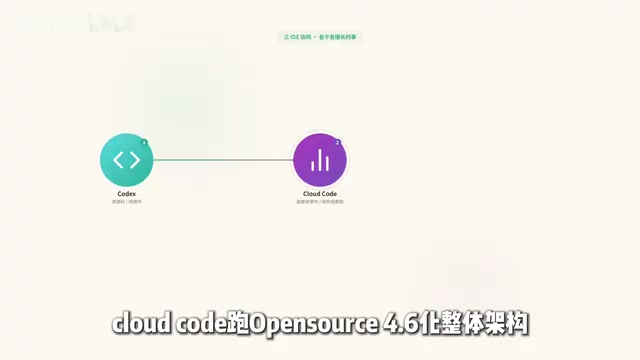
When dissecting an industrial-grade project at OpenCloud's scale, Muyu adopted a three-IDE collaborative workflow:
| IDE/Tool | Model | Best For |
|---|---|---|
| Codex | GPT 5.3 | Reading source code details, grinding through specific implementations |
| Claude Code | OPUS 4.6 | Drawing overall architecture, most stable structural sense |
| Cursor | - | Local file modifications and visual cross-referencing |
Each tool handles what it's best at, delivering a tier above what any single tool could achieve alone. The core of this approach isn't the tools themselves — it's assigning different cognitive tasks to the most suitable AI capability.
Deep Dive into OpenCloud's Three-Layer Architecture
Layer 1: Client Layer
Web UI, WeChat Mini Programs, iOS, Android, custom clients — all connect to the Gateway through a unified set of interfaces. This layer is the only place you need to modify when doing secondary development, because the input layer is where your business logic lives.
Key elements to focus on:
- Interface specifications
- Connection protocols
- Security closure mechanisms
Layer 2: Gateway Layer (The Hardest Part)
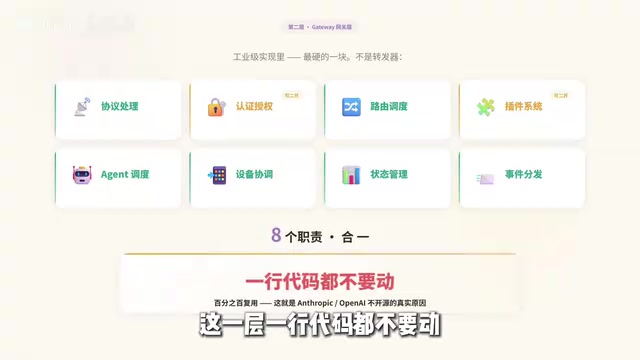
This is the most critical part of OpenCloud's industrial-grade implementation. It's not a simple forwarder — it's a complex system combining eight responsibilities into one:
- Protocol handling
- Authentication & authorization
- Routing & dispatch
- Plugin system
- Agent scheduling
- Device coordination
- State management
- Event distribution
Muyu's assessment is very direct: Don't touch a single line of code in this layer — reuse it 100%. This is also the real reason Anthropic and OpenAI don't open source theirs — writing this kind of gateway yourself means six months of pitfalls. It's the core moat of any industrial-grade system.
Layer 3: Agent Runtime Layer
The underlying layer is built on the PI Agent framework (not a LangChain runtime), divided into three sub-layers:
- Model Layer: Interfaces with all mainstream models following the OpenAI API specification
- Tool Layer: Tools, MCP, and Skills working as a coordinated trio
- Memory Layer: Layered management of short-term memory, long-term memory, and vector retrieval
This layer is the primary extension point when building custom Agents. Once you understand the boundaries of these three layers, you know exactly where to make changes and where to leave things alone.
The Four-Step Methodology: A Reusable Source Code Dissection Framework

After dissecting all three layers, you'll have three specification documents in hand: client specs, gateway specs, and Agent Runtime specs. Muyu's standard process is:
- Read the top level: Start with the project's overall layering and entry points
- Layer-by-layer dissection: Dive deeper into each layer, clarifying responsibility boundaries
- Specification documents: Output interface specs and design constraints for each layer
- Secondary development decisions: Determine what to reuse, what to extend, and what to rewrite
Following this rhythm: three days to extract the architecture, one week to produce a secondary development checklist.
Once abstracted from OpenCloud, this methodology applies to all industrial-grade open-source projects. OpenCloud is just the teaching material this time — the core value lies in the transferability of the method itself.
Practical Application Scenarios
This capability is most valuable for three types of people:
- Job seekers targeting AI positions: Being able to dissect industrial-grade source code is currently the hardest credential to beat
- People driving Agent project deployment at their companies: Need to quickly understand and reuse mature architectures
- Indie developers: Want to build Agent products from a solid starting point, needing industrial-grade references rather than demo-grade imitations
Conclusion
The biggest change in the AI programming era isn't "you don't need to write code anymore" — it's the redistribution of cognitive barriers. Not being able to read industrial-grade source code used to be normal; now it means you're not using the right methods. 3-IDE collaboration, layer-by-layer dissection, specification document output — this workflow transforms "understanding industrial-grade projects" from a senior engineer's privilege into a standardized process backed by methodology.
What matters isn't which AI tool you use, but whether you've developed layered thinking: knowing what questions to ask at each layer, which tool to use, and what documents to produce. That's the true meaning of one person doing the work of a full team.
Related articles
 Tutorials
Cursor + Codex Dual-IDE Collaboration: A Practical Methodology for Open-Source Project Customization
A complete methodology for open-source project customization based on real-world experience, detailing the Cursor+Codex dual-IDE workflow, seven-stage process, MVP validation, and AI source code reading techniques.
 Tutorials
Cursor Multi-Agent in Practice: Building a Full-Stack Next.js Blog in 50 Minutes
Build a full-stack blog in 50 minutes using Cursor IDE's multi-Agent mode with Next.js, Clerk auth, and Supabase. Learn the 4-phase AI Agent workflow and key integration pitfalls.
 Tutorials
Building an AI Software Factory from Scratch: A Cursor Engineer's Hands-On Experience with Multi-Agent Collaboration
Cursor engineer Eric shares practical insights on building an AI software factory: automation levels, guardrail design, parallel Agent management, and scaling to 1000+ Agents for 24/7 development.