Advanced LangGraph in Practice: Complete Guide to Agent Optimization, Evaluation, and Cloud Deployment
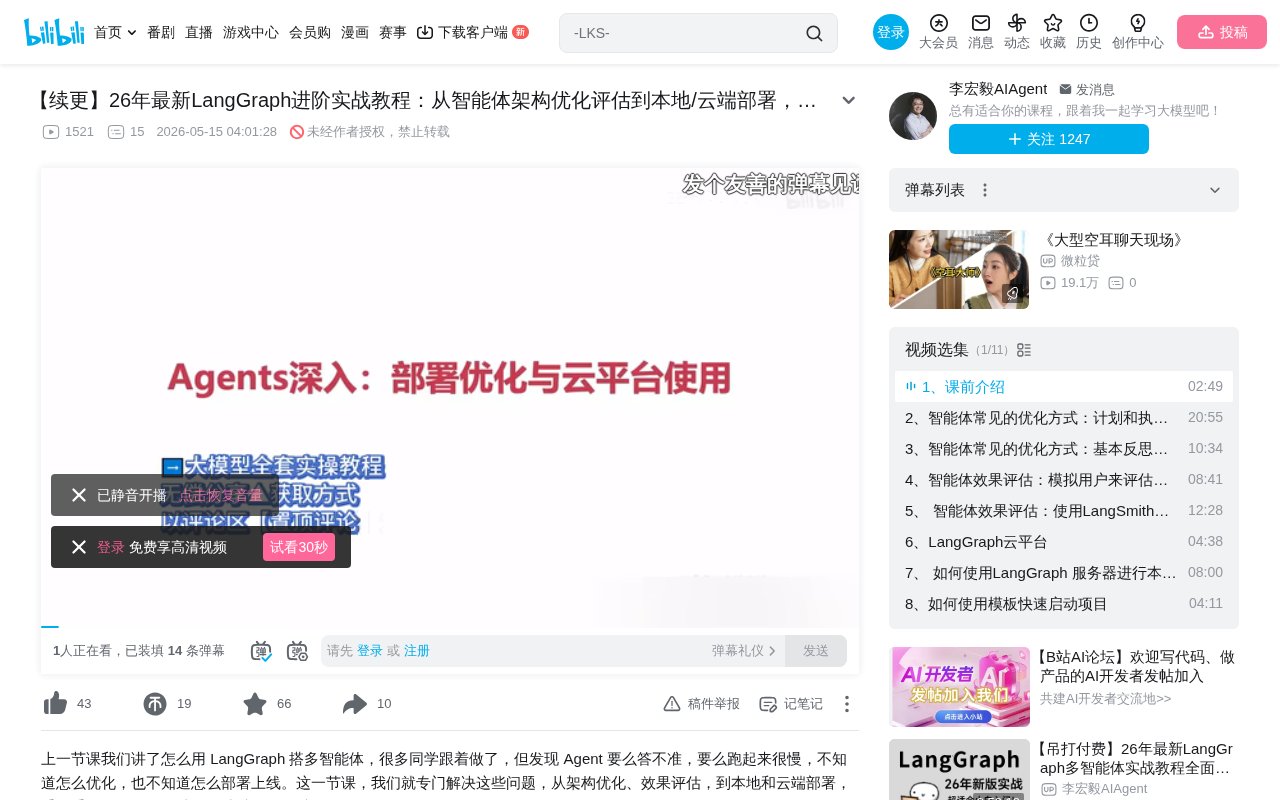
Advanced LangGraph guide covering agent optimization, evaluation methods, and cloud deployment for production.
This article systematically covers three core advanced LangGraph development topics: multi-agent architecture optimization (including hierarchical, collaborative, and adversarial patterns plus communication efficiency), agent evaluation frameworks (LLM-as-Judge, trajectory evaluation, and other methods for non-deterministic outputs), and LangGraph Cloud Platform's build, deploy, and observability capabilities—providing a complete technical pathway from Demo to production.
Overview
After mastering the basics of LangGraph and multi-agent architectures, developers face the next challenge: how to make agent systems perform better in production environments, how to scientifically evaluate their effectiveness, and how to efficiently deploy them to the cloud. Based on the latest advanced LangGraph tutorials from Bilibili, this article systematically covers three core topics in the agent deep optimization phase.
Agent Architecture Optimization Strategies
Optimization Approaches: From Single-Agent to Multi-Agent
The single-agent paradigm is relatively rigid with limited optimization potential. Multi-agent systems, however, offer much more room for optimization due to their diverse architectural patterns—including hierarchical, collaborative, adversarial, and other modes.
Hierarchical architecture refers to a setup where a "manager" agent handles task allocation and result aggregation, while lower-level agents each perform specific subtasks—similar to corporate management hierarchies. This is suitable for scenarios with clear task boundaries and well-defined decomposition. Collaborative architecture places multiple agents on equal footing, working together through shared state or message passing to complete tasks cooperatively—ideal for complex decision-making scenarios requiring multi-perspective synthesis. Adversarial architecture borrows from the adversarial concept of GANs, having multiple agents propose different solutions to the same problem and selecting the optimal one through a judging mechanism—suitable for scenarios requiring high-quality creative output or cross-validation.
Core optimization directions include:
- Architecture selection optimization: Choose the most appropriate multi-agent collaboration mode based on specific business scenarios, rather than blindly pursuing complex architectures. For example, a simple customer service Q&A scenario might only need a single agent with tool calling, while complex research report generation might require a hierarchical architecture to coordinate search, analysis, writing, and other specialized agents.
- Communication efficiency optimization: Reduce unnecessary information transfer between agents to lower Token consumption and latency. In multi-agent systems, every inter-agent message transfer means additional LLM call overhead. Taking GPT-4 as an example, the cost per 1000 tokens is approximately $0.03-$0.06, and a poorly designed multi-agent system could see costs multiply due to redundant communication. Optimization strategies include information compression (passing only key conclusions rather than complete reasoning processes), asynchronous communication (non-blocking message passing), and caching mechanisms (avoiding redundant computation).
- Task decomposition optimization: Properly delineate responsibility boundaries for each agent to avoid functional overlap or gaps.
Key Considerations for Optimal Performance
In practice, developers are most concerned with how to achieve optimal agent output quality. This involves not only fine-tuning prompt engineering, but also:
- Fine-grained state management design: One of LangGraph's core design principles is modeling the agent's execution process as a Stateful Graph. State in LangGraph is typically defined using TypedDict or Pydantic models, carrying critical information such as conversation history, intermediate computation results, and tool call records. Fine-grained state design means finding the balance between "sufficient information" and "state bloat"—retaining enough context for agent decision-making while avoiding oversized state objects that increase serialization overhead or exceed the LLM's context window limits.
- Proper configuration of conditional routing logic: Conditional Edges are the core mechanism in LangGraph for controlling workflow direction. They determine which node to execute next based on the current state content—essentially a state machine's transition function. Proper routing design needs to consider all possible branch paths, avoid infinite loops or unreachable nodes, and set fallback paths for exceptional situations.
- Robust error handling and fallback mechanisms: Including retry strategies for failed LLM calls, degradation plans for tool execution exceptions, and maximum iteration limits for when agents get stuck in loops.
- Efficient context window utilization: Current mainstream LLMs have context windows ranging from 4K to 128K tokens (e.g., GPT-4 Turbo supports 128K, Claude 3 supports 200K), but longer context doesn't necessarily mean better results—research shows LLMs exhibit a "Lost in the Middle" phenomenon, where attention to information in the middle of the context is lower. Therefore, strategies like message trimming, summary compression, and prioritizing key information are needed to maximize context utilization efficiency.
Agent Evaluation Framework
Why Specialized Evaluation Methods Are Needed
In traditional software development, we verify application quality through unit tests, stress tests, and similar methods. However, as a new product paradigm, agents produce non-deterministic outputs, making traditional testing methods insufficient.
This non-determinism stems from the LLM's generation mechanism itself—even with temperature set to 0, different inference batches, different hardware environments, or even different API versions can lead to output variations. At a deeper level, an agent system is a composite system whose final output is the cumulative result of multiple LLM calls, tool executions, and state transitions. Any minor change in any component can lead to significantly different final results. This fundamentally conflicts with traditional deterministic software's basic assumption that "identical inputs must produce identical outputs."
In academia, LLM evaluation has developed into an independent research direction. From early automatic metrics based on n-gram matching like BLEU and ROUGE, to today's human evaluation and model evaluation (LLM-as-Judge) methods, evaluation techniques themselves are rapidly evolving. For more complex systems like agents, evaluation difficulty escalates further because we need to assess not only the quality of the final output but also the reasonableness of intermediate decision processes.
Unique challenges in agent evaluation:
- Output diversity—the same input may produce different but equally valid outputs
- Coherence evaluation across multi-turn conversations
- Accuracy and timing of tool calls
- Overall effectiveness measurement in multi-agent collaboration
Evaluation Tools and Methods
The LangChain ecosystem provides corresponding evaluation toolchains to help developers systematically assess agent application effectiveness. LangSmith is the core evaluation and observability platform from the LangChain team. It not only provides Trace capabilities (recording inputs, outputs, latency, and Token consumption for every LLM call) but also includes a systematic evaluation framework. Developers can create evaluation Datasets, define Evaluators, then batch-run agents with automatic scoring.
Widely adopted evaluation methodologies in the industry include: LLM-as-Judge (using a stronger LLM to judge the output quality of a target LLM, e.g., using GPT-4 to evaluate GPT-3.5's responses), reference-based comparative evaluation (comparing agent outputs with human-annotated standard answers using semantic similarity), and rule-based evaluation (checking whether outputs meet specific format requirements or contain necessary information). For agent systems, Trajectory Evaluation is also needed—assessing whether the agent's decision path is reasonable, such as whether it correctly called a search tool when it should have, or whether it avoided unnecessary redundant steps.
Evaluation dimensions typically cover:
- Accuracy evaluation: Whether the agent's output correctly answers the user's question
- Completeness evaluation: Whether the response covers all necessary information
- Efficiency evaluation: Number of steps and time required to complete the task
- Robustness evaluation: Performance when facing abnormal inputs
LangGraph Cloud Platform and Deployment
Core Platform Capabilities
The LangGraph Cloud Platform, developed by the LangChain team, aims to significantly simplify the development and deployment workflow of multi-agent systems in production environments.
Pushing an agent system from local development to production presents a series of unique engineering challenges. First is the state persistence problem: agent conversation state needs to survive service restarts, scaling events, and similar scenarios without data loss, requiring reliable state storage solutions (such as databases or distributed caches). Second is long connection management: a single agent response may take tens of seconds or even minutes (involving multiple LLM calls and tool executions), making traditional HTTP request-response patterns inadequate and requiring streaming or WebSocket support. Additionally, there's the concurrency control problem: when multiple users interact with the system simultaneously, how to properly allocate computing resources, manage API rate limiting, and handle concurrent access conflicts on shared state. These issues often don't surface during single-machine development but are critical problems that must be solved in production.
Core capabilities include:
- Build: Provides visual agent building tools to lower the development barrier
- Deploy: One-click deployment capability without manual configuration of complex infrastructure. The platform automatically handles containerization, load balancing, auto-scaling, and other DevOps tasks, allowing developers to focus solely on agent logic.
- Observability: Real-time monitoring of agent runtime status, tracking every decision step. This includes detailed execution trace tracking, performance metric monitoring (latency, throughput, error rates), and cost statistics (Token consumption and API call expenses), helping developers quickly identify issues and continuously optimize system performance.
LangGraph Studio Visual Development Tool
LangGraph Studio is the visual development tool provided by the platform, allowing developers to intuitively design, debug, and monitor agent workflows through a graphical interface.
Unlike traditional IDE debugging with breakpoints and logs, debugging agent systems requires understanding the execution flow of the entire decision graph—which nodes were triggered, how state changed between nodes, and why conditional routing chose a particular path. LangGraph Studio visualizes this information, letting developers "see" the agent's thinking process. Developers can observe message flow in real-time through the graphical interface, inspect input/output state at each node, and even roll back to a historical node for re-execution (similar to time-travel debugging). This visualization capability is particularly important for developing and debugging complex multi-agent systems—when a system contains more than 5 agent nodes and over a dozen conditional edges, purely code-level debugging is nearly impossible to do efficiently. Studio also supports interactive testing, where developers can input test cases directly in the interface and observe system responses in real-time, significantly shortening the "modify-test-verify" iteration cycle.
Summary
From basic agent construction to production-grade deployment, LangGraph provides a complete technical pathway. The three phases of optimization, evaluation, and deployment are interconnected: optimization improves performance, evaluation validates optimization results, and the cloud platform rapidly pushes verified systems into production. For teams actively developing agents, systematically mastering knowledge across these three dimensions is the key step from Demo to product.
Key Takeaways
- Multi-agent architecture optimization spans three levels: architecture selection, communication efficiency, and task decomposition
- Agent evaluation requires specialized methodologies—traditional software testing approaches are insufficient for AI systems with non-deterministic outputs
- LangGraph Cloud Platform provides three core capabilities: build, deploy, and observability, simplifying production deployment
- LangGraph Studio UI offers visual development and debugging tools, improving development efficiency for complex multi-agent systems
- From optimization to evaluation to deployment, a complete technical pathway is formed for taking agents from Demo to product
Related articles
 Tutorials
Cursor + Codex Dual-IDE Collaboration: A Practical Methodology for Open-Source Project Customization
A complete methodology for open-source project customization based on real-world experience, detailing the Cursor+Codex dual-IDE workflow, seven-stage process, MVP validation, and AI source code reading techniques.
 Tutorials
Cursor Multi-Agent in Practice: Building a Full-Stack Next.js Blog in 50 Minutes
Build a full-stack blog in 50 minutes using Cursor IDE's multi-Agent mode with Next.js, Clerk auth, and Supabase. Learn the 4-phase AI Agent workflow and key integration pitfalls.
 Tutorials
Building an AI Software Factory from Scratch: A Cursor Engineer's Hands-On Experience with Multi-Agent Collaboration
Cursor engineer Eric shares practical insights on building an AI software factory: automation levels, guardrail design, parallel Agent management, and scaling to 1000+ Agents for 24/7 development.