Agent Development Learning Roadmap: A Four-Stage Systematic Guide from Beginner to Practitioner
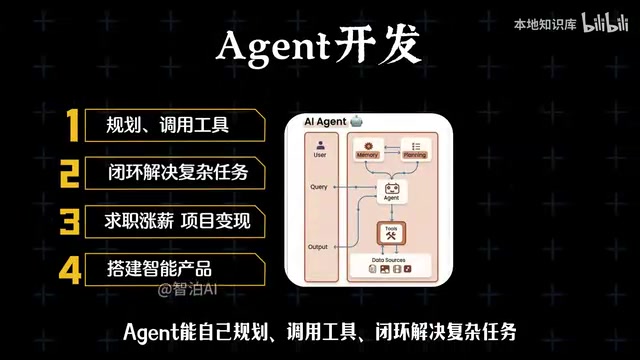
A four-stage systematic guide to AI Agent development from foundational concepts to production deployment.
This article presents a structured four-stage learning roadmap for AI Agent development: understanding core concepts (planning, memory, tool use), mastering paradigms like ReAct and Chain of Thought, building multi-agent collaboration systems with frameworks like AutoGen and LangGraph, and implementing real-world projects. It includes practical tips, common pitfalls to avoid, and resource recommendations for building solid Agent development skills in 2-3 months.
Why Agent Development Is the Core Competitive Advantage in AI Today
In an era of rapid large model iteration, basic RAG applications and simple API calls are no longer scarce skills. RAG (Retrieval-Augmented Generation) solves model knowledge staleness and hallucination issues by combining external knowledge bases with large models, but it remains essentially a passive Q&A system—it can only retrieve and generate answers, unable to proactively execute operations, call tools, or perform multi-step reasoning. When tasks require cross-system operations (such as querying a database, then calling an API, then generating a report), a pure RAG architecture falls short.
The bar for AI positions is rising rapidly—the ability to independently develop intelligent Agents is the true core competitive advantage.
The fundamental difference between an Agent and traditional AI applications is this: an Agent can autonomously plan tasks, invoke tools, and solve complex problems in a closed loop. Traditional AI applications typically operate in a single-turn or multi-turn input-output mode—users ask questions, models answer—the entire interaction chain is passive. The core breakthrough of Agents lies in introducing "Autonomy"—the ability to decompose goals, select strategies, execute actions, and adjust behavior based on feedback without step-by-step human instructions. This capability relies on the Emergent Abilities of large language models, particularly the complex reasoning, instruction following, and tool use capabilities that emerge when parameter scale exceeds certain thresholds. From an industry perspective, Agents represent a paradigm shift from AI as a "tool" to AI as a "digital employee."
Whether you're seeking better job opportunities, freelance projects, or building intelligent products, Agent development has become an essential hardcore skill.
Recently, a tutorial series on Bilibili claiming to be "196 hours from Tsinghua University" on Agent development gained attention. While the title has marketing elements, the learning roadmap it outlines is genuinely worth referencing. This article will break down a systematic learning method for Agent development based on that roadmap, combined with actual industry requirements.
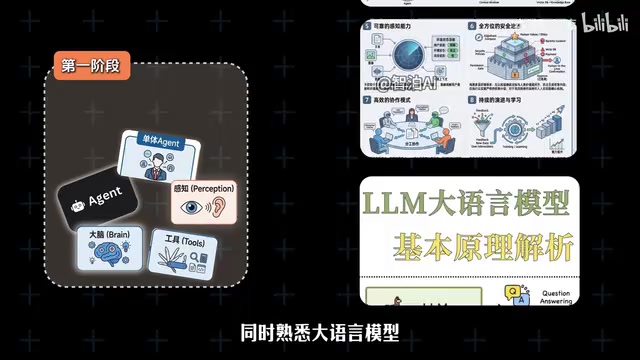
Phase One: Foundation—Thoroughly Understanding Core Agent Concepts
Understanding the Essence of Agents
The first step in learning Agent development isn't rushing to write code—it's understanding what an Agent actually is. Simply put, an Agent is an intelligent system capable of perceiving its environment, making autonomous decisions, and executing actions. Unlike ordinary chatbots, Agents have the following core components:
- Planning Module: Decomposes complex tasks into executable sub-steps. Planning capability is the key feature distinguishing Agents from simple dialogue systems, enabling them to handle complex tasks requiring multi-step reasoning—similar to how humans create plans before executing large projects step by step.
- Memory Module: Short-term memory handles current conversation context, while long-term memory stores historical experiences. An Agent's memory system typically has three layers: Working Memory corresponds to the current conversation's context window, limited by the model's Context Length; short-term memory extends context capacity through summarization and compression techniques; long-term memory relies on vector databases (such as Pinecone, Milvus, Chroma) to store historical interactions and learned experiences. By converting text into vectors via Embedding models and using similarity search to recall relevant memories when needed, this layered architecture enables Agents to accumulate experience and continuously improve performance over long-term interactions.
- Tool Use: The ability to invoke external APIs, databases, search engines, etc. to complete specific operations. Tool use extends the Agent's "hands and feet," allowing it to truly interact with the external world rather than being limited to text generation. OpenAI's Function Calling and Anthropic's Tool Use API are both technical interfaces for implementing this capability.
- Large Language Model (LLM): Serves as the Agent's "brain," responsible for reasoning and decision-making. The LLM plays the role of central controller in the Agent architecture—it receives environmental information and memory content, decides the next action through reasoning, and generates tool call parameters or final output.
Recommended Study Content
This phase should take 2-3 weeks, focusing on the following materials:
- Lilian Weng's classic blog post LLM Powered Autonomous Agents—published in June 2023, this post systematically outlines Agent architecture composition and is considered essential reading for the Agent field. Its Planning-Memory-Tool Use framework has become the standard paradigm for understanding Agents.
- Agent-related technical documentation published by OpenAI, Anthropic, and other companies
- Official concept introductions from mainstream frameworks like LangChain and AutoGen
Building a solid theoretical foundation prevents the "knowing how but not why" dilemma during subsequent development.
Phase Two: Core Advancement—Mastering Agent Operating Principles and Paradigms
Classic Agent Paradigms
After understanding the basics, you need to dive deep into Agent operating mechanisms. Several classic paradigms you must master include:
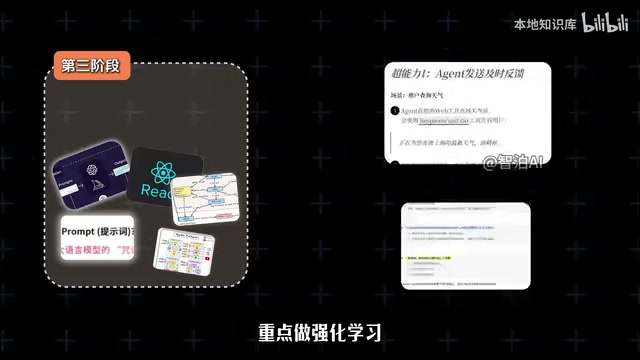
- ReAct (Reasoning + Acting): Has the model alternate between reasoning and acting—currently the most mainstream Agent architecture. Proposed by Yao et al. in 2022, its core idea is to have the large model alternately generate "Thought" and "Action" while receiving "Observation" from the environment as feedback. This Thought-Action-Observation loop simulates the human cognitive process of problem-solving—first thinking about what to do, then executing the action, then adjusting the next strategy based on results. Compared to pure reasoning or pure acting approaches, ReAct performs significantly better on tasks requiring interaction with external environments. Currently, OpenAI's Function Calling mechanism and LangChain's Agent implementation are both deeply influenced by the ReAct paradigm at their core.
- Chain of Thought (CoT): Enhances model reasoning ability through chain-of-thought prompting. Proposed by the Google Brain team in 2022, CoT significantly improves accuracy on complex tasks like mathematical reasoning and logical judgment by including intermediate reasoning steps in prompts to guide models to "think step by step." CoT is one of the foundational techniques for Agent planning capability.
- Plan-and-Execute: Creates a complete plan first, then executes step by step. This paradigm decouples planning and execution—a Planner Agent generates the task plan, then an Executor Agent carries out each subtask sequentially. Its advantage is better global perspective, making it suitable for complex tasks requiring long-term planning.
- Reflexion: Introduces self-reflection mechanisms that enable Agents to learn from mistakes. Reflexion has the Agent generate reflective summaries after task failures, stores experiences in memory, and avoids repeating mistakes in subsequent attempts. This mechanism simulates the human learning process of "post-mortem review" and is an important technique for achieving continuous Agent evolution.
Prompt Engineering and Optimization
An Agent's performance is largely determined by Prompt design quality. Prompts are the "programming language" between humans and LLMs. In Agent systems, the System Prompt defines the Agent's identity, capability boundaries, and behavioral specifications—its design quality directly determines Agent reliability and consistency. This phase requires mastering:
- Structured design of system prompts: organizing modules including role definition, task description, constraints, and output format
- Few-shot example selection strategies: guiding models to understand expected behavior patterns through carefully selected examples
- Output format constraint techniques: using JSON Schema, XML tags, and other structured formats to ensure parseable output
- Prompt design for error handling and retry mechanisms: how to guide models toward self-correction through prompts when tool calls fail or outputs don't meet expectations
Phase Three: Multi-Agent Collaboration—From Single Agent to Multi-Agent Systems
Core Logic of Multi-Agent Systems
A single Agent has limited capabilities—truly powerful systems are often completed through collaboration among multiple Agents. This concept originates from decades of research in Distributed AI and Multi-Agent Systems (MAS), now made practically viable through the powerful capabilities of large language models. This phase requires understanding:
- Role Division: How to assign specialized roles to different Agents (researcher, coder, reviewer, etc.). The core principle of role division is "specialization"—each Agent focuses on a specific domain, achieving optimal performance in their area through refined System Prompts and tool set configurations.
- Communication Mechanisms: How Agents transmit information and coordinate actions. Multi-Agent system communication patterns mainly come in three forms: in the Blackboard pattern, all Agents read and write to a shared state space; in the Message Passing pattern, Agents communicate directly through structured messages; in the Hierarchical pattern, a coordinator Agent handles task assignment and result aggregation. Which communication pattern to choose depends on task complexity and inter-Agent dependencies.
- Conflict Resolution: How to make decisions when multiple Agents disagree. Common strategies include voting mechanisms, authority arbitration (decided by a senior Agent), debate-style reasoning (Agents challenge each other until consensus is reached), etc.
- Workflow Orchestration: How to design efficient multi-Agent collaboration processes
Recommended Multi-Agent Development Frameworks
Currently mainstream multi-Agent frameworks include:
- AutoGen (Microsoft): Supports flexible multi-Agent conversation patterns. AutoGen adopts a conversational communication architecture where Agents collaborate through natural language dialogue, supports Human-in-the-loop, and is particularly suitable for scenarios requiring human-AI collaboration. Its design philosophy is transforming complex tasks into structured dialogues between multiple Agents.
- CrewAI: A role-based multi-Agent collaboration framework. CrewAI's design is inspired by real team collaboration patterns—developers define Agent roles (Role), goals (Goal), and backstories (Backstory), and the framework automatically handles task allocation and coordination. It leans toward hierarchical management, with a Manager Agent overseeing the whole process.
- LangGraph: A graph-structure-based Agent workflow orchestration tool. LangGraph is an orchestration framework from the LangChain team that models Agent execution flows as directed graphs. Nodes in the graph represent different processing steps (such as LLM calls, tool execution, conditional logic), and edges represent state transition logic. Compared to linear Chain structures, graph structures can express loops, branches, parallelism, and other complex control flows—which is crucial for Agent systems requiring iterative reflection and conditional branching. LangGraph also has built-in state persistence mechanisms with checkpoint recovery support, making it particularly suitable for developing production-grade Agent applications.
Phase Four: Practical Implementation—Connecting Agents to Real Business Scenarios
Recommended Hands-On Projects
Theoretical learning must ultimately land in actual projects. The following three project types cover core Agent development scenarios:
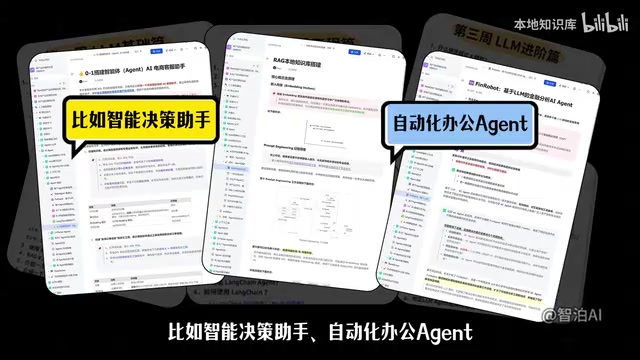
- Intelligent Decision Assistant: An Agent that can collect information, analyze data, and provide recommendations—suitable for finance, consulting, and similar scenarios. These Agents typically need to integrate search engines, data analysis tools, and specialized knowledge bases. The core challenge is enabling the Agent to make sound judgments with incomplete information while clearly explaining the decision rationale.
- Office Automation Agent: Automatically handles emails, generates reports, and manages schedules to directly boost work efficiency. The technical challenges for these Agents include API integration with multiple office systems (Gmail, Slack, Notion, Google Sheets, etc.), as well as accurate user intent understanding and permission management.
- Multi-Agent Collaboration System: Multiple Agents work together with division of labor to complete complex tasks, such as automated software development pipelines. A typical example is the MetaGPT project, which simulates a software company's organizational structure with Product Manager Agent, Architect Agent, Engineer Agent, and Tester Agent collaborating to complete the entire process from requirements to code.
Complete Agent Development Workflow
Every project should run through the following complete workflow:
- Requirements analysis and architecture design: Clarify the core problem the Agent needs to solve, choose between single-Agent or multi-Agent architecture, and determine which tools and data sources to integrate
- Agent role definition and Prompt writing: Design the System Prompt, defining the Agent's capability boundaries, behavioral specifications, and output format
- Tool integration and API connection: Implement callable tool functions for the Agent, handling authentication, rate limiting, error retries, and other engineering details
- Debugging, optimization, and error handling: Debugging Agent systems is more complex than traditional software because LLM output is non-deterministic—you need comprehensive logging, exception handling, and graceful degradation strategies
- Performance evaluation and iterative improvement: Establish evaluation metrics (such as task completion rate, step efficiency, cost control) and continuously optimize through A/B testing
Agent Development Learning Tips and Common Pitfalls
Avoiding Common Pitfalls
- Don't skip the fundamentals: Many people rush to use frameworks without truly understanding underlying principles, making it impossible to troubleshoot problems. Understanding foundational concepts like the ReAct loop, token calculation, and context window management is a prerequisite for efficient debugging.
- Don't blindly trust frameworks: Frameworks like LangChain and AutoGen update extremely quickly—understanding principles matters more than memorizing APIs. In fact, many production-grade Agent systems choose to call LLM APIs directly rather than relying on frameworks, because framework abstraction layers sometimes introduce unnecessary complexity and performance overhead. Once you master the principles, you can quickly adapt regardless of how frameworks change.
- Don't neglect engineering skills: Agent development isn't just AI technology—it also involves system design, error handling, performance optimization, and other engineering challenges. Agents in production environments need to consider concurrency handling, cost control (LLM API call costs), security protection (preventing Prompt Injection attacks), Observability, and other engineering challenges.
Choosing Learning Resources
For the various "Tsinghua University XX hours" tutorials on Bilibili, approach them rationally. These videos are often compilations of materials from multiple sources with varying quality. A more recommended learning path is:
- Official documentation + GitHub example code as primary sources: Official documentation from LangChain, OpenAI, and Anthropic are the most authoritative learning materials
- Quality technical blogs and papers as supplementary: Such as Lilian Weng's blog and Agent-related papers on arXiv
- Video tutorials as introductory guidance
- Hands-on practice always comes first: Start with the simplest single-tool Agent and gradually increase complexity
Conclusion
Agent development is indeed one of the most valuable skill directions in AI today. By systematically following the four-phase roadmap of "concept understanding → principle mastery → multi-Agent collaboration → practical implementation," combined with continuous hands-on practice, you can absolutely build solid Agent development capabilities within 2-3 months. The key is: do more, watch less—start with simple projects and progressively tackle complex scenarios.
It's worth noting that Agent technology is still evolving rapidly. Since 2024, new technologies like OpenAI's Assistants API, Anthropic's Computer Use, and Google's Gemini Agent have been continuously emerging, while standardization protocols like MCP (Model Context Protocol) are also driving interoperability in the Agent ecosystem. Staying informed about cutting-edge developments and continuously updating your knowledge system is essential for maintaining competitiveness in this fast-changing field.
Related articles
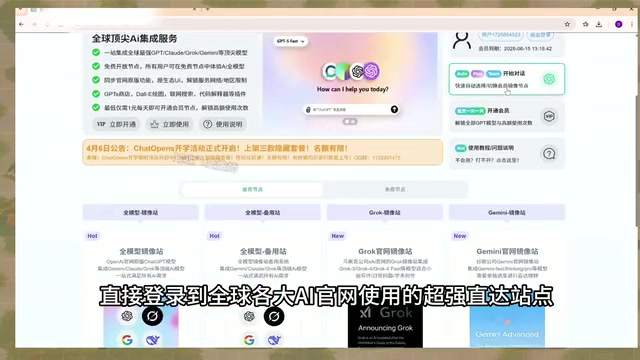
AI Aggregator Platforms Tested: A Complete Guide to Using GPT 5.5 and Other Top Models for Free
A hands-on guide to using GPT 5.5, Gemini 3.1 Pro, and Grok 4.2 for free via AI aggregator platforms, covering cross-model context memory, account pool mechanisms, and key security risks.
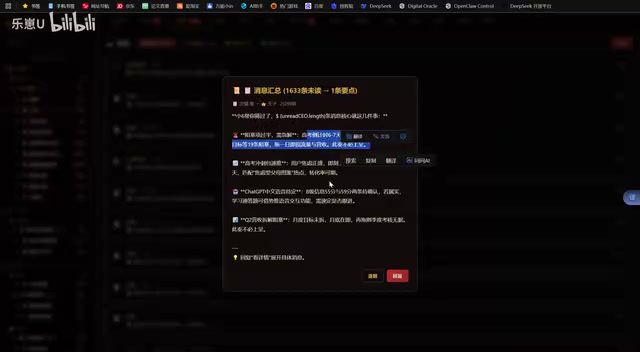
Vibe Coding in Practice: A Junior Student Uses Cursor to Build a Multi-Agent System with 51 AI Officials Based on the Three Departments and Six Ministries Framework
A junior student uses Cursor and Vibe Coding to build a multi-agent system with 51 AI officials modeled on China's Three Departments and Six Ministries, featuring task distribution, approval workflows, and Token cost visualization.
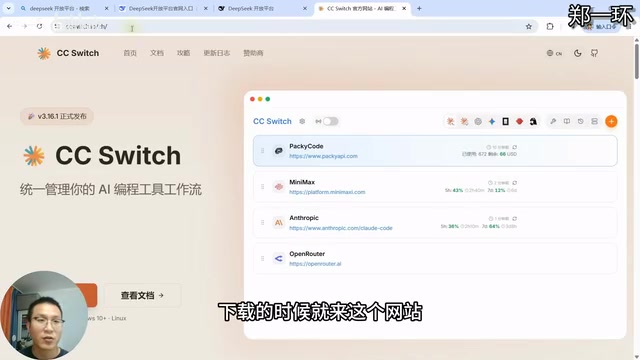
How to Connect Codex to DeepSeek Models: Free Switching via CC Switch
Learn how to connect OpenAI Codex to DeepSeek models via CC Switch, enabling free switching between DeepSeek and GPT with complete setup and routing guide.