Agent Loop Explained: Solving Code Refactoring Pain Points with the ReAct Pattern
Agent Loop Explained: Solving Code Ref…
Agent Loop uses the ReAct cycle to let AI autonomously complete complex tasks like code refactoring.
This article uses component decoupling in code refactoring as an entry point to introduce Agent Loop — the core architecture of AI coding tools. Based on the ReAct (Reasoning-Acting-Observation) pattern, Agent Loop enables an Agent to autonomously analyze code, invoke tools, and verify results within a loop, continuously accumulating context through tool feedback until the task is complete. Compared to single-shot code generation, Agent Loop offers state persistence and tool invocation capabilities, making it especially suited for complex refactoring scenarios that involve multiple steps and incomplete information.
Code Refactoring: An Unavoidable Daily Challenge for Developers
In real-world software development, most work isn't about building brand-new projects from scratch. The more common scenario is this: you join a new team, inherit someone else's project, and need to modify and optimize the existing codebase. The underlying implementation reflects the original developer's design philosophy, technology choices, and skill level at the time — and you need to evolve the project from there.
This "building on someone else's foundation" work pattern is the core source of code refactoring pain points. In this article, we'll walk through a concrete refactoring scenario to explain how Agent Loop works and how it helps us tackle these challenges.

A Typical Refactoring Scenario: From Coupling to Decoupling
Overly Coupled Components
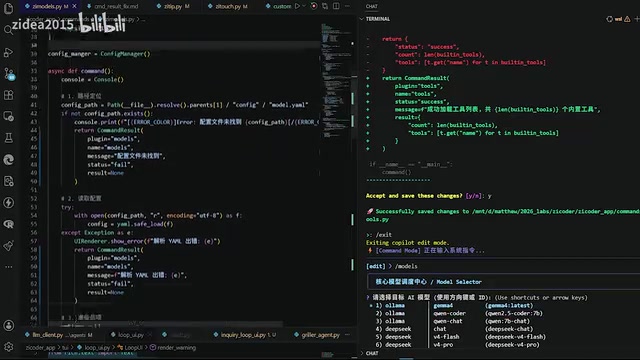
Imagine you have a command-line tool project that includes a terminal selector component — when the user presses Enter, a model selection list pops up in the bottom-right corner with a pretty nice interactive experience. The problem is that this component was written directly inside a specific command implementation, making it tightly coupled to that command.
Understanding the Nature of Coupling
Code coupling is a core metric in software engineering for measuring the degree of dependency between modules. High coupling means that modifying one module will affect others, making the system fragile and hard to maintain. Software engineering classifies coupling levels from low to high: data coupling, stamp coupling, control coupling, common coupling, and content coupling. The scenario where a terminal selector is directly embedded in a command implementation is a textbook case of "content coupling" — the highest degree of coupling, where one module directly depends on the internal implementation details of another.
The goal of decoupling is to make each module as independent as possible, following SOLID design principles such as the Single Responsibility Principle (SRP) and the Open/Closed Principle (OCP). SRP requires that a module be responsible for only one thing, while OCP requires that modules be open for extension but closed for modification. Extracting the terminal selector into an independent component is a direct application of both principles: the selector is only responsible for "selection," and other commands can reuse it without modifying its internals.
When other commands or modules want to reuse this terminal selector, things get messy. This is when a project manager typically raises a requirement: extract this selector component, encapsulate it as a standalone component, and make it available for the entire team.
This scenario of "extracting shared components from coupled code" is extremely common in day-to-day development and is a classic example of refactoring work. Martin Fowler, in his seminal book Refactoring: Improving the Design of Existing Code, refers to these operations as "Extract Function" and "Extract Class" — among the most fundamental and frequently used refactoring techniques.
Why Is Manual Refactoring So Inefficient?
Manually completing this kind of refactoring requires the following steps:
- Understand the existing code logic: Figure out the dependencies between the component and the command
- Design the new interface: Define the component's API after extraction
- Split the code: Separate the component logic from its original location
- Update call sites: Modify all references
- Test and verify: Ensure functionality remains unchanged after refactoring
Each step requires the developer to have a deep understanding of the project — it's time-consuming and error-prone. Research shows that developers spend roughly 50% of their working time understanding and maintaining existing code, rather than writing new code. This is precisely where the Agent Loop mechanism in AI coding tools can deliver value.
The Core Principles of Agent Loop
What Is Agent Loop?
In today's mainstream AI coding tools (such as Cline, Cursor, etc.), there's a core mechanism called Agent Loop. No matter how complex the tool's external behavior appears, it follows this fundamental pattern under the hood.
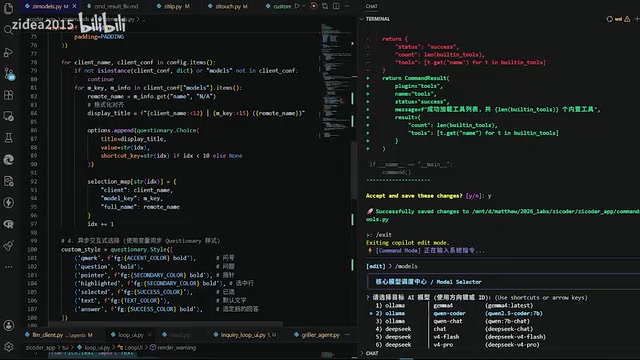
The essence of Agent Loop can be described with the following structure:
Create Agent → Place in Loop → Agent executes cyclically → Agent autonomously decides when to exit
Specifically, the system creates an Agent instance and places it into a loop structure. This loop continuously drives the Agent to execute tasks, and the Agent itself decides when to break out of the loop — when it determines the task is complete, it exits.
Compared to traditional AI code generation tools, Agent Loop introduces two fundamentally upgraded capabilities. Traditional code generation (like early GitHub Copilot) is single-shot and stateless: input a prompt, output a code snippet, process ends — the AI knows nothing about the execution result. Agent Loop introduces state persistence and tool invocation as its two core mechanisms. The Agent can remember all the context accumulated throughout the task execution process and interact with the real development environment by calling external tools (file system, terminal commands, code search, etc.), forming a closed feedback loop. This means the Agent is no longer just a "suggester" but a true "executor."
The ReAct Pattern: A Three-Step Cycle of Reasoning, Acting, and Observing
Agent Loop is essentially an implementation of the ReAct (Reasoning + Acting) pattern. In each iteration of the loop, the Agent goes through three steps:
- Reasoning: Analyze the current state and think about what to do next
- Acting: Call tools to perform specific operations (e.g., read files, modify code, run commands)
- Observation: Obtain the results of tool execution as input for the next round of reasoning
This process repeats until the Agent determines the task is complete.
The ReAct pattern didn't emerge from thin air — it originates from a 2022 academic paper jointly published by Google and Princeton University: ReAct: Synergizing Reasoning and Acting in Language Models. The research found that when large language models are asked to explicitly output their reasoning process (i.e., "Chain-of-Thought") while generating action instructions, model performance on complex tasks improves significantly, and "hallucination" problems are effectively reduced. This is because explicit reasoning steps force the model to perform logical verification before acting, rather than jumping straight to conclusions. Today, ReAct has become the de facto standard architecture for building AI Agent systems, widely adopted by mainstream Agent frameworks like LangChain and AutoGen.
The Self-Improvement Mechanism Driven by Tool Feedback
A key question is: how does the Agent achieve "getting better as it goes" throughout the task execution process?
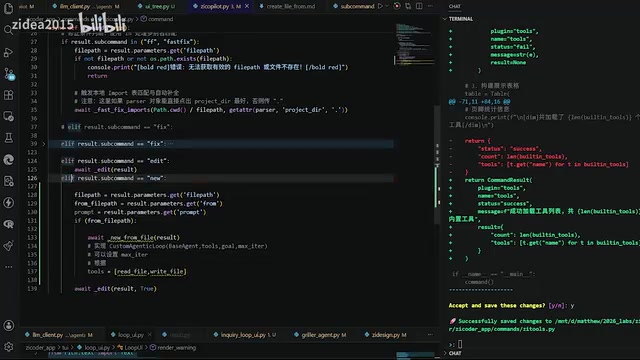
The answer lies in the feedback loop from tool invocations. Each time the Agent calls a tool, it receives execution results. These results are incorporated into the Agent's context, continuously deepening its understanding of the project. Taking code refactoring as an example:
- Round 1: The Agent reads files to understand the code structure
- Round 2: The Agent analyzes dependencies and formulates a refactoring plan
- Round 3: The Agent creates the new component file
- Round 4: The Agent modifies the original code, replacing it with component calls
- Round 5: The Agent verifies the modifications and exits the Loop after confirming everything is correct
The output of each round becomes the input for the next, forming a closed loop of continuously accumulated knowledge. In cognitive science, this mechanism corresponds to the concept of "In-Context Learning" — the model doesn't "learn" through gradient updates but dynamically adjusts its output strategy by accumulating more and more task-relevant information within the context window. This is also the core advantage that distinguishes Agent Loop from single-shot code generation: it can handle complex scenarios where information is incomplete at the start and decisions need to be made through exploration.
Agent Loop in Action: The Refactoring Workflow
Returning to the component extraction scenario mentioned earlier, the complete Agent Loop workflow looks like this:
- Receive the task: The user describes the requirement — "Extract the terminal selector from the command into a standalone component"
- Analyze the code: The Agent calls file-reading tools to understand the existing code structure and coupling relationships
- Formulate a plan: Based on the analysis, plan the extraction steps
- Execute the refactoring: Using code editing tools, progressively complete component splitting, interface design, and reference updates
- Verify completion: After confirming all modifications are correct, exit the Loop
Throughout the process, the Agent works like an experienced developer — understanding, operating, and verifying as it goes — until the refactoring task is complete. It's worth noting that this approach aligns closely with the "Test-Driven Refactoring" philosophy in software engineering: first understand the current state, then make small incremental changes, verifying at each step to ensure behavior is preserved. Agent Loop automates this rigorous engineering practice, significantly reducing the cognitive burden and error risk of refactoring.
Summary and Outlook
Agent Loop is the core architectural pattern of today's AI coding tools. Through the ReAct cycle, it enables AI to autonomously analyze problems, invoke tools, and verify results until the task is complete. This mechanism is particularly well-suited for complex tasks like code refactoring that require multiple steps and multiple rounds of interaction.
Truly useful intelligent assistance tools don't just generate code snippets — they understand project context and solve real development pain points. Once the infrastructure (toolchains, Agent frameworks) is in place, the key is integrating these capabilities to address the real challenges developers face daily — and code refactoring is one of the most frequent and valuable scenarios among them.
Key Takeaways
- Most development work involves modifying existing projects; code refactoring is one of the most common development pain points
- Agent Loop is the core architecture of today's mainstream AI coding tools, creating an Agent and placing it in a loop to continuously execute tasks
- Agent Loop is essentially an implementation of the ReAct (Reasoning + Acting) pattern, originating from 2022 academic research by Google and Princeton; the Agent self-improves by continuously calling tools and receiving feedback
- The Agent autonomously decides when to exit the Loop — breaking out when it determines the task is complete
- Unlike single-shot code generation, Agent Loop has state persistence and tool invocation capabilities, handling complex scenarios with incomplete information that require exploration-based decision-making
- This mechanism is particularly well-suited for refactoring tasks like component extraction and code decoupling that require multi-step interaction
Related articles
 Tutorials
Cursor + Codex Dual-IDE Collaboration: A Practical Methodology for Open-Source Project Customization
A complete methodology for open-source project customization based on real-world experience, detailing the Cursor+Codex dual-IDE workflow, seven-stage process, MVP validation, and AI source code reading techniques.
 Tutorials
Cursor Multi-Agent in Practice: Building a Full-Stack Next.js Blog in 50 Minutes
Build a full-stack blog in 50 minutes using Cursor IDE's multi-Agent mode with Next.js, Clerk auth, and Supabase. Learn the 4-phase AI Agent workflow and key integration pitfalls.
 Tutorials
Building an AI Software Factory from Scratch: A Cursor Engineer's Hands-On Experience with Multi-Agent Collaboration
Cursor engineer Eric shares practical insights on building an AI software factory: automation levels, guardrail design, parallel Agent management, and scaling to 1000+ Agents for 24/7 development.