AI Agent Development: A Complete 6-Week Systematic Learning Roadmap
A structured 6-week roadmap to learn AI Agent development from fundamentals to production deployment.
This article presents a comprehensive 6-week learning roadmap for AI Agent development. It covers core architecture and components (Week 1), ReAct and Function Calling paradigms (Week 2), multi-agent collaboration (Week 3), RAG integration (Week 4), deployment and customization (Week 5), and end-to-end project practice (Week 6), along with practical tips to avoid common pitfalls.
With the rapid advancement of large model technology, AI Agents have become one of the most promising directions for real-world AI applications. However, many learners follow trends blindly, lose direction, and end up with little to show for their efforts. Based on a systematic Agent development curriculum, this article outlines a clear six-week learning roadmap to take you from zero to hands-on practice.
Why AI Agents Are Worth Investing In Right Now
From the breakout year of large models to RAG application exploration, and now to the scaled deployment of intelligent agents, AI Agent development has moved from proof-of-concept to production practice. Major tech companies are rolling out Agent platforms one after another, and enterprise demand for Agent development talent continues to rise.
The concept of AI Agents originates from Agent theory in artificial intelligence research, dating back to multi-agent system research in the 1990s. But in the era of Large Language Models (LLMs), Agents have taken on an entirely new meaning: they are no longer simple rule-driven programs, but intelligent systems that use LLMs as their "brain," capable of perceiving their environment, making autonomous decisions, and executing actions. 2023 was dubbed the "Year of Large Models" — models like OpenAI's GPT-4 and Google's Gemini demonstrated powerful reasoning capabilities, making it possible for Agents to transition from academic concepts to engineering practice.
But the reality is that most learners hit pitfalls right at the beginning:
- Blindly following trends — rushing to build without understanding the core principles of Agents
- Only copying templates — using off-the-shelf Agent frameworks without being able to adapt them to real business needs
- Failing to identify practical use cases — building Agents that are neither usable nor useful
The root cause of these problems isn't the field itself, but the lack of a systematic learning path. A structured learning plan is far more effective than consuming fragmented tutorials.
The Six-Week Systematic Learning Roadmap in Detail
This curriculum breaks down AI Agent development into six stages, progressing layer by layer from foundational architecture to end-to-end practice. Here's the core content and learning focus for each stage.
Week 1: Building the Foundation — Core Architecture and Components
Every great structure starts with a solid foundation. The focus of Week 1 is to thoroughly understand the core architecture of Agents. A complete AI Agent typically includes the following key components:
- Planning Module: How an Agent breaks down complex tasks into executable sub-steps. Planning capability is the core feature that distinguishes Agents from simple chatbots. Common planning strategies include Task Decomposition, sub-goal setting, and feedback-based plan adjustment. Classic implementations include Tree of Thoughts and Plan-and-Solve prompting strategies.
- Memory Module: The management mechanisms for short-term and long-term memory, which determine an Agent's contextual understanding ability. An Agent's memory system draws from cognitive science models of human memory classification. Short-term memory typically corresponds to the current conversation's context window, limited by the model's token length (e.g., GPT-4's 128K tokens). Long-term memory requires external storage support, with common implementations including: vector databases storing semantic representations of historical interactions (using Pinecone, Milvus, Chroma, etc.), structured databases storing key facts and user preferences, and summary-based compressed memory. Advanced memory management also involves retrieval strategies (weighted by relevance, recency, and importance) and memory reflection and consolidation mechanisms — all of which directly impact the Agent's performance quality in long-term interactions.
- Tool Use: How an Agent interacts with external APIs, databases, search engines, and other tools. Tool calling extends the Agent's capabilities beyond pure text generation, enabling it to execute code, query real-time data, manipulate file systems, and more.
The goal of this stage is to build a complete knowledge framework and understand each component's role and how they work together. It's recommended to study alongside the official documentation of mainstream frameworks like LangChain or LlamaIndex. LangChain is currently the most popular LLM application development framework, created by Harrison Chase in October 2022, offering modular components such as Chains, Agents, Memory, and Tools that greatly simplify LLM application development. LlamaIndex (formerly GPT Index) focuses on data connection and index construction, excelling at converting various formats of private data (PDFs, databases, APIs, etc.) into knowledge bases usable by LLMs. The two are complementary: LangChain focuses more on application orchestration and Agent logic, while LlamaIndex focuses more on data processing and retrieval optimization — in practice, they are often used together.
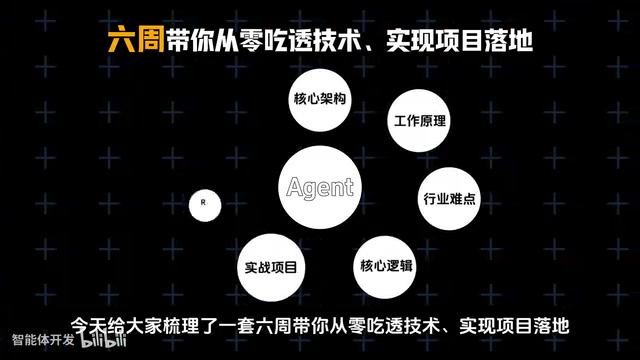
Week 2: Mastering the Core — Operating Principles and Key Paradigms
After understanding the components, Week 2 requires diving deep into the operating principles of Agents. There are two core paradigms you must master:
-
ReAct (Reasoning + Acting): This allows an Agent to alternate between reasoning and action, and is currently the most mainstream Agent design pattern. The Agent first thinks about what to do next (Thought), then executes an action (Action), and continues reasoning based on the observation results (Observation). The ReAct paradigm was jointly proposed by Google Research and Princeton University in 2022. Their paper "ReAct: Synergizing Reasoning and Acting in Language Models" demonstrated a method for language models to alternate between reasoning and acting. Unlike traditional Chain-of-Thought (CoT) which only performs reasoning, ReAct allows the model to actively call external tools to gather information during the reasoning process, then continue reasoning based on new information. This Thought-Action-Observation loop enables Agents to handle complex tasks requiring multi-step interaction, such as multi-hop question answering, fact verification, and complex calculations.
-
Function Calling: Through structured function calling mechanisms, large models can precisely trigger external tools — a key technology for extending Agent capabilities. Function Calling was introduced by OpenAI in June 2023 with the GPT-3.5/GPT-4 API update. Its essence is enabling large models to recognize user intent during conversations and generate structured function call parameters (in JSON format) rather than natural language responses. Developers pre-define available function names, descriptions, and parameter schemas, and the model determines when to call which function and outputs parameters conforming to the schema. This mechanism greatly reduces the development difficulty of Agent tool calling, avoiding the complex prompt engineering and output parsing logic of traditional approaches. Currently, all major models (Claude, Gemini, Qwen, etc.) support similar capabilities.
The difficulty at this stage lies in understanding the Agent's decision loop mechanism and how to handle exceptions and edge cases during actual operation. For example, how an Agent gracefully degrades when a tool call fails, and how to set termination conditions when reasoning enters an infinite loop — these engineering details often determine an Agent's stability in production environments.
Week 3: Advanced Skills — Multi-Agent Collaboration
A single Agent's capabilities are ultimately limited. Truly complex business scenarios often require multiple Agents working together. The core of Week 3 is unlocking the design logic of multi-agent collaboration:
- How multiple Agents divide work and communicate
- How to design Agent role definitions and task assignments
- Various tuning techniques to address common issues like output deviation and hallucinations

Currently, commonly used multi-Agent frameworks in the industry include CrewAI, AutoGen, MetaGPT, and others, each with distinct characteristics. CrewAI adopts a "role-playing" design philosophy, having each Agent play a specific professional role (e.g., researcher, writer, reviewer) and collaborate through task pipelines to complete complex work. AutoGen, developed by Microsoft Research, emphasizes conversational collaboration between Agents, supporting human-AI hybrid multi-turn interactions suitable for scenarios requiring human decision-making involvement. MetaGPT simulates a software company's organizational structure, having multiple Agents assume roles such as product manager, architect, and programmer to collaboratively complete software development tasks. Common challenges across these frameworks include: information synchronization between Agents, conflict resolution, task dependency management, and overall process controllability. It's recommended to study at least one framework in depth and understand its underlying collaboration mechanisms.
Week 4: Deep Integration — Combining RAG with Agents
The combination of RAG (Retrieval-Augmented Generation) and Agents is the most common architecture pattern in enterprise-level applications today. RAG is a technical paradigm proposed by Facebook AI Research in 2020. Its core idea is to retrieve relevant information from an external knowledge base before the large model generates an answer, injecting the retrieval results as context into the prompt so the model generates answers based on the most current and accurate information. RAG effectively addresses the knowledge cutoff date problem and hallucination issues of large models, making it one of the most mature solutions for enterprise AI applications. A typical RAG pipeline includes five stages: document chunking, vector storage, semantic retrieval, context assembly, and answer generation.
The focus of Week 4 is:
- Connecting the building logic of RAG and Agents, understanding when to use RAG, when to use Agents, and when to combine both. Simply put: when the task is primarily knowledge Q&A and answers exist in existing documents, RAG is the lighter choice; when the task requires multi-step reasoning, tool calling, or dynamic decision-making, Agents are more appropriate; and when an Agent needs to reason and make decisions based on a private knowledge base, the RAG+Agent combined architecture is the best approach.
- Becoming proficient with lightweight tools (such as low-code platforms like Dify and Coze) to rapidly build prototypes. Dify is an open-source LLM application development platform that provides a visual workflow orchestration interface; Coze is an AI Bot development platform launched by ByteDance that supports plugin extensions and multimodal interaction. These platforms significantly lower the barrier for Agent prototype validation.
- Learning to adapt technical solutions to real business scenarios
This stage is the critical turning point from "learning technology" to "business implementation." Whether you can connect Agents with specific industry needs determines your technical value.
Week 5: Skill Expansion — Deployment and Scenario Customization
Development is only the first step — how to stably deploy Agents to production environments is equally important:
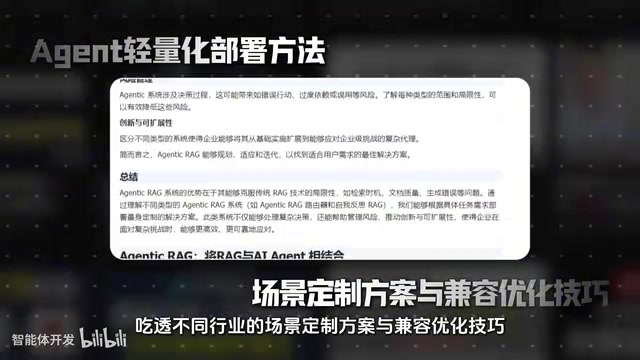
- Lightweight deployment methods for Agents (local deployment, cloud deployment, edge deployment). Local deployment suits data-sensitive scenarios and typically requires quantized models (e.g., GGUF format) to reduce hardware requirements; cloud deployment leverages containerized services from platforms like AWS, Azure, and Alibaba Cloud for elastic scaling; edge deployment targets IoT devices and mobile endpoints, with strict requirements on model size and inference latency.
- Scenario customization solutions for different industries (customer service, marketing, data analysis, content creation, etc.). Each industry scenario has vastly different requirements for Agents: customer service scenarios emphasize response speed and accuracy, requiring strict safety guardrails; marketing scenarios focus on personalization and creative generation; data analysis scenarios require Agents to write and execute SQL/Python code; content creation scenarios need multi-round iteration and style control capabilities.
- Performance optimization and compatibility tuning techniques, including prompt caching, concurrency control, token usage optimization, and multi-model routing strategies
Week 6: End-to-End Practice — Completing a Project Independently
The final week is the hands-on integration stage, with the goal of independently completing a multi-scenario Agent project. This is not only a comprehensive test of the knowledge from the previous five weeks but also a crucial step for accumulating project experience and connecting with real business needs.
It's recommended to choose an industry scenario you're familiar with and go through the complete process from requirements analysis, architecture design, development implementation, to testing and deployment. A complete Agent project should include: clear user requirement definitions, Agent architecture design documentation, core functionality code implementation, systematic test cases (including edge cases and exception handling), and post-deployment monitoring and iteration plans. Project completeness matters more than technical complexity — a simple Agent that runs stably is far more valuable than a feature-rich but error-prone complex system.
Learning Tips and Pitfall Avoidance Guide
Based on this learning roadmap, here are some practical recommendations:
-
Don't skip the fundamentals: Many people rush to build projects with only a superficial understanding of Agent core principles, then find themselves helpless when problems arise. The foundational learning in the first two weeks may seem dry, but it's the bedrock for everything that follows.
-
Learn by doing: After completing each module, immediately get hands-on. Even a simple weather query Agent is ten times better than just reading without practicing. The bugs and exceptions you encounter in practice are often the best learning materials.
-
Focus on scenarios, not just technology: Technology is the means; scenarios are the purpose. Throughout your learning, always ask: What real problem can this technology solve? What kind of Agent capabilities are enterprises willing to pay for?
-
Stay alert to new tools: The Agent development field iterates extremely fast, with new frameworks and tools emerging constantly. Maintain an open learning mindset, but don't frequently switch tech stacks. It's recommended to deeply invest in one primary framework while staying aware of industry trends, and only consider migration after new tools have matured.
-
Prioritize observability and evaluation systems: Agent behavior is inherently non-deterministic, making it crucial to establish comprehensive logging, behavior tracking, and effectiveness evaluation mechanisms. Common evaluation dimensions in the industry include task completion rate, response latency, token consumption, and user satisfaction. It's recommended to establish evaluation baselines from the very beginning of your project.
Conclusion
AI Agent development is a field that combines technical depth with commercial value. Six weeks of systematic learning may not make you an expert, but it's enough to help you build a complete knowledge framework, master core skills, and complete initial project practice. In the AI wave, systematic learning combined with continuous practice is the most reliable path forward for anyone.
Agent technology is still in a period of rapid evolution — from single Agents to multi-Agents, from text interaction to multimodal, from passive response to proactive planning — each technological leap creates new application possibilities. Seizing this window of opportunity and building a solid technical foundation with hands-on experience will lay a strong foundation for your career development in the AI era.
Related articles
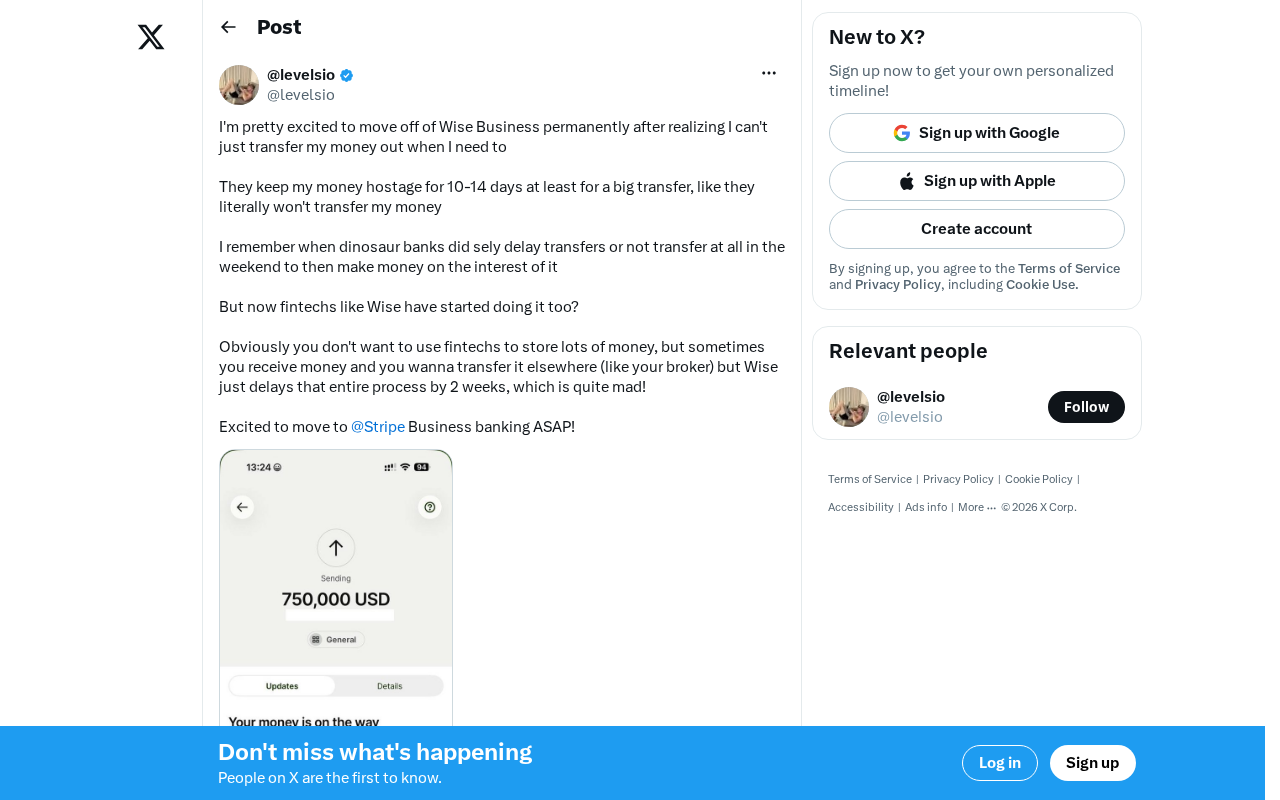
Wise Large Transfer Delayed Two Weeks: How Should Cross-Border Entrepreneurs Respond?
Wise Business users face 10-14 day delays on large transfers, sparking debate on whether fintech is repeating traditional banking mistakes. Analysis and practical tips for cross-border entrepreneurs.
Perplexity Partners with Intel: Local AI Models and Hybrid Inference Come to Laptops
Perplexity partners with Intel to bring local AI models and hybrid inference to Core Ultra Series 3 laptops. We break down the architecture, NPU capabilities, and the cloud-to-edge AI trend.

AI Large Model Learning Roadmap Breakdown: Three Stages from Application Development to Model Fine-Tuning
Deep breakdown of a popular AI large model learning roadmap covering LangChain, RAG, Agent, and LoRA fine-tuning across three stages, with analysis of its strengths and limitations for career changers.