AI Agent Development: A Complete Six-Week Systematic Learning Roadmap
A structured six-week roadmap to learn AI Agent development from scratch to production.
This article presents a comprehensive six-week learning roadmap for AI Agent development based on a 54-episode tutorial series. It covers core architecture (planning, memory, tool use), the ReAct and CoT paradigms, multi-agent collaboration, RAG integration, production deployment, and hands-on projects, along with realistic advice for learners.
With the rapid advancement of large model technology, AI Agents have become one of the most promising directions for real-world applications. However, many learners follow trends blindly without a systematic plan, ultimately achieving little. Based on a 54-episode zero-to-hero Agent development tutorial series on Bilibili, this article outlines a clear six-week learning roadmap to help learners of all backgrounds find their path from beginner to advanced.
Why AI Agent Development Deserves Your Attention
AI Agents are not simple chatbots — they are AI systems capable of autonomous planning, tool invocation, and multi-step task execution. Compared to traditional prompt engineering, Agents possess stronger autonomous decision-making and task completion capabilities, giving them broad application prospects in enterprise automation, intelligent customer service, data analysis, and more.
The concept of AI Agents originates from the "intelligent agent" theory in artificial intelligence, traceable back to multi-agent system research in the 1990s. But what truly made Agents practical was the leap in large language model (LLM) capabilities since 2022. Models like GPT-4 and Claude demonstrated powerful reasoning, planning, and instruction-following abilities, enabling LLM-based Agents to understand complex instructions, decompose tasks, and execute autonomously. The viral success of open-source projects like AutoGPT and BabyAGI in 2023 marked the official transition of Agents from academic concept to engineering practice.
However, the tutorial also points out a harsh reality: 90% of learners fall into critical traps from the very beginning. Common issues include: blindly following trends without identifying viable use cases, copying existing templates without understanding them, and failing to build truly usable Agent products.
The root cause of these problems is the lack of a systematic learning framework. Many people watch a few tutorials and rush to start building, neglecting the understanding of core architecture and underlying principles, leaving them helpless when facing real-world problems.
Detailed Six-Week AI Agent Development Learning Roadmap
This tutorial series is designed for zero-foundation learners, providing a complete path from beginner to hands-on practice, with clear learning objectives and skill outputs for each week.
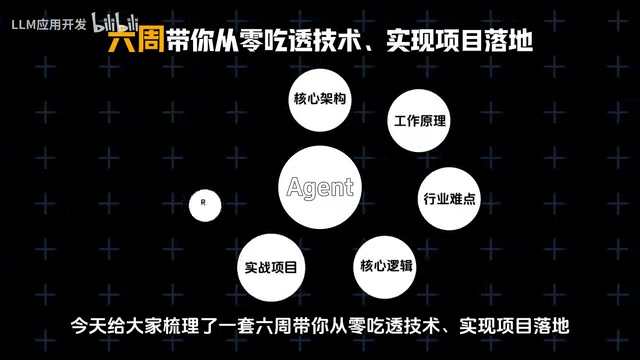
Week 1: Building the Foundation — Core Architecture and Components
The first step in learning Agent development isn't rushing to write code — it's thoroughly understanding the Agent's core architecture. This week focuses on:
-
Planning Module: How Agents break down complex tasks into executable sub-steps. Planning capability is the core feature that distinguishes Agents from ordinary LLM applications. Common planning strategies include Task Decomposition, sub-goal setting, and feedback-based plan adjustment. Current mainstream implementations include having the LLM directly generate execution plans, using tree search (such as Tree of Thoughts) to explore multiple paths, and leveraging external planners for structured orchestration.
-
Memory Module: Designing short-term and long-term memory to give Agents contextual understanding. Short-term memory typically corresponds to the current conversation's context window (limited by the model's Context Length), while long-term memory requires external storage (such as vector databases) to persist historical interaction information. Well-designed memory mechanisms enable Agents to maintain consistency across multi-turn interactions and learn from past experiences.
-
Tool Use: How to enable Agents to call external APIs, databases, search engines, and other tools. Tool-calling capability greatly expands an Agent's action boundaries — LLMs themselves cannot execute code, access real-time data, or operate external systems, but through Function Calling mechanisms, Agents can select appropriate tools based on task requirements and pass parameters correctly, enabling actions like searching, computing, and file operations.
These three core components form the skeleton of an Agent. Understanding how they collaborate is the foundation for all subsequent advanced learning.
Week 2: Mastering the Core — Operating Principles and Mainstream Paradigms
After grasping the basic architecture, Week 2 dives deep into Agent operating mechanisms. The focus is on two mainstream paradigms:
-
ReAct Paradigm: Alternating between Reasoning and Acting, where the Agent thinks before executing, forming a "Thought-Action-Observation" loop. The ReAct paradigm was proposed by the Google Research team in 2022 (paper: ReAct: Synergizing Reasoning and Acting in Language Models). Its core innovation lies in combining traditional chain-of-thought reasoning with external tool invocation. Previously, LLMs either only reasoned or only acted, and this separation led to poor results. ReAct's "Thought-Action-Observation" loop lets the model perform reasoning analysis at each step, decide what action to take, and then adjust its next strategy based on observations, significantly improving completion rates for complex tasks.
-
CoT (Chain of Thought): Chain-of-thought reasoning that enables Agents to demonstrate clear reasoning processes. CoT was proposed by Google in a 2022 paper. By adding prompts like "Let's think step by step" or providing examples with reasoning steps, it stimulates the LLM's ability to reason incrementally. CoT not only improves model performance on math and logic tasks but, more importantly, makes the reasoning process interpretable and debuggable — which is crucial for troubleshooting in Agent development.
The key insight at this stage is understanding that Agents don't produce results in a single shot but iteratively approach the goal through multiple rounds. Mastering these principles enables flexible strategy adjustment during actual development.
Week 3: Advanced Skills — Multi-Agent Collaboration
A single Agent's capabilities are ultimately limited. Multi-agent collaboration is the key to solving complex business problems.

The concept of multi-agent collaboration draws from distributed systems and organizational management theory. In the AI field, representative frameworks include Microsoft's AutoGen, CrewAI, and MetaGPT. These frameworks simulate human team collaboration by defining Agent roles (such as project manager, programmer, tester), communication protocols, and task routing mechanisms. Core challenges include: avoiding information redundancy between Agents, handling conflicting decisions, and designing efficient task orchestration strategies. Currently, the three mainstream collaboration patterns are hierarchical (with a central dispatcher), peer-to-peer (Agents negotiate as equals), and pipeline (sequential handoff).
Key topics to master this week include:
- Communication and task allocation mechanisms between multiple Agents
- Various tuning techniques to address output deviation and hallucination issues
- Practical methods for making Agents respond to requirements precisely and efficiently
For example, a complex data analysis task can be split among a "Data Collection Agent," a "Data Cleaning Agent," and a "Report Generation Agent" working collaboratively, with each Agent focusing on its area of expertise.
Week 4: Deep Integration — Combining RAG with Agents
The combination of RAG (Retrieval-Augmented Generation) and Agents is one of the hottest technical directions today. RAG was first proposed by Meta AI in 2020 to address two inherent limitations of large language models: knowledge cutoff dates and factual hallucinations. It works by retrieving relevant document fragments from an external knowledge base before generating an answer, injecting the retrieved results as context into the prompt, allowing the model to generate responses based on real data. The RAG tech stack typically includes: document chunking, vector embedding, vector database storage (such as Pinecone, Milvus, Chroma), similarity retrieval, and result reranking. Compared to fine-tuning, RAG's advantages include no need to retrain the model, real-time knowledge updates, and lower costs.
This week's learning objectives are:
- Understanding the end-to-end logic of building RAG-integrated Agents that can retrieve from external knowledge bases
- Becoming proficient with lightweight tools (such as LangChain, LlamaIndex, etc.)
- Adapting to various real business scenarios, bridging the gap from technology to business
LangChain and LlamaIndex are the two most mainstream frameworks in the current Agent development ecosystem. LangChain was created by Harrison Chase in 2022, offering modular components like Chains, Agents, Memory, and Tools to help developers quickly build LLM-based applications. LlamaIndex (formerly GPT Index) focuses on data connection and index construction, excelling at converting various unstructured data (PDFs, web pages, databases, etc.) into LLM-searchable knowledge bases. The two are complementary: LangChain is better suited for building complex Agent workflows, while LlamaIndex is better for building high-quality RAG systems. Recently, LangGraph (LangChain's graph orchestration extension) has also become a popular choice for building stateful multi-step Agents.
RAG solves the problems of model knowledge cutoff and hallucination, while Agents provide autonomous decision-making and multi-step execution capabilities. Together, they can cover the vast majority of enterprise-level application scenarios.
Week 5: Skill Expansion — Deployment and Scenario Customization
Technical development is only the first step. How to deploy Agents to production environments and adapt them to different industries is the real challenge.
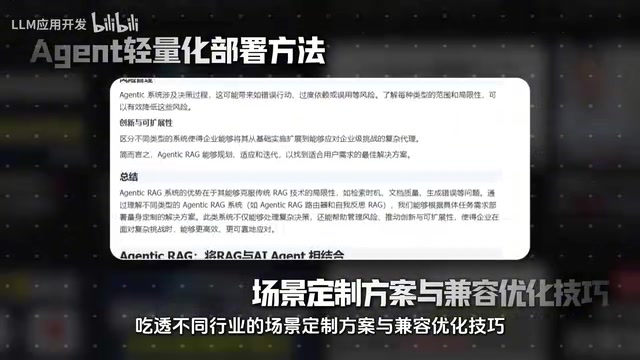
This week's focus includes:
-
Lightweight Agent deployment methods to reduce resource consumption. Agent deployment in production environments requires consideration of latency, concurrency, cost, and other dimensions. Common optimization strategies include: using smaller parameter models (such as 7B/13B scale) for simple subtasks, reducing redundant API calls through caching mechanisms, adopting asynchronous architectures to improve throughput, and leveraging containerization technologies (Docker/Kubernetes) for elastic scaling.
-
Industry-specific customization solutions (finance, education, e-commerce, etc.). Each industry has its specific data formats, compliance requirements, and business processes. For example, the financial sector requires strict data security and audit trails, education requires personalized learning path recommendations, and e-commerce requires real-time inventory and pricing information integration.
-
Compatibility optimization techniques to ensure Agents run stably across different environments
Week 6: End-to-End Practice — Completing an Independent Agent Project
The final week is the capstone of the entire learning roadmap. The goal is to integrate all knowledge and independently complete multi-scenario Agent projects. This is not only a test of the previous five weeks' learning outcomes but also a critical phase for accumulating project experience and connecting with real business needs.
When selecting a hands-on project, consider the following dimensions: the project should include a complete Agent workflow (Planning → Tool Calling → Memory Management → Result Output), involve RAG integration with at least one external data source, and include basic error handling and fallback strategies. Typical beginner-level projects include: intelligent document Q&A assistants, automated research report generators, and multi-step data analysis Agents.
Learning Advice and Realistic Considerations for Agent Development
The learning roadmap design of this tutorial series is well-structured, progressing layer by layer from foundational architecture to hands-on implementation. However, several points deserve attention:
First, the six-week timeline should be viewed realistically. For complete beginners, six weeks may only be enough to establish a basic cognitive framework. Reaching the level of independent development requires more practice and project accumulation. Based on the "10,000-hour rule" in software engineering and real-world development experience, going from beginner to independently delivering production-grade Agent applications typically requires 3-6 months of sustained effort.
Second, Agent development is not entirely free of programming prerequisites. Although the tutorial is positioned as "zero-foundation," skills like Python basics, API calls, and JSON data processing are still necessary. It's recommended to master at least basic Python syntax before studying Agents. Additionally, familiarity with HTTP protocols, asynchronous programming, environment variable management, and other web development fundamentals will significantly reduce friction during the learning process.
Third, use cases matter more than the technology itself. Many people learn a pile of technologies but don't know what to build. It's recommended to start from industries or work scenarios you're familiar with and identify pain points that Agents can truly solve. A good Agent application scenario typically has these characteristics: the task involves multiple steps with clear success criteria, requires integrating multiple information sources, is highly repetitive and time-consuming when done manually, and has moderate real-time requirements (allowing response times of a few seconds to tens of seconds).
Conclusion
AI Agent development is indeed one of the most promising directions in the current AI landscape, but the key to success lies not in chasing trends but in systematic learning and continuous practice. This 54-episode tutorial series provides a relatively complete learning framework suitable as a beginner's reference. However, whether you truly master this technology ultimately depends on your willingness to dig deep at every stage and apply what you've learned to real business scenarios.
From a broader perspective, Agent technology is still in a phase of rapid evolution. Leading companies like OpenAI, Anthropic, and Google are continuously optimizing their models' Agent capabilities (such as more reliable Function Calling, longer context windows, and stronger instruction following), while the open-source community keeps releasing new frameworks and tools. Staying attuned to the technological frontier while building a solid foundation is the best strategy for navigating this fast-changing field.
Related articles
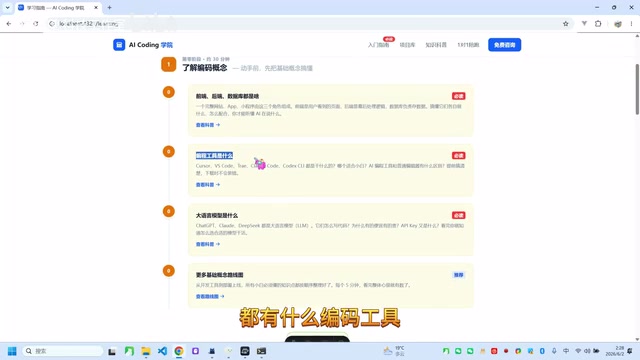
Learn to Code with AI from Scratch: A Complete Learning Path from Beginner to Deployment
A complete learning path for coding with AI from scratch — from concepts and environment setup to using Cursor, Claude, and other AI tools to build and deploy your first project.
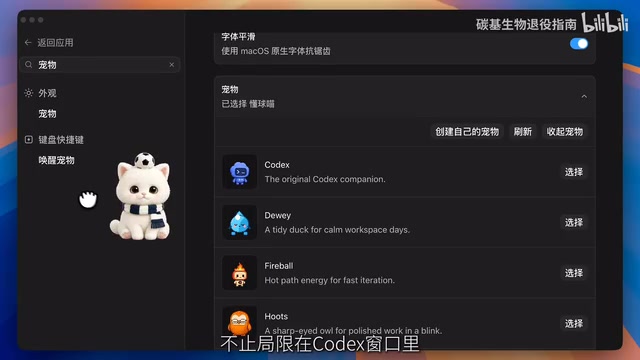
Codex Hands-On from Scratch: Building a Full-Stack World Cup App Without Writing Code
Learn how to build a full-stack World Cup app with OpenAI Codex without writing code, covering multi-session concurrency, MCP voice synthesis, Skill encapsulation, and scheduled task automation.
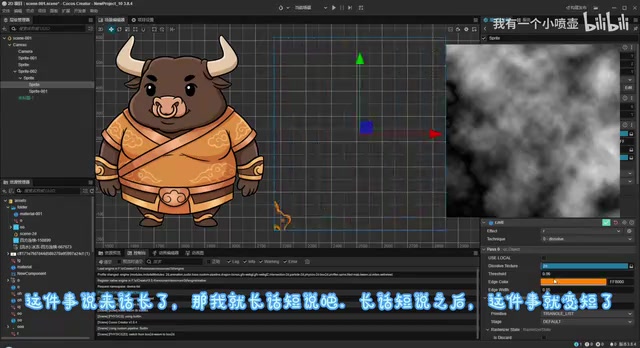
AI Generates 7 Cocos Dissolve Shaders at Once — Zero Errors, Ready to Use
Generate 7 Cocos grayscale dissolve Shader versions at once with AI templates — zero compilation errors, ready to use. Covers dissolve principles and AI-assisted Shader workflows.