AI Agent Development Learning Roadmap: A Four-Stage Guide from Zero to Production
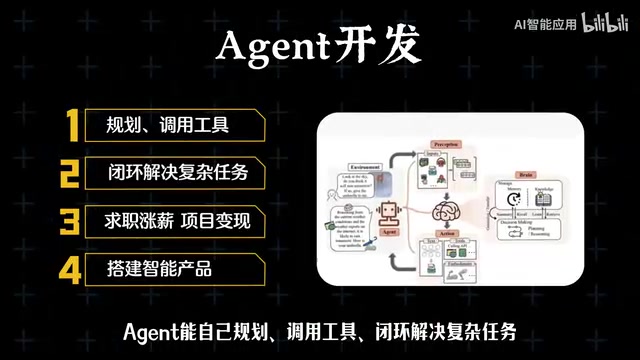
A four-stage learning roadmap to master AI Agent development from fundamentals to production.
This article presents a complete AI Agent development learning roadmap in four progressive stages: mastering core concepts (planning, memory, tool use), understanding agent paradigms like ReAct and Plan-and-Execute, learning multi-agent collaboration patterns, and building real-world projects. It covers mainstream tech stacks including LangChain, LangGraph, and CrewAI, with practical guidance on hallucination control, Function Calling, and deployment.
Why Is Agent Development a Core Skill in the LLM Space?
In today's rapidly evolving landscape of large model applications, basic RAG retrieval augmentation and simple API calls are no longer the core competitive edge for AI roles. RAG (Retrieval-Augmented Generation) effectively mitigates issues like outdated knowledge and hallucinations by retrieving relevant document snippets from external knowledge bases before generation. However, RAG is fundamentally still a one-shot "retrieve-stitch-generate" pipeline — it cannot handle complex tasks that require multi-step reasoning, dynamic decision-making, or cross-system operations. For example, when a user says "Analyze competitor data and generate a weekly report for me," RAG can only retrieve existing documents, whereas an Agent can automatically call data APIs to fetch data, invoke analysis tools to process it, and then use document generation tools to produce the report.
The ability to independently develop intelligent Agents — enabling AI to autonomously plan, invoke tools, and solve complex tasks end-to-end — is the truly hardcore skill. Traditional LLM applications are essentially a passive "question-and-answer" mode: the user inputs a prompt, the model returns a result, and the interaction ends there. The core breakthrough of Agents lies in introducing an "autonomous loop" mechanism: given a high-level goal, an Agent can automatically decompose the task into multiple sub-steps, independently decide which tool to call and what information to retrieve at each step, and dynamically adjust subsequent plans based on intermediate results. This means an Agent is no longer just a "tool" but something closer to a "digital employee" with rudimentary autonomy. This leap from passive response to proactive planning is the fundamental reason why Agent development has become a core skill.
Whether you're looking to land a job, earn more, take on freelance projects, or build intelligent products, AI Agent development has become a must-learn direction. The sooner you start learning systematically, the better positioned you'll be to ride this wave.
This article outlines a complete AI Agent development learning roadmap, divided into four progressive stages, to help you go from zero to production and systematically master this critical technology.
Stage 1: Foundations — Thoroughly Understand Core Agent Concepts
Learning Objectives
The focus of this stage is building a solid theoretical foundation. You need to first understand what an Agent actually is and how it fundamentally differs from traditional LLM applications.
Core Learning Content
- Core Agent Theory: Understand the definition, characteristics, and working principles of intelligent agents
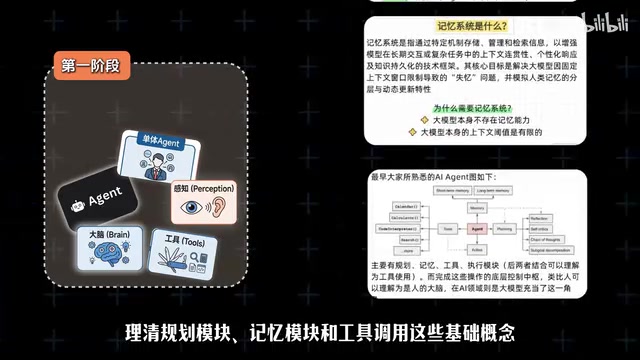
- Core Component Breakdown: Planning module, Memory module, Tool Use
- LLM Fundamentals: Familiarize yourself with the LLM's role as the Agent's "brain" and its capability boundaries
The Planning module determines how an Agent decomposes tasks and formulates execution steps. Current mainstream planning strategies fall into two categories: the first is "think-while-doing" (e.g., ReAct), where the Agent re-evaluates the current state and decides the next step after each action; the second is "think-then-do" (e.g., Plan-and-Execute), where the Agent generates a complete execution plan before carrying it out step by step. The former offers greater flexibility but can get stuck in local loops, while the latter provides better global coherence but is weaker at handling unexpected situations. In practice, the two strategies are often combined — starting with coarse-grained planning while allowing local adjustments during execution.
The Memory module gives Agents context awareness and the ability to accumulate experience. Agent memory is typically divided into two layers: short-term and long-term memory. Short-term memory corresponds to the context window of the current conversation, limited by the model's token length (e.g., GPT-4 Turbo supports 128K tokens). Long-term memory requires external storage solutions, commonly including vector databases (such as Pinecone and Chroma) for storing semantic vectors of historical interactions, and structured databases for storing key facts and user preferences. How to efficiently retrieve and inject historical memory within a limited context window is a key challenge in Agent engineering, directly impacting the Agent's coherence and perceived "intelligence."
Tool Use empowers Agents to interact with the external world. These three core components form the basic skeleton of an intelligent agent.
Learning Tips
Spend 1–2 weeks reading classic papers (such as Lilian Weng's LLM Powered Autonomous Agents) while getting hands-on experience with existing Agent products (like AutoGPT and MetaGPT) to build intuitive understanding.
Stage 2: Core Advancement — Master Agent Operating Principles and Paradigms
Learning Objectives
Level up from "understanding concepts" to "understanding principles." Master the core operational logic of Agents and learn to tackle real-world development challenges.
Core Learning Content
- Agent Action Principles: Understand how Agents perceive their environment, make decisions, execute actions, and obtain feedback
- Classic Agent Paradigms:
- ReAct (Reasoning + Acting): Alternating between reasoning and action — currently the most mainstream Agent paradigm
- CoT (Chain of Thought): Chain-of-thought reasoning that helps Agents perform complex logical deduction
- Plan-and-Execute: A decoupled architecture that plans first and executes second
- Overcoming Common Challenges: Hallucination control, tool selection accuracy, infinite loop issues, etc.
Key Concept: ReAct Paradigm Explained
The core idea of the ReAct paradigm is to have the Agent first "think" (Thought), then "act" (Action), and finally "observe" (Observation) the result at each step, forming a continuous reasoning-action loop. This pattern makes the Agent's decision-making process more transparent and controllable, and it's the default Agent execution logic adopted by mainstream frameworks like LangChain.
The Technical Foundation of Tool Calling: Function Calling
The core technology enabling Agent tool invocation is Function Calling. Taking OpenAI's implementation as an example, developers pre-define a set of functions with their names, parameters, and descriptions (in JSON Schema format). During inference, the model determines whether it needs to call a function; if so, it outputs the structured function name and parameters, and the application layer code actually executes the function and returns the result to the model. This mechanism leaves "decision-making" to the model and "execution" to the code, effectively combining AI capabilities with traditional software capabilities. MCP (Model Context Protocol) is an open standard proposed by Anthropic that aims to unify the integration protocol for different tools and data sources, reducing the development cost of connecting Agents to external systems.
Engineering Practices for Hallucination Control
In Agent scenarios, hallucination issues are more dangerous than in regular conversations — because Agents take real actions based on incorrect information. Common engineering-level control measures include: forcing the Agent to retrieve factual evidence before calling tools (Grounding); setting up human confirmation checkpoints for critical operations (Human-in-the-Loop); applying formatting constraints on the Agent's intermediate reasoning steps to prevent it from skipping verification and jumping straight to conclusions; and introducing a "reflection" mechanism that lets the Agent self-check whether results are reasonable after taking action. In production environments, these strategies typically need to be used in combination.
Stage 3: Advanced Enhancement — Multi-Agent Collaboration and Output Optimization
Learning Objectives
Master multi-agent collaboration and prompt tuning techniques to make Agent outputs more precise and practical.
Core Learning Content
- Multi-Agent Collaboration Logic: Understand how multiple Agents divide labor and coordinate to accomplish complex tasks
- Reinforcement Learning Basics: Learn how to continuously optimize Agent performance through feedback mechanisms
- Prompt Tuning Techniques: Systematically master prompt engineering to precisely control Agent output quality
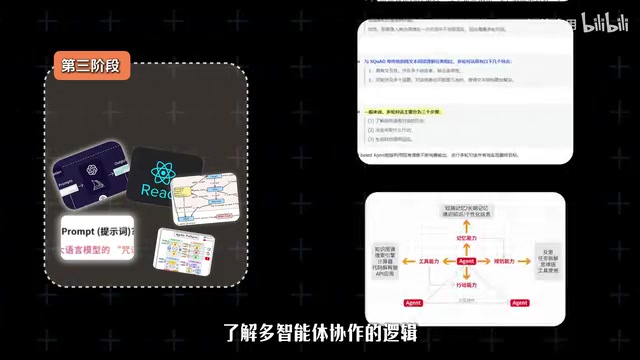
Three Typical Multi-Agent Collaboration Patterns
- Hierarchical: A primary Agent handles task assignment while multiple sub-Agents handle execution
- Peer-to-Peer: Multiple Agents negotiate as equals, reaching consensus through discussion
- Pipeline: Agents process tasks sequentially in relay fashion, with each Agent responsible for a specific stage
In real projects, the choice of collaboration pattern depends on the task's complexity and how it can be decomposed. For example, a content creation system might require a pipeline collaboration of "Research Agent → Writing Agent → Review Agent."
Stage 4: Production Deployment — Connecting to Real Business Scenarios
Learning Objectives
Integrate the knowledge from the first three stages and personally complete 2–3 hands-on projects, running through the entire process from development to deployment.
Recommended Hands-On Projects
| Project | Difficulty | Core Technical Points |
|---|---|---|
| Intelligent Decision Assistant | ⭐⭐⭐ | Information retrieval, reasoning & decision-making, result presentation |
| Office Automation Agent | ⭐⭐⭐⭐ | Multi-tool invocation, file processing, workflow automation |
| Multi-Agent Collaboration System | ⭐⭐⭐⭐⭐ | Multi-Agent communication, task allocation, result aggregation |

Key Practices for Agent Project Development
Every project should go through the following complete workflow:
- Requirements Analysis: Clearly define the specific problem the Agent needs to solve
- Architecture Design: Choose the appropriate Agent paradigm and toolchain
- Development & Implementation: Write core logic, integrate with LLMs and external tools
- Debugging & Optimization: Handle edge cases, optimize response quality and speed
- Deployment & Launch: Containerized deployment, runtime monitoring
After completing these projects, you'll have demonstrable, tangible results that directly strengthen your resume.
Recommended Technology Stack for Agent Development
For those looking to get started quickly with Agent development, here's the current mainstream technology stack:
- Framework Layer: LangChain, LangGraph, CrewAI, AutoGen
- Model Layer: GPT-4, Claude, open-source models (Qwen, DeepSeek)
- Tool Layer: Function Calling, MCP protocol, various API integrations
- Deployment Layer: FastAPI, Docker, cloud services
LangChain is currently the most popular framework for LLM application development, offering foundational capabilities like chain-based invocation, tool integration, and memory management — ideal for building Agents with linear workflows. LangGraph is an advanced framework from the LangChain team, specifically designed for building Agents with complex state transitions and conditional branching. It models the Agent's execution flow as a directed graph, where each node is a processing step and edges represent state transition conditions. For complex Agents requiring loops, parallelism, and conditional logic, LangGraph is more flexible and controllable than LangChain's Chain mode. CrewAI and AutoGen focus on multi-agent collaboration scenarios — the former emphasizes role-playing team collaboration, while the latter, developed by Microsoft, focuses on conversational coordination between Agents.
Conclusion
AI Agent development is a field that requires systematic learning — you can't skip the fundamentals and jump straight into projects, nor can you stay at the theoretical level alone. By following the four progressive stages of "Concepts → Principles → Optimization → Production," you can develop the ability to independently build enterprise-grade Agents in approximately 2–3 months.
In today's increasingly competitive AI application landscape, mastering intelligent agent development will become your most powerful differentiating advantage.
Related articles
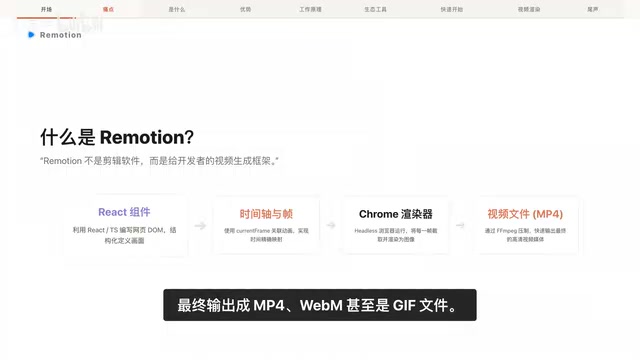
Remotion: The Open-Source Framework for Code-Driven Video Production with React
Deep dive into Remotion, the open-source framework for writing videos with React components. Covers core principles, use cases, comparison with traditional editors, and quick start guide.
Nex N2 Pro Real-World Testing: Top 5 on Official Benchmarks, Only 12th in Independent Tests
Deep-dive testing of Nex N2 Pro open-source Agent model comparing official benchmarks vs independent results. The 397B parameter model shows decent frontend generation but ranks 12th independently, not top 5 as claimed.
Claude Code Workflow in Practice: From Requirement Grilling to AFK Agent Auto-Coding
A detailed walkthrough of building real features with Claude Code: Grill Me requirement interrogation, auto-generated PRDs, AFK agent coding, and QA iteration loops with DDD and TDD strategies.