AI Agent Development Methodology: A Complete Guide from ReAct to Enterprise-Grade Tech Stack

A systematic overview of AI Agent evolution, core tech stack, and development paradigms.
This article systematically outlines the development trajectory and core technology system of AI Agents. It argues that Agents represent a new software paradigm driven by large models, where LLM capabilities determine the Agent's capability floor. From the theoretical foundation of the ReAct framework in 2022 to the maturation of multi-agent architectures, Agent development has formed a four-layer tech stack: model service layer, Agent type layer, development framework layer, and production deployment layer—transitioning from proof-of-concept to enterprise-grade engineering practice.
Introduction: Agents Are More Than Just API Calls
In the era of large language models, "AI Agent" has become one of the hottest keywords in the tech community. However, many developers still think of Agent development as nothing more than "calling an API with LangChain," or even dismiss it as lacking technical depth. In reality, from the introduction of the ReAct paper in 2022 to the gradual maturation of multi-agent architectures, Agent development has evolved into a complete theoretical framework and technology stack.
This article is based on the methodology section of an enterprise-grade Agent development course. It systematically outlines the evolution of Agents, the core technology stack, and development paradigms to help developers build a comprehensive understanding of the field.
The Essence of AI Agents: A New Generation of Software Powered by Large Models
From Web to Mobile to Agent
Different eras produce different software paradigms. The 2000s belonged to web applications—portal sites like Sohu, Sina, and NetEase defined the first decade of the internet. In the mobile internet era, apps on Android and iOS became the software people used most heavily every day. Now, AI Agents are emerging as the third major software paradigm.
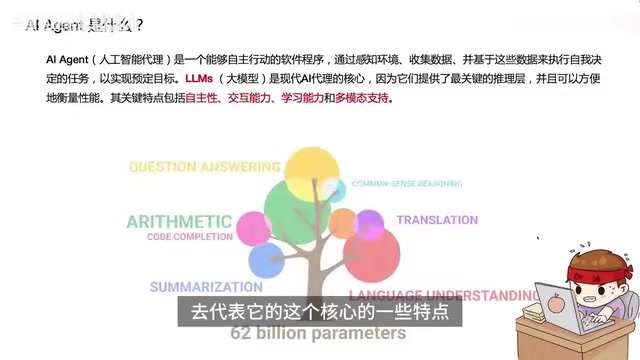
The fundamental difference between Agents and the previous two generations of software is this: their core driving force is the Large Language Model (LLM). Business logic that was hard-coded by programmers and product managers in traditional software can now be dynamically determined by large models in specific contexts, generating interactions and outcomes on the fly.
The LLM Determines the Agent's Capability Floor
A key insight is: the LLM's capabilities directly determine the Agent's capability floor. If the underlying model is powerful enough (e.g., GPT-4, Claude 3.5), even a less-than-elegant Agent engineering design can still guarantee basic response quality. Conversely, if the model itself is insufficient, no amount of prompt engineering or architecture optimization can overcome its fundamental limitations.
This also explains why competition at the model layer is so fierce—one model releases a new version today, another gets an upgrade tomorrow. Improvements in model capabilities directly expand the boundaries of what upper-layer Agents can accomplish.
The ReAct Framework: The Early Theoretical Foundation of Agents
A Unified Framework for Reasoning + Acting
The theoretical origin of Agents can be traced back to the ReAct paper (Reasoning + Acting), published in mid-2022. An interesting detail: this paper was published before ChatGPT's release—the theoretical framework came first, followed by widespread public awareness of large models.
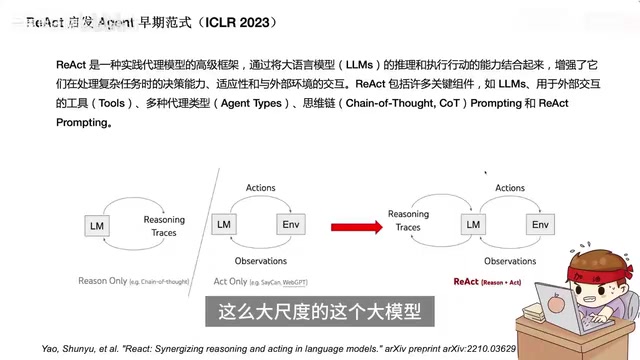
ReAct integrates two core capabilities of large models into a single framework:
- Reasoning (Reasoning/Trace): Using prompt engineering techniques like Chain of Thought to enable step-by-step reasoning, significantly improving generation quality
- Acting (Action): Allowing the model to call external tools to interact with the environment, then making further decisions based on feedback
Before ReAct, projects like WebGPT and ToolFormer had already explored the possibility of LLMs calling external tools, but they were limited to single-call patterns. ReAct's core contribution was integrating reasoning and acting into an iterative loop: perceive environment → reason and decide → execute action → receive feedback → reason again.
Limitations of the ReAct Framework
Despite proposing an elegant theoretical framework, ReAct revealed significant issues in practical implementation:
- Too abstract: It provided no concrete implementation details—how exactly to reason, how specifically to interact with the environment—all lacked clear guidance
- Enormous token consumption: The iterative loop pattern consumes tokens heavily in practice, making costs difficult to control
- No termination mechanism: Should it loop indefinitely? When should it stop? These engineering questions were left unanswered in the paper
The industry gradually realized: simple Reasoning + Action is insufficient to fully describe a production-grade Agent. This drove the emergence of richer Agent development paradigms.
Core Agent Development Tech Stack: A Four-Layer Architecture
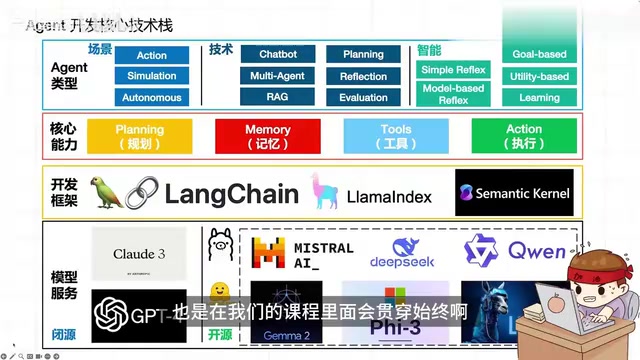
The course outlines a comprehensive panoramic view of the Agent development tech stack, organizing the entire system into clear hierarchical layers.
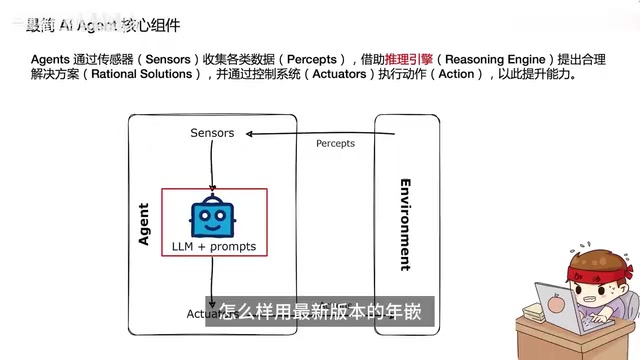
Layer 1: Model Service Layer
The model service layer is the foundation of the entire Agent tech stack and the most fiercely competitive area today. It's divided into two camps:
Closed-source commercial models:
- Anthropic's Claude 3 series
- OpenAI's GPT-4 series
- These two are currently the Top 2 in closed-source model services
Open-source model ecosystem:
- Meta LLaMA: The cornerstone of this wave of open-source LLMs
- Mistral AI: Called "Europe's OpenAI," continuously releasing new models with MoE architecture
- Google Gemma 2: Second-generation lightweight open-source model
- Microsoft Phi-3: A representative of small-size, high-performance models
- Chinese models: Qwen (通义千问), DeepSeek, etc.
For developers, the key tool is Ollama—a model hosting platform that enables quick deployment of open-source models on local GPUs with REST API services. In real projects, both closed-source API calls and open-source private deployment modes are typically supported simultaneously.
Layer 2: Agent Type Layer
This is the most complex layer in the Agent tech stack. Agent types can be categorized along three dimensions:
- By scenario: Agent designs for different application contexts
- By technology: Agent architectures based on different technical implementations
- By intelligence level: Agent capability tiers from simple to complex
These three dimensions overlap, but examining them from different perspectives helps us understand the full picture of Agents more clearly. The core goal is: when you encounter various "XX Agent" concepts, you can quickly identify which category it belongs to, what problem it solves, and what scenarios it's suited for.
Layer 3: Development Framework Layer
LangChain plays a critical role in the Agent development ecosystem. It achieves decoupling between the model service layer and prompt engineering, allowing different roles to focus on their respective domains:
- From early various Chains (LLMChain, RouterChain, TransformChain)
- To the current shift toward Runnables and LCEL (LangChain Expression Language)
- The new version of LangChain will completely deprecate LLMChain
Beyond LangChain, frameworks like LangGraph and AutoGen provide more specialized support in areas such as multi-agent collaboration.
Layer 4: Production Deployment Layer
This is an often-overlooked but critically important layer. Most developers' Agents end up as nothing more than command-line tools, lacking:
- A visual frontend interaction interface
- One-click deployment via Docker containerization
- Cross-server rapid distribution and collaboration capabilities
Production-grade Agents need to address these "peripheral" but essential engineering challenges to truly operate in enterprise environments.
From Theory to Practice: The Evolution of Agent Development
Looking back at the evolution of Agent development, a clear path from exploration to maturity emerges:
- Mid-2022: ReAct paper proposes the Reasoning + Acting framework
- Late 2022: ChatGPT launches, bringing public awareness of LLM capabilities
- Early 2023: Experimental projects like AutoGPT and BabyAGI emerge, validating strategies like chain-of-thought and complex problem decomposition
- Mid-2023: The LangChain ecosystem matures, offering pre-built Agent strategies like Plan-and-Execute and Zero-shot ReAct
- Subsequent developments: The industry recognizes the limitations of a single ReAct framework; Multi-Agent systems and more granular process control become mainstream directions
This evolutionary timeline tells us: Agent development isn't chaotic experimentation—it follows a clear theoretical lineage and logical technical progression. Behind the apparent "hundred schools of thought" are different teams exploring and optimizing along different dimensions.
Conclusion
Agent development is transitioning from early proof-of-concept to enterprise-grade engineering practice. Understanding the underlying theory, mastering the layered architecture of the core tech stack, and knowing the applicable scenarios for different Agent types are foundational knowledge that every developer looking to go deep in this field must establish. Don't stay at the "LangChain + RAG" level of understanding—the world of Agents is far richer than that.
Related articles
 Deep Dives
Deep Dive into How OpenClaw (Open-Source Crayfish) AI Agent Works
Deep analysis of OpenClaw AI Agent internals: System Prompt, tool calling, SubAgents, Skill system, memory, and Context Engineering explained.
 Deep Dives
Demystifying Transformer: A Word-Continuation Function, Deconstructed
Understand Transformer through the lens of word continuation. Breaking down language generation into Embedding, Transformer Block, and Probability output modules for intuitive understanding.
 Deep Dives
Five Core Differences Between Claude Code and Regular AI Chat
A detailed comparison of Claude Code vs regular AI chat across five dimensions: interaction, context understanding, execution, memory, and tool integration.