AI Agent Development Tutorial: A Practical Guide from Zero to One-Person Company
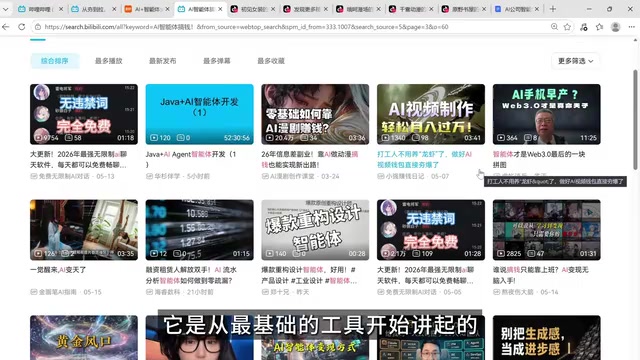
A complete guide to learning AI Agent development and building a one-person company through automated workflows.
This article systematically covers the three-stage learning path for AI Agent development — from LLM fundamentals and Prompt Engineering, through core technologies like RAG, LangChain, and visual platforms like Coze and Dify, to practical project implementation. It also explores how AI Agent workflows enable a one-person company model with automated content production, multi-account operations, and scalable monetization.
Why AI Agents Have Become the Hottest Skill
Recently, a series of tutorials on building AI Agents on Bilibili (China's YouTube equivalent) has attracted massive attention. One creator shared their complete journey of building a "one-person company" from scratch by learning AI Agent workflows — simultaneously running three accounts, taking on external client projects, and achieving automated content production. The core capability behind all this is the red-hot technology of AI Agent development.
This article systematically outlines the learning path, core tech stack, and practical monetization logic of AI Agent development based on that tutorial's content framework, helping you build a comprehensive understanding of this field.

What Are AI Agents? The Fundamental Difference from Ordinary AI Tools
Many people still use AI at the "Q&A" level — using tools like Doubao or ChatGPT to search for things or write copy. But AI Agents represent a quantum leap: they can not only understand instructions but also autonomously plan, invoke tools, and execute multi-step tasks.
From a technical architecture perspective, an AI Agent's core typically contains four key modules: a perception module (receiving external input), a planning module (decomposing goals into subtasks), an action module (calling external tools to execute tasks), and a memory module (storing context and historical information). This architecture draws from the BDI (Belief-Desire-Intention) model in cognitive science, where agents act autonomously based on their understanding of the world (beliefs), goals they want to achieve (desires), and current execution plans (intentions). Since 2023, with the significant improvement in reasoning capabilities of large models like GPT-4, AI Agents have moved from academic concepts to engineering practice, with organizations like OpenAI and Google DeepMind making Agent capabilities a core direction for next-generation AI products.
In simple terms:
- Ordinary AI usage: You ask a question, it gives an answer — one question, one response.
- AI Agents: You give it a goal, and it breaks down tasks, calls different tools, and executes in loops until the entire workflow is complete.
Here's a practical example: Using AI to make short videos — you can probably learn to make one in a few minutes from any random tutorial. But stringing together topic selection, copywriting, visuals, editing, publishing, and data analysis into a single automated pipeline that the agent runs on its own — that's the value of Agent workflows.
Systematic Learning Path for AI Agent Development: Three Progressive Stages
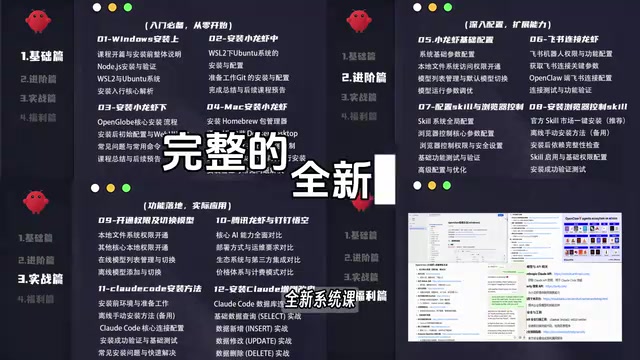
Based on the tutorial's curriculum design, learning AI Agent development can be divided into three stages, which is also the generally recognized learning roadmap in the industry.
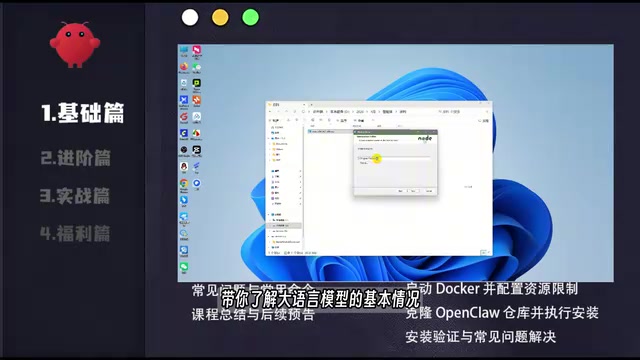
Foundation Stage: Concepts and Tool Onboarding
The core goal of this stage is to build a cognitive framework:
- Large Language Model (LLM) fundamentals: Understanding how models like GPT and Claude work. You don't need deep mathematical derivations, but you should know what they can and cannot do.
- Mainstream AI Agent product awareness: Understanding the Agent platforms and tool ecosystems available in the market, both domestic and international.
- Prompt Engineering: This is the foundational skill for collaborating with AI. Good prompts can multiply the quality of model output several times over — crucial for both beginners and advanced practitioners.
Prompt Engineering has evolved from early experiential tricks into a systematic methodology. Core techniques include: Few-shot Learning (guiding model output format through examples), Chain-of-Thought (guiding the model to reason step by step), ReAct (alternating between reasoning and action), Tree-of-Thought (exploring multiple reasoning paths), and more. In practice, a good prompt typically includes role definition, task description, output format constraints, examples, and boundary conditions. Research shows that optimized prompts can improve GPT-4's accuracy on specific tasks from 60% to over 95%, making Prompt Engineering one of the most cost-effective foundational skills of the AI era.
For absolute beginners, the barrier to entry at this stage isn't high. As the creator mentioned, before learning, their understanding of AI was "just using Doubao to ask questions, that's it." The key is to learn systematically rather than consuming fragmented tutorials.
Intermediate Stage: Core Tech Stack Deep Dive
This stage introduces real development frameworks and technical components:
- RAG (Retrieval-Augmented Generation): Enables AI to answer questions based on your own knowledge base — the core technology for building enterprise-grade intelligent customer service and knowledge assistants.
RAG (Retrieval-Augmented Generation) was first proposed by Meta AI in 2020, designed to solve two core pain points of large language models: knowledge cutoff date limitations and hallucination problems. Its working principle is to retrieve relevant document fragments from an external knowledge base before the model generates an answer, injecting these fragments as context into the prompt so the model generates responses based on real data. A typical RAG pipeline includes: document chunking, vectorization (Embedding), storage in vector databases (such as Pinecone, Milvus, Chroma), semantic retrieval, context assembly, and answer generation. This technology allows enterprises to have AI accurately answer questions based on private data without fine-tuning the model, significantly lowering the technical barrier and cost of AI deployment.
- LangChain Framework: Currently the most popular LLM application development framework, providing standardized toolchains for building complex AI applications.
LangChain was created by Harrison Chase in October 2022 and gained over 70,000 GitHub stars within just one year, becoming the de facto standard framework for LLM application development. Its core value lies in providing a standardized abstraction layer that encapsulates common needs like prompt management, model invocation, tool integration, memory management, and chain calls into reusable components. Developers can combine these components like building blocks to construct complex applications. The LangChain ecosystem also includes LangSmith (a debugging and monitoring platform) and LangGraph (for building stateful multi-step Agent workflows). Competing frameworks include LlamaIndex (focused on data indexing and retrieval), AutoGen (Microsoft's multi-Agent collaboration framework), and CrewAI (focused on multi-Agent role-playing).
- Agent Frameworks: Learning how to give AI autonomous decision-making and tool-calling capabilities.
- Private Deployment: Including solutions like OpenCode, addressing data security and customization needs.
- Visual Development Frameworks: Low-code platforms like Coze and Dify that enable non-professional developers to build complex Agent workflows.
Coze (under ByteDance) and Dify (an open-source project) represent the low-code trend in AI application development. Coze provides a visual workflow orchestration interface where users can build complex agents with conditional logic, loops, and API calls through drag-and-drop nodes, with one-click publishing to platforms like Feishu, WeChat, and Discord. Dify is an open-source LLMOps platform that supports private deployment and provides full-process visual management from prompt orchestration to RAG pipelines and Agent tool invocation. The emergence of these platforms means AI application development is no longer exclusive to programmers — product managers, operations staff, and content creators can all build customized AI workflows based on their business needs. This is considered an important milestone in what the industry calls "technology democratization."
The goal of this stage is to transition from "knowing how to use" to "knowing how to modify and build." Once you master these technologies, you'll have the ability to customize AI solutions for different scenarios.
Practical Stage: Project Implementation and Monetization
Technology must ultimately serve real needs. The practical projects mentioned in the tutorial include:
- Office automation and batch file processing: Using agents to replace repetitive office labor.
- Intelligent customer service Q&A systems: Building industry-specific customer service bots based on RAG technology.
- Automated content production: Batch generating short video materials, copywriting, and other content.
The One-Person Company Model: Monetization Logic of AI Agents
One of the most valuable insights shared by the creator is the concept of a "one-person company." This isn't a marketing gimmick but a genuinely viable work model in the AI Agent era.
A Qualitative Shift in Efficiency
Taking an e-commerce product promotion account as an example, the creator provided comparative data:
- Manual operation period: Maximum 2 videos per day, with product selection, copywriting, visuals, and editing all done manually, exhausting an entire day.
- After Agent workflow integration: 15-20 videos per day, with more stable performance metrics than before.
This isn't just a matter of efficiency improving several times over — it's a fundamental transformation of the work model — humans handle judgment and decisions while agents handle all repetitive labor.
The Possibility of Running Multiple Tracks in Parallel
In the traditional model, one person's energy is limited, making it nearly impossible to simultaneously run multiple accounts or take on projects across different domains. But with AI Agent workflows, the creator achieved:
- Simultaneously running 3 accounts in different domains (manga drama, novel promotion, e-commerce product videos)
- Taking on external client projects (local restaurant AI digital human promotions, women's fashion short video ad materials)
- Providing paid consulting services
This is essentially a "company" with no team and no office, but with complete business capabilities.
A Rational Perspective on Monetization
To the creator's credit, they maintained considerable honesty in their sharing. They explicitly stated:
"Not every video I make goes viral, and not every account takes off. Before the three accounts that worked out, I also abandoned several accounts with mediocre data that barely monetized at all."
This logic is similar to Warren Buffett's investment philosophy — out of 200+ companies, only about a dozen truly make big money. The value of AI Agents isn't in guaranteeing success every time, but in dramatically reducing the cost of trial and error, giving you the ability to keep experimenting until you find an effective path.
Recommendations and Considerations for Learning AI Agent Development
Who Should Learn AI Agent Development?
- Content creators: Self-media professionals looking to boost output efficiency and achieve multi-platform operations.
- Freelancers/side-hustle explorers: Individuals wanting to monetize AI skills through client work.
- Corporate employees: Professionals looking to introduce AI automation at work and enhance their career competitiveness.
- Career transitioners in tech: Developers with some programming background who want to enter the AI application development field.
Pitfalls to Watch Out For
- The fragmented learning trap: There are many tutorials on Bilibili, but they're "generally not detailed or complete enough, with many key steps glossed over." Systematic learning is far more efficient than consuming scattered tutorials.
- The rush-to-results mentality: You won't start making money immediately after learning — it requires continuous practice and iteration.
- Tool dependency syndrome: Tools and platforms will constantly update and evolve. The key is mastering underlying logic and methodology, not the operations of any specific tool.
Conclusion
AI Agent development is rapidly evolving from a "cutting-edge technical concept" into a "practical productivity skill." Whether for personal efficiency gains or commercial monetization, mastering the ability to build Agent workflows will be one of the most cost-effective skill investments in the coming years.
What matters isn't your current technical foundation, but whether you're willing to invest time in systematic learning and continuous iteration through practice. As the old saying goes — the best time to plant a tree was ten years ago; the second best time is now.
Related articles

Your Pension Forced to Buy AI Bubble Stocks: The Truth Behind Nasdaq's Rule Changes
Nasdaq's fast-track rule changes may force your 401K and pension funds to buy SpaceX, OpenAI, and Anthropic stock. Analysis of the $4T valuation bubble and what investors can do.

GPT 5.6 Internal Testing Codename Revealed, Google Pays SpaceX $920M Monthly for Computing Power
OpenAI begins GPT 5.6 Kindle Alpha internal testing with stronger base reasoning. Google partners with SpaceX at $920M/month for computing power. Gemma 4 QAT enables edge deployment, Claude Cowork doubles credits.
Create Now Review: Can You Really Build Apps with Natural Language and Zero Coding Experience?
In-depth review of Create Now's AI software development tool: intelligent requirements discovery, modular development, visual iteration, and one-click deployment. Can zero-experience users turn ideas into real software?