Create Now Review: Can You Really Build Apps with Natural Language and Zero Coding Experience?
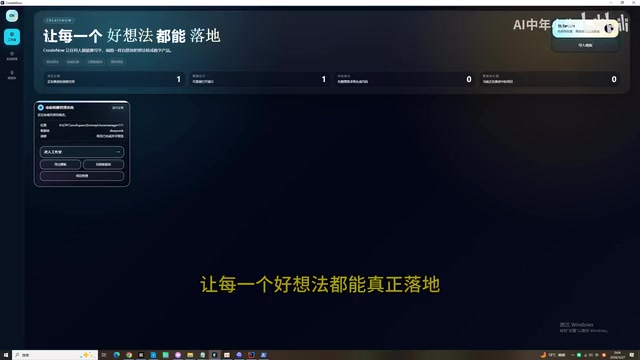
Create Now lets non-coders build apps through natural language conversation across the full development lifecycle.
Create Now is an AI-powered software development platform that enables zero-experience users to build applications using only natural language. Its four-step workflow covers intelligent requirements discovery, modular development, visual iteration, and one-click deployment. While it addresses a real pain point in bridging the gap between ideas and usable software, questions remain about its complexity ceiling and production-readiness.
Knowing How to Code Doesn't Mean You Can Build Software — Where's the Real Bottleneck for Ordinary People?
AI coding tools are emerging left and right — Cursor, Copilot, Claude, and other large language models can already generate remarkably high-quality code. But here's the harsh reality: most ordinary people still can't build the software they want.
The reason is simple — building usable software has never been equivalent to writing code. It's a complete systems engineering effort that involves at least five major stages:
- Defining requirements: Turning vague ideas into clear functional descriptions
- Analysis and design: Determining the technical approach and architecture
- Writing code: The actual development work
- Testing and validation: Ensuring correct functionality and smooth user experience
- Deployment and launch: Making the software truly usable and shareable
Current large language models can, at best, barely substitute for the "writing code" stage alone. For people without technical backgrounds, the real bottleneck is often at step one — you don't know how to transform the vague ideas in your head into structured product requirements that AI can understand.
This is precisely the core problem Create Now aims to solve.
Create Now's Core Philosophy: Natural Language Is the Only Development Skill You Need
According to its creators, Create Now was built over three months with a core mission: "Let every good idea truly come to life." Unlike most AI coding tools on the market, it doesn't require users to have any coding knowledge. The only thing users need to do is — talk.
Behind this philosophy lies a profound insight: natural language is a skill everyone already possesses. If natural language can serve as the sole input for software development, then the power to build software truly returns to every ordinary person.
Create Now's Four-Step Workflow: The Complete Path from Idea to Usable Software
Step 1: AI Product Manager — Intelligent Requirements Discovery and Organization
Create Now's first highlight is that it doesn't rush to write code the moment you share your idea. Instead, the AI takes on the role of a senior product manager, engaging you in deep conversation.
For example, if you say "I want a photo album that manages family photos and can intelligently categorize them by face recognition," the AI won't immediately start developing. Instead, it will ask follow-up questions: How many people does it need to recognize? Should photos be arranged on a timeline? Do you need sharing features? Through this guided dialogue, it helps you uncover potential requirements you hadn't even realized yourself, ultimately producing a clear and complete feature list for your confirmation.
This step addresses ordinary people's biggest pain point: bridging the gap from vague ideas to structured requirements.
Step 2: AI Development Team — Modular Professional Development
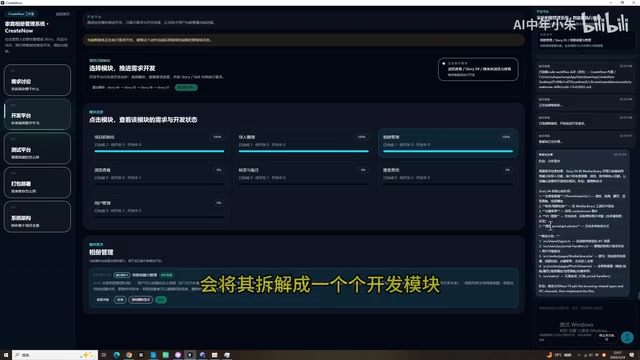
Once requirements are confirmed, Create Now automatically breaks down the feature list into individual development modules. At this point, the AI transforms into a software engineer, developing according to professional engineering standards.
The platform has built-in mainstream front-end and back-end technology stacks, aiming to ensure the output isn't a "toy-level demo" but a reasonably robust, usable product. If this can be achieved, it would be a significant complement to existing AI coding tools — after all, much AI-generated code can run but often falls short in engineering standards, error handling, and security.
Step 3: What You See Is What You Get — Visual Review and Rapid Iteration
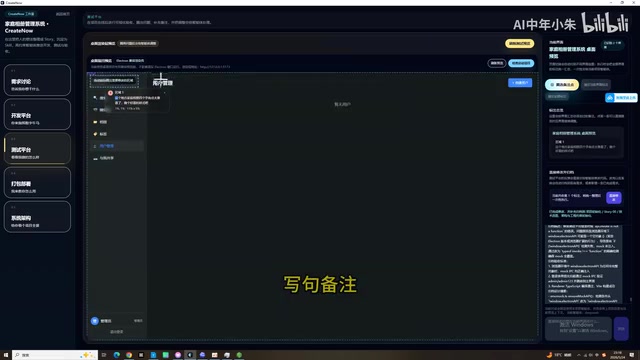
After one-click project launch, users are presented with an interactive software prototype. This step is designed to be highly intuitive: if something doesn't look right, just circle it and write a note.
For instance, "make this button bigger" or "add a tooltip here" — the AI immediately understands and makes the change, while automatically archiving this modification as a new requirement record. This "what you see is what you get, modify and it's done" experience dramatically reduces communication costs, allowing non-technical people to precisely express their intentions.
Step 4: One-Click Packaging — Easy Deployment and Launch
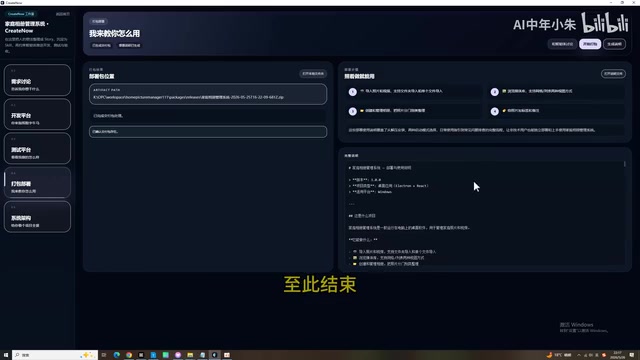
Finally, Create Now provides one-click packaging and deployment guides to help users push their software from the development environment to a shareable state. Throughout the entire process, the platform's built-in AI agents are available at any time to answer questions users encounter at any stage.
Create Now's Limitations: The Gap Between Ideal and Reality
From a product philosophy perspective, Create Now has indeed identified a real and important pain point. The main problem with current AI coding tools is that most of them target developers with some technical foundation, not truly "zero-experience ordinary people." Create Now's attempt to bridge this gap by covering the entire software development lifecycle is directionally correct.
But we need to stay rational:
- Complexity ceiling: For simple utility applications, this workflow might work well; but for software involving complex business logic, high concurrency, data security, and similar scenarios, how far purely natural-language-driven development can go still needs validation.
- The standard of "robust and usable": The gap between a demo and a production-grade product is enormous. Whether AI-generated code meets standards for maintainability and scalability needs to be proven through real-world cases.
- Ongoing iteration capability: Software development isn't a one-time project. Subsequent bug fixes, feature iterations, version management, and other long-term maintenance tasks are equally challenging for ordinary people.
Democratization of Software Development: An Irreversible Industry Trend
Despite the questions above, the direction Create Now represents — the democratization of software development — is an almost irreversible trend. From no-code platforms to AI coding assistants, and now to full-lifecycle AI software workstations, the abstraction level of tools keeps rising while the technical barrier for users continues to drop.
As the creators put it: "Natural language is something we all know, which means the power to develop software will ultimately belong to every ordinary person." This statement may be overly idealistic, but it points to a clear evolutionary direction.
Reportedly, the creators plan to use Create Now weekly to turn various creative ideas into reality, spanning professional tools and everyday utility apps. These real-world cases will be the best litmus test for verifying the platform's true capabilities.
For ordinary people who have ideas but can't code, Create Now at least offers a new option worth watching and trying. And for the industry as a whole, it's more like a "preview of the future form of software engineering" — a future where everyone is a product manager, and AI is your development team.
Related articles
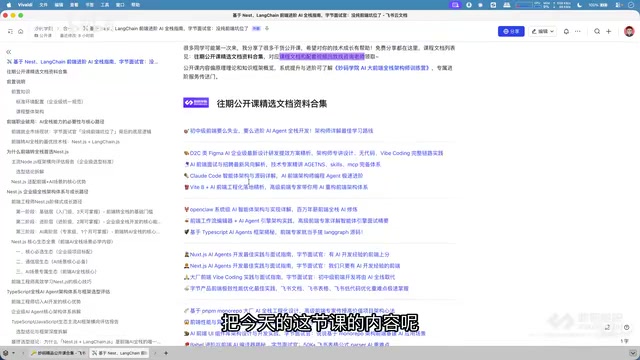
NestJS + LangChain: A Practical Guide for Frontend Engineers Transitioning to AI Full-Stack Architecture
How can frontend engineers transition to AI full-stack? This guide covers NestJS + LangChain, TypeScript fundamentals, AI Agent development, local model deployment, and cross-language architecture skills.
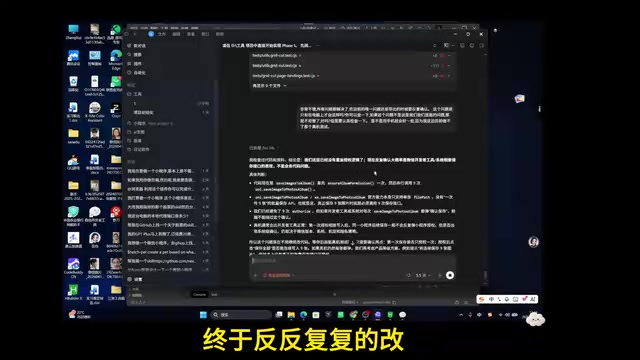
Building a Complete Mini Program with Codex: A Full-Process Walkthrough from Zero to Launch
A detailed walkthrough of building a complete WeChat Mini Program from scratch using OpenAI Codex, covering seven image tool features, membership system, WeChat Pay integration, and AI-assisted development strategies.
OpenAI Codex Deep Dive: The AI Develop…
OpenAI Codex Deep Dive: The AI Development Tool That Makes Programming Feel Like Flying
Deep dive into how OpenAI Codex redefines programming. From real developer feedback to the Time to Fly project, analyzing Codex's strengths in code generation, context understanding, and the AI coding tool competitive landscape.