AI Agent Learning Roadmap: From Beginner to Enterprise-Level Development in Three Months
AI Agent Learning Roadmap: From Beginn…
A complete three-month, four-stage roadmap for learning AI Agent development from scratch
This article systematically breaks down a three-month roadmap for learning AI Agent development from scratch, divided into four stages: LLM fundamentals (Transformer principles and Prompt Engineering), core Agent paradigms (ReAct think-act-observe loop and frameworks like LangChain), memory mechanisms and tool calling (vector databases for long-term memory), and multi-agent collaboration (AutoGen/CrewAI frameworks). The article emphasizes project-driven learning and notes that Python programming proficiency is a prerequisite.
Why AI Agent Development Is Worth Learning
AI Agents have moved from concept to real-world implementation, becoming one of the hottest technology directions in enterprise digital transformation. Whether it's intelligent customer service, office automation, or multi-agent collaboration systems, market demand for AI Agent development talent is growing rapidly.
For developers looking to break into or transition to this field, a core question is: How long does it actually take to learn AI Agent development from scratch? A practical course from Bilibili offers a relatively pragmatic answer — three months, divided into four stages, progressively mastering the complete skill stack from LLM fundamentals to multi-agent collaboration.
Let's break down this AI Agent learning roadmap and analyze the core knowledge points and learning strategies for each stage.
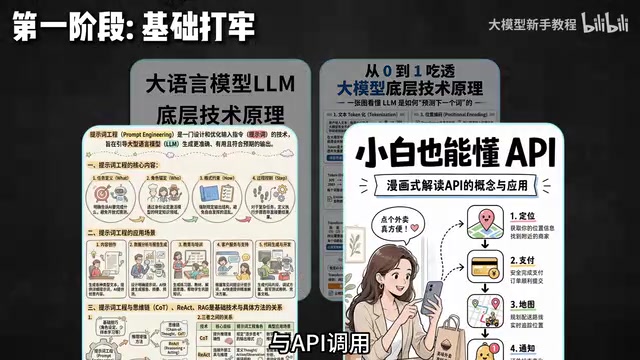
Stage One: Building a Solid LLM Foundation
All Agent development requires an understanding of the underlying logic of Large Language Models (LLMs). The goal of this stage is to figure out two things:
- How LLMs work: Understand core concepts like the Transformer architecture, tokenization, context windows, and temperature parameters. You don't need to train a model from scratch, but you must know how models "think" — this directly determines the quality of your decisions when designing Agents later.
Transformer Architecture Background: The Transformer is the cornerstone of modern large language models, proposed by Google in the 2017 paper Attention Is All You Need. Its core innovation is the "Self-Attention" mechanism, which allows the model to attend to all other words in the input sequence simultaneously when processing each word, thereby capturing long-range dependencies. Compared to previous RNN/LSTM architectures, Transformers can be highly parallelized during training, making it possible to train models with hundreds of billions of parameters like GPT, Claude, and Gemini. Tokenization is the first step in how models process text — text is split into subword units, with each Token corresponding to an ID in the vocabulary. The Context Window determines how many Tokens the model can "see" at once; GPT-4's 128K context window means it can process approximately 100,000 characters of text simultaneously. The Temperature parameter controls output randomness: closer to 0 produces more deterministic outputs, closer to 2 produces more diverse outputs — this directly affects Agent performance stability across different task scenarios.
- Prompt Engineering and API Calls: Master common Prompt Engineering techniques (such as Few-shot and Chain-of-Thought), and become proficient in calling APIs from major LLMs like OpenAI and Claude. This is the "foundation" of Agent development — an Agent is essentially driven by carefully designed prompts to accomplish complex tasks through LLMs.
Core Prompt Engineering Techniques: Few-shot Prompting involves providing a small number of examples (typically 3-5) in the prompt, allowing the model to understand the task format through analogical learning. Compared to Zero-shot (no examples), this can significantly improve accuracy on complex tasks. Chain-of-Thought (CoT) was proposed by Google in 2022, with the core idea of requiring the model to "think step by step" in the prompt, making complex reasoning processes explicit. Research shows that simply adding "Let's think step by step" can improve model accuracy on mathematical reasoning tasks by several times. For Agent developers, Prompt Engineering isn't just about "asking good questions" — it's the core means of defining an Agent's role boundaries, behavioral constraints, and output formats. A carefully designed System Prompt is essentially an Agent's "operating system."

This stage should take about 2-3 weeks, with the focus on hands-on practice — writing lots of prompts and observing differences in model outputs.
Stage Two: Mastering Core Agent Paradigms
Entering the core territory of Agent development, this stage requires understanding how Agents actually work.
The ReAct Paradigm: Think-Act-Observe Loop
ReAct (Reasoning + Acting) is currently the most mainstream Agent design paradigm, originating from the 2022 paper ReAct: Synergizing Reasoning and Acting in Language Models jointly published by Princeton University and Google. The paper's core finding is that pure reasoning (like CoT) lacks interaction with the external environment, while pure action lacks language reasoning capability — combining both enables LLMs to excel at complex tasks.
The core idea is to have the LLM follow a loop when executing tasks:
- Thought: Analyze the current situation and decide what to do next
- Action: Call tools or execute operations
- Observation: Get action results as input for the next round of thinking
At the engineering implementation level, the ReAct paradigm is realized through specific Prompt templates: the model is required to output in "Thought: / Action: / Observation:" format, where the Action part triggers actual tool calls (such as search engines or code executors), and the Observation is the real result returned by the tool injected back into the context. This loop iterates continuously until the model outputs "Final Answer" or reaches the maximum iteration count. Understanding the ReAct paradigm means understanding the "soul" of AI Agents — when an Agent gets stuck in a loop or makes wrong decisions, you can often locate the root cause by examining the Thought chain.
Framework Practice: LangChain and LangGraph
Building on paradigm understanding, you need to master at least one mainstream Agent development framework, such as LangChain or LangGraph. LangChain provides rich tool chains and abstraction layers for quickly building Agent prototypes; LangGraph is better suited for building complex stateful workflows.
This stage should take 3-4 weeks, with the focus on building projects following framework documentation rather than just reading theory.
Stage Three: Memory Mechanisms and Tool Calling
An Agent without memory is like a goldfish — every conversation starts from zero. The core problem to solve in this stage is: How do you make an Agent "smart" and able to "remember"?
Memory System Design
- Short-term Memory: Typically implemented based on the conversation context window, allowing the Agent to maintain coherence within a single session
- Long-term Memory: Stores historical interaction information through vector databases (such as Chroma, Pinecone), enabling the Agent to remember user preferences and history across sessions
Vector Databases and Long-term Memory Principles: Vector databases are the key infrastructure for implementing Agent long-term memory. They work by converting text into high-dimensional vectors through embedding models (such as OpenAI's text-embedding-ada-002), then storing these vectors and supporting efficient similarity retrieval. When an Agent needs to recall historical information, it also converts the current query into a vector and finds the most relevant historical records through cosine similarity or Euclidean distance — this process is called Vector Search or Semantic Search. Chroma is a lightweight open-source vector database suitable for local development and prototyping; Pinecone is a cloud-native managed service suitable for large-scale production deployments. In Agent memory architecture design, you also need to consider "forgetting mechanisms" — filtering memories through time decay, importance scoring, and other strategies can effectively control storage costs and improve retrieval quality. This technology stack is also the core component of RAG (Retrieval-Augmented Generation), one of the most widely used architectural patterns in enterprise AI applications today.

Tool Usage Capability
Truly valuable Agents must be able to interact with the real world — searching the web, querying databases, calling third-party APIs, reading and writing files, etc. Learning how to define and register Tools for an Agent is another key focus of this stage.
Suggested Practice Project: Build an intelligent customer service system with memory. This project exercises memory management, tool calling, and conversation flow design simultaneously, and is one of the most common Agent application scenarios in enterprises.
This stage should take 3-4 weeks.
Stage Four: Multi-Agent Collaboration
A single Agent has limited capabilities; real enterprise-level applications often require multiple Agents working together. This is currently the most cutting-edge and challenging direction in the AI Agent field.
Three Classic Collaboration Patterns
Multi-agent systems have several classic collaboration patterns:
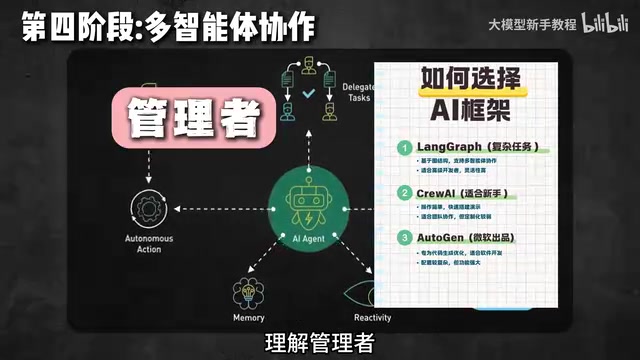
- Manager-Executor Pattern: A "manager" Agent handles task decomposition and assignment, while multiple "executor" Agents each handle their own responsibilities
- Debate Pattern: Multiple Agents analyze the same problem from different angles, reaching better solutions through "debate"
- Pipeline Pattern: Agents process tasks sequentially, with the output of one Agent serving as input for the next
Choosing a Multi-Agent Framework
Current mainstream multi-agent frameworks include:
-
AutoGen (by Microsoft): Open-sourced by Microsoft Research in 2023, its design philosophy abstracts multi-Agent collaboration into a "Conversable Agent" model. Each Agent can both send and receive/respond to messages, and human users can participate as a special type of Agent. AutoGen's core advantage is flexibility — it supports hybrid orchestration of LLM Agents, tool execution Agents, and human proxies, making it suitable for complex scenarios requiring human-AI collaboration.
-
CrewAI: Built around the core concept of "role-playing," using "Role," "Goal," and "Backstory" to define each Agent's identity, "Task" to describe work content, and "Crew" to organize collaboration relationships. This anthropomorphic abstraction lowers the understanding barrier for non-technical personnel, making Agent definition with roles, goals, and tools more intuitive and user-friendly.
Worth noting is the Agent orchestration standardization trend emerging in 2024 — including Anthropic's MCP (Model Context Protocol), which is attempting to solve interoperability issues between different frameworks and models. This will be an important development direction for the multi-agent field going forward.
This stage should take 3-4 weeks, completing 2-3 full projects to consolidate what you've learned.
Learning Advice and Practical Considerations
Is Three Months Enough?
Frankly speaking, the three-month timeframe is conditional:
- You need some programming foundation (at least familiarity with Python)
- You can invest 2-3+ hours of effective study time per day
- You learn through project-driven practice, not passive video watching
If you're starting from absolute zero, you may need an additional 1-2 months to build up your programming foundation.
Three Common Pitfalls to Avoid
- Don't just learn frameworks without learning principles: Frameworks iterate, but core concepts like the ReAct paradigm and memory mechanisms are universal
- Don't try to learn everything at once: Master one framework first (like LangChain), then expand horizontally
- Value engineering skills: Enterprise-level Agent development isn't just about calling APIs — it also involves error handling, logging and monitoring, cost control, and other engineering concerns
Career Prospects
AI Agent development is indeed a hot direction in the job market right now, but claims of "learn and immediately get hired" should be viewed rationally. Mastering the knowledge system in this learning roadmap gives you the technical foundation to qualify for relevant positions, but actual employment also depends on project experience, problem-solving ability, and depth of understanding of business scenarios.
The most important point: building projects hands-on is always more valuable than watching videos.
Key Takeaways
- AI Agent learning can be divided into four stages: LLM fundamentals, core Agent paradigms, memory and tools, and multi-agent collaboration
- ReAct (Think-Act-Observe) is the most mainstream Agent design paradigm today, originating from a 2022 academic paper — understanding it is key to mastering Agent development
- Memory mechanisms (short-term context window + long-term vector database) and tool-calling capabilities are what transform Agents from toys into productivity tools
- Multi-agent collaboration (AutoGen/CrewAI) represents the frontier of enterprise-level Agent applications, with standardization protocols like MCP driving ecosystem maturity
- The three-month learning roadmap requires programming fundamentals and sustained commitment; project-driven learning is more effective than passive video watching
Related articles
 Tutorials
Cursor + Codex Dual-IDE Collaboration: A Practical Methodology for Open-Source Project Customization
A complete methodology for open-source project customization based on real-world experience, detailing the Cursor+Codex dual-IDE workflow, seven-stage process, MVP validation, and AI source code reading techniques.
 Tutorials
Cursor Multi-Agent in Practice: Building a Full-Stack Next.js Blog in 50 Minutes
Build a full-stack blog in 50 minutes using Cursor IDE's multi-Agent mode with Next.js, Clerk auth, and Supabase. Learn the 4-phase AI Agent workflow and key integration pitfalls.
 Tutorials
Building an AI Software Factory from Scratch: A Cursor Engineer's Hands-On Experience with Multi-Agent Collaboration
Cursor engineer Eric shares practical insights on building an AI software factory: automation levels, guardrail design, parallel Agent management, and scaling to 1000+ Agents for 24/7 development.