AI Agent Practical Development: A Complete Guide from Concept to Building Production-Grade Intelligent Agents
AI Agent Practical Development: A Comp…
AI Agents are systems that autonomously perceive, decide, and act—powered by enabling LLMs to proactively use tools.
This article systematically introduces the definition, mainstream products, and core technical principles of AI agents. AI agents possess three key capabilities: environment perception, autonomous decision-making, and action execution, with their "thinking while doing" pattern derived from the ReAct framework. Current representative products include OpenAI Deep Research, Zhipu AutoGLM, and Manus. The core technology lies in achieving standardized multi-tool integration through the MCP protocol, enabling large models to proactively invoke external tools to complete complex tasks.
What Is an AI Agent?
The concept of AI Agent has been appearing frequently in tech circles in recent years, but many people's understanding of it remains superficial. By definition, an AI Agent is a system or program capable of autonomously perceiving its environment, making decisions, and executing actions.
Background: The Academic Origins of AI Agents The concept of AI agents didn't emerge recently—its academic roots trace back to AI research in the 1980s and 1990s. Turing Award winner Marvin Minsky proposed the embryonic concept of a "society of agents" in his book The Society of Mind. In 1995, Russell and Norvig formally defined an agent as "anything that can be viewed as perceiving its environment through sensors and acting upon that environment through actuators" in their classic textbook Artificial Intelligence: A Modern Approach, laying the theoretical foundation for modern AI agents. Early agents were mostly rule-based systems with very limited capabilities due to constraints in computing power and data. It wasn't until the rise of Large Language Models (LLMs)—especially when models like GPT-4 demonstrated powerful reasoning and instruction-following capabilities—that AI agents truly transitioned from academic concepts to industrial deployment, experiencing explosive growth.
At its core, an agent is still a program written in code, but it possesses three key capabilities:
- Environment Perception: The ability to understand the current context and user input
- Autonomous Decision-Making: The ability to determine how to handle situations even when they weren't present in training data
- Action Execution: Not just providing suggestions, but actually completing operations
Take an intelligent customer service agent as an example: when a user raises an entirely new question, the agent can autonomously determine how to handle it based on the current environment and execute the corresponding actions—all without human intervention. This characteristic of "appearing to possess intelligence" is precisely where the name "intelligent agent" comes from.
Major companies like IBM and NVIDIA have similar definitions and descriptions of AI agents, all centered around three dimensions: autonomy, decision-making capability, and action execution.
Analysis of Current Mainstream AI Agent Products
OpenAI Deep Research and Zhipu AutoGLM
OpenAI's Deep Research is a typical agent product whose ultimate goal is achieving AGI, currently primarily used for complex reasoning tasks. A domestic product with similar functionality is Zhipu's "AutoGLM" (ChenSi), whose core characteristic is "thinking while doing"—being able to think and perform data retrieval simultaneously.
AutoGLM's working method is quite distinctive: it can proactively operate a browser to search for information online, then continue deeper thinking after acquiring knowledge, making research results more thorough and comprehensive. Users need to install a browser plugin that the agent controls to read web pages and extract information.
This cyclical pattern of "think + search + think again" is precisely what distinguishes agents from traditional AI conversation tools. Academically, this pattern corresponds to the ReAct (Reasoning + Acting) framework proposed by Google Research in 2022—combining the reasoning capabilities of language models with external tool invocation, allowing models to interleave concrete actions (such as searching, computing) while generating textual reasoning, and incorporating action results into the context for the next reasoning step. The ReAct framework has been proven to significantly outperform pure reasoning or pure action approaches on complex tasks. AutoGLM's "thinking while doing" and Manus's multi-step autonomous decision chains are essentially concrete implementations and extensions of this framework at the engineering level.
Manus: An Agent Closer to AGI
Manus represents a more advanced form of agent development, closer to the concept of Artificial General Intelligence (AGI).
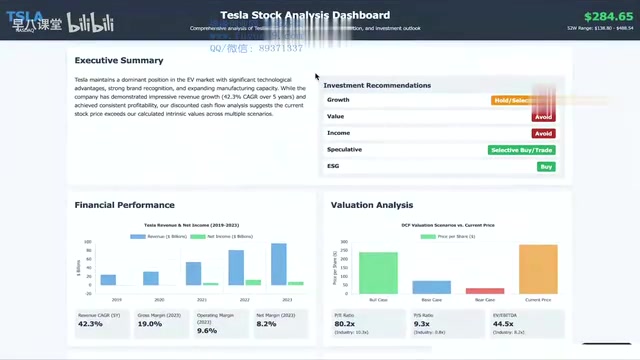
Taking Tesla stock analysis as an example, Manus's workflow is impressive:
- Remote Computer Startup: Launching a complete computing environment on a remote machine
- Shell Command Execution: Performing various management operations on the operating system
- Autonomous Decision Chains: Deciding the next step based on intermediate results
- Complete Output Generation: Ultimately producing a visualization dashboard website for Tesla stock analysis
The ability to execute Shell commands means the agent's capability boundaries are vastly expanded—it can read files, create files, write code, deploy code, and run code. This goes far beyond simply browsing web pages; it represents complete system operation capabilities.
However, this powerful capability comes with significant security risks that the industry is actively discussing. Key risks include: Prompt Injection Attacks—malicious web pages or files embedding text disguised as instructions to trick the agent into performing unintended operations; Excessive Permission Escalation—agents potentially accessing or modifying system resources beyond the task scope during execution; and Irreversible Operation Risks—operations like deleting files or sending emails that are difficult to undo once executed. Current mainstream industry countermeasures include: sandbox isolation (running agents in containerized environments), the principle of least privilege (granting only the minimum permissions needed for the current task), and human-in-the-loop confirmation mechanisms (requiring manual secondary confirmation for high-risk operations). In actual engineering deployment, the design of these security boundaries is equally important as the agent's capability design.
Core Technical Principles of Agents: Tool Calling and the MCP Protocol
From the performance of products like Manus, the core capability of agents can be distilled to one key point: enabling AI large models to proactively use tools.
Specifically, Manus's core capability lies in script execution. As long as the Shell execution channel is established and the large model can proactively invoke Shell commands, similar effects can be quickly achieved. The underlying technical architecture includes:
- Tool Integration: Connecting various external tools (browsers, terminals, databases, etc.) to the agent
- MCP Protocol: Achieving standardized integration of multiple tools, providing agents with a unified tool invocation interface
- Decision Loop: A closed loop of perceive → think → act → observe → think again
The MCP (Model Context Protocol) was officially open-sourced by Anthropic in November 2024, aiming to solve the pain point of "fragmented integration" between AI models and external tools/data sources. Before MCP, every time a new tool (such as a database, browser, or file system) was integrated, developers had to write custom adapter code for that specific tool, resulting in extremely high maintenance costs. MCP borrows the standardization philosophy of USB interfaces, defining a unified client-server communication specification: the AI model acts as the client, various tools expose their capabilities as MCP Servers, and both sides communicate through a standardized JSON-RPC protocol. This completely decouples tool development from model invocation—developers only need to write an MCP Server once, and it can be reused by any model that supports MCP, dramatically reducing the complexity of multi-tool integration. Currently, mainstream products like Claude and Cursor fully support MCP, and the ecosystem is expanding rapidly.
Practical Path to Developing an AI Agent from Scratch
For developers who want to build their own AI agents, the following core competencies are essential:
- Understanding Agent Architecture: Clearly designing the three modules of perception, decision-making, and execution, as well as the engineering implementation of decision loop frameworks like ReAct
- Multi-Tool Integration: Connecting databases, browsers, file systems, and other tools through protocols like MCP, leveraging standardized interfaces to reduce integration costs
- Large Model Invocation: Enabling models to autonomously select and use tools based on context
- Process Orchestration: Designing reasonable task decomposition and execution chains
- Security Boundary Design: While granting agents system operation capabilities, preventing security risks like prompt injection through sandbox isolation, permission controls, and other measures
It's worth noting that although products like Manus are described as "close to AGI," there remains a fundamental gap between current agents and true AGI. Core characteristics of AGI include cross-domain transfer learning, continuous autonomous learning, and metacognitive abilities, while existing agents are essentially "tool-augmented language models"—their intelligence comes from pre-trained large models and they don't possess genuine autonomous learning or cross-domain generalization capabilities. Understanding this boundary helps developers set reasonable expectations in actual engineering and avoid being misled by product narratives.
The barrier to agent development is rapidly decreasing. After mastering the core principles, developers can absolutely build agent applications with Deep Research-level research capabilities or Manus-level system operation capabilities. The key lies in understanding the underlying principles rather than being dazzled by the surface appearance of products.
Key Takeaways
- The concept of AI agents originated from academic research in the 1990s; the rise of large language models enabled their true industrial deployment. Their core definition is a program system capable of autonomously perceiving environments, making decisions, and executing actions
- Current mainstream agent products include OpenAI Deep Research, Zhipu AutoGLM, and Manus; their "thinking while doing" decision loop is essentially an engineering implementation of the ReAct framework
- Manus achieves powerful system operation capabilities through remote Shell command execution, but simultaneously requires sandbox isolation and the principle of least privilege to guard against security risks like prompt injection
- The core technology of agents lies in enabling large models to proactively use tools; the MCP protocol was open-sourced by Anthropic in 2024, achieving decoupled multi-tool integration through a standardized client-server specification
- Current agents still have a fundamental gap from true AGI; building production-grade agents requires mastering five core competencies: Agent architecture design, multi-tool integration, large model invocation, process orchestration, and security boundary design
Related articles
 Tutorials
Cursor + Codex Dual-IDE Collaboration: A Practical Methodology for Open-Source Project Customization
A complete methodology for open-source project customization based on real-world experience, detailing the Cursor+Codex dual-IDE workflow, seven-stage process, MVP validation, and AI source code reading techniques.
 Tutorials
Cursor Multi-Agent in Practice: Building a Full-Stack Next.js Blog in 50 Minutes
Build a full-stack blog in 50 minutes using Cursor IDE's multi-Agent mode with Next.js, Clerk auth, and Supabase. Learn the 4-phase AI Agent workflow and key integration pitfalls.
 Tutorials
Building an AI Software Factory from Scratch: A Cursor Engineer's Hands-On Experience with Multi-Agent Collaboration
Cursor engineer Eric shares practical insights on building an AI software factory: automation levels, guardrail design, parallel Agent management, and scaling to 1000+ Agents for 24/7 development.