AI Agent Tutorial Collection: Complete Coverage of Multi-Agent, Memory, and Reasoning
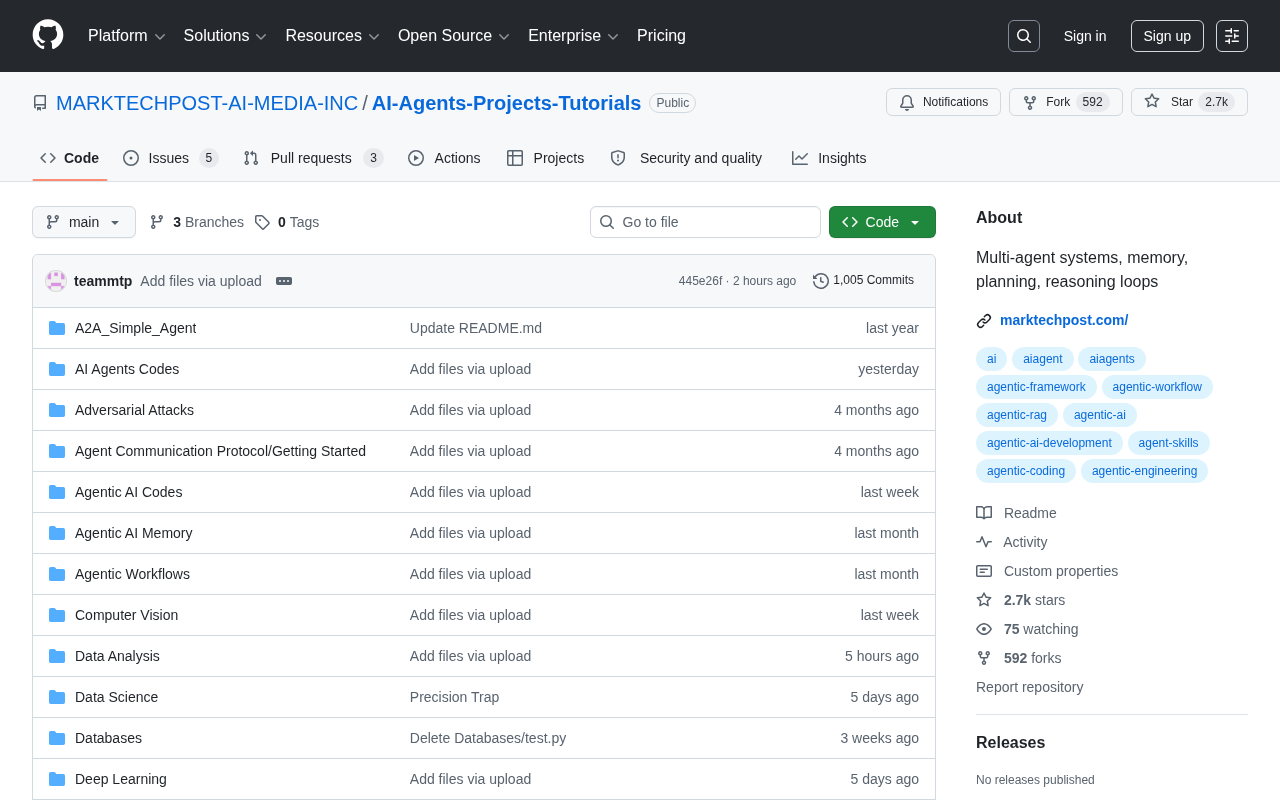
A structured open-source tutorial collection covering the four pillars of AI Agent development via Jupyter Notebooks.
AI-Agents-Projects-Tutorials is a GitHub project with 2,690+ Stars maintained by MarkTechPost, offering systematic Jupyter Notebook tutorials on AI Agent development. It covers four core modules—multi-agent systems, memory mechanisms, planning capabilities, and reasoning loops—providing runnable code examples that let developers learn by doing. The project bridges theory and practice for anyone building AI Agents.
Project Overview
In the field of AI Agent development, quality learning resources are often scattered across various sources, forcing developers to spend considerable time searching and filtering. The open-source project AI-Agents-Projects-Tutorials, maintained by MarkTechPost (a well-known AI media outlet) on GitHub, is changing this situation. The project has earned over 2,690 Stars and 590 Forks, making it a popular resource repository in the AI Agent learning space.
Founded in 2017, MarkTechPost is an online media platform focused on machine learning, deep learning, and data science. Unlike the academically-oriented arXiv or industry-focused TechCrunch, MarkTechPost positions itself as "making cutting-edge AI research accessible to the broader tech community," with content that bridges paper interpretation and engineering practice. The media outlet has hundreds of thousands of followers on social platforms, and having their editorial team maintain this tutorial project means the content has been professionally curated and reviewed—offering better systematization and accuracy compared to scattered tutorials from individual developers.
The project uses Jupyter Notebooks as its primary medium, systematically covering the core topics of AI Agent development: Multi-agent Systems, Memory, Planning, and Reasoning Loops. These four modules form the key pillars of the current AI Agent technology stack.
Jupyter Notebook has unique advantages as a teaching medium—originally born in the scientific computing domain (formerly IPython Notebook), it has become the standard tool in data science and AI. Its core value lies in combining code, execution results, visualizations, and Markdown text within a single document, embodying the "Literate Programming" paradigm. For AI Agent education, Notebooks allow learners to execute code cell by cell, observing the Agent's reasoning process, tool calls, and output changes in real time—an immediate feedback mechanism far more efficient than reading static code repositories. Additionally, cloud-based Notebook services like Google Colab allow learners to run tutorials without configuring local environments, further lowering the barrier to entry.
Analysis of the Four Core Modules
Multi-agent Systems
Multi-agent systems are one of the most watched directions in the current AI Agent field. Compared to single Agents, multi-agent architectures allow multiple Agents with different roles and capabilities to work collaboratively on complex tasks. Tutorials in this module cover core concepts such as inter-Agent communication protocols, task allocation strategies, and conflict resolution mechanisms.
From AutoGen to CrewAI, from LangGraph to MetaGPT, multi-agent frameworks have experienced explosive growth. This wave began in the second half of 2023: Microsoft's AutoGen pioneered the concept of "conversable Agents," allowing multiple Agents to collaborate through natural language messages; CrewAI introduced a "role-playing" mechanism, giving each Agent clearly defined responsibilities (such as researcher, writer, reviewer); LangGraph, built on the LangChain ecosystem, defines workflows between Agents as directed graphs, providing more granular process control; MetaGPT simulates a software company's organizational structure, having Agents play roles like product manager, architect, and programmer to collaboratively complete software development. These frameworks each have their own focus but collectively drive multi-agent systems from academic research toward engineering practice. This project presents these cutting-edge practices as runnable Notebooks, significantly lowering the barrier to entry.
Memory
Memory is the key capability that evolves AI Agents from "stateless tools" to "context-aware assistants." An Agent without memory starts from scratch with every interaction, while a memory-capable Agent can:
- Short-term memory: Maintain contextual coherence within a single conversation
- Long-term memory: Retain user preferences and historical information across sessions
- Working memory: Temporarily store intermediate results during complex reasoning
Implementing memory mechanisms typically involves vector databases, summary compression, retrieval augmentation, and other techniques—all practical challenges in Agent development. Among these, vector databases serve as the infrastructure for memory mechanisms. The core principle is converting unstructured data like text and conversation history into high-dimensional vectors through Embedding models, then storing them in databases optimized for similarity search. When an Agent needs to recall relevant information, it quickly finds the most relevant historical records through vector similarity retrieval (such as cosine similarity or Approximate Nearest Neighbor search/ANN). Popular vector databases include Pinecone, Weaviate, Qdrant, ChromaDB, and Milvus. In actual Agent development, memory implementation goes far beyond simple storage and retrieval—it requires designing memory expiration strategies, importance scoring, summary compression (condensing lengthy conversation histories into key information), and hierarchical memory organization. These engineering details directly impact the Agent's response quality and reasoning efficiency.
Planning
Planning is the core capability for Agents handling complex tasks. When facing a multi-step task, an Agent needs to decompose it into an executable sequence of subtasks and dynamically adjust the execution plan. Common planning strategies include:
- Task Decomposition: Breaking large goals into smaller steps
- Reflection & Refinement: Adjusting plans based on execution feedback
- Tool Selection: Choosing the most appropriate tool for each subtask
This module is crucial for building Agents capable of autonomously completing end-to-end tasks. Notably, planning capability research is deeply influenced by Automated Planning in classical AI—from STRIPS to HTN (Hierarchical Task Networks), traditional planning algorithms provide important theoretical foundations for LLM-driven Agent planning. Current LLM Agent planning methods essentially combine these classical ideas with large language models' natural language understanding capabilities, enabling Agents to flexibly generate and adjust plans in open-domain tasks.
Reasoning Loops
Reasoning loops are the Agent's "thinking engine." The classic ReAct (Reasoning + Acting) paradigm allows Agents to progressively approach goals through a "think-act-observe" cycle.
The ReAct paradigm originated from the 2022 paper "ReAct: Synergizing Reasoning and Acting in Language Models," jointly published by Princeton University and Google Brain. The paper's core insight is that pure Chain-of-Thought reasoning lacks the ability to interact with the external world, while pure action execution lacks reasoning guidance. ReAct interweaves both, forming a "Thought → Action → Observation" loop: the Agent first thinks about what to do (Thought), then executes specific operations like calling APIs or searching (Action), observes the results (Observation), and continues the next round of thinking based on observations. This paradigm profoundly influenced the design of virtually all subsequent Agent frameworks—LangChain's Agent module, AutoGPT's execution loop, and others all use ReAct as their theoretical foundation.
More advanced reasoning patterns include:
- Chain-of-Thought: Step-by-step reasoning to improve complex problem-solving
- Tree-of-Thought: Exploring multiple reasoning paths to select the optimal solution
- Self-Reflection: Agents critically evaluating their own outputs
Tree-of-Thought (ToT), proposed by Princeton University in 2023, is an important extension of linear Chain-of-Thought. Traditional CoT reasons along a single path—once an intermediate step goes wrong, the final result deviates. ToT models the reasoning process as a search tree, generating multiple candidate ideas at each decision node, scoring branches through evaluation functions (which can be the LLM's own judgment), then exploring the most promising paths using Breadth-First Search (BFS) or Depth-First Search (DFS) strategies. This approach significantly outperforms linear reasoning in tasks requiring forward-looking planning (such as mathematical proofs, creative writing, and strategy games). Self-Reflection lets the Agent act as its own "reviewer," critically examining generated outputs and iteratively improving them—the Reflexion framework is a representative implementation of this approach.
The design of reasoning loops directly determines an Agent's intelligence level and reliability.
Project Value and Target Audience
Why This Project Deserves Attention
The project's unique value lies in its combination of systematization and practicality. There's no shortage of theoretical articles about AI Agents, but there is a lack of tutorial collections that translate theory into runnable code. Using Jupyter Notebooks as the medium means developers can execute step by step, modify parameters, observe results, and truly "learn by doing."
Furthermore, MarkTechPost's backing as a professional AI media outlet ensures content quality and timeliness. The project is continuously updated, keeping pace with the rapid iteration in the AI Agent field. In the current landscape where Agent technology evolves daily—from OpenAI launching GPTs and the Assistants API in early 2024, to Anthropic releasing Claude's Tool Use capability, to Google's Gemini Agent ecosystem strategy—maintaining tutorial content timeliness is particularly important. A continuously maintained open-source tutorial repository helps developers stay current with the latest API changes and best practices.
Who Should Learn From This
- AI Developers: Engineers looking to build Agent systems from scratch
- Researchers: Academics who need to quickly reproduce and validate Agent architectures
- Technical Managers: Team leaders who want to understand the full Agent technology landscape for technical decision-making
- AI Enthusiasts: Learners interested in Agent technology with some Python background
Recommended Learning Path
The project is hosted on GitHub and can be cloned directly for local execution. The following progressive path is recommended:
- Start with Reasoning Loops to understand the basic operating mechanism of Agents
- Learn Memory mechanisms to give Agents context-awareness capabilities
- Master the Planning module to build Agents that can handle complex tasks
- Finally, move into Multi-agent Systems to learn Agent collaboration and orchestration
The design logic of this learning path follows the progressive principle of "from individual to system": reasoning loops are the core operating mechanism of a single Agent, memory and planning are key modules for enhancing individual Agent capabilities, and multi-agent systems represent the ultimate form of combining multiple fully-capable Agents into more powerful systems. Knowledge at each layer serves as the foundation for the next—skipping prerequisite modules to jump directly into multi-agent systems often leads to insufficient understanding of underlying mechanisms.
At this critical stage where AI Agents are transitioning from concept to implementation, such a structured learning resource repository is undoubtedly a powerful tool for developers. Whether you're just getting started or looking to deepen your understanding, this project deserves a place on your learning list.
Related articles

Five Common Claude Code Mistakes — How Many Are You Making?
Five common Claude Code mistakes developers make: copy-pasting code, skipping CLAUDE.md, inefficient prompting, ignoring docs, and poor context management — with fixes.
Andrew Ng's New Course Explained: A Practical Guide to Using OpenAI's O1 Reasoning Model
Deep dive into Andrew Ng and OpenAI's Reasoning with O1 course covering test-time scaling, new prompting paradigms, multi-model orchestration, and practical applications for developers.

Learning AI After College Entrance Exams: A Complete Path from Zero to Freelancing
How to efficiently learn AI skills during summer break after exams? A complete path from mastering prompts and hands-on projects to freelancing on platforms.