Can AI Agents Replace a Development Team? A Practical Guide for Non-Technical People

Can ordinary people use AI Agents to build a virtual development team replacing traditional software development?
This article explores whether non-technical people can use AI Agents to replace traditional development teams (CEO, product manager, developers, QA) for project delivery. While AI coding capabilities are already quite mature, aesthetic design remains a weakness, and there's no turnkey solution for complete multi-Agent workflows yet. The recommendation is to start with a single full-stack tool to build an MVP, gradually introduce multi-Agent frameworks, and keep humans in the loop for visual design decisions.
A Real Question from an Ordinary Person
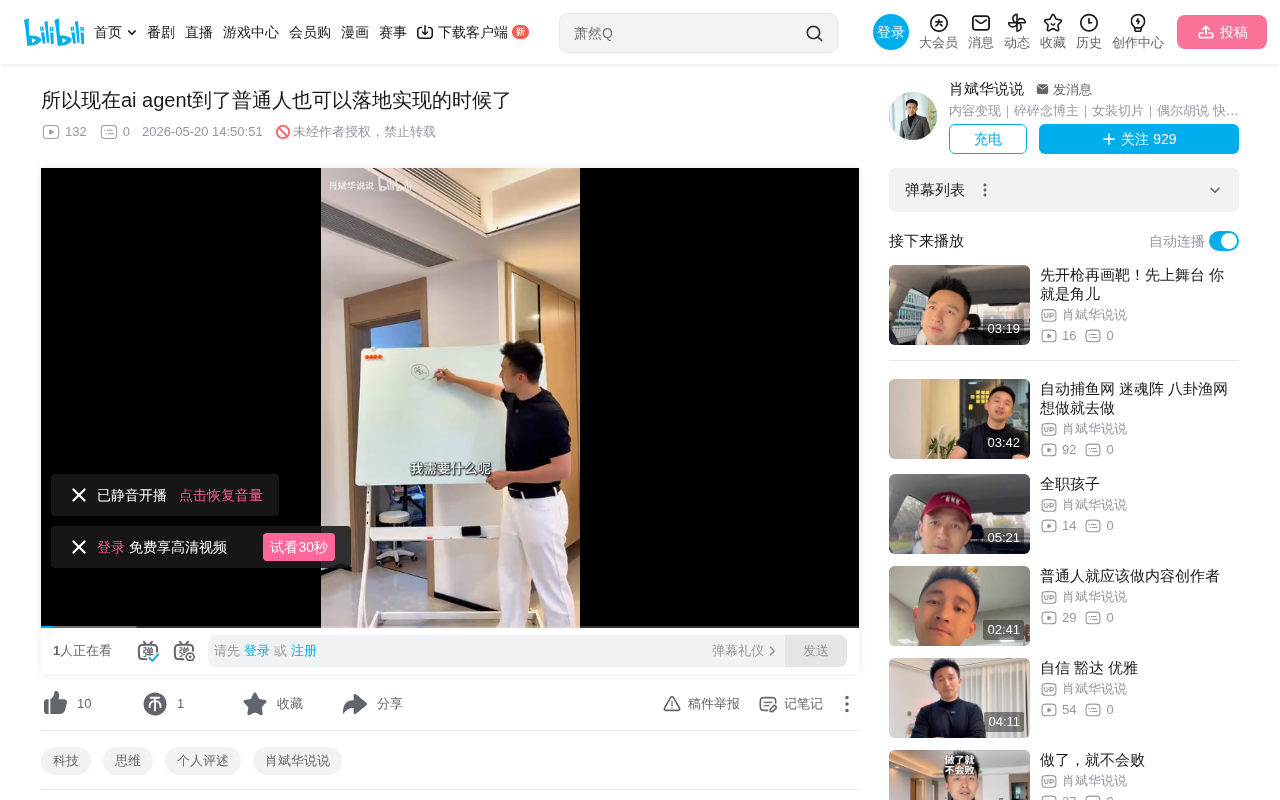
Recently, a Bilibili creator named Huazai raised a very down-to-earth question: As an ordinary person with a specific project need, can you use AI Agents to build a complete "virtual development team" that replaces the traditional process of hiring people, communicating, developing, and reviewing?
This question resonated widely because it represents a real pain point for a huge number of non-technical entrepreneurs and individuals today — they have ideas and budget, but the traditional development process is too heavy, too slow, and too expensive.
Traditional Development: A Long Human Chain
Huazai described a scenario we're all familiar with:
- The Client (You) → Share your idea with the CEO or project lead
- CEO → Understand the requirements and assign them to a product manager
- Product Manager → Break down requirements into feature lists, technical frameworks, and style definitions
- Developers → Write code based on the product documentation
- Review Phase → Product manager and relevant team members test and accept the deliverables
- Delivery → V1.0 goes live, then iterate to V1.1, V2.0 based on feedback…
At every node in this chain, there's a specific person. Finding people takes time, communication has costs, and information loss between people is a primary cause of project delays. In software engineering, this phenomenon is known as "communication overhead" — Frederick Brooks pointed out in his classic book The Mythical Man-Month that as team size grows, communication paths increase exponentially, and project efficiency may actually decline. For a relatively standardized need like a functional website (displaying data, images, and videos), this entire process feels unnecessarily cumbersome.
The AI Agent Alternative: A Theoretically Perfect Closed Loop
Inspired by a creator named Zara, Huazai proposed a bold vision — replacing every role in the chain with an AI Agent:
CEO Agent: Requirement Understanding and Task Decomposition
Users simply describe their needs in natural language, and the CEO Agent handles understanding intent, breaking down tasks, and setting timelines. Models like ChatGPT and Claude already possess strong requirement understanding and project planning capabilities. Combined with a System Prompt, they can fully play the role of a "project manager."
The System Prompt is the core mechanism for defining an AI Agent's behavioral boundaries and role characteristics — it's injected into the model before the conversation begins, explicitly telling the model "who you are, what you can do, and how you should respond." A well-crafted System Prompt can make a general-purpose LLM behave like a professional project lead, incorporating elements like role definition, behavioral guidelines, output format, and constraints. The quality of Prompt Engineering directly determines an Agent's performance ceiling, which is why the same model can perform vastly differently in different people's hands.
Product Manager Agent: Requirement Refinement and Solution Design
This agent takes the tasks decomposed by the CEO Agent and further refines them into specific feature points, page structures, interaction logic, and technology choices. This step can be implemented through dedicated Agent workflows, such as Cursor's Agent mode or custom LangChain/CrewAI workflows.
The core idea behind multi-Agent collaboration frameworks (like CrewAI, AutoGen, and MetaGPT) is to decompose complex tasks into multiple roles, each with its own System Prompt, tool-calling permissions, and memory mechanism. The framework orchestrates communication protocols between Agents, task handoff sequences, and conflict resolution strategies. For example, MetaGPT directly simulates a software company's standard operating procedures (SOP), having the Product Manager Agent output PRD documents, the Architect Agent output system designs, and the Engineer Agent write code based on those designs. This approach reduces the cognitive load on individual Agents through role specialization, minimizing hallucinations and omissions. However, the challenge is that information transfer between Agents can produce cumulative errors — much like a game of "telephone" in human teams.
Developer Agent: Code Generation and Implementation
This is currently the most mature part of the pipeline. Tools like OpenAI's Codex, Cursor, Windsurf, and Bolt.new can already generate runnable code directly from requirement descriptions. For standardized products like functional websites, AI coding completion rates are already quite high.
AI coding tools have rapidly evolved from code completion to full project generation. GitHub Copilot (2021) pioneered the paradigm of inline code suggestions; Cursor (2023) deeply integrated AI into the IDE, supporting multi-file editing and project-level context understanding; Bolt.new and Lovable went even further, allowing users to generate, preview, and deploy complete web applications directly in the browser through natural language descriptions. OpenAI's Codex Agent (2025) represents the latest direction — it can autonomously run terminal commands, install dependencies, and execute tests in a sandbox environment, achieving end-to-end automation from requirements to deployable code. These tools rely on LLMs' deep understanding of code semantics, built on training across billions of lines of open-source code on GitHub.
QA Agent: Automated Testing and Quality Checks
This agent performs functional testing, UI inspection, and performance evaluation on the generated product. While automation in this area isn't as mature as in coding, by presetting acceptance criteria and automated test scripts, it can cover most scenarios. A common approach today is to have AI generate unit tests and end-to-end test cases (using frameworks like Playwright or Cypress), then have another Agent run these tests and analyze the results. For visual-level acceptance, there are also solutions based on multimodal models (like GPT-4o's vision capabilities) that let AI "look" at page screenshots and judge whether they match the design expectations.
The Gap Between Ideal and Reality
While this approach is theoretically elegant, Huazai honestly pointed out several key issues:
Token Costs Are Not Negligible
Throughout the entire process, every Agent consumes Tokens (compute costs). A complete website development project, from requirement analysis to code generation to testing and acceptance, might require hundreds of thousands or even millions of Tokens. While this is much cheaper than hiring people, the math needs to be done carefully.
It's worth explaining the concept and cost structure of Tokens here. A Token is the basic unit by which large language models process text, roughly equivalent to 3/4 of an English word or one Chinese character. Current mainstream models charge separately for input and output Tokens — for example, GPT-4o's input price is approximately $2.50 per million Tokens, and output is about $10 per million Tokens; more powerful reasoning models (like o1 or Claude Opus) can cost several times more. In multi-Agent collaboration scenarios, every conversation between Agents, every code generation and review produces Token consumption, and the longer the context window, the higher the cost per call. For a moderately complex website project going through the full pipeline of requirement analysis, architecture design, code generation, and test fixes, cumulative consumption of 500K–2M Tokens is common, translating to roughly tens to hundreds of RMB (a few to a few dozen USD) — which is indeed orders of magnitude lower compared to outsourcing costs that often run into tens of thousands.
Aesthetics Is AI's Weak Spot
Huazai particularly emphasized an issue that many technical people overlook — aesthetics. Functional requirements are standardized; "it's always the same stuff," and AI can handle it perfectly. But the visual presentation, interaction experience, and brand tone of the final product — these highly subjective elements — are areas where AI's performance remains inconsistent.
This is why even when AI can write perfectly functional code, many products still look "AI-generated" — lacking the obsessive attention to detail and intuitive sense of beauty that human designers bring. The root of this problem is that aesthetics involves cultural context, emotional resonance, and subtle visual balance — things that are extremely difficult to quantify into explicit instructions. When you tell AI to "make a premium-looking page," it might pile on dark backgrounds and serif fonts, but true premium feel often comes from restrained whitespace, rhythmic animations, and subtle color transitions — these "you know it when you see it" qualities remain firmly in the domain of human designers.
The Path to Implementation Is Unclear
Huazai's core confusion is really this: What should the first step actually be? The market is flooded with AI tools, but there's currently no out-of-the-box, mature solution for chaining together a CEO Agent, Product Agent, Developer Agent, and QA Agent into a closed-loop workflow.
This predicament reflects a typical characteristic of the current AI tool ecosystem: individual tools are already powerful enough, but interoperability and workflow orchestration between tools are still in early stages. Much like SaaS tools in the early 2000s, each tool solves a specific problem, but stringing them together into a complete workflow requires an additional "glue layer." Currently, this glue layer role is being filled by various Agent orchestration frameworks and automation platforms (like n8n, Make, and AI-enhanced versions of Zapier), but there's still a noticeable gap before we reach a true "one-click virtual development team."
Practical Advice for Non-Technical People
If you're like Huazai and want to use AI Agents to accelerate project delivery, here are some actionable paths:
Step 1: Start with a full-stack AI development tool. Tools like Bolt.new, Lovable, and Cursor can already generate complete web applications from natural language descriptions. You don't need to build a full multi-Agent system from the start — first use a single tool to build an MVP (Minimum Viable Product).
MVP (Minimum Viable Product) is a core concept of the Lean Startup methodology, systematically articulated by Eric Ries in The Lean Startup. The core idea is to use minimal resources to build a product version that can validate core hypotheses, then iterate quickly based on real user feedback. AI development tools have dramatically lowered the cost of building MVPs — prototypes that previously required a small team spending weeks can now be completed by one person using Bolt.new or Cursor in just hours. This means the "Build-Measure-Learn" cycle has been compressed from weeks to days or even hours, allowing individual entrepreneurs to rapidly validate multiple business hypotheses at extremely low cost, rather than betting everything on a single unvalidated idea.
Step 2: Use ChatGPT/Claude as your "Product Manager." Before starting development, thoroughly communicate your requirements with an LLM and have it produce a detailed PRD (Product Requirements Document). This document becomes the foundation for all subsequent development work. A PRD typically includes product goals, user personas, feature lists, page flow diagrams, and non-functional requirements (performance, security). A high-quality PRD significantly improves the accuracy of subsequent AI coding, because it provides a clear "specification" for code generation.
Step 3: Introduce multi-Agent frameworks for iteration. As project complexity increases, consider using multi-Agent collaboration frameworks like CrewAI, AutoGen, or MetaGPT, letting Agents with different roles handle their respective responsibilities.
Step 4: Keep human involvement for aesthetics. At least for now, final decisions on UI design and visual style should be made by humans. You can use AI to generate initial drafts, then have a designer (or yourself) make adjustments. A practical compromise is to use mature UI component libraries (like shadcn/ui or Tailwind UI) as design constraints — these libraries have already been refined by professional designers, and AI-generated interfaces within these constraints are typically much better than those created with complete creative freedom.
Final Thoughts
Huazai's question fundamentally touches on a deeper proposition of the AI era: When AI can replace most execution-level work, what is an ordinary person's core competitive advantage?
The answer might be: the ability to ask good questions, aesthetic judgment, and the ability to translate vague requirements into clear instructions. These three capabilities correspond precisely to the parts of human cognition that are hardest to automate — creative thinking, subjective value judgment, and the transformation from abstract to concrete. AI Agents have indeed reached a stage where ordinary people can start experimenting with real-world implementation, but between "being able to use them" and "using them well," there's still a gap that needs to be bridged. The good news is that this gap is shrinking at a visible pace — tools that required professional developers to operate in early 2024 have, by mid-2025, already been used by numerous non-technical users to successfully deliver complete products.
Key Takeaways
- AI Agents can theoretically replace the CEO, product manager, developers, and QA personnel in a traditional development pipeline, forming a complete closed loop
- Coding is currently the most mature area for AI replacement, with tools like Codex and Cursor already generating runnable code
- Aesthetics and visual design remain a clear weakness for AI — human involvement is recommended
- Token compute costs are far lower than labor costs, but still require careful planning for complex projects
- Non-technical people should start with a single full-stack tool (like Bolt.new) and gradually introduce multi-Agent collaboration frameworks
Related articles
 Deep Dives
Deep Dive into How OpenClaw (Open-Source Crayfish) AI Agent Works
Deep analysis of OpenClaw AI Agent internals: System Prompt, tool calling, SubAgents, Skill system, memory, and Context Engineering explained.
 Deep Dives
Demystifying Transformer: A Word-Continuation Function, Deconstructed
Understand Transformer through the lens of word continuation. Breaking down language generation into Embedding, Transformer Block, and Probability output modules for intuitive understanding.
 Deep Dives
Five Core Differences Between Claude Code and Regular AI Chat
A detailed comparison of Claude Code vs regular AI chat across five dimensions: interaction, context understanding, execution, memory, and tool integration.