AI Coding Tools Showdown: Cloud Code, Cursor, Codex & OpenCode (International Big Four) VS China's Top Three
A head-to-head comparison of 7 top AI coding tools: international Big Four vs China's Top Three.
This article compares seven leading AI coding tools in 2026 across three dimensions: feature positioning, core strengths, and use cases. The international Big Four—Cloud Code (reasoning), Cursor (IDE experience), Codex (enterprise scale), and OpenCode (privacy/open-source)—are evaluated alongside China's Top Three: Trae (Chinese fluency), Tongyi Lingma (Alibaba Cloud integration), and Wenxin Quick Code (legacy refactoring/compliance).
Introduction: AI Coding Tools Enter the Era of Fierce Competition
By 2026, the AI coding tools market has evolved from the rudimentary stage of "code completion" to a full-fledged era of intelligent programming agents. On the international front, Cloud Code, Cursor, Codex, and OpenCode stand as the Big Four, while domestically, ByteDance's Trae, Tongyi Lingma, and Wenxin Quick Code form the challenger alliance. With so many options available, how should developers choose?
This article provides a comprehensive comparison of these seven mainstream AI coding tools across three dimensions—feature positioning, core strengths, and use cases—to help you find the "weapon" that best suits your needs.
The International Big Four: Top-Tier AI Coding Tools with Distinct Strengths
Cloud Code: The Ceiling of Logical Reasoning
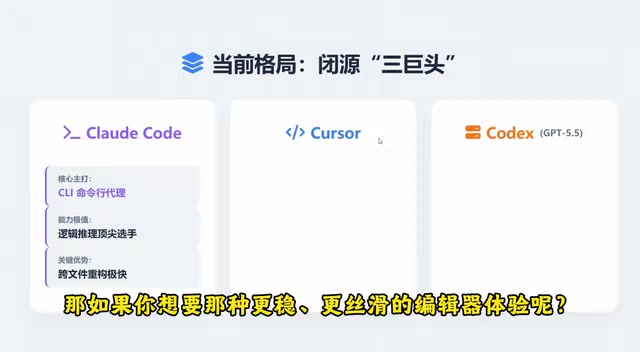
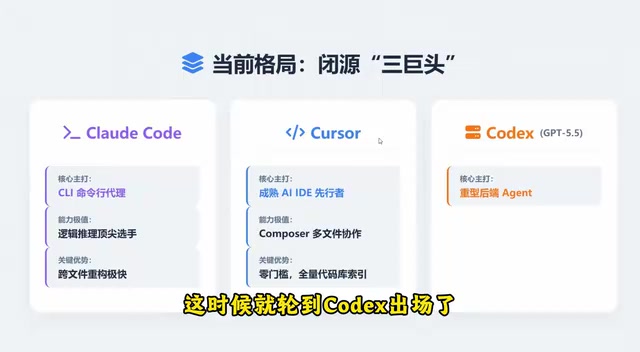
Cloud Code is Anthropic's flagship product, built around a CLI (command-line) agent mode. Its core advantage lies in logical reasoning capability—widely recognized as the ceiling in this domain.
The CLI (Command Line Interface) agent mode means the AI tool runs directly in the terminal command line without a graphical interface, completing code generation, file operations, and system command execution through text interaction. The advantage of this mode is that it eliminates UI rendering resource consumption, concentrating all computational resources on reasoning itself. As the developer of the Claude model series, Anthropic's breakthrough in Constitutional AI training methods gives the model exceptional performance in long-chain logical reasoning and multi-step planning. The "ceiling of logical reasoning" specifically manifests in the model's ability to understand code dependencies spanning dozens of files, accurately tracking variable propagation paths and side effect scopes during refactoring.
If your daily work involves complex cross-file refactoring and requires AI with clear global thinking capabilities, Cloud Code is the undisputed first choice. It doesn't pursue flashy interfaces but instead invests all computing power into "thinking things through."
Target users: Senior developers pursuing ultimate logic and automation capabilities.
Cursor: The Industry Benchmark for AI IDE Editors
As the pioneer of AI IDEs, Cursor remains the baseline for editor experience. Its Composer multi-file collaboration feature is still the industry benchmark, capable of indexing your entire codebase and providing a silky-smooth editing experience.
Traditional IDEs (Integrated Development Environments) like VS Code and IntelliJ provide code editing, debugging, and version control, while AI IDEs deeply integrate large language model capabilities on top of these foundations. Cursor's Composer feature is essentially a multi-file editing agent—it can simultaneously open and modify multiple files in a project, understanding import relationships and type dependencies between files. Under the hood, it uses RAG (Retrieval-Augmented Generation) technology to build a vector index of the entire codebase. When developers make requests, the system first retrieves relevant code snippets as context, then generates precise modification plans. This "full codebase indexing" capability means the AI isn't looking at individual files in isolation but has project-level global awareness.
Cursor's greatest advantage is zero-barrier onboarding. Even programming beginners can quickly benefit from AI-assisted coding. A mature IDE experience combined with powerful multi-file collaboration keeps it firmly in the first tier in 2026.
Target users: Full-stack developers who value IDE experience and need multi-file collaboration.
Codex: The Ultimate Weapon for Enterprise-Scale Heavy Tasks
When you're facing large-scale enterprise tasks—like fixing hundreds or thousands of bugs, or performing massive code migrations—Codex is your ultimate weapon.
It has evolved into a heavy-duty backend Agent powered by the GPT 5.5 core, specifically designed for large-scale operations. From its origins as OpenAI's code generation model, Codex has transformed from a simple code completion tool into an AI Agent with autonomous planning and execution capabilities. The term "heavy-duty backend Agent" means tasks don't execute locally on the user's machine but run in cloud-based sandbox environments—the AI can autonomously create branches, write code, run tests, and fix failing test cases, all without human intervention. GPT 5.5 shows significant improvements over previous models in context window size, tool-calling accuracy, and long-term task planning. This architecture is particularly suited for batch processing tasks, such as simultaneously fixing 100 issues, each running independently in containers, with results submitted as Pull Requests for human review.
This isn't a tool for "writing code"—it's an AI engineer capable of independently completing complex engineering tasks.
Target users: Technical teams handling enterprise-scale large-scale tasks.
OpenCode: The Phenomenal Dark Horse of Open-Source AI Coding
What if cloud services go down, or your company's core code isn't allowed to be uploaded to the internet? OpenCode is your lifeline.
With over 160,000 stars on GitHub, this is an absolute phenomenon in the open-source world. It has two killer features:
- Data privacy assurance: Supports local private deployment, keeping your code assets firmly in your own hands
- High model flexibility: Supports free switching between various open-source models, with no vendor lock-in
OpenCode's 160,000 stars reflect the developer community's strong demand for "AI sovereignty." Private deployment means the entire AI coding assistant runs on the enterprise's own servers, with code data never leaving the internal network. This is crucial for industries like finance, defense, and healthcare—where code often involves core business logic or sensitive data, and uploading to third-party clouds poses compliance risks. "Model flexibility" means OpenCode adopts a model-agnostic architecture design, supporting integration with various open-source models like Llama, Qwen, and DeepSeek, as well as privately fine-tuned models. Developers can choose different models based on task characteristics—strong logical models for reasoning tasks, lightweight models for quick completions—achieving optimal balance between cost and effectiveness.
This level of freedom is something closed-source tools cannot provide. For hardcore geeks with a "zero-tolerance" policy on code privacy, OpenCode is the only choice.
Target users: Privacy-conscious geeks and enterprises seeking customization.
China's Top Three: Powerful AI Coding Assistants for Chinese-Language Contexts
Trae (ByteDance): The Dominant Force in Chinese Coding Experience
What's the biggest headache international tools give Chinese developers? Their Chinese comprehension isn't native enough—there's always a "translation tone."
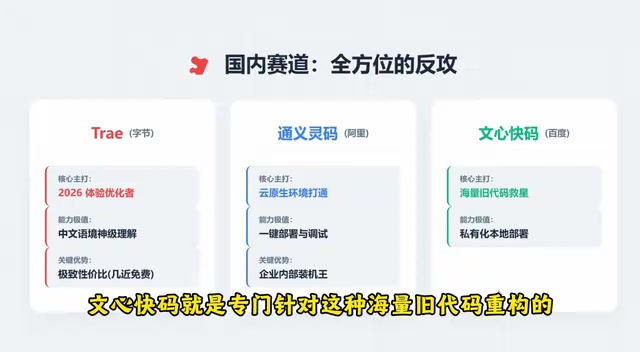
ByteDance's Trae perfectly solves this pain point. Its understanding of Chinese programming contexts and Chinese comments reaches a godlike level, completely free of translation artifacts. Understanding Chinese programming contexts goes far beyond simple "translation"—it involves challenges at multiple levels: first, semantic understanding of Chinese variable naming and comments, such as understanding the business meaning of a function named "获取用户余额" (get user balance); second, handling mixed Chinese-English code, where Chinese comments are interwoven with English code (common among Chinese developers); and third, comprehension of Chinese technical documentation and API docs. ByteDance trained Trae extensively using Chinese open-source projects and Chinese tech community corpora, with specialized alignment training for Chinese programming scenarios. This gives it far superior accuracy over general models when understanding natural language instructions like "把这个接口改成分页查询" (change this API to paginated query).
More importantly, ByteDance's strategy is extremely aggressive—emphasizing cost-effectiveness with generous quotas, and even offering many features completely free. For startups or individual developers, Trae's cost advantage is overwhelming.
Target users: Developers and startup teams who value fluent Chinese communication and high cost-effectiveness.
Tongyi Lingma (Alibaba): The Go-To Tool for Alibaba Cloud Native Developers
If you work with Alibaba Cloud daily, Tongyi Lingma is custom-built for you. It's deeply integrated with the Alibaba Cloud ecosystem, providing white-glove full-pipeline service from writing code to one-click deployment and cloud debugging.
Cloud Native development means applications are built for cloud environments from the ground up, fully leveraging containerization, microservices, CI/CD, and other cloud capabilities. Tongyi Lingma's "deep integration" with the Alibaba Cloud ecosystem specifically manifests in: directly understanding and generating Alibaba Cloud SDK calling code, automatically configuring cloud service resources like OSS storage, RDS databases, and Function Compute, and even one-click generation of Terraform infrastructure-as-code configurations. This integration eliminates the friction of developers constantly switching between IDE, cloud console, and deployment tools. For teams already deeply invested in Alibaba Cloud, this means the entire pipeline from "writing an API" to "running that API in production" has AI assistance.
The advantage of this deep integration is that you don't need to switch between multiple tools—the entire development-to-deployment workflow can be completed within a single ecosystem.
Target users: Cloud native developers within the Alibaba Cloud ecosystem.
Wenxin Quick Code (Baidu): Legacy Code Refactoring & Government/Enterprise Compliance Expert
Many large companies have legacy codebases accumulated over decades, and refactoring them is a nightmare. Wenxin Quick Code is specifically built for massive legacy code refactoring scenarios.
Legacy code refactoring is one of the most painful aspects of enterprise IT modernization. Many large enterprises' core systems still run Java, C++, or even COBOL code written 10-20 years ago—code that often lacks documentation, has low test coverage, and high coupling. AI-assisted refactoring requires models capable of understanding outdated programming paradigms, identifying design patterns, and safely replacing modules incrementally. Wenxin Quick Code's advantage in this area comes from Baidu's long-term experience serving government and enterprise clients, with its model specifically optimized for dependency analysis and safe refactoring path planning in large-scale codebases.
Additionally, it follows an extremely robust compliance path. For government and enterprise clients, compliance is the top priority in tool selection. Government/enterprise compliance involves data localization (data doesn't leave the country), Level 3 classified protection certification, national cryptographic algorithm support, and other requirements. Wenxin Quick Code's deployment solutions have passed multiple domestic security certifications, meeting the strict information security audit standards of government agencies and state-owned enterprises—you can adopt it with confidence in this regard.
Target users: Large enterprises and government/enterprise clients with substantial legacy code requiring refactoring.
AI Coding Tool Selection Guide: How to Find the Best Tool for You
No tool is absolutely superior—it's all about fit. Here's a quick decision guide:
| Use Case | Recommended Tool | Core Reason |
|---|---|---|
| Ultimate logic & automation | Cloud Code | Ceiling-level reasoning |
| Mature IDE + multi-file collaboration | Cursor | Industry benchmark, zero barrier |
| Enterprise-scale large tasks | Codex | GPT 5.5 heavy-duty Agent |
| Privacy-first + customization | OpenCode | Local deployment, model freedom |
| Fluent Chinese + high cost-effectiveness | Trae | Godlike Chinese comprehension, generous free tier |
| Alibaba Cloud ecosystem development | Tongyi Lingma | Full-pipeline deep integration |
| Legacy code refactoring + compliance | Wenxin Quick Code | Government/enterprise compliance, refactoring expertise |
In actual tool selection, several key factors need consideration: team size determines the depth of your collaboration feature needs; tech stack determines the importance of ecosystem integration; security compliance requirements may directly eliminate certain cloud-based tools; and budget becomes the decisive factor when features are comparable. Teams are advised to use each tool's trial period for 1-2 weeks of real project validation before formal procurement, evaluating actual value through real work scenarios rather than demos.
Conclusion: Pragmatic Choices in a Differentiated Competitive Landscape
The 2026 AI coding tools market shows a clearly differentiated competitive landscape. International tools still hold advantages in underlying model capabilities and versatility, but domestic tools are rapidly catching up in Chinese comprehension, localized ecosystems, and cost-effectiveness.
Notably, this market is shifting from "single-tool competition" to "tool-combination competition." More and more developers are adopting multi-tool collaborative workflows—for example, using Cloud Code for architecture design and complex refactoring, Cursor for daily coding, and OpenCode for sensitive projects. Tools aren't mutually exclusive but can be flexibly switched based on task characteristics.
For most Chinese developers, the most pragmatic strategy is probably: choose one primary tool that best matches your workflow, while staying attentive to and experimenting with new tools. After all, in this era of rapidly evolving AI coding tools, today's landscape could be disrupted tomorrow.
Related articles

Five Common Claude Code Mistakes — How Many Are You Making?
Five common Claude Code mistakes developers make: copy-pasting code, skipping CLAUDE.md, inefficient prompting, ignoring docs, and poor context management — with fixes.
Andrew Ng's New Course Explained: A Practical Guide to Using OpenAI's O1 Reasoning Model
Deep dive into Andrew Ng and OpenAI's Reasoning with O1 course covering test-time scaling, new prompting paradigms, multi-model orchestration, and practical applications for developers.

Learning AI After College Entrance Exams: A Complete Path from Zero to Freelancing
How to efficiently learn AI skills during summer break after exams? A complete path from mastering prompts and hands-on projects to freelancing on platforms.