AI Competitive Analysis in Practice: A Complete Method to Decode Short-Video Account Positioning in 2 Minutes

Short-video creators should copy positioning before scripts — AI tools turn competitive analysis into a 2-minute task.
This article argues that the most common mistake short-video creators make is copying scripts and formats while ignoring the most critical element: positioning. Positioning determines content boundaries, target audience, and monetization path — it's the foundational architecture of any account. Traditional account analysis takes a full day for just two accounts, but AI tools can complete multi-dimensional analysis in four steps and two minutes, improving efficiency by an order of magnitude. However, AI only solves the problem of understanding others — the real competitive advantage lies in differentiated decision-making and iterative execution.
The First Step in Short-Video Creation Isn't Copying Scripts — It's Copying Positioning
Everyone in short-video creation has heard this advice: to succeed, you first need to learn how to "copy." Copy topics, copy scripts, copy formats — it's practically the standard onboarding path for beginners. But many people end up turning their accounts into a hodgepodge — imitating one creator today, paraphrasing another tomorrow, ultimately producing a confused mess with dismal metrics.
Where does the problem lie? A Bilibili creator offered an answer that most people overlook: You're copying in the wrong order.

Positioning Is the Core Element You Should "Copy" First
Are scripts, formats, and topics important? Of course. But they're not the most important starting point.
What you should truly learn first is copying positioning. A peer account with solid performance metrics — their positioning is your compass. Once the direction is set, you can clearly judge what to learn and what to skip when you later study formats, scripts, and topics.
The logic is simple — if you haven't even figured out your direction, no amount of technique-copying will get you anywhere. Positioning determines your content boundaries, target audience, and monetization path. It's the foundational architecture of your entire account.
The Underlying Logic of Account Positioning
Account positioning in short-video operations is equivalent to "strategic positioning" in the business world. This theory was first proposed by Jack Trout in 1969, with the core idea of occupying a unique position in the user's mind. Mapped to the short-video space, positioning contains three key dimensions: who you create for (target audience), what value you provide (content boundaries), and how you differ from others (differentiation).
Platform recommendation algorithms are also highly correlated with positioning — platforms like Douyin and Bilibili judge tag weights based on an account's content consistency. The clearer the positioning, the easier it is for algorithms to push content to precise audiences, creating a positive traffic loop. An account with vague positioning, even if individual videos occasionally go viral, will struggle to accumulate a stable follower profile and will long-term fall into the trap of "starting from scratch with every video."

The Efficiency Bottleneck of Traditional Competitive Analysis
To figure out an account's positioning, the traditional method is to "guess" — thoroughly dissect their content, analyzing their niche, persona, business model, topic structure, and style.
But this process is extremely time-consuming. Using traditional methods, you can deeply analyze at most two accounts per day. For creators who need extensive competitive research, this efficiency is far from sufficient.

More critically, many beginners simply lack the analytical ability to deconstruct accounts. You can't understand a single video, can't figure out an account — no matter how good the methodology is, execution remains a fog. Traditional account analysis requires creators to possess multi-dimensional analytical perspectives: at the data level, you need to observe trends in completion rates and engagement rates; at the content level, you need to identify topic patterns and narrative structures; at the business level, you need to infer monetization models and average order values — developing these capabilities often requires months or even years of hands-on experience.
AI Tools Enable a Paradigm Shift in Competitive Analysis
In the AI era, this problem has an entirely new solution.
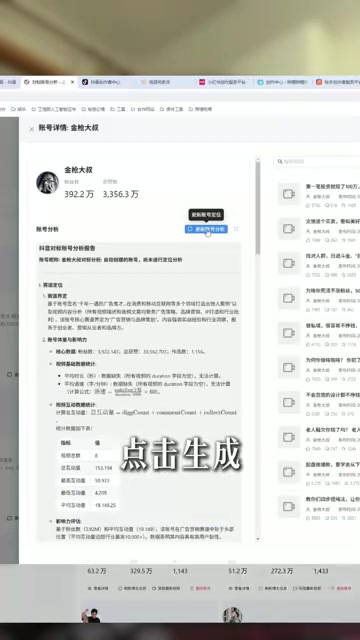
The video demonstrates an AI competitive analysis workflow: Copy link → Paste link → Click avatar → Click generate — four steps, and a complete account breakdown is done within two minutes.
The Technical Principles Behind AI Competitive Analysis
The underlying technology of these AI account analysis tools typically combines multimodal large language models (such as GPT-4, Claude, etc.) with web scraping technology. The workflow roughly involves: crawlers scraping the target account's public information (including video titles, thumbnails, bios, comment section data, etc.), then feeding this unstructured information into large language models for structured analysis. LLMs, leveraging pattern recognition capabilities trained on massive text corpora, can extract high-level insights such as niche classification, persona characteristics, and monetization logic from fragmented information. These tools essentially combine senior operators' analytical frameworks (Prompts) with AI's information processing capabilities, achieving scalable replication of expert experience.
AI automatically outputs analysis results across the following dimensions:
- Niche Positioning: The specific sub-category the account operates in
- Persona Analysis: The creator's role positioning and expression style
- Business Model: Monetization path and profit logic
- Topic Structure: The underlying framework of content planning
- Style Characteristics: Visual, linguistic, pacing, and other presentation-layer features
This means that analyzing two accounts, which previously took an entire day, can now be batch-processed — potentially a dozen or more in a single hour. Efficiency has improved by an order of magnitude.
Practical Implications for Short-Video Creators
Methodology Is Depreciating; Execution Is Appreciating
The creator said something very blunt: "What used to separate you from me was philosophy, method, and technique — but now a single prompt can solve all those problems."
While somewhat absolute, this statement reflects a real trend: The barriers of information asymmetry and methodology are being rapidly flattened by AI tools. The "account analysis intuition" that previously required years of experience to develop can now be directly output by AI in a structured format.
This phenomenon isn't unique to the short-video industry. In the early days of short-video development (2018-2021), mastering platform rules and operational methodologies was itself a scarce resource, with paid courses often priced at thousands of yuan. But as AI tools proliferate, this information asymmetry is rapidly dissolving. Similar transformations are occurring in programming (GitHub Copilot lowering the coding skill barrier) and design (Midjourney making visual creation no longer exclusive to professional designers). Economics calls this phenomenon "skill commoditization": when a skill can be standardized and replaced by tools, its market premium drops rapidly, while the meta-ability to integrate tools and make judgments becomes more valuable.
The Real Competitive Advantage Lies in Action and Iteration
When everyone can use AI to quickly complete competitive analysis, the competitive focus shifts to:
- Can you make differentiated decisions based on the analysis results?
- Can your content execution quality match your positioning requirements?
- Can your iteration speed keep up with market changes?
AI solves the problem of "understanding others," but "excelling yourself" still requires the creator's own judgment and execution.
A Practical Framework for Differentiated Decision-Making
Once AI helps you complete competitive analysis, differentiated decision-making is where creators are truly tested. Common differentiation strategies include: blue ocean segmentation (finding underserved sub-needs within a large niche), persona differentiation (presenting the same content with a different personalized expression), format innovation (repackaging proven topics in new content formats), and cross-domain grafting (migrating successful models from field A to field B).
It's worth noting that differentiation doesn't mean complete innovation — it means making a 20% unique adjustment on an already validated direction. This ratio leverages existing market validation to reduce risk while establishing sufficient distinctiveness. For example, when AI analysis shows that all top accounts in a niche use a "knowledge explainer" persona, you could try entering the same niche with a "roast and review" persona — the content essence remains the same, but the expression style creates a clear distinction.
Summary
The correct learning path for short-video creation should be: Copy positioning first, then copy methods. The emergence of AI tools has transformed "copying positioning" from a high-barrier analytical skill into a standardized operation completable in two minutes. Those who leverage tools effectively will have a head start from the very beginning.
However, it's important to recognize clearly that AI tools lower the analysis barrier, not the creation barrier. When everyone can quickly understand others' positioning, what truly creates the gap will be: who can more quickly convert analytical insights into differentiated content output, and who can build hard-to-replicate personal brand moats through continuous iteration. Tools make the starting line fair, but the finish line still belongs to those who continuously refine their execution.

Key Takeaways
- The first step in short-video learning should be copying positioning, not scripts — positioning is your account's compass
- Traditional account analysis methods can handle at most two accounts per day, with low efficiency and high barriers
- AI tools can complete full-dimensional analysis of an account's niche, persona, business model, and topic structure in two minutes
- In the AI era, methodology barriers are flattened — real competitive advantage shifts to execution and differentiated decision-making
- The correct path is to first use AI for rapid competitive analysis to determine direction, then learn specific techniques in a targeted manner
Related articles
 Tutorials
Cursor + Codex Dual-IDE Collaboration: A Practical Methodology for Open-Source Project Customization
A complete methodology for open-source project customization based on real-world experience, detailing the Cursor+Codex dual-IDE workflow, seven-stage process, MVP validation, and AI source code reading techniques.
 Tutorials
Cursor Multi-Agent in Practice: Building a Full-Stack Next.js Blog in 50 Minutes
Build a full-stack blog in 50 minutes using Cursor IDE's multi-Agent mode with Next.js, Clerk auth, and Supabase. Learn the 4-phase AI Agent workflow and key integration pitfalls.
 Tutorials
Building an AI Software Factory from Scratch: A Cursor Engineer's Hands-On Experience with Multi-Agent Collaboration
Cursor engineer Eric shares practical insights on building an AI software factory: automation levels, guardrail design, parallel Agent management, and scaling to 1000+ Agents for 24/7 development.