AI Daily Brief: Codex Cross-Host Sessions, Claude Code Quota Reset, AlphaFold Lead Joins Anthropic
Codex cross-host sessions, Claude Code quota fix, AlphaFold's Jumper joins Anthropic, EU backs 400B open-source model.
On June 20, 2025, OpenAI Codex shipped cross-host session handoff for seamless local-remote workflows, while Claude Code fixed a quota bug affecting 3% of users. AlphaFold lead and Nobel laureate John Jumper announced his departure from DeepMind to join Anthropic. The EU selected a consortium to build a 400B-parameter open-source model covering all 24 official languages, and Cloudflare launched temporary accounts for AI Agents.
On June 20, 2025, several major developments broke simultaneously across the AI landscape. From OpenAI Codex's cross-host session handoff feature, to Claude Code's quota bug fix, to AlphaFold's lead scientist jumping ship to Anthropic, and the EU betting on a 400-billion-parameter open-source model — today's information density is remarkably high. Let's break them down one by one.
Codex Desktop Now Supports Session Handoff Between Local and Remote Hosts
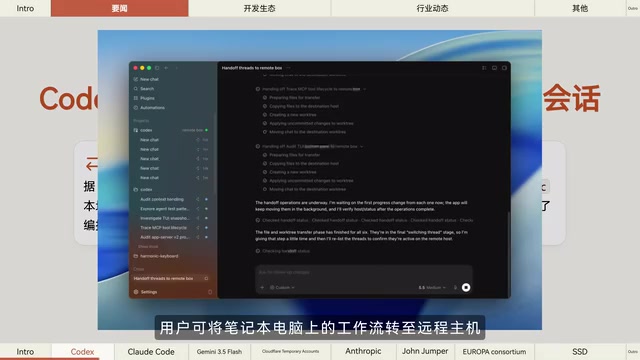
OpenAI Codex desktop has shipped a practical update: seamless session handoff between local and remote hosts. Developers can start a workflow on their laptop, transfer it to a remote host for continued execution, and switch back to local at any time.
This feature is critical for developers who frequently switch between environments. For example, you can write code and do initial debugging locally, then hand the session off to a GPU-equipped remote server for training or deployment — all without rebuilding context. This kind of "session roaming" capability is becoming a standard direction for AI coding tools.
From a technical implementation perspective, the core challenge of Session Roaming lies in serializing and restoring context state. In an AI coding assistant scenario, a session's context includes not just conversation history, but also the file state of the current working directory, parsed code ASTs (Abstract Syntax Trees), dependency graphs, and runtime environment variables. Achieving seamless cross-host handoff requires efficiently packaging, transmitting, and precisely restoring these states on the target host. This is fundamentally different from traditional SSH remote development or VS Code Remote Development — the latter fixes the development environment on the remote side, while Codex's approach lets the AI's understood context flow between arbitrary nodes.
However, the community has simultaneously flagged a serious issue: Codex's InsIcolite logging defaults to global Trace level, continuously writing to disk at approximately 5MB/s. Some users estimate this annualized write volume at roughly 640TB, potentially causing severe SSD wear. The issue has not yet received an official fix, and developers using Codex are advised to monitor their logging configuration.
For context, Trace level is the most verbose logging level, typically only enabled during deep debugging. Common log levels from lowest to highest are Trace, Debug, Info, Warn, Error, and Fatal. Continuous writing at 5MB/s translates to roughly 18GB per hour. Modern consumer-grade NVMe SSDs typically have a Total Bytes Written (TBW) rating of 300–600TB, meaning that without intervention, Codex's logging could exhaust an SSD's design lifespan within a year. This type of issue is known as a "Log Storm" in software engineering, usually the result of default configurations not being optimized for production environments.
Claude Code Quota Bug Fix and Gemini Quota Reset
Claude Code: 3% of Users Affected by Quota Display Error
Anthropic's Claude issued a notice on June 19 stating that approximately 3% of Claude Code users experienced a quota display error, with some users unable to send messages at all. The company confirmed the issue has been fixed and reset the quota limits for affected users.
While the impact scope seems small, given the rapid growth of the Claude Code user base, the actual number of affected users could be significant. This also reflects the infrastructure challenges AI coding tools face during periods of rapid expansion — the stability of quota and billing systems directly impacts user experience and trust.
Looking deeper, the quota management system for AI coding tools is far more complex than traditional SaaS billing systems. Token consumption per code generation request varies enormously — a simple code completion might only require a few hundred tokens, while a full code refactoring could consume tens of thousands. Combined with Claude Code's support for multi-turn conversations and long context windows, real-time quota calculation must maintain precise consistency under high-concurrency scenarios. This is fundamentally a consistency problem in distributed systems, and when user volume grows rapidly, synchronization delays in rate limiters and quota trackers can easily lead to display errors or even service outages.
AntiGravity Fixes Gemini 3.5 Flash Looping Output Issue
The AntiGravity lead announced a fix for the Gemini 3.5 Flash text looping output issue and deployed a new version. Additionally, all users' weekly quotas have been reset so everyone can experience the updated performance.
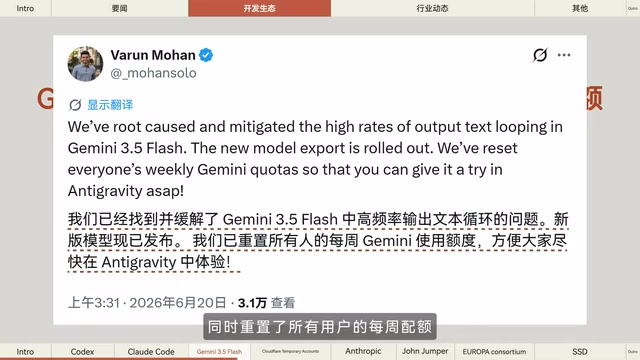
Text looping output is one of the well-known persistent issues with large language models, and it's especially prone to occurring in lightweight models like Flash. This fix is good news for users who rely on Gemini 3.5 Flash for daily development.
From a technical standpoint, Repetition Loop is a known defect in autoregressive language models. The root cause lies in the model's decoding strategy: when the model assigns high probability to a specific token sequence at a given generation step, those tokens are generated and then fed back as input context for the next step, further reinforcing the same pattern's probability and creating a positive feedback loop. Lightweight models (like the Flash series), with fewer parameters and attention heads, have relatively limited ability to model long-range dependencies and are more susceptible to falling into local probability traps. Common mitigation techniques include Repetition Penalty, Frequency Penalty, and N-gram-based deduplication detection.
Cloudflare Launches Temporary Accounts for AI Agents
Cloudflare has launched a Temporary Accounts feature designed for AI Agents. The core design philosophy is to lower the deployment barrier for AI Agents: Agents don't need to register an account in advance — they can deploy a Worker directly to Cloudflare by running a specific command, with a 60-minute validity period. Developers can later claim the Worker and associated resources like databases through a claim link.
This feature provides infrastructure support for AI Agent "use-and-go" scenarios. Imagine an AI Agent that needs to temporarily deploy an API endpoint or data processing service while executing a task — previously this required a tedious account registration and configuration process, but now it can be done directly. This is an important signal that cloud providers are actively adapting to AI Agent work patterns.
It's worth noting that Cloudflare Workers is an Edge Computing platform based on the V8 engine, with code running on edge nodes across more than 300 data centers worldwide rather than on centralized cloud servers. This architecture is naturally suited for AI Agents' "use-and-go" scenarios: Agents can quickly deploy lightweight services on the node closest to the user, achieving millisecond-level response times. The 60-minute validity period of the temporary accounts draws on the concept of an "Ephemeral Sandbox" — creating an isolated runtime environment for each task that is automatically cleaned up after completion, reducing security risks while simplifying resource management. This pattern is similar to Jobs and CronJobs in Kubernetes, but elevates the abstraction level to the point where no infrastructure management is required at all.
AlphaFold Lead Leaves DeepMind to Join Anthropic
AlphaFold's lead scientist and Nobel laureate John Jumper has announced his departure from Google DeepMind after nearly 9 years, with plans to join Anthropic after a break.
This is a highly symbolic personnel move. John Jumper won the 2024 Nobel Prize in Chemistry for leading the AlphaFold project to solve the protein structure prediction problem, making him one of DeepMind's most iconic scientists. His departure and move to Anthropic suggests, on one hand, that Anthropic's ability to attract top scientific talent is growing, and on the other, it may hint at Anthropic's ambitions in scientific computing and biological AI.
To understand the weight of this move, one needs to appreciate the milestone significance of the AlphaFold project. Protein structure prediction has been a central challenge in biology for half a century, known as the "Protein Folding Problem." Proteins are composed of amino acid chains, and their three-dimensional folded structure determines biological function, but the computational complexity of inferring 3D structure from a 1D sequence is extremely high. Traditional methods like X-ray crystallography and cryo-electron microscopy can take months or even years to resolve a single protein structure. AlphaFold2 achieved near-experimental accuracy in prediction at the CASP14 (Critical Assessment of protein Structure Prediction) competition in 2020, and the subsequently open-sourced AlphaFold database covered over 200 million protein structure predictions, fundamentally transforming the research paradigm of structural biology. As the project's technical lead, John Jumper's scientific influence is virtually unmatched in the AI field. His joining Anthropic may signal that Anthropic is seriously considering extending large language model capabilities into the domain of scientific discovery.
Policy and International Developments
White House and Anthropic Jointly Developing AI Vulnerability Assessment Framework
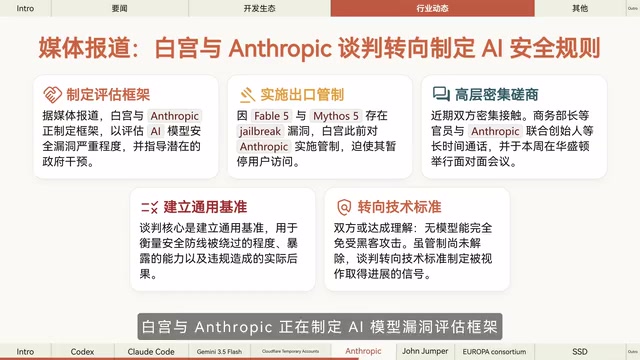
According to media reports, the White House and Anthropic are jointly developing an AI model vulnerability assessment framework. Previous controversies over Jailbreak attacks had sparked discussions around export controls, and negotiations between the two parties have now shifted from the policy level to establishing concrete technical standards.
This development deserves close attention. If a standardized vulnerability assessment framework ultimately takes shape, it will have far-reaching implications for security compliance across the entire AI industry, particularly regarding model exports and cross-border deployment.
Some technical background on Jailbreak attacks is warranted here. Jailbreak refers to bypassing an AI model's Safety Alignment mechanisms through carefully crafted prompts to generate prohibited content. Common jailbreak techniques include role-play induction, multi-turn progressive guidance, encoding obfuscation (such as Base64-encoded instructions), and exploiting multilingual switching to bypass safety filters. Currently, the industry lacks a unified vulnerability assessment standard — different companies define "safety" differently and use different testing methods. If the framework jointly developed by the White House and Anthropic is implemented, it could resemble the CVE (Common Vulnerabilities and Exposures) system in cybersecurity, establishing standardized classification, rating, and disclosure processes for AI model security flaws. This is particularly critical for AI model export controls, as regulators need a quantifiable standard to determine whether a model meets safety requirements.
EU Selects 400-Billion-Parameter Open-Source Model Project
The European Commission has announced the selection of the Europa consortium, led by Italian company Doming, as the winner of the Frontier AI Grand Challenge project. The project plans to develop an open-source frontier AI model covering all 24 official EU languages with over 400 billion parameters.
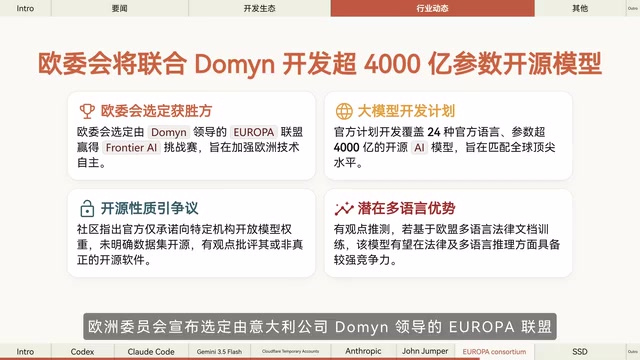
The EU's strategic intent is crystal clear: establish autonomous capability in the AI race dominated by the US and China, while reinforcing Europe's digital sovereignty through multilingual coverage. While 400 billion parameters isn't the absolute cutting edge in scale, the open-source positioning combined with full coverage of 24 languages gives it unique value in the European market.
At a deeper level, the EU's "Digital Sovereignty" strategy aims to reduce dependence on American and Chinese tech giants, ensuring Europe maintains autonomous control over data, algorithms, and infrastructure. The EU had previously established the world's strictest AI regulatory framework through the EU AI Act, and this investment in an open-source large model marks a critical step from "regulation" to "construction." Full coverage of 24 official languages carries special significance: current mainstream large models perform far better in English than in other languages, and Europe's smaller languages (such as Maltese, Estonian, and Irish) are severely underrepresented in training data. An open-source model specifically optimized for these languages has not only technical value but also serves as a political tool for the EU to maintain linguistic diversity and cultural identity.
Takeaways
Today's AI developments reveal several clear trends: AI coding tool infrastructure is maturing rapidly (Codex cross-host sessions, Cloudflare temporary accounts); the trend of top talent gravitating toward Anthropic is unmistakable (John Jumper's move); AI safety and compliance are moving from policy discussions to technical standardization (the White House–Anthropic framework). Meanwhile, the Codex SSD wear issue reminds us that in the rush of rapid tool iteration, overlooking details can carry unexpected costs.
Related articles

ChatGPT Schedule Planning Feature Explained: How AI Helps Teams Organize Work Efficiently
A deep dive into ChatGPT's schedule planning feature: coordinate team schedules and assign tasks through natural language. Learn AI planning strategies and practical tips to boost collaboration.

Vibe Coding in Practice: Three Strategies for Building an English Learning Game with Dramatically Different Results
Three controlled experiments compare pure Prompt, pre-prepared assets, and Godot engine strategies for Vibe Coding an English learning game — revealing dramatic differences in quality and Token cost.

Build an App in 30 Minutes with Zero Code: A Complete Hands-On Walkthrough Using the AI Tool Tusi
Build a fully installable mobile app in 30 minutes with zero code using AI tool Tusi. A complete walkthrough from requirements to finished product, showing how AI shifts app development from coding skills to clear communication.