AI Daily: OpenClaw 3.5x Performance Boost, Copilot Memory Opens Up, Programming Tools Evolve Across the Board

May 16, 2025 sees intensive AI updates as programming tools move toward autonomy and model iteration accelerates.
On May 16, 2025, the AI industry saw multiple major updates: MiniMax M2.7 joined OrcaRouter to simplify developer access, GitHub Copilot deprecated an old model and opened its Memory personalization feature, Qoder 1.0 evolved from a plugin to an autonomous development workbench, and Meituan's benchmark revealed clear ceilings in LLM general reasoning. Overall trends show AI programming tools shifting from assistance to autonomy, model transitions accelerating, and the open-source ecosystem thriving.
Overview
On May 16, 2025, the AI industry saw a wave of intensive updates. From MiniMax M2.7 joining OrcaRouter, to GitHub Copilot's model transitions and memory feature rollout, to the release of programming tool Qoder 1.0, the developer ecosystem is undergoing a deep transformation. This article compiles the most important technical developments of the day to help readers quickly grasp the industry pulse.
Model and Platform Integration Updates
MiniMax M2.7 Goes Live on OrcaRouter
MiniMax announced that its M2.7 model has officially been integrated into the Orca Router platform. Developers can now call the model directly through a single OpenAI-compatible API, eliminating the need for cumbersome interface integration work. This trend of "one API to access multiple models" is becoming an industry standard, significantly reducing integration costs for developers.
InternSR Preview: 35-Billion Parameter Scientific Multimodal Model
Shanghai AI Laboratory released InternSR Preview, a scientific multimodal foundation model with 35 billion parameters. Designed specifically for scientific computing scenarios, the model received support from the SGLM Agent inference framework on launch day, greatly lowering the barrier for local deployment and multimodal inference. Specialized models for scientific computing are moving from the lab to real-world applications.
XAI Grok Integrates with Hermes Agent
XAI officially announced that Grok subscribers can connect their accounts directly to Hermes Agent, developed by the Niles Research team. This provides subscribers with a new programming environment option, enabling real code generation performance comparisons with traditional code assistance tools.
Major GitHub Copilot Ecosystem Updates
Grok CodeFast 1 Officially Deprecated
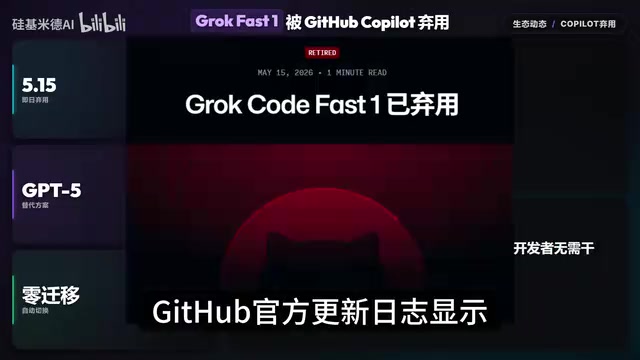
GitHub's official changelog shows that starting May 15, the Grok CodeFast 1 model has been deprecated across all GitHub Copilot service experiences. The official recommendation is to switch the underlying model to GPT-5 Mini or Cloud Haiku 4.5, with the entire transition happening automatically without requiring any developer action. The pace of old-to-new model transitions is accelerating, reflecting that the iteration speed of AI programming tool capabilities has far exceeded traditional software cycles.
Copilot Memory Opens Early Access
GitHub Copilot Memory is now available for early access to Pro and Pro+ users. This new feature can remember a developer's personal code commit style, PR structure, and even writing tone, maintaining consistency across different repositories. Developers no longer need to repeatedly input formatting instructions—the AI automatically outputs code in formats that match personal habits. This marks the evolution of AI programming assistants from "general-purpose tools" to "personalized assistants."
Accessibility Agent Enters Testing

GitHub is testing a universal accessibility agent using a dual-system architecture of reviewer and implementer. It has reviewed 3,535 PRs so far with a 68% issue resolution rate. Through direct integration into Copilot CLI and VSCode, it can automatically review and fix accessibility issues in code. The compliance checking workflow for frontend developers is poised for significant simplification.
Development Framework and Tool Upgrades
OpenClaw Achieves 3.5x Performance Improvement
The open-source agent framework OpenClaw released its latest version, claiming a 3.5x improvement in end-to-end response time performance. To prevent performance regression, the development team also added automated testing of NPM releases every 6 hours. For framework users, the most tangible experience is noticeably faster response speeds in daily coding. This dual strategy of "performance + stability" is worth emulating by other open-source projects.
Qoder 1.0: From Plugin to Autonomous Development Workbench
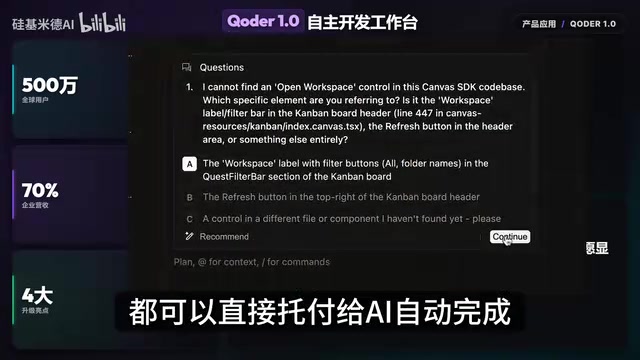
Programming tool Qoder officially launched version 1.0, evolving its product form from a traditional AI coding plugin to an agent-driven autonomous development workbench. As long as requirements are clearly defined, code execution, verification, and delivery can all be delegated directly to AI for automatic completion. This represents an important directional shift in AI programming tools—from "assisting humans in writing code" to "AI autonomously completing development tasks."
Application Scenario Expansion
OpenAI Personal Finance Feature Preview
OpenAI has begun rolling out a personal finance preview feature to US-based Pro users. Users can securely connect financial accounts, allowing ChatGPT to provide personalized analysis based on real financial context, eliminating the hassle of manually organizing income and expenses. Large language models are extending from information retrieval tools toward the role of personal financial advisors, though privacy and security concerns remain users' biggest worry.
Air Translate: Mac System-Level Real-Time Translation
A community developer open-sourced the Air Translate tool on GitHub, which can directly capture system audio playing on a Mac, transcribe it locally in real-time, and translate it into foreign languages. For users who frequently watch foreign-language videos without subtitles, this is essentially a free system-level subtitle machine.
Industry Benchmarks and Market Dynamics
Meituan Releases General 365 Reasoning Evaluation Benchmark
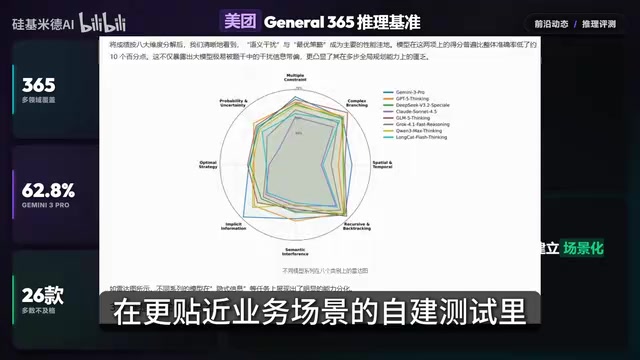
Meituan's technical team released the General 365 reasoning evaluation benchmark covering multiple domains. In actual testing of 26 mainstream large models, most failed to reach the 60-point passing threshold, and even the flagship Gemini 3 Pro achieved only 62.8% accuracy. These results demonstrate that in tests closer to real business scenarios, the general reasoning capabilities of large models still have a clear ceiling, with considerable distance remaining from true "general intelligence."
Runway Opens Tokyo Office
AI video tool developer Runway announced the opening of an office in Tokyo, with an initial investment of up to $40 million. Over the past year, Runway's customer base in Japan has tripled, making Japan its third-largest global market. Well-known companies like Yamaha and SoftBank have already integrated its video generation services, with the Asia-Pacific market becoming a key growth driver in the AI video space.
Summary
Today's developments reveal several clear trends: First, AI programming tools are moving from assistance to autonomy, with both Qoder 1.0 and Copilot Memory driving this shift. Second, model replacement is accelerating, with GitHub Copilot's underlying model switches now happening seamlessly. Third, the open-source ecosystem remains vibrant, with OpenClaw's performance breakthrough and Air Translate's community contribution showcasing developer community creativity. For practitioners, maintaining sensitivity to toolchain changes is more important than chasing performance metrics of any single model.
Related articles
 Tech Frontiers
GitHub Agent HQ Launch: AI Coding Tools Enter the Era of Platform Competition
GitHub Universe unveils Agent HQ platform for unified coding agent management, Copilot upgrades with multi-model support. OpenAI completes restructuring, Anthropic tests new model, NVIDIA open-sources AI models.
 Tech Frontiers
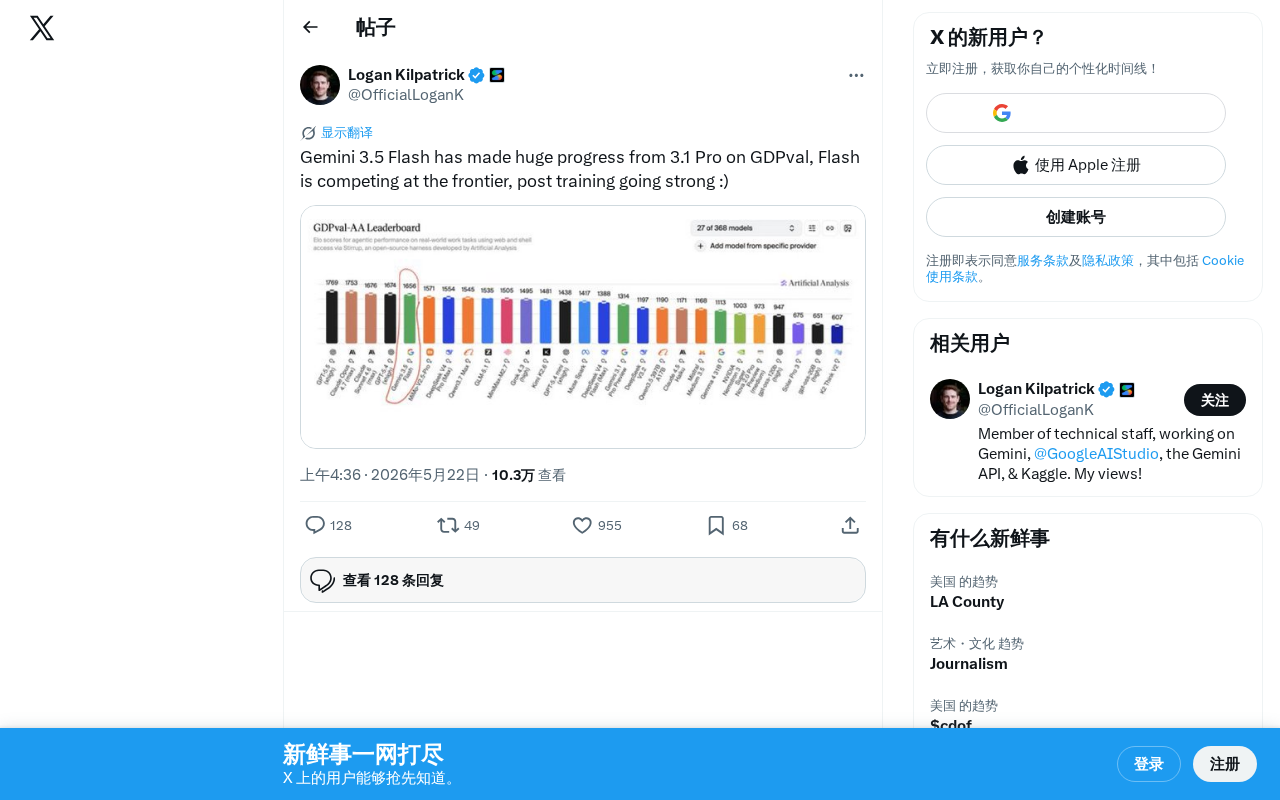
Gemini 3.5 Flash Achieves a Massive Leap on the GDPval Benchmark
Google Gemini 3.5 Flash surpasses Gemini 3.1 Pro on the GDPval benchmark. The lightweight Flash model leverages post-training techniques to approach frontier-level performance, redefining the balance between quality and cost.
 Tech Frontiers
Google Gemini Antigravity Weekly Quota Tripled — AI Coding Without Limits
Google Gemini triples Antigravity weekly quotas following a prior daily quota boost. Analyzing the impact on developers and its strategic significance in AI coding.