AI Has Multiplied Your SEO Competitors by 1000x: How Content Creators Can Break Through
AI has multiplied SEO competitors 1000x — here's how content creators can still win.
AI tools like ChatGPT and Claude have reduced content production costs to near zero, causing an explosion in SEO competitors. This article analyzes the structural changes in SEO competition in the AI era and explores how content creators can break through by leveraging differentiated content based on real experience, building brand trust, diversifying across multiple channels, and using AI as a tool while adding uniquely human value.
AI Is Fundamentally Changing the SEO Competitive Landscape
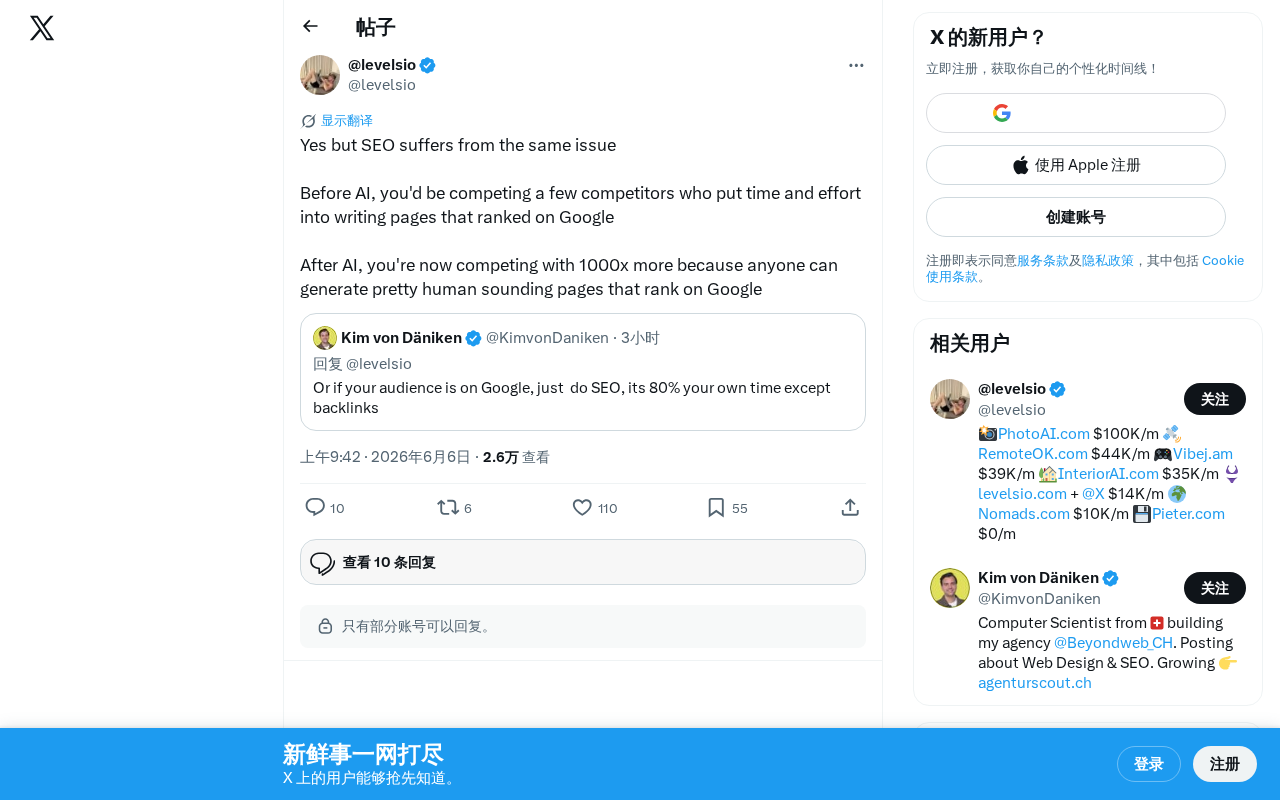
A Twitter user recently shared a thought-provoking observation: AI is fundamentally changing the competitive landscape of SEO (Search Engine Optimization). While brief, this insight precisely reveals the structural shift happening in content creation — your number of SEO competitors may have already exploded by 1000x.
SEO Before AI: A Craft Practiced by the Few
Before AI tools became widespread, SEO was a field that demanded significant time and effort. SEO (Search Engine Optimization) has evolved since the birth of search engines in the 1990s — from early-stage black-hat tactics like keyword stuffing and link farms, to a mature phase where Google continuously raised content quality standards through PageRank, the Panda update, the Penguin update, and more. Throughout this evolution, SEO's core competitive advantage gradually focused on the long-term accumulation of content quality, user experience, and site authority.
To rank a page well on Google, you needed to:
- Conduct deep keyword research and understand user search intent
- Spend hours or even days writing high-quality content
- Continuously optimize page structure, internal links, and backlinks
- Accumulate domain expertise and writing skills
These barriers meant your number of competitors was limited — only those truly willing to invest time and effort could produce content capable of competing for rankings. It was a relatively "fair" playing field where hard work and expertise were rewarded accordingly.
After AI: An Explosion in SEO Competitors
When large language models like ChatGPT and Claude enabled anyone to generate "impressively professional-sounding" content in minutes, the rules of the game changed completely. ChatGPT (based on OpenAI's GPT architecture) and Claude (based on Anthropic's Constitutional AI) mastered language patterns, knowledge structures, and writing styles through pre-training on massive text datasets. These models can generate structurally complete, grammatically correct, and seemingly professional long-form content from simple prompts. Traditional content creation required domain knowledge, writing skills, and information synthesis abilities, but LLMs have "democratized" these capabilities — anyone who can type a prompt can get professional-looking output.
Now you may be facing 1000x more SEO competitors than before.
While this number is rhetorical, the underlying logic is entirely sound:
- Content production costs approach zero: Writing a 2000-word professional article used to take an entire day; now it takes minutes
- Technical barriers have vanished: No writing ability needed, no domain knowledge required — just the ability to use AI tools
- Scaling has become effortless: A single person can operate hundreds of websites, producing thousands of articles daily
Notably, Programmatic SEO — a strategy that automatically generates large volumes of pages targeting long-tail keywords using templates and databases — has undergone a qualitative leap in the AI era. Before LLMs, this approach was limited by the poor readability of templated content. Now operators can batch-call AI models via API, combined with keyword databases, to generate thousands or even tens of thousands of seemingly unique articles in extremely short timeframes. Since 2023, the proportion of AI-generated content among new internet content has surged dramatically, with certain industries (such as product reviews, travel guides, and health advice) being hit particularly hard.
The Flood of AI-Generated Content: Information Quality Severely Diluted
This phenomenon raises a deeper issue — when search results are flooded with AI-generated content, truly valuable original content becomes harder to discover.
This creates a paradox: AI lowered the barrier to content creation, which theoretically should have brought more great content to the surface. In reality, it has primarily spawned massive amounts of content that "looks decent but lacks genuine insight," diluting the quality of the entire information ecosystem. In economics, this is known as the "lemon market" effect — when low-quality products flood the market, consumers struggle to distinguish good from bad, potentially driving high-quality products out of the market entirely.
Google has been addressing this challenge through algorithm updates (such as the Helpful Content Update), attempting to identify and demote low-quality AI-generated content. The Helpful Content Update, first launched in August 2022, introduced a site-level classification signal — if a website contains a large amount of unhelpful content, the entire site's rankings may be affected, even if some of its content is high quality. Subsequent updates in 2023 and 2024 further strengthened the ability to identify AI-generated content. Google has explicitly stated that it doesn't focus on whether content is AI-generated, but rather whether it's helpful to users and demonstrates E-E-A-T (Experience, Expertise, Authoritativeness, Trustworthiness). But this cat-and-mouse game has only just begun.
Breakthrough Strategies for SEO Practitioners in the AI Era
Facing this shift, content creators and SEO practitioners need to rethink their strategies:
- Differentiated competition: Pure information aggregation content will find it increasingly difficult to stand out. Unique perspectives, first-party data, and real-world experience become more precious. In Google's E-E-A-T framework, the "Experience" dimension added in 2022 is particularly crucial — it emphasizes whether content creators have first-hand practical experience with the topic. AI can synthesize existing information into professional text, but it cannot provide genuine usage experiences, personal stories, or original experimental data. Real experience, original research, and unique perspectives are the scarcest content assets in the AI era.
- Brand building: When content itself becomes hard to differentiate, brand trust becomes a key competitive advantage. Users increasingly prefer to get information from sources they trust, rather than randomly clicking on unfamiliar websites in search results.
- Multi-channel distribution: You can no longer put all your bets on Google Search. Social media, communities, email lists, and other channels are growing in importance. Especially as AI-powered search (such as Google SGE, Perplexity, etc.) rises, the way traditional search traffic is distributed is undergoing fundamental change.
- Embrace AI but transcend it: Use AI to boost efficiency, but layer on uniquely human creativity and judgment. The best practice is to use AI as a research assistant and drafting tool, then inject unique insights, fresh data, and personal experience through human editing.
AI hasn't killed SEO, but it has ushered the field into a completely new era of intensified competition. The key to adapting isn't rejecting AI, but finding the value that AI cannot replace — content rooted in genuine human experience, original thinking, and deep professional judgment will become increasingly precious in the vast ocean of AI-generated content.
Key Takeaways
Related articles
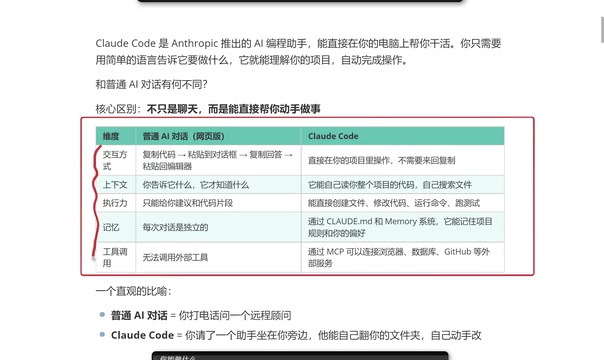
Getting Started with Claude Code: 5 Key Differences from Traditional AI Chatbots
Explore 5 key differences between Claude Code and traditional AI chatbots like ChatGPT, covering interaction, context, execution, memory, and tool integration.
Your Pension Forced to Buy AI Bubble Stocks: The Truth Behind Nasdaq's Rule Changes
Nasdaq's fast-track rule changes may force your 401K and pension funds to buy SpaceX, OpenAI, and Anthropic stock. Analysis of the $4T valuation bubble and what investors can do.

GPT 5.6 Internal Testing Codename Revealed, Google Pays SpaceX $920M Monthly for Computing Power
OpenAI begins GPT 5.6 Kindle Alpha internal testing with stronger base reasoning. Google partners with SpaceX at $920M/month for computing power. Gemma 4 QAT enables edge deployment, Claude Cowork doubles credits.