AI Hospital Appointment Booking Mini-Program: Full-Stack Development with Spring Boot + Vue 3 + DeepSeek
A full-stack hospital booking mini-program with AI-powered consultations using Spring Boot, Vue 3, and DeepSeek.
This article walks through a hospital appointment booking mini-program built with Spring Boot, Vue 3, and DeepSeek. The project features a three-terminal architecture (user mini-program, doctor portal, admin portal) with AI-powered smart consultations, health checkup report interpretation, online diagnosis, and complete appointment workflows — ideal for graduation projects showcasing full-stack and AI integration skills.
Project Overview
This is a hospital appointment booking mini-program built on the Spring Boot + Vue 3 + DeepSeek tech stack, featuring AI-powered smart consultations, online diagnosis, health checkup management, and AI-driven medical report interpretation. The project adopts a three-terminal architecture (user-facing mini-program, doctor portal, and admin portal) with comprehensive functionality, making it ideal as a graduation project or coursework reference.
The standout feature of this project is the deep integration of a large language model (DeepSeek) into medical scenarios. Beyond AI-powered smart consultations, it can automatically interpret health checkup reports and provide personalized health recommendations — a compelling demonstration of AI + healthcare in practice.
DeepSeek: A Cost-Effective Chinese LLM
DeepSeek is a series of large language models developed by DeepSeek AI. The DeepSeek-V2/V3 models employ a Mixture of Experts (MoE) architecture, dramatically reducing inference costs while maintaining strong reasoning capabilities. Compared to closed-source models like GPT-4, DeepSeek offers a much more cost-effective API solution, making it particularly suitable for small-to-medium project integrations. In healthcare scenarios, the core value of LLMs lies in their natural language understanding — they can parse symptoms described in colloquial language and provide structured preliminary suggestions based on medical knowledge from training data, far surpassing traditional rule-engine or keyword-matching triage systems.
User-Facing Mini-Program Features
Homepage & Health Report Display
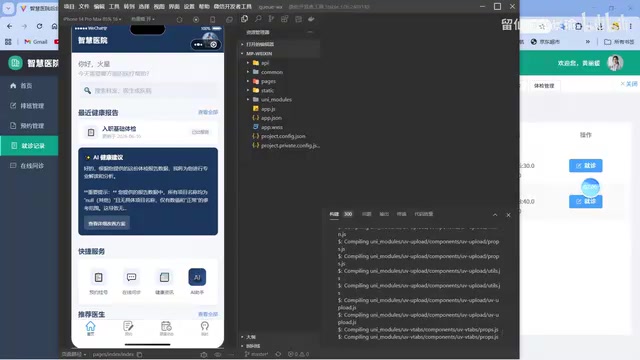
The user-facing side is delivered as a WeChat Mini-Program with a clean, practical homepage design. A search bar sits at the top, followed by the user's most recent health report — a summary of their latest checkup. Users can tap to view the full report, which includes AI-generated health interpretations and recommendations.
WeChat Mini-Programs run on WeChat's JavaScript engine using a dual-thread architecture: the rendering layer uses a WebView thread while the logic layer uses a JsCore thread, with the two communicating through the Native layer. This architecture ensures both security and performance. Choosing a mini-program as the user-facing platform for healthcare has natural advantages: the no-download, use-and-go experience lowers the barrier for patients, while WeChat's real-name verification system provides foundational support for patient identity verification. Vue 3 can be compiled into mini-program code through cross-platform frameworks like uni-app, allowing developers to work with familiar Vue syntax.
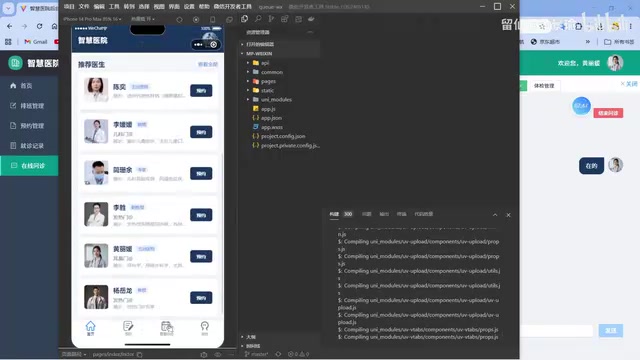
The homepage also features a quick-access service bar with entry points for appointment booking and online consultations, along with a recommended doctors list below. The bottom navigation includes three core modules: appointments, health updates, and personal center.
AI Smart Doctor: Intelligent Consultation Powered by DeepSeek
This is one of the project's most distinctive features. The AI assistant acts as a smart doctor — users can chat directly with the AI, describe their symptoms, and receive preliminary suggestions. Built on the DeepSeek LLM, it understands users' health concerns and provides professional responses.
Compared to traditional keyword-matching triage systems, LLM-based AI consultations can more accurately understand user-described symptoms and provide more targeted preliminary advice. Traditional triage systems rely on preset symptom-to-department mapping rules and often struggle with complex or vague symptom descriptions. In contrast, LLMs — pre-trained on massive volumes of medical text — possess semantic understanding of symptom descriptions and context-tracking capabilities across multi-turn conversations, enabling them to progressively narrow down possible causes through follow-up questions, much like a real doctor would.
Complete Appointment Booking Flow
The full appointment booking flow is designed as follows:
- Select a Doctor: Users can choose from the recommended list or filter by department
- Select a Patient: Multiple patient profiles can be added via "My Patient Cards"
- Confirm Appointment: Submit the appointment after selecting a time slot
- Wait for Call: The doctor portal handles the queuing and calling process
- Complete Visit: The doctor fills in medical orders, completing the workflow
Users can review their history in "Appointment Records" and "Visit Records," forming a complete closed-loop workflow. It's worth noting that appointment booking requires careful concurrency control on the technical side — when multiple users compete for the same time slot simultaneously, the system must use mechanisms like database optimistic locking, distributed locks, or message queues to prevent overbooking. This is one of the core technical challenges in the backend design of such systems.
Health Checkup & AI Report Interpretation
The health checkup workflow is: User signs up for a checkup package → Admin enters the checkup report → User views the report → AI interprets the report and provides recommendations.
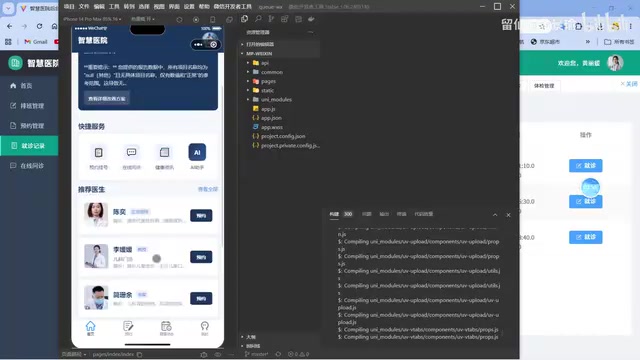
The AI interpretation feature is a major highlight. The system automatically analyzes various indicators in the checkup report and generates easy-to-understand interpretations along with personalized health recommendations. The "Recent Health Report" on the homepage also syncs with the latest checkup results.
From a technical implementation perspective, AI interpretation of checkup reports typically uses a Prompt Engineering approach: the system assembles structured data from the report (such as complete blood count, liver function tests, and their reference ranges) into a specifically formatted prompt, which is sent to the LLM API along with preset system role instructions. Based on medical knowledge from its training data, the model explains abnormal indicators, analyzes correlations between indicators, and generates personalized health recommendations. The key challenges in this approach are prompt design quality and output accuracy control — the temperature parameter is typically set to a low value to reduce model randomness and ensure the rigor of medical advice.
Online Consultation
The online consultation feature supports real-time messaging between users and doctors. After a user selects a doctor and initiates a consultation, the doctor portal displays the messages and enables replies, providing basic online diagnostic communication capabilities.
Doctor Portal Features
The doctor portal includes the following functional modules:
- Schedule Viewing: Doctors can check their assigned schedules
- Appointment Management: View which users have booked appointments and manage the calling queue
- Visit Processing: Fill in medical orders after completing a visit
- Online Communication: Respond to users' online consultation questions
The doctor portal is designed around core workflows with a clean, efficient interface that minimizes unnecessary steps. This design philosophy aligns with a core principle in healthcare IT — doctors' time is extremely valuable, and systems should minimize their operational burden, making technology serve clinical work rather than adding extra workload.
Admin Portal Features
System Management & Scheduling Configuration
The admin portal is a web-based backend with a statistics overview on the homepage. Core management features include:
- System Management: Add doctors, configure role permissions
- Patient Management: Manage all patient information
- Department Management: Add and edit departments, with information synced to the user-facing side
- Schedule Management: Arrange doctor schedules, set appointment slot quantities and times
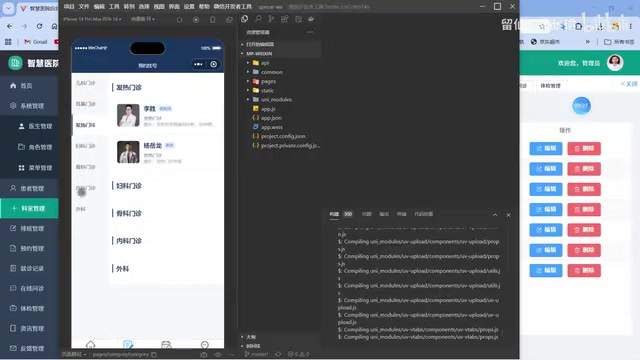
Schedule management is the foundation of the entire appointment system — only after an admin completes scheduling can the corresponding doctor be booked by users. Admins can select the department, doctor, date range, and daily slot count. Schedule system design must account for multiple constraints, including doctors' preferred consultation times, department room resource limitations, and holiday adjustments. In real Hospital Information Systems (HIS), the scheduling module is often one of the most complex business modules.
Business Management Features
- Appointment Management: View all appointment and visit records
- Checkup Management: Publish checkup items/packages, view sign-ups, and enter checkup reports
- Content Management: Publish health news articles displayed on the user-facing side
- Feedback Management: Handle user-submitted feedback and suggestions
Technical Architecture & Stack Analysis
The project's tech stack breakdown:
| Layer | Technology |
|---|---|
| Frontend (User) | WeChat Mini-Program + Vue 3 |
| Frontend (Admin) | Vue 3 |
| Backend | Spring Boot |
| AI Capabilities | DeepSeek API |
This tech stack is both mainstream and practical. Spring Boot provides a stable backend service, Vue 3 ensures frontend development efficiency, and DeepSeek serves as the underlying AI capability layer — together they effectively meet the demands of healthcare scenarios.
Spring Boot is widely used as a backend framework in healthcare information systems. Its mature security framework, Spring Security, enables fine-grained access control (e.g., distinguishing between patient, doctor, and admin roles). ORM frameworks like Spring Data JPA or MyBatis efficiently handle complex medical data models. Additionally, Spring Boot's transaction management mechanism is critical for business scenarios requiring data consistency, such as appointment booking — for example, preventing overbooking during high-concurrency slot competition.
For graduation projects, this tech stack demonstrates both full-stack development capabilities and the application of cutting-edge AI technology, making it a high-value project.
Project Evaluation & Use Cases
Strengths:
- Complete three-terminal architecture with closed-loop business workflows
- Natural AI integration — not just simple API calls
- Broad feature coverage spanning appointments, consultations, and checkups — core healthcare scenarios
- Well-suited as a graduation/coursework project to showcase full-stack development skills
Areas for Improvement:
- Online consultations could benefit from WebSocket integration for real-time communication. Traditional HTTP follows a request-response pattern where clients must actively poll for new messages, resulting in low efficiency and high latency. The WebSocket protocol establishes a persistent, full-duplex communication channel between client and server, allowing the server to proactively push messages to clients for true real-time communication. In Spring Boot, this can be quickly integrated via the spring-boot-starter-websocket module, and combined with the STOMP protocol and a message broker (such as RabbitMQ) to build a scalable real-time messaging system. For medical consultation scenarios, real-time communication capability directly impacts doctor-patient communication efficiency and user experience.
- AI diagnostic results should include disclaimers. This is not just a product-level suggestion but a hard legal compliance requirement. According to China's Administrative Measures for Internet-Based Diagnosis and Treatment, AI systems cannot independently make diagnostic conclusions and can only serve as assistive tools. The National Medical Products Administration (NMPA) classifies medical AI software as medical devices, subject to approval as Class II or Class III devices based on risk level. In real-world projects, AI consultation outputs should be clearly labeled as "for reference only, not a medical diagnosis" and should guide users to visit legitimate medical institutions.
- Health checkup report interpretation could be enhanced with data visualization — for example, using charting libraries like ECharts to display historical trends of various indicators as line charts and highlight abnormal indicators with radar charts, significantly improving report readability and user experience.
Overall, this is a feature-complete, well-architected full-stack project, particularly suitable for computer science students looking to demonstrate AI application capabilities. From both technical depth and business completeness perspectives, it's a worthwhile case study in healthcare full-stack development.
Related articles
The Decline of Tokenmaxxing: Why Selling Outcomes Matters More Than Selling Tokens
The Tokenmaxxing craze is fading as enterprise AI procurement shifts from chasing Token counts to focusing on actual business outcomes. Learn why outcome-based AI evaluation is the right approach.
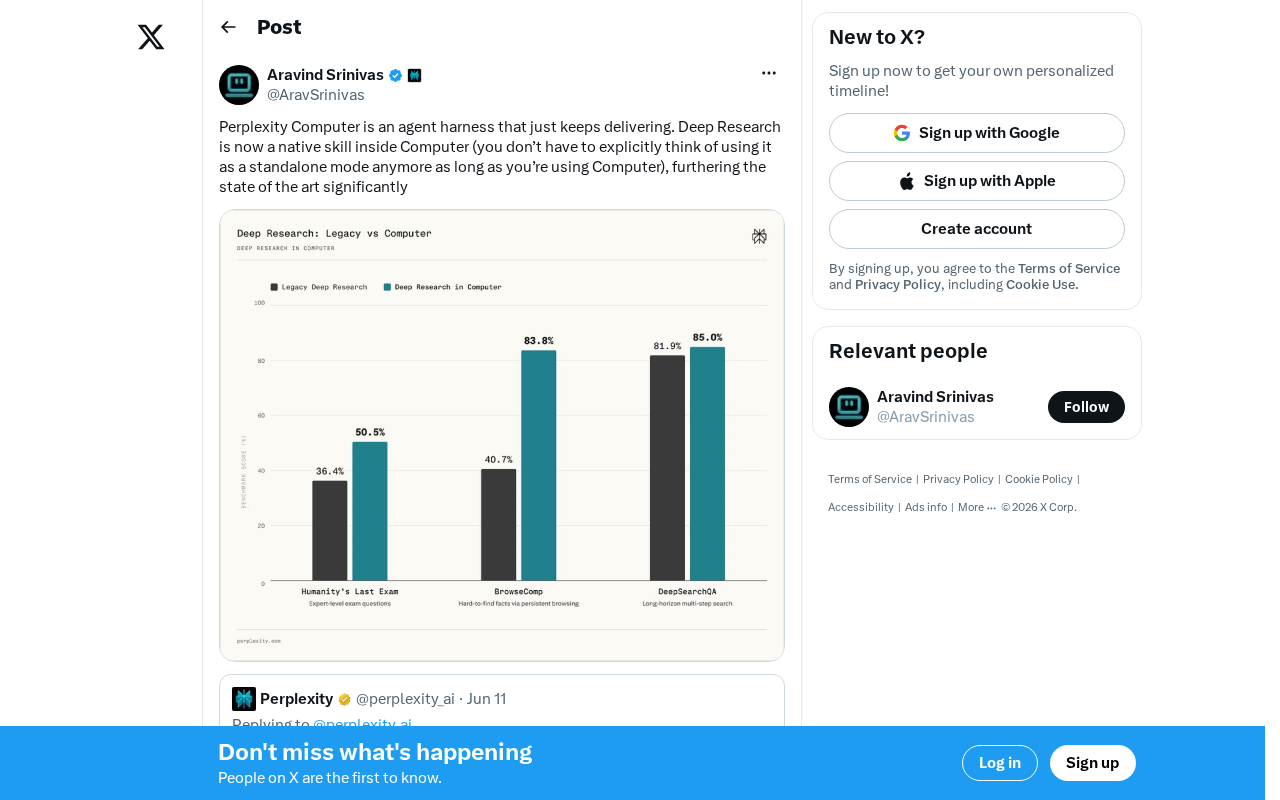
Perplexity Computer Integrates Deep Research as a Native Skill: A New Paradigm for AI Agent Capability Fusion
Perplexity integrates Deep Research as a native skill in Computer, enabling automatic invocation without manual mode switching. Analyzing the Agent Harness design philosophy and AI capability fusion trends.
Key Takeaways from Andrew Ng × OpenAI's Prompt Engineering Course: Two Core Principles Explained
Deep dive into Andrew Ng & OpenAI's ChatGPT Prompt Engineering course: Base LLM vs instruction-tuned models, two core prompting principles, and API-first development thinking for developers.